

You’re scrolling through a comment section, or maybe your little brother just texted it to you, and there it is: SYBAU. No context, no explanation, just five capital letters staring back at you. Your first instinct is probably to Google it before you reply, because typing the wrong thing back could either land a joke or start a fight.
That’s exactly what this guide is for. Below, you’ll get the actual SYBAU meaning in text, where it came from, how it shows up differently across TikTok, Instagram, Snapchat, and WhatsApp, and — maybe most importantly — how to respond without overreacting or under-reacting.
Quick Answer
SYBAU stands for “Shut Your Bitch Ass Up.” It’s internet slang used to tell someone to stop talking, and its tone ranges from playful teasing between friends to a genuine insult during an argument. Despite feeling like a brand-new TikTok term, evidence of the acronym actually goes back more than two decades — it just resurfaced through recent meme culture.
What Does SYBAU Mean in Texting?
In a text message or comment, SYBAU is shorthand for a phrase that includes profanity, so it reads as blunt no matter who sends it. People use it to shut down a conversation, react to something unbelievable, or poke fun at a friend’s exaggerated claim.
Here’s the thing that trips people up: the literal words are harsh, but the actual usage is usually softer. Think of it the way people use “shut up” out loud — sometimes it’s “stop talking to me,” sometimes it’s “no way, that’s wild.” SYBAU works the same way in text.
SYBAU Full Form and Short Meaning
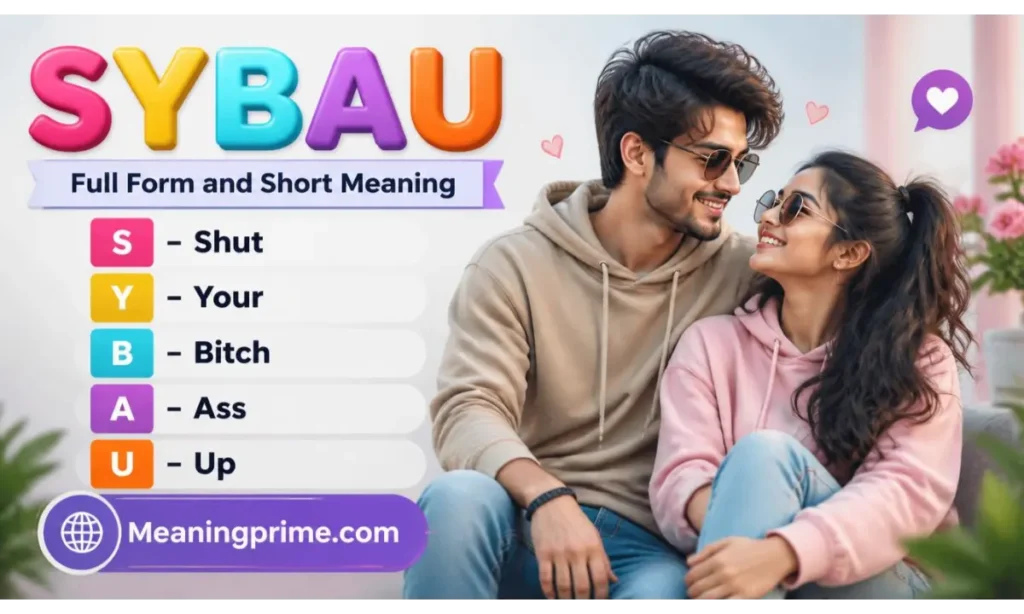
The letters break down like this:
- S – Shut
- Y – Your
- B – Bitch
- A – Ass
- U – Up
In plain English, people use it to say:
- Stop talking.
- I don’t believe you.
- That’s ridiculous.
- Okay, that’s enough.
It’s rude by definition. But rudeness in slang doesn’t always translate to genuine anger — context does most of the heavy lifting here.
SYBAU Meaning in Chat and Online Conversations
Meaning of SYBAU in text conversations usually depends on what came right before it. It’s rarely the opening line of a fight. It’s almost always a reaction.
Take this exchange:
Friend 1: I’m running a marathon tomorrow with zero training. Friend 2: SYBAU 💀
Nobody’s actually angry there. Friend 2 is saying, “I don’t buy that for a second.” Swap the tone, though, and the same word turns sharp:
Person 1: You need to actually listen instead of talking over people. Person 2: SYBAU.
No emoji, no laughing punctuation, just the word on its own — that reads as a real dismissal. The emojis, punctuation, and relationship between the two people are doing all the work of telling you which version you’re looking at.
SYBAU Meaning in Text From a Guy or a Girl
A lot of people search SYBAU meaning in text from a guy (or from a girl) because the sender matters just as much as the words. If it comes from someone you’re texting casually or flirting with, SYBAU often functions as playful pushback — almost a way of saying “stop, you’re making me laugh” or “quit being cocky.” It can even carry a teasing, borderline-flirty energy in that context, similar to saying “oh, shush” with an eye-roll attached.
If it comes from someone you’re arguing with, or someone you don’t know well, treat it as what it looks like on paper: a blunt way of telling you to stop talking. The words don’t change. The relationship changes what they’re doing.
Where Did SYBAU Come From?
Most slang glossaries treat SYBAU like it was invented last year on TikTok. That’s not quite accurate. Merriam-Webster’s slang dictionary traces evidence of the phrase back more than two decades, which means it’s been floating around forums, early chatrooms, and gaming communities for a long time before social media ever picked it up.
What changed recently is visibility, not age. TikTok, Discord, and meme pages gave the old acronym a second life, spreading it fast through repetition in viral comment threads. So when someone calls SYBAU a fresh Gen-Z invention, that’s not the full story — it’s an old term riding a new wave.
Why Did SYBAU Become Popular Again?
A few overlapping trends pushed SYBAU back into everyday texting and comments.
Fast, Reaction-Style Communication
Typing “please stop saying that, it sounds completely made up” takes effort. Typing “SYBAU” takes two seconds and gets the same point across, sometimes with more punch.
Meme Culture
TikTok and meme pages thrive on exaggerated reactions. A phrase that sounds dramatic on the page fits perfectly into a format built around over-the-top responses to everyday videos.
Gen-Z Humor
Younger users tend to lean into phrases that sound intense but are delivered with obvious sarcasm. Something that reads as harsh in isolation becomes funny the second you add the right emoji or all-caps energy.
Comment Section Trends
Once a handful of viral videos get flooded with the same comment, everyone else picks it up. That’s how “SYBAU 💀” ends up under thousands of unrelated posts within a matter of weeks.
SYBAU Meaning on TikTok
SYBAU meaning in text slang TikTok searches usually come from people who spotted it in a comment section with zero context. On the platform, it shows up most when someone makes an exaggerated caption claim, a video captures an awkward moment, or a creator shares an opinion the comments strongly disagree with.
A caption like “I slept two hours and feel amazing” will almost guarantee a “SYBAU 💀” reply — translation: nobody’s buying that. It’s the most common SYBAU meaning in text TikTok scenario, and it’s almost never a real insult.
SYBAU Meaning on Instagram
On Instagram, you’ll mostly spot SYBAU in Reels comments, meme-page posts, and close-friend story replies. A post captioned “everyone secretly wants to be like me” might get “SYBAU 😂” from a friend — shorthand for “okay, that’s enough confidence for one day.”
Using it with people you know tends to read as playful. Dropping it under a stranger’s post is different; without an established relationship, it can come across as flat-out rude, even if you didn’t mean it that way.
SYBAU Meaning on WhatsApp
WhatsApp conversations tend to be more private, so SYBAU shows up almost exclusively between people who already know each other well.
Friend 1: I’m going to be a millionaire by next year. Friend 2: SYBAU 😭
That’s affectionate disbelief, not an insult. WhatsApp threads carry more personal history than a public comment section, so the existing relationship usually settles any ambiguity before it starts.
SYBAU Meaning on Snapchat
Snapchat conversations run casual by default, so short slang fits naturally into snap replies and group chats. Someone might send “I look terrible today” and get “SYBAU, you look fine” back — a quick way of shutting down the complaint rather than a serious jab.
SYBAU on Reddit and Urban Dictionary
If you’ve searched SYBAU meaning in text slang Urban Dictionary, you’ve probably noticed those entries lean more aggressive than the TikTok version. That’s because Urban Dictionary tends to reflect the term’s rawest, most literal use — a direct insult, closer to how it functioned in older gaming chats before it went mainstream.
On SYBAU meaning in text Reddit threads, it’s more of a mixed bag: some commenters use it as a genuine putdown, while others stack it with “💀” purely for comedic effect. Reddit’s threaded format actually makes intent easier to spot, since you can scroll up and see exactly what triggered the reply.
What SYBAU Does Not Mean
Because it’s an unusual string of letters, people guess wrong fairly often. To be clear, SYBAU is not:
- “See you back at university”
- A school or academic abbreviation
- A tech or business term
- A compliment
- A polite request of any kind
If you’ve seen a random slang site claim SYBAU evolved from something like “see you, bro,” take that with a grain of salt — that theory isn’t backed by any credible slang dictionary or usage history, and it doesn’t match how the term actually gets used online.
How Harsh Is SYBAU? Comparing It to Similar Slang
Not all “shut up” slang carries the same weight. Here’s roughly where SYBAU lands next to its cousins:
| Term | Literal Meaning | Typical Harshness | Common Tone |
| SYBAU | Shut Your Bitch Ass Up | High (contains profanity) | Playful among friends, sharp among strangers |
| STFU | Shut The F*** Up | High (contains profanity) | Usually more direct and serious than SYBAU |
| “Be so fr” | Be so for real | None | Lighthearted disbelief |
| “No cap” | No lie | None | Neutral, used for emphasis |
| WTV | Whatever | Low | Dismissive, mildly annoyed |
SYBAU and STFU sit at the top of the harshness scale simply because both include a curse word. The difference is tone: STFU tends to show up when someone’s genuinely fed up, while SYBAU more often shows up as a reaction to something absurd, exaggerated, or funny.
Common Misunderstandings About SYBAU
Is SYBAU Always an Insult?
No. Between close friends, it’s frequently a joke. Between strangers or during a real disagreement, it reads as disrespectful. The words never change — the relationship does.
Is SYBAU Appropriate for Everyone?
Not really. It contains profanity, so it doesn’t belong in school assignments, work Slack messages, formal emails, or conversations with people you don’t know well. Even in casual settings, it’s worth reading the room first.
Can SYBAU Be a Joke?
Yes, and honestly, that’s how most people use it now. Emojis like 💀 or 😭 usually signal “I’m kidding,” while a bare “SYBAU.” with a period and nothing else usually signals the opposite.
Why Do Kids Say SYBAU? A Note for Parents and Teachers
If you’re an adult who just found this in your kid’s texts and panicked a little, take a breath. Most of the time it’s copied straight from TikTok or meme culture, not typed with real hostility behind it — a trend phrase, not a red flag on its own.
Still, it’s worth a quick conversation if:
- Your child uses it in a genuinely heated argument, not a joke.
- It’s aimed at an adult, teacher, or someone clearly upset by it.
- It’s showing up paired with other aggressive language, not just as a punchline.
Most kids pick up trending slang the same way past generations picked up “whatever” or “as if” — because everyone around them is saying it, not because they’re trying to be cruel.
Similar Slang Terms and Related Abbreviations
STFU
“Shut The F*** Up.” More direct and generally more serious than SYBAU, with less room for a joking read.
SYB and SYW (Don’t Get These Confused)
SYB shows up in some chats as a shortened, slightly softer version of SYBAU, though it’s far less common. SYW usually means “Show Your Work” in school contexts, or occasionally “See You Whenever” — it has nothing to do with SYBAU despite the similar letters. Check context before assuming a connection.
LOL
“Laugh Out Loud” — one of the oldest texting abbreviations still in daily use.
FR
“For Real,” used to agree with or emphasize a statement, like “FR, that show got so much better this season.”
WTV
“Whatever,” typically signaling mild indifference or disinterest in continuing an argument.
IDK
“I Don’t Know” — a basic, everyday texting shortcut.
TBH
“To Be Honest,” usually dropped right before an unfiltered opinion.
How to Reply When Someone Says SYBAU
Your best response depends entirely on the tone you’re picking up and how well you know the person.
Funny Replies
- “You wish 😂”
- “Make me.”
- “I’m just speaking facts.”
- “You can’t handle the truth.”
Polite Replies
- “Haha, fair enough.”
- “I was just sharing my take.”
- “No worries, moving on.”
- “Got it, I hear you.”
Flirty Replies
- “Only if you ask nicely 😉”
- “You secretly love it when I talk.”
- “You’d miss this if I stopped.”
Boundary-Respecting Replies
- “I’d rather we keep this respectful.”
- “You can disagree without the insult.”
- “Let’s cool it and talk normally.”
You’re never obligated to match someone’s tone just because they escalated first.
Is SYBAU Still Popular?
SYBAU hasn’t faded yet. It’s still common across TikTok comments, meme pages, gaming chats, and casual group texts, though slang like this tends to rise and fall in waves rather than stick around forever. Merriam-Webster’s own entry sums it up well: often tongue-in-cheek, but still capable of showing up in a genuinely heated argument. That’s a fair read of where it stands today — alive, widely recognized, and still context-dependent.
SYBAU and Modern Gen-Z Slang Culture
SYBAU is a good example of a broader pattern in texting: turning long, emotionally loaded phrases into short, punchy abbreviations that spread fast. It’s less about literal meaning and more about shared shorthand — you either recognize the reference or you don’t.
Understanding terms like this helps you avoid misreading a joke as an insult, or an insult as a joke.
FAQs
What does SYBAU mean in a chat?
SYBAU means “Shut Your Bitch Ass Up.” In a chat, it’s typically used to react to something exaggerated or unbelievable, or to shut down an argument, depending on tone and context.
What is the full form of SYBAU?
The full form is “Shut Your Bitch Ass Up,” an internet slang acronym rather than a formal phrase.
What does SYBAU mean on TikTok?
On TikTok, SYBAU usually appears as a humorous comment reacting to a surprising, over-the-top, or unbelievable claim in a video or caption.
Is SYBAU a bad word?
It contains profanity, so yes, it’s considered rude or offensive in certain settings, even though it’s frequently used in a joking way between friends.
Can friends use SYBAU with each other?
Yes, friends often use it playfully. It’s best avoided with people you don’t know well, in professional settings, or in any conversation where it could easily be taken the wrong way.
Conclusion
The SYBAU meaning in text boils down to “Shut Your Bitch Ass Up” — a blunt, profanity-based way of telling someone to stop talking. What surprises most people is that it’s not some brand-new invention; it’s an old acronym that simply found a second life through TikTok, memes, and group chats. Whether it lands as a joke or an insult comes down to who’s sending it, what platform it’s on, and what came right before it.
Next time it shows up in your notifications, take a second to read the room before you react. A quick glance at the tone, the emojis, and your relationship with the sender will tell you almost everything you need to know — and a thoughtful reply will always beat a defensive one.