

You just got a text back and it says “mk.” Just two letters. No punctuation, no explanation, and now you’re sitting there re-reading your last message trying to figure out if your friend is mad, busy, or just typing lazy. Sound familiar?
That flat little reply shows up everywhere — texts, DMs, group chats, even work Slack threads — and it can carry ten different vibes depending on who sent it and how. This guide breaks down the real MK meaning in text, how it shifts across platforms and genders, and exactly how to reply so a two-letter message never leaves you spiraling again.
Whether it came from a crush, a coworker, or your best friend mid-argument, you’re about to know exactly what to make of it.
Quick Answer: In texting, “MK” almost always means okay — a shorter, more casual cousin of “mmkay.” It usually signals agreement, but the tone can range from genuinely fine to mildly annoyed depending on punctuation, capitalization, and what came right before it. Context decides everything.
MK Meaning in Text: The Full Breakdown
At its core, the MK meaning in text is simple: it’s shorthand for “okay.” People type it when a full “okay” feels too formal or too much effort for a quick chat. You’ll see it end a conversation, confirm plans, or just acknowledge that a message landed.
But here’s the thing — “mk” rarely feels neutral. Because it drops the extra letters of “okay” and skips any warmth like an exclamation point or a follow-up sentence, it can read as short, blunt, or even a little cold, even when the sender doesn’t mean it that way.
Where MK Came From
Nobody owns a patent on internet slang, but “mk” grew out of the same texting shortcuts that gave us “k” for okay and “kk” for double confirmation. As phones got smaller keyboards and conversations got faster, people started dropping vowels and syllables anywhere they could. “Mk” slid in as a middle ground — shorter than “okay,” but softer and slightly more textured than a bare “k.”
The Tone Behind MK (Agreement vs. Hesitation)
Punctuation and context do most of the heavy lifting here. A few examples show how differently the same two letters can land:
- “Mk, see you at 7!” — genuine, upbeat agreement
- “mk.” — flat, possibly annoyed or distracted
- “Mk, I guess.” — reluctant agreement, some hesitation
- “mkkkk” — playful, exaggerated for emphasis
Read those side by side and it’s obvious: the letters barely change, but the feeling behind them swings wildly. That’s why the MK meaning in text always needs the surrounding conversation to make full sense — the word itself rarely tells the whole story.
MK vs. K vs. Kk vs. Okay: What’s the Difference?
All four options technically mean the same thing, but each one carries a slightly different weight. Here’s how they stack up:
| Reply | Formality | Typical Feel |
|---|---|---|
| Okay | Neutral to formal | Safe for work, clear, no hidden tone |
| Mk | Casual | Quick agreement, can feel abrupt |
| Kk | Very casual | Friendly, often reads as upbeat |
| K | Bare minimum | Frequently read as cold or annoyed |
Notice where “mk” sits — more casual than a full “okay,” but not quite as friendly-sounding as “kk.” That middle-ground position is exactly why the MK meaning in text trips people up so often: it’s short enough to feel curt, but common enough that most senders don’t mean anything by it.
What Does MK Mean From a Girl?
When a girl texts “mk,” it usually still means “okay” — but the emotional undertone tends to get read more closely in this context, especially in dating or relationship texts. A quick “mk” after a heartfelt message can feel dismissive, even if she just got distracted by something else entirely.
If you’re overanalyzing a “mk” from someone you’re into, look at the pattern instead of the single text. Does she usually reply with more warmth? Was this a one-off during a busy afternoon? A single short reply rarely tells the whole story, so resist reading a breakup into two letters.
MK Meaning in Text From a Guy
From a guy, “mk” tends to carry less emotional weight on average — plenty of guys use short replies as their default style, not a mood indicator. That said, the same rules apply: if someone who normally sends longer, warmer texts suddenly drops to “mk,” something might be off, whether that’s a bad day, distraction, or genuine annoyance.
The safest move either way? Don’t assign a hidden meaning to brevity alone. Look at tone shifts over time, not a single short reply.
What Does MK Mean on Snapchat?
On Snapchat, “mk” works the same way it does in regular texting — a fast “okay” to close out a chat or confirm you saw someone’s snap. Because Snapchat conversations move quickly and often happen between snaps rather than full sentences, short replies like “mk” are extremely common and usually don’t carry much weight.
If a streak or an ongoing chat suddenly drops to nothing but “mk” replies, that’s more likely about someone being busy than a sign of real distance — Snapchat’s fast pace just naturally produces shorter texts overall.
MK Meaning on Instagram
The MK meaning in text carries over almost exactly onto Instagram. In DMs or comments, “mk” typically shows up as a quick agreement or acknowledgment — replying to a plan, confirming you saw a post, or wrapping up a back-and-forth in the comments section. Because Instagram conversations often happen alongside photos or stories, “mk” frequently pairs with an emoji to soften it, like “mk 😊” versus a bare “mk.”
MK Meaning on TikTok
The MK meaning in text stays consistent on TikTok too. Comments move fast, and “mk” fits right into that rhythm as a casual “okay” or “got it” response to another comment or a creator’s reply. You’ll also spot it used sarcastically in comment threads — a short “mk” thrown out to shut down an argument without engaging further, similar to how “sure, whatever” gets used elsewhere.
MK Meaning on WhatsApp
The MK meaning in text leans a bit warmer on WhatsApp. This platform tends to host more personal, ongoing conversations — family group chats, close friends, coworkers — so “mk” here usually reflects genuine agreement rather than sarcasm. Because WhatsApp shows read receipts and typing indicators, a quick “mk” often just means someone saw your message, agreed, and is moving on with their day.
Other Meanings of MK (Not Slang)
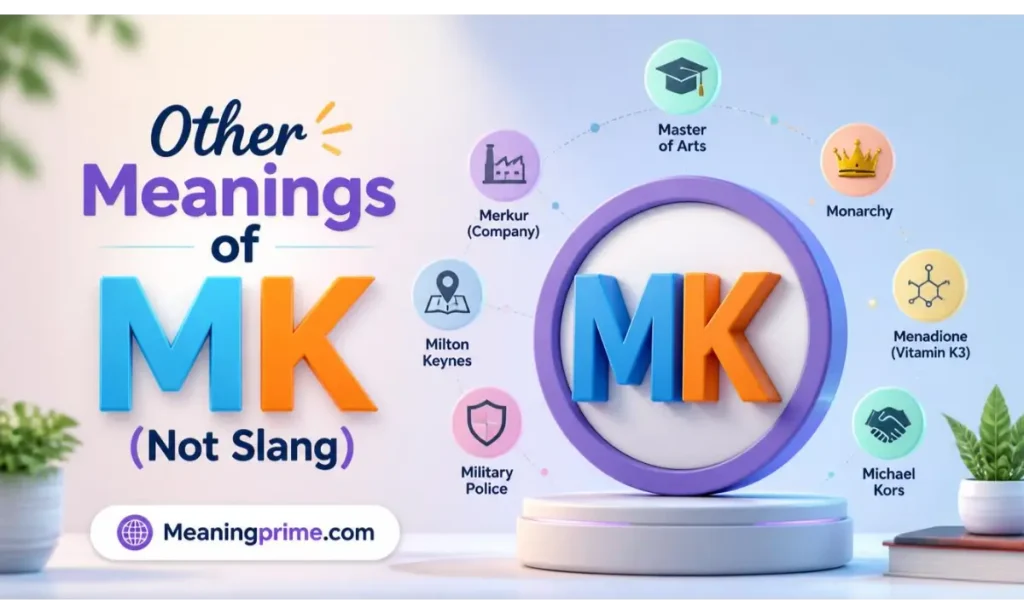
Outside of texting slang, “MK” stands for plenty of unrelated things depending on where you spot it. Here’s a quick reference:
| Context | What MK Means |
|---|---|
| Gaming | Mortal Kombat, the fighting game franchise |
| Fashion & Retail | Michael Kors (also its stock ticker symbol) |
| Names & Initials | Mark, Mackenzie, Mika, or any name starting with M and K |
| Geography | The Mekong River/region, or Milton Keynes, UK |
| Automotive | Model generation, like “Golf Mk7” (Volkswagen) |
| Cosmetics | Mary Kay, the beauty and skincare brand |
If “mk” shows up in a gaming forum, it’s probably Mortal Kombat. If it’s in a shopping haul video, it’s likely Michael Kors. The texting meaning — okay — only applies in casual conversation, not in these niche or branded contexts, so it always helps to double-check where the abbreviation is actually appearing before assuming the everyday MK meaning in text applies.
Is MK Rude or Passive-Aggressive?
On its own, “mk” isn’t rude. It’s just short. But short replies can feel passive-aggressive when they show up in the wrong moment — cutting off a longer conversation, responding to an apology, or replacing what would normally be a more detailed answer.
If you’re on the receiving end and something feels off, it’s fair to ask directly rather than guess. A simple “hey, everything okay?” clears up more than trying to decode tone from three letters.
Regional and Generational Differences in MK Usage
The MK meaning in text stays pretty consistent across English-speaking regions, but how often people use it — and how casual it feels — does shift a bit. In the US and Canada, “mk” tends to show up most in younger, Gen Z-heavy group chats and DMs, while older texters often stick with a full “ok” or “okay.”
In the UK and Australia, shorthand like “mk” competes with other regional favorites like “ta” or “cheers” for wrapping up a casual exchange, so it shows up a little less consistently than in North American texting culture. None of this changes what the word means — just how often you’ll actually run into it, and from whom.
How to Reply to MK in a Text
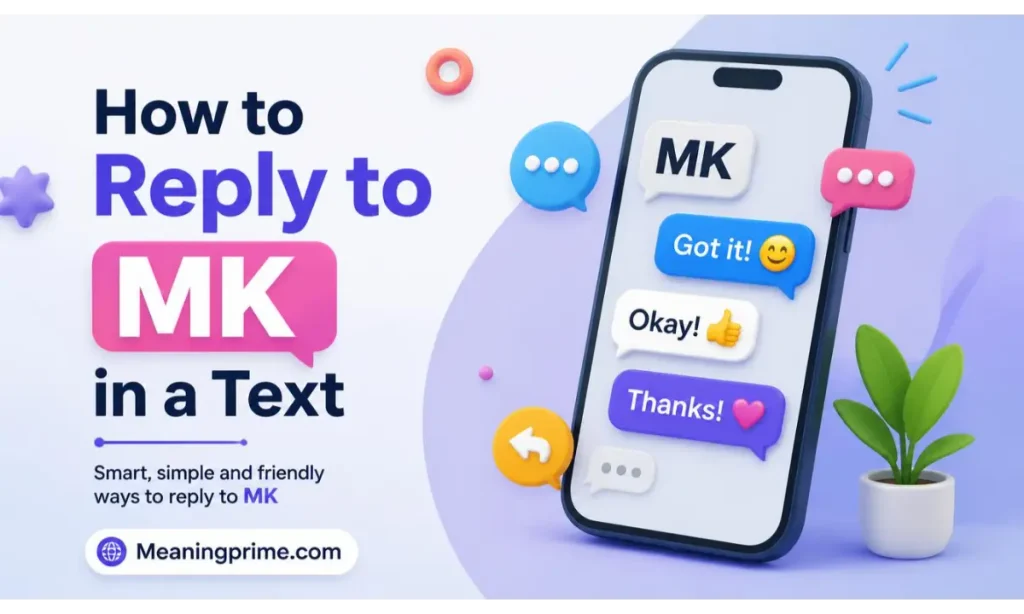
Not sure how to respond when someone sends you a bare “mk”? A few solid options:
- Match the energy: reply with “kk” or “sounds good” if it’s a casual, low-stakes chat
- Add warmth: toss in an emoji or a follow-up question if you want to keep the conversation going
- Check in: if the “mk” felt off, a light “you good?” opens the door without accusing anyone of anything
- Let it be: sometimes “mk” really is just “okay” — not every short reply needs a response at all
None of these options are wrong. The right pick just depends on the relationship, the platform, and whatever came before that single “mk” showed up.
Should You Use MK at Work or in Professional Messages?
Generally, no. Save “mk” for friends, family, and casual chats. In work emails, Slack, or Teams messages, it can read as dismissive or unprofessional, even if that’s not your intent. Swap it for “Sounds good,” “Understood,” or “Got it” instead — they take one extra second to type and land far better with coworkers or clients.
The exception is close-knit teams with a genuinely casual culture, where shorthand like this gets used constantly without anyone blinking. When in doubt, spell it out — a full “okay” never reads as wrong, while an abrupt “mk” sometimes does.
That said, understanding the MK meaning in text still matters even at work, since plenty of coworkers use it in casual Slack DMs even if they’d never type it in a formal email thread. Reading the room, and the channel, matters just as much as the word itself.
MK Meaning in English (Full Form Explained)
Strictly speaking, “MK” isn’t a true acronym with a fixed full form — it’s a phonetic shortening of “okay,” dropping the “o” and softening the ending. So while people sometimes ask what MK “stands for,” the honest answer is that it doesn’t stand for a phrase at all in texting slang. It’s simply a stylized, trimmed-down way of writing “okay,” which is why dictionaries treat the MK meaning in text as informal shorthand rather than a formal abbreviation with its own entry.
Frequently Asked Questions
What does mk mean in text?
The core MK meaning in text is “okay” — texting shorthand that usually signals agreement or acknowledgment. The exact tone depends on punctuation and context.
What does mk mean for a girl?
It typically still means “okay,” though in dating or relationship texts, a short “mk” can sometimes read as distracted or less enthusiastic than a fuller reply.
What if a girl says mk?
Look at her usual texting style before reading too much into it. A one-off short reply is rarely significant, but a sudden shift from longer, warmer texts to “mk” might be worth a gentle check-in.
What is the full form of mk?
“MK” doesn’t have an official full form — it’s a phonetic shortening of “okay,” not a true acronym.
Is it okay to text “mk” to your boss?
It’s best to avoid it. Professional messages read better with “Understood” or “Sounds good” instead of casual shorthand like “mk.”
Does mk always mean someone is upset?
No. Most of the time, “mk” is simply a fast way to say “okay” with no hidden feelings attached. It’s worth a closer look only if it breaks from someone’s usual texting style.
Conclusion
At the end of the day, the MK meaning in text almost always comes back to a simple “okay” — the real question is just how much warmth (or lack of it) comes along for the ride. Pay attention to punctuation, past texting patterns, and the platform it shows up on, and you’ll read the tone correctly almost every time.
Whether it’s from a girl, a guy, a coworker, or a group chat full of friends, the MK meaning in text rarely deserves the overthinking it gets. When in real doubt, skip the guesswork and just ask.