

You’re mid-conversation, everything’s normal, and then someone drops a lone “DW” and walks away from the chat. No context. No follow-up. Just three letters sitting there while you try to figure out if you’re in trouble or totally fine.
That confusion is exactly why so many people search for DW meaning in text. The good news? It’s one of the easier abbreviations to crack once you know what to look for, and this guide covers every real meaning, plus how to use it (and when to skip it) so you never second-guess a text again.
By the end of this guide, the DW meaning in text you’re dealing with, whether it’s from a friend, a partner, a coworker, or even a stranger online, won’t feel like a puzzle anymore.
Quick Answer
DW most commonly means “Don’t Worry” in texting and chat. It’s used to reassure someone, calm them down, or brush off an apology. Less commonly, DW can mean “Dear Wife,” and outside of texting it stands for things like Doctor Who, Data Warehouse, or even dishwasher, depending entirely on where you see it.
What Does DW Mean in Text & Chat?
In everyday texting, DW meaning in text almost always comes down to one phrase: “Don’t Worry.” It’s a quick, low-effort way to tell someone to relax.
Think of it as digital shorthand for:
- Relax, it’s handled
- No big deal
- Everything’s under control
- You don’t need to stress about this
For example:
- “DW, I’ve got it covered.”
- “DW about the mix-up, honestly.”
You’ll see it mostly in casual chats between friends, partners, and coworkers who already have a relaxed rapport. It’s not a formal phrase, and it isn’t trying to be one.
Once you understand the basic DW meaning in text, spotting it in the wild gets a lot easier. It shows up constantly, and it’s rarely trying to hide anything.
Full Form, Stands For & Short Meaning of DW
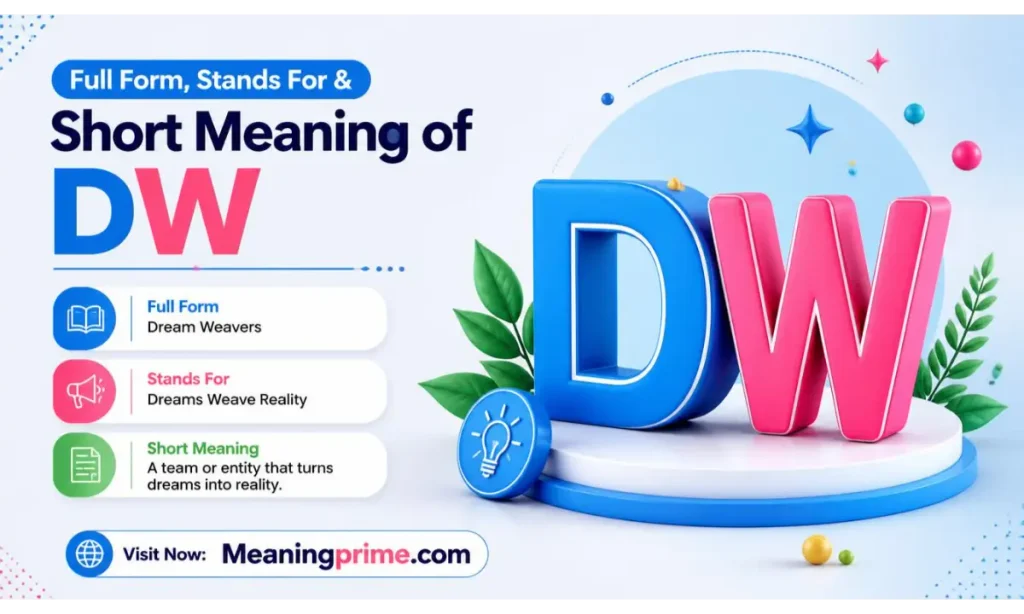
The short answer: DW = Don’t Worry.
There’s no deeper technical trick hiding behind it. It’s simply an abbreviation people started using because typing three letters is faster than typing eleven. Some folks assume it must stand for something more complicated, but in day-to-day chat, “Don’t Worry” is the meaning that wins almost every time.
If you take away just one thing from this guide, let it be this: the default DW meaning in text is reassurance, full stop. Everything else is a context-specific exception.
DW as “Dear Wife” (or Darling Wife) — The Other Common Meaning
Here’s where a lot of articles stop short, and it trips people up. DW also shows up as “Dear Wife” or “Darling Wife,” mostly in marriage forums, parenting groups, and relationship threads where posters don’t want to use their spouse’s real name.
You’ll spot it in sentences like:
- “My DW handled the whole move by herself while I was traveling.”
- “Can’t thank my DW enough for putting up with my late nights.”
This meaning almost never shows up in regular friend-to-friend texting. It lives in a specific corner of the internet: forums, Reddit threads, and community groups where people talk about their relationships. If you see “DW” paired with warm, affectionate language rather than a reassurance, this is probably the meaning at play.
Occasionally, someone will use “dw” sarcastically here too, so tone still matters even in this narrower context. It’s worth knowing this second DW meaning in text exists, even if you’ll run into it far less often than “don’t worry.”
dw, DW, or D/W? Does Capitalization Change the Meaning?
Short answer: no, but it does say something about the sender’s mood.
- Lowercase “dw” is the most common style in fast, casual texting. It feels breezy and low-key.
- Uppercase “DW” can read as slightly more emphatic, almost like the sender wants to make sure you actually relax.
- “d/w” shows up occasionally, mostly among people who like slashes in their shorthand (think “b/c” for “because”). It means the exact same thing.
None of these variations change the definition. They just shift the tone a little, and honestly, most people don’t even notice which one they used. Whichever style you go with, the underlying DW meaning in text stays exactly the same.
Origin, History & First Known Use of DW
DW’s roots trace back to early messaging culture: AOL chat rooms, MSN Messenger, and the first wave of SMS texting in the late ’90s and early 2000s. Typing speed mattered, screens were tiny, and shorthand spread fast.
“Don’t worry” got trimmed down to three letters because it’s a phrase people type constantly, and shrinking common phrases was just part of how chat culture worked back then. From there, it moved into forums, then social media, then gaming chats, and now it’s everywhere.
The “It Saves Characters” Myth — Is That Still True?
You’ll see a lot of articles claim DW caught on purely because old phone plans charged per character. That’s only half the story. Sure, early SMS had strict character limits, and shorter texts sent faster. But on most modern phone plans, you’re not billed per character anymore.
The real reason DW stuck around isn’t cost. It’s habit and speed. Once shorthand becomes second nature, people keep using it even after the original reason for it fades. That’s basically the whole story of internet slang, and it’s a big part of why the DW meaning in text has barely shifted in over two decades.
How People Use DW in Daily Conversations
People reach for DW constantly, and usually for one of these reasons:
- Comforting a friend who’s stressed
- Responding to an apology without making it awkward
- De-escalating a tense moment
- Giving quick, no-fuss reassurance
Texting examples
- “I might be running late.” → “DW, take your time.”
- “Sorry I forgot to call.” → “DW, it happens.”
- “I’m freaking out about the exam.” → “DW, you’ve studied enough.”
It’s friendly, low-pressure, and works in nearly any casual relationship. This is the everyday DW meaning in text you’ll run into most, by a wide margin.
DW Meaning Across WhatsApp, Instagram, TikTok & Snapchat
The DW meaning in text stays consistent no matter which app you’re using, but the core meaning of DW doesn’t shift much depending on the app. What changes is how often you’ll see it and in what kind of exchange.
DW meaning in WhatsApp usually shows up in personal chats with friends or family, often as a one-word reply that closes out a topic. On Instagram, it pops up in DMs and comment replies, especially after someone apologizes for a late reply or missed tag. What does DW mean on Snapchat conversations? The same thing, just faster and shorter, since Snapchat’s whole culture leans toward quick back-and-forth. On TikTok, you’ll mostly see it in comment sections, reassuring a creator after a slip-up or a joke that landed wrong.
Across every platform, the tone stays relaxed. Nobody’s using DW to start a serious conversation.
DW Meaning on Discord & Roblox
DW meaning in Discord chats follows the same “don’t worry” pattern you’d see anywhere else, though it shows up a lot in gaming-specific moments too. Someone messes up a raid, drops the ball in a group project channel, or shows up late to a voice call, and “dw” is the go-to response.
DW meaning in Roblox chat is nearly identical. Younger players especially lean on shorthand heavily, and DW fits right in during fast-paced in-game chatting, whether it’s smoothing over a mistake in a group game or reassuring a teammate who just lost a round. Gaming culture moves fast, but the DW meaning in text hasn’t needed to catch up. It was already built for speed.
DW Meaning in Medical Terms
Step outside texting, and DW meaning in medical contexts flips entirely. In radiology, DW usually refers to Diffusion-Weighted imaging, a type of MRI scan that measures how water molecules move through tissue. Doctors use it to detect strokes, tumors, and other tissue changes early.
If you’ve ever seen “DW-MRI” or “DWI” on a medical report, that’s the context. It has absolutely nothing to do with reassurance or texting, so if you spot DW in a clinical setting, don’t assume it means “don’t worry.” The casual DW meaning in text simply doesn’t carry over into a hospital chart.
All 10 Meanings of DW Explained
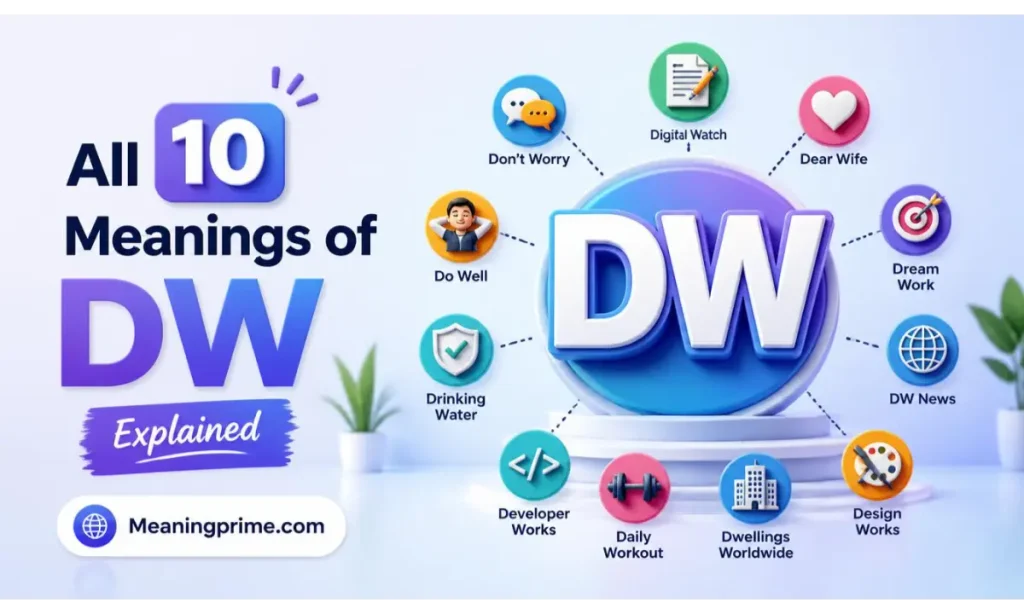
DW carries more weight than most three-letter abbreviations, and searching for the DW meaning in text alone won’t cover every situation you’ll come across. Here’s a rundown of every meaning worth knowing:
| # | Meaning | Where You’ll See It |
|---|---|---|
| 1 | Don’t Worry | Texting, social media, everyday chat |
| 2 | Dear Wife / Darling Wife | Marriage forums, relationship threads |
| 3 | Diffusion-Weighted (imaging) | Medical reports, radiology |
| 4 | Doctor Who | TV fandom, entertainment discussions |
| 5 | D.W. Read | Reference to the character from Arthur |
| 6 | Deutsche Welle (DW News) | German international broadcaster |
| 7 | Data Warehouse | IT, databases, business analytics |
| 8 | Dishwasher | Appliance listings, home classifieds |
| 9 | Disney World | Travel planning chats and forums |
| 10 | Downtown West | Local, location-based shorthand |
In casual texting, meaning #1 wins the vast majority of the time. The rest depend heavily on context, so if a message doesn’t make sense as “don’t worry,” scan the surrounding conversation before assuming.
Common Confusions, Mistakes & Wrong Interpretations
DW trips people up more than you’d expect for three letters. Some common mix-ups:
- Reading it as cold or dismissive when it’s actually meant kindly
- Confusing it with “dw” as a typo for “down” or “dude, what”
- Taking it too seriously in an already tense conversation
- Assuming it only ever means one thing, in every context, forever
Tone genuinely does most of the heavy lifting here. A “DW 😊” reads completely differently from a flat “dw.” with a period and nothing else. Context and punctuation matter more than the abbreviation itself, and most misunderstandings around the DW meaning in text come down to missing that emotional cue rather than the letters themselves.
Similar Terms, Alternatives & Related Slang
DW doesn’t operate alone. It sits in a whole family of casual reassurance and reaction slang, and knowing these neighbors helps the DW meaning in text click into place even faster.
| Term | Meaning | Typical Use |
|---|---|---|
| DW | Don’t Worry | Reassurance |
| NP | No Problem | Casual acknowledgment |
| NVM | Never Mind | Cancels a previous message |
| IDC | I Don’t Care | Neutral or dismissive |
| ISTG | I Swear to God | Emphasis, frustration, or sincerity |
| IKR | I Know, Right | Agreement, shared reaction |
These all live in the same casual register. Mixing them into a chat naturally makes conversations feel quicker without sounding robotic.
Real Chat Examples of DW by Situation
Context changes everything about how DW lands. Here’s how the same DW meaning in text plays out across different relationships.
With Friends
- “I missed your call.” → “DW, I was slammed too.”
- “Sorry I bailed on plans.” → “DW, we’ll reschedule.”
With a Partner or Spouse
- “I forgot to pick up dinner.” → “DW, I already ordered.”
- “I’m nervous about meeting your parents.” → “DW, they already love you.”
At Work
- “I might miss the deadline by a day.” → “DW, we can push it.”
- “I sent that email to the wrong client.” → “DW, I’ll follow up and smooth it over.”
In Gaming & Social Media
- “I lost us the round!” → “DW, we’ll win the next one.”
- “Sorry I couldn’t join the stream today.” → “DW, catch the next one.”
Notice how the phrase barely changes, but the emotional weight shifts depending on who’s saying it and why.
How to Reply When Someone Says DW
How to respond to DW really comes down to matching the tone you were given.
Casual replies:
- “Okay, thanks!”
- “Got it 👍”
Warmer replies:
- “You’re the best, appreciate it.”
- “Thanks, that actually helps.”
Playful replies:
- “Too late, already panicked 😂”
- “I was mid-spiral, but okay.”
More formal replies (for work contexts):
- “Thanks for the reassurance.”
- “Noted, appreciate you letting me know.”
If a “dw” ever feels like it’s brushing something off instead of resolving it, it’s completely fine to follow up with something direct like “wait, are we actually good though?”
When You Should NOT Use DW
DW is great for casual chats, but it has limits. Skip it in:
- Emails to clients or managers
- First conversations with someone new in a professional setting
- Situations where the other person needs a real explanation, not just reassurance
- Formal apologies where “don’t worry about it” spelled out shows more effort
In these cases, spelling out “don’t worry about it” reads as more respectful and less rushed. Shorthand can come across as careless in the wrong setting, even if that’s not what you meant. Knowing when to skip the DW meaning in text altogether is just as useful as knowing when to use it.
Is DW Still Popular? Trends & Online Usage
Yes, and it’s not going anywhere soon. DW remains especially common among Gen Z and younger Millennials, who lean heavily on shorthand across texting apps, Discord, and social platforms.
What does dw mean on Gen Z slang lists specifically? Same core meaning, just used even more casually and often paired with lowercase, minimal punctuation, and emojis. It’s slightly less common in professional Slack messages or formal emails, but in personal chats, it’s as steady as ever. New slang comes and goes constantly, yet DW has stuck around because it’s short, clear, and universally understood. Odds are good the DW meaning in text will still be exactly the same five years from now.
Quick Facts About DW Meaning in Text
| Factor | Details |
|---|---|
| Primary Meaning | Don’t Worry |
| Secondary Meaning | Dear Wife / Darling Wife |
| Category | Internet slang, texting abbreviation |
| Tone | Friendly, reassuring |
| Common Platforms | WhatsApp, Snapchat, Instagram, Discord, Roblox, SMS |
| Formality | Informal only |
| Popularity | High among Gen Z and Millennials |
Frequently Asked Questions
What Does DW Mean From a Girl or a Guy?
DW meaning in text from a girl and DW meaning from a boy are identical: it means “Don’t Worry” in almost every case. There’s no hidden romantic subtext by default. It’s simply reassurance, and the sender’s gender doesn’t change that.
Is DW Rude in Texting?
No, DW isn’t rude on its own. It’s usually kind and reassuring. It can feel a little cold if it’s the only reply to a serious message, but that’s about tone and context, not the abbreviation itself.
What Does DW Mean on Snapchat?
On Snapchat, DW means “Don’t Worry,” same as everywhere else. It’s especially common there because Snapchat conversations tend to move fast and stay short.
What Does “I Won’t DW” Mean?
“I won’t dw” usually means “I won’t worry about it,” with the sender turning DW into a verb on the fly. It’s a casual, self-directed version of the same reassurance, showing how flexible the abbreviation has become in modern texting.
Is DW Okay to Use in Formal or Work Emails?
Generally, no. DW works fine in Slack messages between close coworkers, but in client emails or formal messages, spelling out “don’t worry about it” reads as more professional and intentional.
Conclusion
At its core, DW meaning in text almost always points back to “Don’t Worry,” a short, friendly way to calm someone down or brush off an apology. But as you’ve seen, it’s not the only meaning out there. From “Dear Wife” in relationship forums to Data Warehouse in tech chats and Diffusion-Weighted imaging in medical reports, DW changes shape depending on where you find it.
Next time someone drops a lone “DW” in your chat, you’ll know exactly what it means, how to reply, and when it’s worth spelling things out instead. That’s really all texting shorthand is: a shortcut, not a mystery.