


You’re scrolling at midnight when a caption reads, “POV: you’re the friend who always replies late.” Wait. Whose point of view is that? Plenty of people pause right there, because the POV meaning they learned in school doesn’t quite match what’s on screen.
This guide clears it up fast. You’ll get the POV meaning on TikTok, Instagram, Reels and in chat, plus 23 real examples, a reply guide and a quick safety check for parents. Whether you’re a teen, a parent or a creator, you’ll know exactly how to read and use it.
Quick Answer: POV stands for “point of view.” Online, the POV meaning has shifted from a literal camera angle to a scenario prompt. A caption that starts with “POV:” asks you to imagine yourself inside that exact situation.
What Does POV Mean?
POV is short for “point of view.” Traditionally, it describes the position someone sees or tells a story from. Directors use it. Novelists use it. Online, though, the POV meaning gets far looser.
Think of “POV:” as a tiny doorway. The words after the colon tell you which room to step into. You’re not asked to see through someone else’s eyes. You’re asked to feel the moment.
Literal POV Meaning vs. Slang POV Meaning
The literal POV meaning is simple. It describes how someone sees or experiences something. “From my POV, we should leave early” is a perfect example. Nothing slangy there.
The slang POV meaning works differently. It introduces an imagined scene, like “POV: it’s Saturday and your alarm rings anyway.” The creator isn’t stating an opinion. They’re inviting you into a moment. Check what follows the word, and the intended sense usually jumps out.
| Type | What it means | Example |
|---|---|---|
| Literal | Personal perspective | “From my POV, the plan works.” |
| Slang | Imagined scenario | “POV: you just hit snooze again.” |
POV Meaning in Social Media
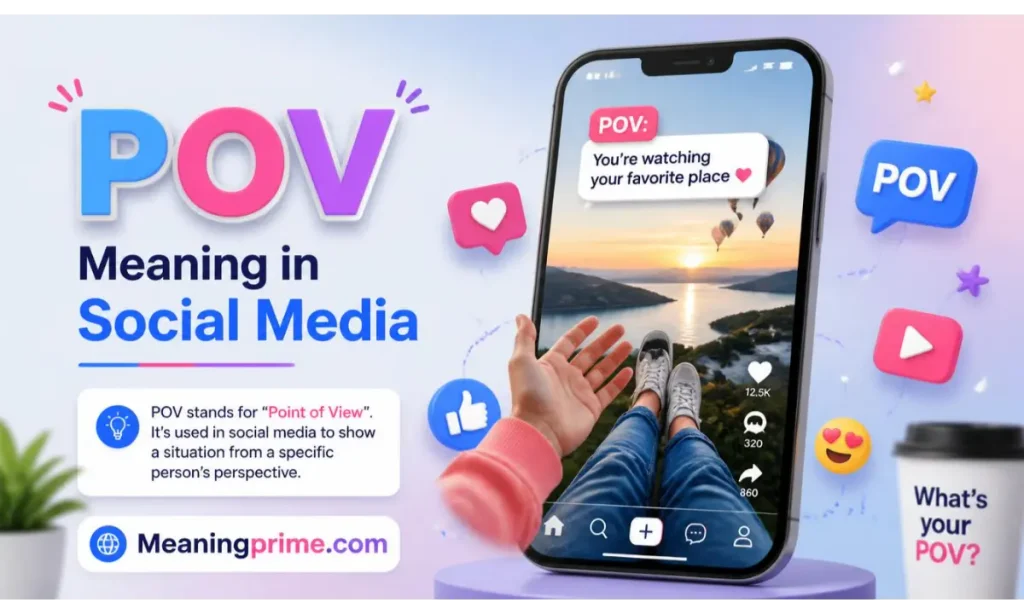
Across social platforms, POV works more like a format than a word. It sets up a scene in a handful of characters. That’s gold for short video, where you get about two seconds to hook someone. In social media, the POV meaning boils down to “picture yourself here.” Creators love it because viewers do half the work.
What Is POV in Gen Z?
Among Gen Z, POV does two jobs. First, it frames jokes and skits. Second, it boosts an opinion. A New Media lecturer told TODAY.com that teens sometimes use it in conversation to signal a firmly held view. So “my POV is that pineapple belongs on pizza” sounds more certain than “I guess.” For this generation, the POV meaning leans heavily on tone.
The Three Types of POV Content You’ll See
TODAY.com’s reporting on teen slang describes three common forms:
- First-person POV: filmed from the creator’s own eyes, like a surfer riding a wave.
- Second-person POV: the “POV: you’re…” style that puts the viewer in the scene.
- Object POV: posted from the viewpoint of a non-living thing, such as “POV: you’re a sock that lost its pair.”
Knowing which type you’re watching makes the POV meaning click faster.
Origin and History of “POV”
From Film Shots and Writing to YouTube
POV began as a craft term. In writing, it names who tells the story. A first-person narrator says “I.” A third-person narrator says “she” or “they.”
Film borrowed the idea. A POV shot shows what a character sees. Many sources treat Abel Gance’s 1927 movie Napoléon as an early example. By the 1950s, POV shots were common in movies. Then, in the early 2010s, YouTube and gaming channels filled up with first-person footage. The original POV meaning stayed literal all that time.
How TikTok Changed the Format
Around 2019 and 2020, TikTok changed everything. Short videos needed instant context. Creators started typing “POV:” at the top of a clip, then acting out the scene. Holding a phone to mimic someone else’s eyes felt clumsy. So they simply showed their own faces. Viewers didn’t mind.
By about 2021, the POV meaning had settled into “imagine this scenario.” Film students may grumble. Language doesn’t care. It follows whatever works.
How “POV” Is Used on Different Platforms
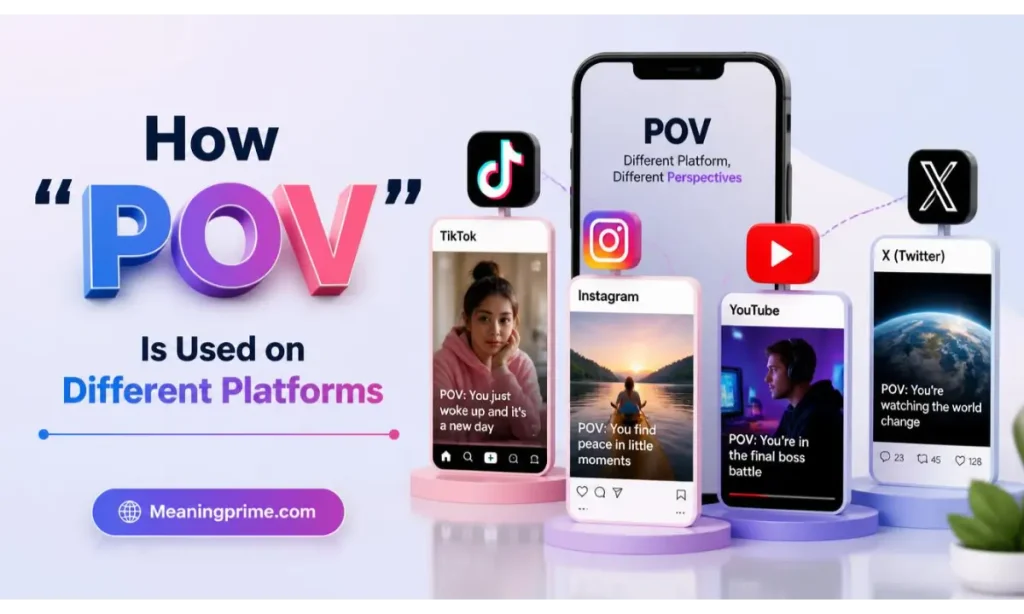
The same three letters behave a little differently from app to app. Here’s the breakdown.
POV Meaning on TikTok
TikTok is home base. Here, the POV meaning covers skits, comedy, emotional stories and role-play. Creators type the setup, then act it out. The caption tells you who you are. The video shows how it feels.
Example: “POV: you’re the only extrovert in a group of introverts.”
POV Meaning on Instagram and in Reels
Instagram Reels borrowed the format wholesale. You’ll see POV captions on Reels, in Stories and even under still photos. A vacation shot might say, “POV: the flight is finally booked.” The POV meaning on Instagram leans relatable and aspirational rather than dramatic.
POV in Facebook Reels
Facebook Reels use the same short vertical-video style, so POV captions work the same way. Creators often cross-post one clip everywhere. If you understand a POV on Instagram, you understand it here.
POV Meaning in Video (YouTube Shorts and Beyond)
In video, POV can be literal or playful. A cyclist with a chest-mounted camera gives you a true first-person view. A comedian acting out a scenario gives you the slang version. YouTube Shorts host both. The POV meaning in video depends on whether the camera or the caption does the work.
POV Meaning in Memes
Memes squeeze POV into a single image. A photo of a cat staring at an empty bowl might read, “POV: it’s 5:59 a.m. and you’re my human.” The image supplies the emotion. The caption supplies the role. That combo travels fast because nobody needs a backstory. It’s also why the POV meaning in memes feels instant.
Twitter/X
On X, POV goes text-only. People write a scenario in one line and let readers fill in the rest. It often carries sarcasm: “POV: you’re a recruiter asking for ten years of experience on an entry-level job.”
Snapchat
Snapchat keeps things casual. Friends send a quick snap captioned “POV: it’s Sunday night and the homework is still blank.” It feels more like an inside joke than a broadcast.
On WhatsApp, POV shows up in group chats, statuses and forwarded memes. It can be playful or literal. “POV: mom asks who ate the last slice” is a joke. “From my POV, we should wait” is a real opinion. Context sorts it out.
Discord and Gaming Chats
Gamers use POV both ways. Streamers show literal first-person footage. Teammates roast each other with lines like “POV: you’re the tank who ran in alone again.” The tone runs playful and sometimes savage.
| Platform | Typical use | Tone | Example |
|---|---|---|---|
| TikTok | Skits, role-play | Dramatic or comic | “POV: you’re the middle child” |
| Instagram / Reels | Captions, Reels | Relatable | “POV: you bought the bag” |
| Facebook Reels | Cross-posted clips | Relatable | “POV: the weekend starts Thursday” |
| X | One-line jokes | Sarcastic | “POV: an app is gaslighting you” |
| Snapchat | Casual snaps | Friendly | “POV: Sunday-night homework” |
| Chats, statuses | Playful or literal | “POV: mom asks who ate the cake” | |
| Discord | Game banter | Roasting | “POV: you forgot to mute” |
POV in Texting vs. Real Life
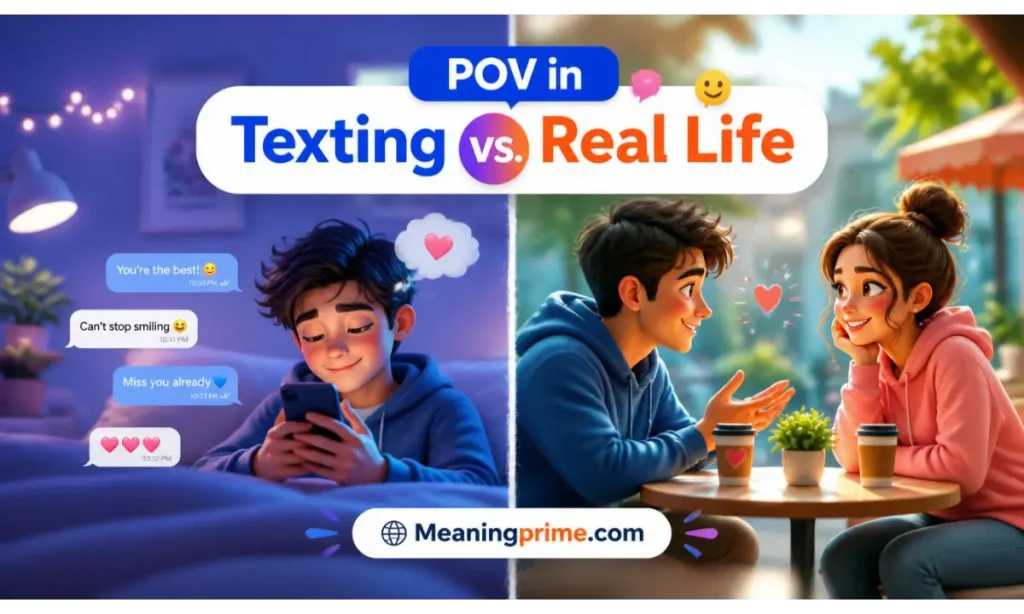
You’ll mostly see POV typed. Saying “POV colon you’re eating alone” out loud sounds robotic. Most people just say, “Imagine you’re eating alone.”
POV Meaning in Chat
In chat, the POV meaning is almost always the scenario type. Friends drop one to share a relatable moment: “POV: you’re me checking my bank app.” You don’t need a real event behind it. The joke is the point. Emojis like 😭 and 💀 signal humor. A lowercase “pov” signals a casual vibe.
How to Reply to a POV Message
Match the energy. If a friend sends a joke, play along.
Friend: POV: you said you weren’t hungry and now you’re eating my fries.
You: Those fries looked lonely 😂
If someone means it literally, answer the idea. For “From my POV, this plan is risky,” try “Fair point. Here’s how I see it.” Still unsure? Ask, “Is that a joke or an actual take?”
Spoken POV: When It Means “Here’s My Opinion”
Out loud, POV often signals a strongly held opinion. A New Media lecturer quoted by TODAY.com said teens use it to show they stand behind a view. So “my POV is that Mondays should be optional” really means “I’m serious.” Treat it as a tone marker. Save it for casual talk.
How to Use POV: A Simple Formula
Want to try it yourself? Follow these steps:
- Type “POV:” with a colon.
- Pick a situation people recognize.
- Address the viewer as “you.”
- Keep the line short. Short lines land better.
- Match the tone with a face, an emoji or a punchline.
Try this: “POV: it’s Sunday night and you just remembered the essay.” Simple. The POV meaning does the rest.
Examples of “POV” in Sentences
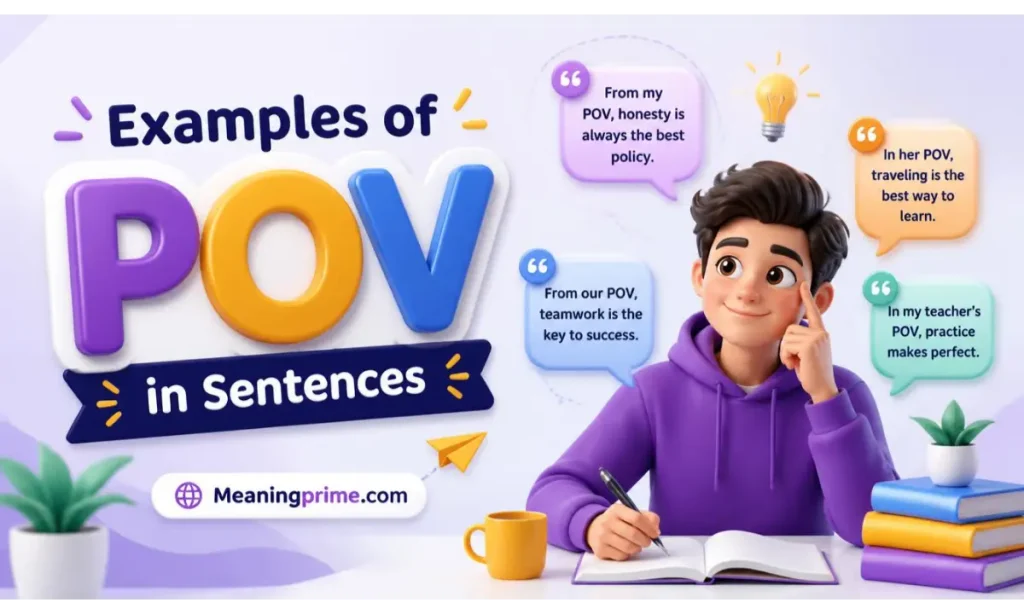
Here are 23 examples. Borrow freely.
Friendly and Casual (5)
- POV: you’re the friend who replies “haha” to a twelve-paragraph text.
- POV: your group chat plans a trip that never happens.
- POV: you arrive early and everyone else runs late.
- POV: you’re holding the door for someone twelve steps away.
- POV: your best friend borrows your charger “for a minute.”
Romantic and Flirty (4)
- POV: your crush waves and you wave back at the person behind you.
- POV: they remember the tiny detail you mentioned last month.
- POV: you rehearse a text for ten minutes, then send “hey.”
- POV: a stranger’s cute dog starts a real conversation.
Sarcastic and Humorous (5)
- POV: you announce a fresh start after one salad.
- POV: your phone says 1% and you feel calm.
- POV: you call it “resting your eyes” at 2 p.m.
- POV: the printer works perfectly once the tech guy watches.
- POV: you nod like you understood the whole meeting.
Online and Caption Use (4)
- POV: the sunrise hike was worth the 5 a.m. alarm.
- POV: you open the app and your feed reads your mind.
- POV: your coffee art looks like an inkblot test.
- POV: it’s day one of spring break ✨
Gaming (3)
- POV: you’re the healer and nobody says thanks.
- POV: your game lags right as you win the fight.
- POV: you find the secret room on your tenth try.
Work and School (2)
- POV: you open your inbox after a week off.
- POV: you study all night and the quiz covers page one.
Other POV Meanings Outside Slang
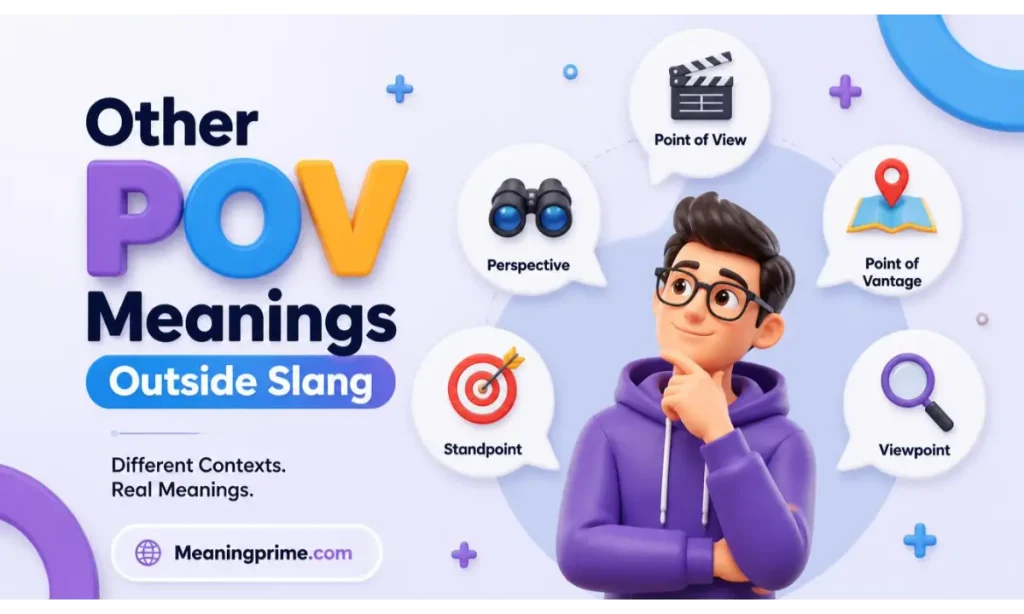
POV isn’t only internet slang. Other fields use the same letters for different things. Context tells you which one you’re reading.
POV Meaning Vehicle
In vehicle contexts, POV can stand for “privately owned vehicle.” Wikipedia’s POV disambiguation page lists it among the abbreviation’s other uses. It tends to appear in formal documents rather than captions. If the surrounding text mentions cars, mileage or transport, the POV meaning is almost certainly this one.
POV Meaning Medical
Medical shorthand varies by hospital, clinic and specialty. Abbreviation directories list several options: patient office visit, physician order verification and portal vein. Ophthalmology listings add postoperative visit. Because the POV meaning in medical notes changes with context, don’t guess. Ask the provider or check the document’s own key. This section is general information, not medical advice.
POV Shot in Film
Back to where it started. A POV shot in film places the camera where a character’s eyes would be. That’s the ancestor of every slang POV meaning you’ve read today. The slang version keeps the “put you inside” idea and drops the camera rules.
Variations and Related Slang
Spelling Variations
You’ll see “POV,” “pov,” “PoV” and “P.O.V.” All four share one POV meaning. Lowercase feels casual. Capitals feel emphatic. Periods feel old-school.
POV vs. “Me When,” TFW, IYKYK and Similar Terms
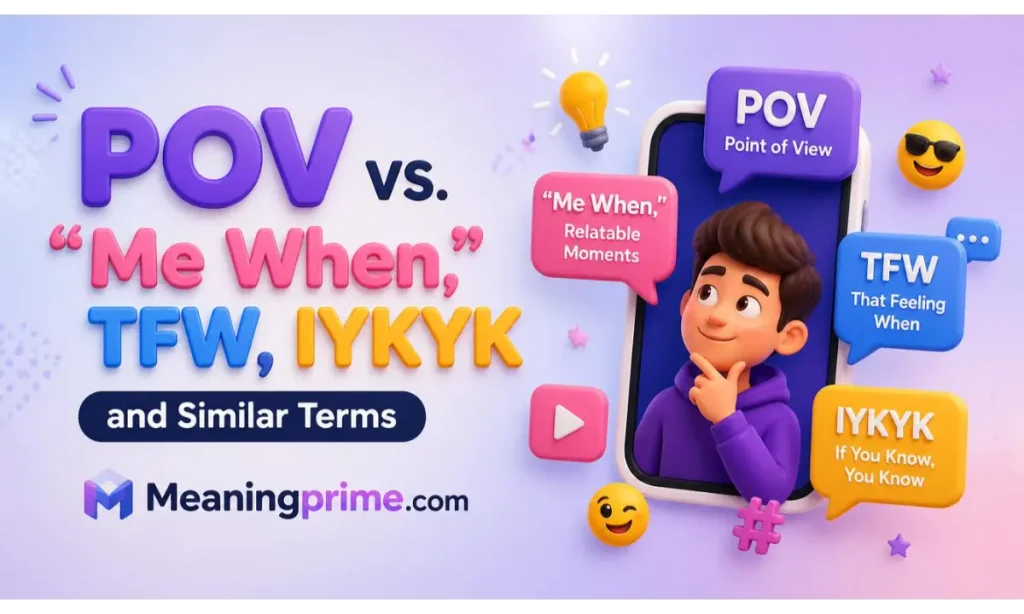
Several phrases set up relatable moments. They aren’t identical.
| Term | Meaning | How it differs |
|---|---|---|
| POV | Point of view; scenario setup | Puts you in the scene |
| Me when | The speaker’s own reaction | Points at the poster |
| TFW | That feeling when | Names an emotion |
| IYKYK | If you know, you know | Insider reference |
| “This gives…” | Describes a vibe | Describes atmosphere, not a scene |
The quick test: POV points at you, while “me when” points at the poster. Only the POV meaning drops you into the scene.
Is “POV” Safe for Kids?
Yes. The phrase is harmless. It simply means point of view, and kids meet it in English class when they study first-person and third-person narrators. The POV meaning itself carries nothing inappropriate. The content around it can vary, though.
What Parents Should Actually Check
Now that you know the POV meaning, focus on the video instead of the word.
- Watch the content, not the caption. POV videos can cover relationship drama, heavy mental health topics or adult humor.
- Use built-in controls. Most platforms offer parental controls or supervision tools.
- Ask your child what a clip meant. Their answer shows what they understood.
- Talk about acting. Many POV skits are performances, not real events.
Monitor content, not vocabulary.
When to Use (and Avoid) “POV”
Use It When
Reach for POV when the POV meaning fits your goal:
- You’re making short videos or Reels.
- You’re texting a funny hypothetical to friends.
- You’re captioning a photo with a scenario.
- You want a playful angle on an ordinary story.
Avoid It When
- You’re writing formal emails, resumes or reports.
- You’re giving a presentation or speech.
- “Imagine…” would say it more clearly.
- You’ve already used it in every post this week.
Common POV Mistakes
A quick check of the POV meaning prevents most slip-ups.
- Assuming it always means “opinion.”
- Expecting the camera to show your exact eyes.
- Skipping the colon. “POV you’re late” reads sloppy.
- Using it for real complaints that need a plain statement.
- Stacking it on every post until it loses punch.
Frequently Asked Questions
What is a POV in social media?
In social media, a POV is a caption or video format that places you inside a specific scenario. The POV meaning here is “imagine yourself in this moment.” It works in videos, memes, Reels and text posts.
What is POV in Gen Z?
For Gen Z, POV sets up scenarios and also stresses an opinion. Tone decides which one. The POV meaning shifts from playful to serious based on what follows the colon.
How do you use POV?
Type “POV:” then describe a relatable moment addressed to “you.” Keep it short and add an emoji or expression to match the mood. The POV meaning stays clear when the scenario is specific.
What is POV in Facebook Reels?
It works like it does on Instagram and TikTok. The caption sets a scenario and the video acts it out. The POV meaning in Facebook Reels is identical, so there’s nothing new to learn.
Does POV mean opinion?
Not exactly. Literally, POV means point of view, which is broader than an opinion. In casual speech, people sometimes use it to stress a strong view. Slang POV captions aren’t opinions at all.
Conclusion
POV stands for “point of view,” yet the POV meaning online has grown into something more playful. When a caption starts with “POV:” it asks you to imagine a scene. The camera angle barely matters anymore.
Here’s the shortcut. Read what follows the word. A colon plus a scenario means “imagine this.” “From my POV” means personal perspective. Once you spot that difference, the POV meaning never feels confusing again. Go ahead and try one.