


Ever clenched your jaw because someone chewed with their mouth open? You weren’t being dramatic. You were just bumping into one of your pet peeves. Then a friend texts, “What’s your biggest pet peeve?” and you freeze, wondering about the pet peeves meaning and how to answer.
This guide breaks down the pet peeves meaning in plain words. You’ll see where the phrase came from, 21 relatable examples, real chat conversations, and replies that land well. You’ll even get translations in Tagalog, French, and Chinese.
Quick Answer: The pet peeves meaning is simple. A pet peeve is a small, personal annoyance that bugs you much more than it bugs most people. Loud chewing, late replies, and dirty dishes in the sink are classic examples. People use the phrase in chats, at work, and in relationships to name the little things that get under their skin.
Pet Peeves Quick Meaning
Let’s start with the basics of the pet peeves meaning. A pet peeve is a specific, everyday irritation that annoys you more than it probably should. It’s usually minor. A stranger humming in a quiet elevator won’t ruin your week. Still, it might make your shoulders tense up.
Three traits separate a pet peeve from a bad mood:
- It’s personal. What drives you up the wall might not faze your best friend at all.
- It repeats. The same thing sets you off every single time.
- It stays small. Pet peeves live in the land of minor annoyances, not serious harm.
You’ll hear it in lines like, “One of my pet peeves is people chewing loudly.” Dictionaries describe it as something that especially annoys you. Honestly, the pet peeves meaning really is that easy.
Why Is It Called a Pet Peeve?
The pet peeves meaning rests on two words with two stories. “Pet” means something you cherish, like a favorite animal you look after. “Peeve” means annoyance, and it grew out of “peevish,” an old word for cranky or ill-tempered.
Put them together and you get an annoyance you keep close, almost like a pet. That’s why people can’t resist complaining about their pet peeves.
The term is an Americanism from the early 1900s. It reached a wide audience through a comic strip called The Little Pet Peeve, which ran in the Chicago Tribune from 1916 to 1920. The strip poked fun at thoughtless everyday behavior. So the pet peeves meaning we use today has been funny and relatable from the very start.
Emotional & Psychological Meaning of Pet Peeves
The pet peeves meaning is rarely about the behavior alone. They’re often about what the behavior signals. Someone who hates being interrupted may feel unheard. Someone who can’t stand a messy room may crave calm and control. That’s why pet peeves work like emotional shortcuts.
They often reflect:
- Your values. Respect, honesty, time, or cleanliness may matter a lot to you.
- Your senses. Some people react strongly to certain sounds, smells, or textures.
- Your past. A habit that reminds you of a stressful moment can sting more than it should.
Understanding the pet peeves meaning on this deeper level helps you stay calm. When something irritates you, ask what it touches. The answer is usually more interesting than the annoyance itself.
Mild pet peeves are a normal part of being human. However, if a small irritation sparks intense anger or distress, talking with a mental health professional can help.
Pet Peeves Meaning vs Ick, Trigger & Dealbreaker
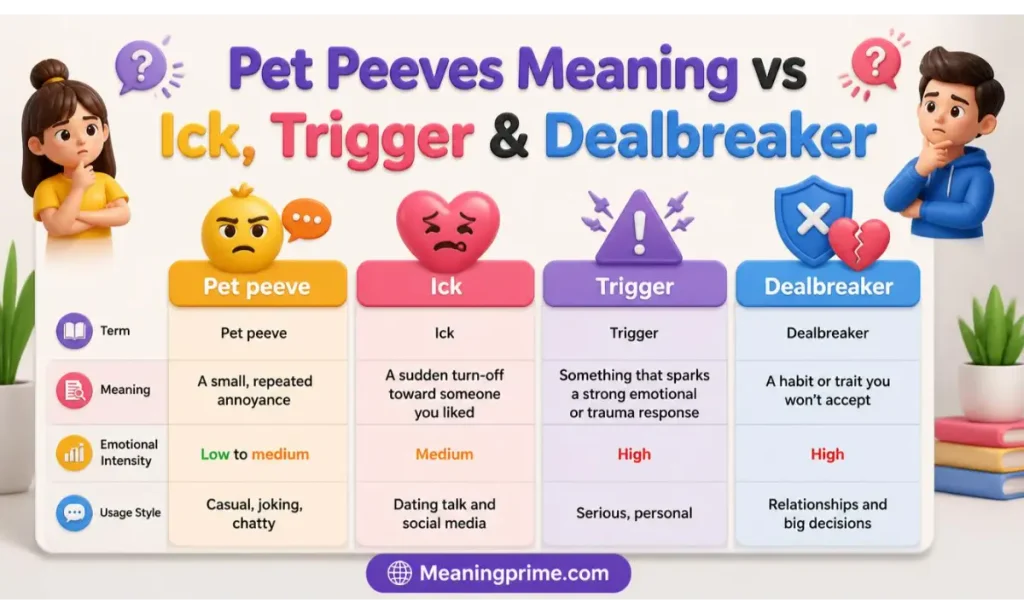
People mix these words up all the time. Each one sits at a different level of intensity, so the label you pick matters.
| Term | Meaning | Emotional Intensity | Usage Style |
|---|---|---|---|
| Pet peeve | A small, repeated annoyance | Low to medium | Casual, joking, chatty |
| Ick | A sudden turn-off toward someone you liked | Medium | Dating talk and social media |
| Trigger | Something that sparks a strong emotional or trauma response | High | Serious, personal |
| Dealbreaker | A habit or trait you won’t accept | High | Relationships and big decisions |
| Pet hate | The British twin of a pet peeve | Low to medium | Everyday speech in the UK |
Think of it as a ladder. Pet peeves sit on the bottom rung. An ick climbs higher in dating, while a trigger belongs in a far more serious category. Calling trauma a pet peeve undersells it. Calling slow walkers a trigger overstates it. Knowing the pet peeves meaning helps you choose the right word.
Variations of Pet Peeves Meaning: 21 Examples by Type
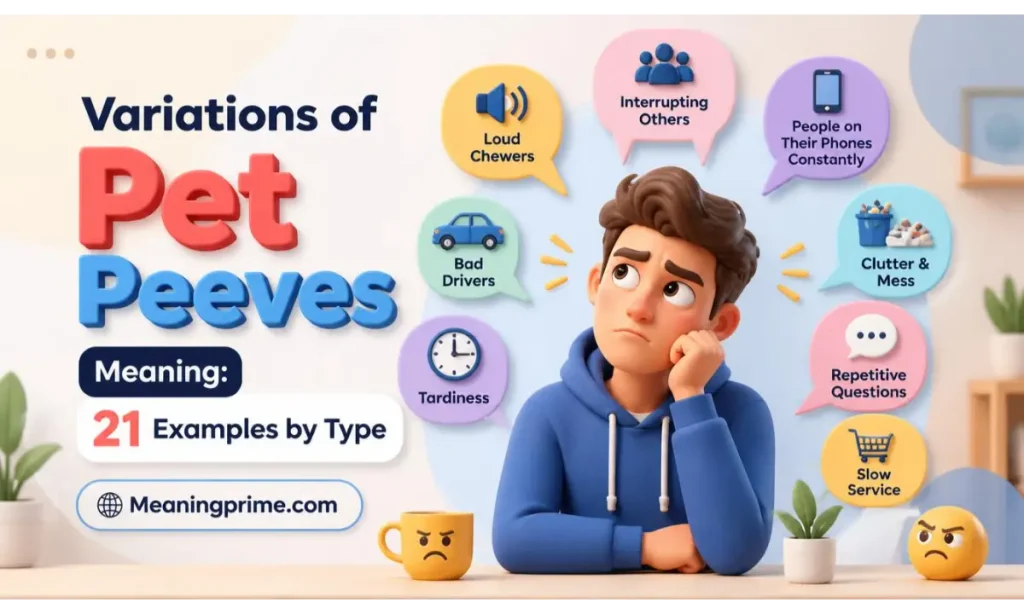
Most pet peeves fall into a few familiar buckets. Here are 21 popular ones, grouped so you can spot your own. Each one shows the pet peeves meaning in action.
Noise-Related Pet Peeves
- Loud chewing. Crunching and smacking can turn a quiet dinner into a test of patience.
- Pen tapping. That steady click-click-click fills a silent room fast.
- Speakerphone in public. Nobody asked to hear your whole call on the train.
Social Etiquette Pet Peeves
- Interrupting. You’re halfway through a thought when someone jumps in.
- Skipping the thank-you. A small “thanks” costs nothing, yet some people never say it.
- Leaving the shopping cart in the lot. The cart return is right there.
Workplace Pet Peeves
- Vague emails. “Can we chat?” with no context makes everyone nervous.
- Meetings that could be emails. An hour gone for a two-line update.
- Reply-all storms. One message turns into fifty unwanted notifications.
Relationship Pet Peeves
- Scrolling during conversations. Phone use while you’re talking feels like being ignored.
- Not listening. Nodding without really hearing is easy to spot.
- Leaving cabinet doors open. Tiny habit, big sigh.
Grammar Pet Peeves
- “Your” vs “you’re” mix-ups. Spellcheck can’t fix everything.
- Missing punctuation. A sentence that never ends can wear a reader out.
- Misusing “literally.” No, you didn’t literally die laughing.
Hygiene Pet Peeves
- Skipping hand washing. It’s basic, and people notice.
- Overpowering perfume or body odor. Strong smells in small spaces are hard to ignore.
- Clipping nails in public. Some things belong at home.
Time-Related Pet Peeves
- Running late. Five minutes becomes twenty, and nobody explains why.
- Endless voice notes. Seven minutes of rambling when a text would do.
- Last-minute cancellations. Plans fall apart an hour before they start.
Biggest Pet Peeves Meaning: What Counts as the Worst One?
Your “biggest pet peeve” is simply the one that bothers you most. It’s not an official ranking. Still, a few show up in nearly every conversation: loud chewing, rudeness, lateness, interrupting, and unanswered messages.
Here’s a handy way to think about it. A regular pet peeve makes you sigh. A biggest pet peeve makes you leave the room. When someone asks, “What’s your biggest pet peeve?” they just want to know which small thing tests you the most. In short, the biggest pet peeves meaning depends on the person answering and the mood of the day.
Pet Peeve in a Sentence
Seeing the phrase in real sentences makes the pet peeves meaning stick. Here are some natural ones:
- “My biggest pet peeve is people who don’t return their carts.”
- “It’s a pet peeve of mine when meetings start late.”
- “Chewing gum loudly? That’s his pet peeve.”
- “Her pet peeves include typos and long voice notes.”
- “Mixing up ‘there’ and ‘their’ is a huge pet peeve for my English teacher.”
Notice the pattern. You can say “my pet peeve is,” “a pet peeve of mine,” or “one of my pet peeves.” All three sound perfectly natural. Using these patterns keeps your pet peeves meaning clear in any chat.
Pet Peeves Meaning in Relationships
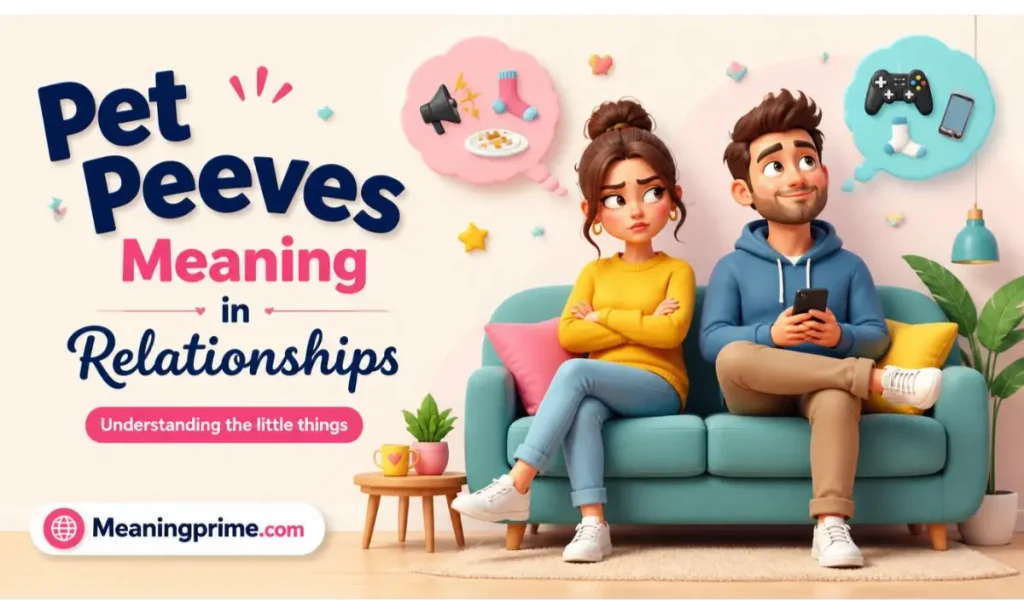
Couples swap pet peeves like favorite songs. One partner can’t stand wet towels on the bed. The other can’t handle a car with an empty gas tank. These quirks seem tiny, but they pile up.
Understanding pet peeves meaning inside a relationship means treating them as information, not attacks. Say it kindly: “It bugs me when plates stay in the sink. Could we try rinsing them right away?” That works far better than a sigh and a slammed cupboard.
Try a weekly check-in too. Each person names one small irritation and one thing they appreciate. It takes two minutes and keeps resentment from building quietly. Over time, you learn which habits are simple quirks and which ones need a real conversation. That balance makes the pet peeves meaning feel less like complaining and more like teamwork.
Pet peeves can bring people closer when you share them with humor. They turn into harmful friction only when you use them to criticize someone’s character.
Pet Peeves Meaning at Work
Offices are pet peeve factories. Different habits, different schedules, and shared spaces all collide. Common ones include loud phone calls, microwaved fish, unclear instructions, and cluttered desks.
A good rule helps here. Raise issues that affect the team’s work, and let the harmless quirks slide. For example, asking for clearer deadlines is reasonable. Complaining about a coworker’s mug choice isn’t.
If a pet peeve keeps surfacing, say it politely and with a solution: “Could we put meeting agendas in the invite?” That keeps the pet peeves meaning professional, not petty.
Pet Peeves Meaning in Texts & Social Media
Online, the phrase works as a conversation starter. People post lists, run polls, and tag friends with “Pet peeve: unread messages.” It’s light, relatable, and easy to join.
Here’s how a real chat might sound:
Maya: Okay, quick question. What’s your biggest pet peeve? Jordan: People who say “we need to talk” and then go silent for three hours. Maya: Ha, mine is voice notes longer than a podcast. Jordan: Fair. We’re basically twins.
Captions work too. Try “Pet peeve of the day: empty coffee pots” or “My pet peeve? Slow walkers in a hurry zone.” Short, funny, and instantly clear. That’s the everyday side of pet peeves meaning on social media.
Smart Replies When Someone Shares Their Pet Peeve
Someone just told you what drives them crazy. Now what? Knowing the pet peeves meaning makes replying easy. A good reply shows you’re listening without turning the chat into a debate.
| Situation | Funny Reply | Polite Reply |
|---|---|---|
| They hate loud chewing | “So no crunchy chips on movie night, got it.” | “That’s fair. I’ll keep it quiet.” |
| They hate lateness | “I’ll set three alarms. Promise.” | “Thanks for telling me. I’ll plan ahead.” |
| They hate interruptions | “Zipping my lips. Go ahead!” | “Sorry about that. Please finish your thought.” |
| They share a silly one | “Wow, that’s oddly specific. I love it.” | “Interesting. What bothers you about it?” |
| You share the same one | “Finally, someone gets it!” | “Same here. It’s so frustrating.” |
Three quick tips:
- Match the mood. Jokes work in casual chats. Warm, simple replies work at work.
- Skip the lecture. Nobody wants a debate over a pet peeve.
- Share back. Offering your own keeps the exchange balanced and fun.
When to Share Your Pet Peeves (and When to Skip)
Sharing is great for bonding. It breaks the ice on a first date, lightens a team lunch, and fills an awkward pause in a group chat. The pet peeves meaning stays friendly when the topic stays small. Nobody minds hearing that you hate soggy cereal.
Timing matters, though. Skip the topic during serious conversations, job interviews, or heated arguments. Bringing up pet peeves in the middle of a fight sounds like criticism. In those moments, the pet peeves meaning shifts from playful to personal.
A simple test works well. Ask yourself, “Will this make someone smile or feel judged?” If it’s a smile, go ahead. If it’s judgment, keep it to yourself. Also, pick pet peeves that are common and harmless. Mean or aggressive ones defeat the whole point and make you sound harsh instead of relatable. That’s the pet peeves meaning most people expect: light, relatable, and kind.
Pet Peeve Opposite
English doesn’t have one official opposite of a pet peeve. However, a few ideas come close. A “guilty pleasure” is something you secretly love. A “soft spot” is a weakness that makes you smile. Some people jokingly say “pet love” for the little habits they adore in others.
In plain terms, the opposite of the pet peeves meaning is anything small that delights you the way pet peeves irritate you. Think of the smell of fresh coffee or a friend who always texts back fast.
Pet Peeve in Tagalog, French & Chinese

Curious how the idea travels? Many languages have a natural way to say it. These are the closest everyday matches:
| Language | Natural Expression | What It Means |
|---|---|---|
| Tagalog | Ikinaiinis ko or Ayaw na ayaw ko | “What annoys me” or “I really can’t stand it” |
| French | Ma bête noire | “My black beast,” the closest match to a pet peeve |
| Chinese | 最反感的事 (zuì fǎngǎn de shì) | “The thing I dislike most” |
Filipinos also use “pet peeve” as-is in Taglish. In French, ce qui m’énerve works for a lighter, everyday annoyance. In Chinese, 我最受不了 (wǒ zuì shòu bù liǎo) means “I can’t stand it.” Translating the pet peeves meaning never matches word for word, but the feeling carries over clearly.
Frequently Asked Questions
What Is the Pet Peeves Meaning in Simple Words?
The pet peeves meaning, in simple words, is a small thing that annoys you more than it annoys most people. Examples include loud chewing, late replies, or messy counters.
Are Pet Peeves Negative?
Not really. Mild pet peeves are normal and often funny. They become a problem only when they spark constant anger or hurt other people.
Do Pet Peeves Reveal Personality?
The pet peeves meaning can hint at your values. Someone who hates lateness may value respect for time. Still, a pet peeve doesn’t define who you are.
Can Couples Have Pet Peeves About Each Other?
Yes, and almost every couple does. Talking about them kindly and early keeps small irritations from growing.
What Is a Pet Peeve Example?
A common example is someone chewing with their mouth open. Others include interrupting, being late, or leaving dirty dishes in the sink.
Conclusion
The pet peeves meaning comes down to this: a small, personal annoyance that bugs you more than most people. It’s casual, relatable, and often funny. From loud chewing to endless voice notes, everyone has a few.
Now you know where the phrase came from, how it differs from an ick or a trigger, and what to say when someone shares theirs. Pick your top three, answer with a smile, and enjoy the conversation. Sharing your pet peeves meaning with friends is one of the easiest ways to bond.