


You’re scrolling through a group chat. Someone posts a wild photo. Three friends reply “no mames” at once. You laugh along but you have no clue what it means. Is it friendly? Is it rude? Fair questions.
This guide breaks down the no mames meaning in plain English. You’ll learn where the phrase comes from and how people use it in texts. You’ll also get reply ideas and a clear warning about when to skip it.
Quick Answer
No mames is Mexican Spanish slang for “no way,” “you’re kidding,” or “come on.” The no mames meaning shifts with tone. It can show shock, disbelief, annoyance, or playful teasing. It’s crude in origin. Save it for close friends.
What Is the No Mames Meaning in Slang?
The no mames meaning works like a reaction button. It tells the other person you can’t believe what you just heard. English has plenty of matches: “no way,” “get out of here,” “seriously?” and “you’ve got to be kidding.”
Tone does the heavy lifting. Said with a laugh, it’s surprise. Said flat, it’s irritation. Said with a grin, it’s teasing. That’s why the no mames meaning depends on delivery as much as on words.
Mexican speakers use it everywhere. You’ll hear it in school hallways, soccer stands, and family kitchens. It also fills memes, captions, and comment sections. Still, it’s crude. Think of it as a mild swear word with a lot of personality.
Why the No Mames Meaning Changes With Emotion
Emotion drives this phrase. People rarely say it calmly. They say it when a feeling hits fast, whether that’s joy, anger, or plain shock. The no mames meaning therefore follows the speaker’s mood.
Think of it as a volume knob for feelings. A small flick gives mild surprise. A full turn gives loud disbelief. Friends read that dial instantly from voice, face, and timing.
Written chats lose some of that. You can’t hear the voice. So texters lean on emojis, capital letters, and stretched spellings. Caps suggest more shock. A string of laughing emojis suggests humor. Learning these cues helps you grasp the no mames meaning even when the sound is missing.
Where Does No Mames Come From?

The phrase comes from the verb mamar, which means “to suck” or “to nurse.” Literally, “no mames” translates to “don’t suck.” In slang, mamar picked up a vulgar edge. So the phrase began as a rude way to say “stop messing with me.”
Over time, the rudeness faded. Speakers kept the shock and dropped the literal image. Today, the no mames meaning has little to do with the verb. Even so, the crude root explains why teachers and grandparents may frown.
Many languages follow this pattern. A taboo word gets used so often that it loses its sting. English has its own mild swear words that people now toss around casually.
Mexicans also created softer versions. “No manches” keeps the rhythm but swaps in a harmless word. We’ll compare the two below.
7 No Mames Meaning Uses in Everyday Conversations
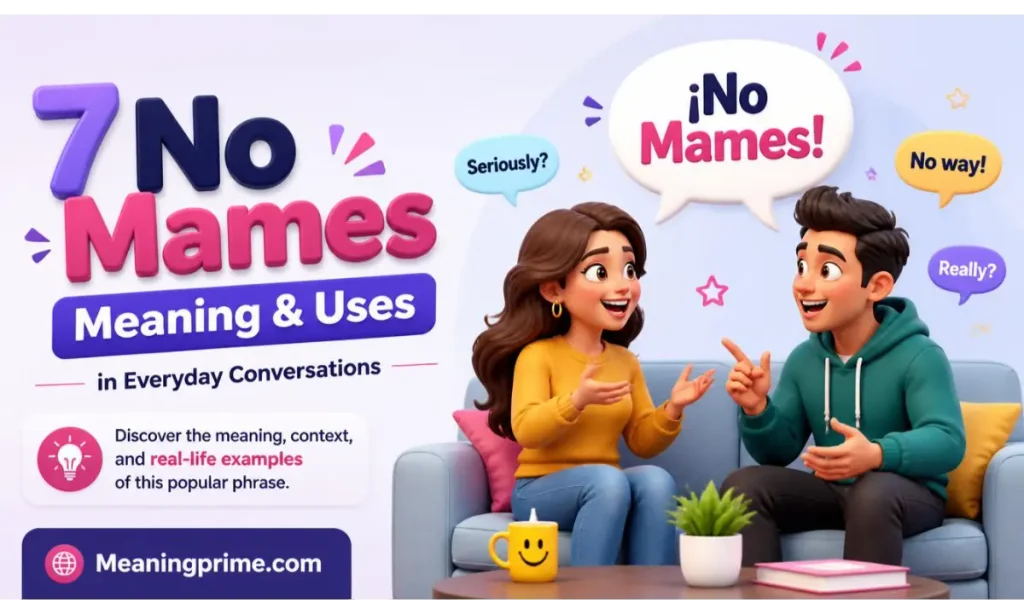
Context decides everything. Here are seven common ways people use the phrase, each with a quick example.
1. No Mames Meaning as Disbelief
Use it when something sounds impossible. It’s the closest match to “no way.”
“Me ofrecieron el trabajo.” “¡No mames!”
(“They offered me the job.” “No way!”)
Notice the pause before the reply. People often say it a beat late, as the news sinks in. That’s classic disbelief.
2. Shock or Surprise
Here the phrase reacts to big news or a wild sight. The voice rises and the eyes widen.
“Mira quién llegó.” “No mames, ¿es él?”
(“Look who showed up.” “No way, is that him?”)
Shock often adds a follow-up question. The speaker wants details right away. That’s why a question trails the phrase here.
3. No Mames Meaning as Annoyance
A flat delivery turns it into a complaint. People use it when something goes wrong.
“Se acabó la batería otra vez.” “No mames.”
(“The battery died again.” “Come on.”)
In annoyance mode, the phrase often stands alone. There’s no follow-up and no smile. It works like a sigh with words.
4. Calling Out a Lie or Exaggeration
Sometimes it means “I don’t buy that.” You say it when a story sounds too big.
“Corrí diez kilómetros en veinte minutos.” “No mames, eso es imposible.”
(“I ran ten kilometers in twenty minutes.” “Come on, that’s impossible.”)
This use usually comes with a raised eyebrow. The speaker challenges the claim without starting a fight. A grin keeps the mood light.
5. Playful Teasing
Between close friends, it works as a friendly jab. A laugh usually follows.
“Pedí pizza con piña.” “No mames, ¿otra vez?”
(“I ordered pineapple pizza.” “Seriously, again?”)
Teasing relies on trust. You’d only say it to someone who knows you’re joking. Otherwise it may sting.
6. Frustration or Disappointment
When plans fall apart, the phrase carries a sigh. It shows you’re let down.
“Cancelaron el concierto.” “No mames, qué mal.”
(“They canceled the concert.” “Ugh, that’s awful.”)
Disappointed versions sound lower and slower. The speaker drags the vowels. A short sigh often comes first.
7. No Mames Meaning as Excitement and Hype
Surprisingly, it can feel positive. When great news lands, people shout it with joy.
“¡Ganamos el campeonato!” “¡No mames, sí!”
(“We won the championship!” “No way, yes!”)
Hype versions sound loud and fast. People often add jumping, laughing, or a string of exclamation marks. Here the no mames meaning turns into pure celebration.
Those seven cases show how flexible the no mames meaning really is. One short phrase carries a whole range of moods.
No Mames Meaning in Texts and Social Media
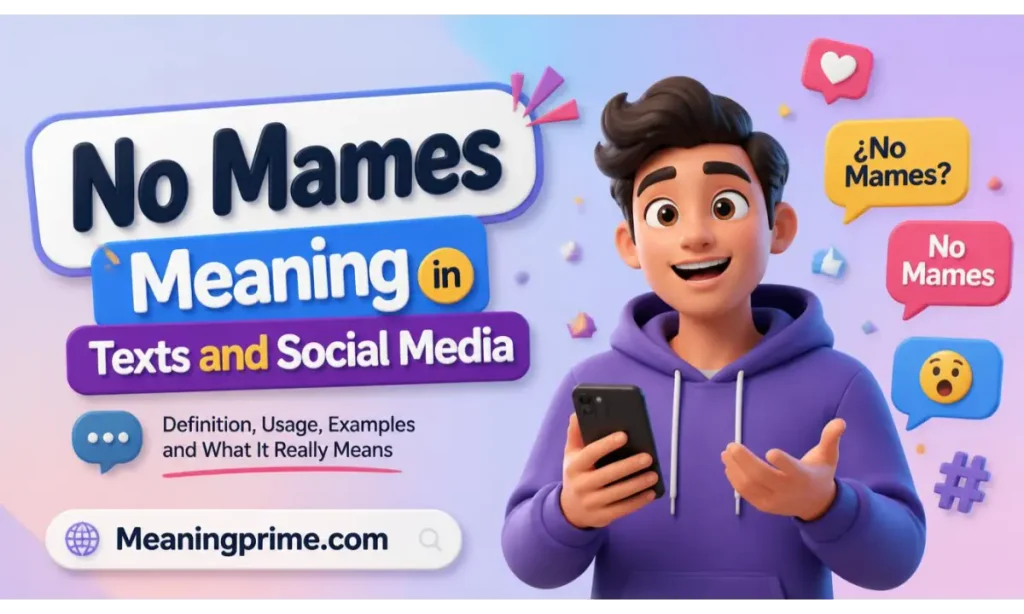
On WhatsApp, Instagram, and TikTok, people shorten and stretch the phrase. You’ll see “nomames,” “no mames wey,” “no mamen,” and “no mameees.” Extra letters add drama. Think of them as a raised voice in written form.
In comments, it often follows a shocking video or a surprising price. A quick “no mames” tells everyone you’re stunned. Creators on TikTok also drop it into captions to set up a punchline. The no mames meaning stays the same online. Only the style changes.
Here’s a texting tip. Pair the phrase with an emoji to set the tone. A laughing face signals play. A flat face signals annoyance. Without one, your message can read harsher than you intend.
No Mames Examples in Real Conversations
Real chats show the phrase better than any definition. This table lists common situations and what each message really says.
| Situation | Message | What It Means |
|---|---|---|
| Friend gets a promotion | “¡No mames, felicidades!” | No way, congrats! |
| Price at the store | “No mames, ¿tan caro?” | Come on, that expensive? |
| Friend tells a tall tale | “No mames, tú no hiciste eso.” | No way, you didn’t do that. |
| Missed the bus | “No mames, otra vez tarde.” | Ugh, late again. |
| Funny meme | “No mames jajaja” | No way, that’s hilarious. |
| Plans canceled | “No mames, qué flojera.” | Come on, what a drag. |
Notice how the meaning shifts from line to line. Each row shows the no mames meaning adapting to the mood. Watch the words around the phrase for clues.
Longer Chat Examples: The No Mames Meaning in Context
Single lines help. Full chats help more. Here are two short exchanges that show the phrase in motion.
Chat 1: Good news
Ana: “Me aceptaron en la universidad.”
Luis: “¡No mames! ¿En serio?”
Ana: “Sí, llegó el correo hoy.”
Luis: “No mames, felicidades.”(Ana: “I got into the university.” Luis: “No way! Seriously?” Ana: “Yes, the email came today.” Luis: “No way, congrats.”)
The phrase appears twice. Both times it expresses joyful disbelief.
Chat 2: Bad news
Sofía: “Perdí mi celular en el metro.”
Marco: “No mames, ¿otra vez?”
Sofía: “Sí, y traía todas mis fotos.”
Marco: “No mames, qué mala suerte.”(Sofía: “I lost my phone on the subway.” Marco: “Come on, again?” Sofía: “Yes, and all my photos were on it.” Marco: “Ugh, what bad luck.”)
Same words. Totally different mood. That contrast sits at the heart of the no mames meaning.
How to Reply When Someone Says No Mames
Your reply depends on the tone. A surprised “no mames” wants confirmation. An annoyed one wants sympathy. A teasing one wants a joke back.
Here are reply ideas you can borrow:
- Confirm it: “Sí, en serio.” (Yes, seriously.) or “Te lo juro.” (I swear.)
- Tease back: “¿Qué pasó? ¿No me crees?” (What’s up? You don’t believe me?)
- Show sympathy: “Ya sé, qué mal.” (I know, that’s awful.)
- Share the story: “Así fue, te cuento.” (That’s how it went. Let me tell you.)
- Match the hype: “¡Sí! ¡Vamos!” (Yes! Let’s go!)
Chatting in English with bilingual friends? Try “Yep, for real,” “I know, right?” or “Believe it.” When you feel unsure, mirror their energy. If they laugh, laugh. If they sigh, sigh. Understanding the no mames meaning helps you read that energy fast.
Short replies work best in text. “Jajaja sí, en serio” keeps things light. “Ya sé, qué mal” shows you care. Long explanations can wait. In fast chats, speed and tone matter more than detail.
No Mames Meaning vs. No Manches and Similar Phrases
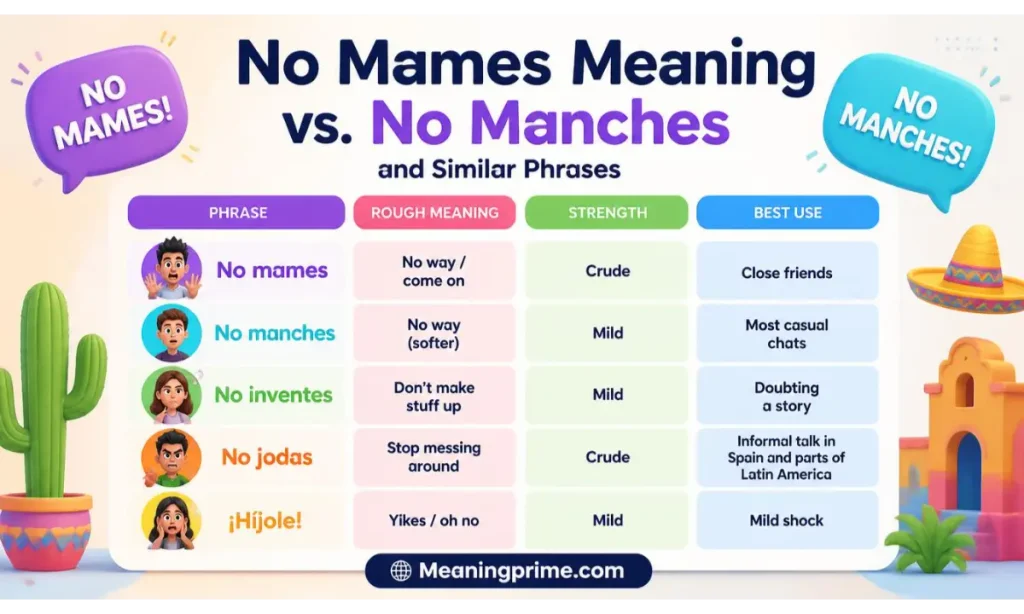
Spanish has plenty of ways to say “you’re kidding.” Some are mild. Others are crude. This table sorts them out.
| Phrase | Rough Meaning | Strength | Best Use |
|---|---|---|---|
| No mames | No way / come on | Crude | Close friends |
| No manches | No way (softer) | Mild | Most casual chats |
| No inventes | Don’t make stuff up | Mild | Doubting a story |
| No jodas | Stop messing around | Crude | Informal talk in Spain and parts of Latin America |
| ¡Híjole! | Yikes / oh no | Mild | Mild shock |
| ¡Órale! | Wow / okay | Mild | Surprise or agreement |
“No manches” is the safe twin. It carries nearly the same punch without the vulgar link. If you don’t know your audience, pick it.
The no mames meaning hits harder and sounds more expressive. Still, both phrases can land the same way in a quick exchange. Context and company make the final call.
No Mames in Memes, Music, and Pop Culture
The phrase thrives online. Mexican meme pages use it as a reaction caption. Comedy sketches, short videos, and casual vlogs use it for quick laughs. Fans copy the style in comments, which keeps the trend rolling.
Music and TV can borrow it too. Creators who aim at younger audiences sometimes include the phrase to sound real. It signals everyday speech. Because of that spread, many non-Spanish speakers meet the phrase before they ever study the language.
Still, fame doesn’t make it formal. Even popular slang keeps its edge. The no mames meaning stays crude no matter how many memes use it.
Is No Mames Offensive? When to Avoid It
It can be. The phrase isn’t a slur. However, it grows from a crude verb. Many people see it as vulgar. Skip it with bosses, teachers, elders, and strangers. Keep it out of work emails and formal chats too.
Among friends, it’s usually fine. Mexican teens, college students, and close coworkers use it freely. If you’re a language learner, listen first. Watch how native speakers use it. Then try it in low-stakes chats. Knowing the no mames meaning helps, but knowing your audience matters more.
Age and region matter too. Younger speakers in big cities tend to shrug it off. Older or more traditional listeners may not. Family settings vary as well. A cousin might laugh while a grandmother winces. When you can’t tell, wait and watch the room.
Here’s a quick guide:
- Usually fine: texting close friends, reacting to memes, casual group chats
- Better to skip: work emails, classrooms, family elders, first meetings
Common Mistakes With the No Mames Meaning
Learners often trip over the same few things. Avoid these and you’ll sound far more natural.
- Using it in formal settings. A polite office chat isn’t the place. Pick “no manches” or “no puede ser” instead.
- Taking it literally. Nobody means “don’t suck.” The literal sense is gone in daily speech.
- Ignoring tone. The same words can mean joy or irritation. Read the mood before you answer.
- Using the wrong form. “No mames” speaks to one person. “No mamen” speaks to a group.
Each slip is easy to fix. A little practice smooths them out.
Tips for Using No Mames Naturally
Want to sound natural? These simple habits help.
- Listen first. Hear how Mexican friends use it before you try.
- Match the volume. A whispered version feels odd in a loud celebration.
- Keep it short. Native speakers rarely add extra words.
- Add a smile or emoji. It protects your tone in text.
- Use it sparingly. Overuse drains the punch.
With time, the no mames meaning will feel like second nature to you.
Where People Use No Mames: Regional Notes and Spelling Variations
Mexico is the phrase’s home turf. You’ll hear it most in Mexico and in Mexican communities across the United States. Mexican TV, music, and memes also spread it to other Spanish-speaking countries. Locals elsewhere may still prefer their own phrases, such as “no puede ser” (it can’t be).
Spelling varies from chat to chat. You’ll see “no mames,” “nomames,” “no mamen,” and “no mames wey.” The word wey roughly means “dude.” Accents and punctuation often vanish in quick texts. The no mames meaning stays steady across all these spellings.
In the United States, bilingual speakers may blend it into English sentences. You might hear “No mames, that’s insane.” The mix feels natural among friends who switch languages.
Quick Cheat Sheet for the No Mames Meaning
Short on time? Use this summary to decode the phrase fast.
| Tone You Hear | Likely Meaning | Smart Reply |
|---|---|---|
| Laughing, high voice | Joyful disbelief | “¡Sí, en serio!” |
| Flat, low voice | Annoyance | “Ya sé, qué mal.” |
| Grin, raised eyebrow | Teasing or doubt | “Te lo juro.” |
| Loud and fast | Excitement | “¡Vamos!” |
| Slow and sighing | Disappointment | “Lo siento, qué mal.” |
Save this table. It captures the no mames meaning in about ten seconds. Then relax and listen for the tone.
Frequently Asked Questions
What is the no mames meaning in English?
It means “no way,” “you’re kidding,” or “come on.” The exact sense depends on tone. It can show shock, doubt, annoyance, or excitement. Context and voice make the difference.
Is no mames a bad word?
It’s crude but not a slur. The phrase grows from a vulgar verb. Many people treat it as casual swearing. Use it only with close friends and skip it in formal settings.
What’s the difference between no mames and no manches?
Both mean nearly the same thing. “No manches” is the softer, safer version. “No mames” carries a stronger and cruder edge. Pick based on your audience.
Can I text no mames to a friend?
Yes, if you two joke around often. Once you know the no mames meaning, add an emoji to set the tone. Avoid it with elders or in work chats.
How do you pronounce no mames?
Say it as “noh MAH-mess.” The stress falls on the first syllable of “mames.” Keep the vowels short and clear. Listening to a native speaker helps a lot.
Conclusion
The no mames meaning boils down to one idea: “I can’t believe it.” Tone then turns that idea into shock, doubt, teasing, annoyance, or joy. You’ve now seen seven common uses and real examples. You’ve also seen how to reply and when to hold back.
Use the phrase with care. Stick to close friends and casual chats. When in doubt, reach for “no manches” and enjoy the conversation. Keep this guide handy the next time a chat lights up with the phrase. You’ll catch the mood quickly and reply with confidence.