
You want a name with a story, not just a sound. Maybe you’ve scrolled through baby-name lists until every option blurred together. Then you spot something like Wulfric or Æthelflæd and wonder, “Wait, that’s a real name?”
It is. This guide shares 35 Anglo-Saxon names with meanings, Old English roots and pronunciation help. You’ll find boy and girl picks, a quick tour of the word-parts behind each name and a clear label for how wearable each one feels today. Whether you’re naming a baby, a character or just feeding a history habit, you’ll find something worth saying out loud.
Quick Answer: Anglo-Saxon names with meanings come from Old English, the language spoken in England before 1066. Most join two word-parts, such as æthel (“noble”) and ræd (“counsel”), to make Æthelred (“noble counsel”). Edward, Alfred and Edith still feel natural today, while Wulfric, Leofrun and Frideswide are rare, bold picks. Below, you’ll find Anglo-Saxon names with meanings for boys and girls, plus easy pronunciation tips.
What Are Anglo-Saxon Names?
The Anglo-Saxons were Germanic settlers (Angles, Saxons and Jutes) who built kingdoms across Britain after Roman rule ended in the early fifth century. Wessex, Mercia and Northumbria became the big players. Their language, Old English, shaped everything from poetry to place names to the way parents named their children.
Anglo-Saxon names with meanings work like tiny sentences. Parents picked two everyday words and fused them, a method scholars call dithematic naming. Take wulf (“wolf”) and ric (“ruler”) and you get Wulfric. Take hild (“battle”) and burh (“fortress”) and you get Hildeburh. These compound names rarely read as perfect phrases. They were wishes for strength, wealth, peace or wisdom.
Families played with the system too. Royal houses treated Anglo-Saxon names with meanings almost like a family crest. King Alfred’s brothers were Æthelbald, Æthelberht and Æthelred, so the æthel- prefix ran through the family like a surname. Alfred himself broke the pattern with ælf-.
Outside influence mattered as well. Viking settlement brought Old Norse names, which is why King Harold’s name likely carried a Scandinavian echo. After 1066, Norman favorites such as William and Robert pushed the old compounds aside. Historians like James Chetwood argue the shift began before the Conquest. A handful of Anglo-Saxon names survived anyway, mostly through kings and saints.
35 Anglo-Saxon Names With Meanings
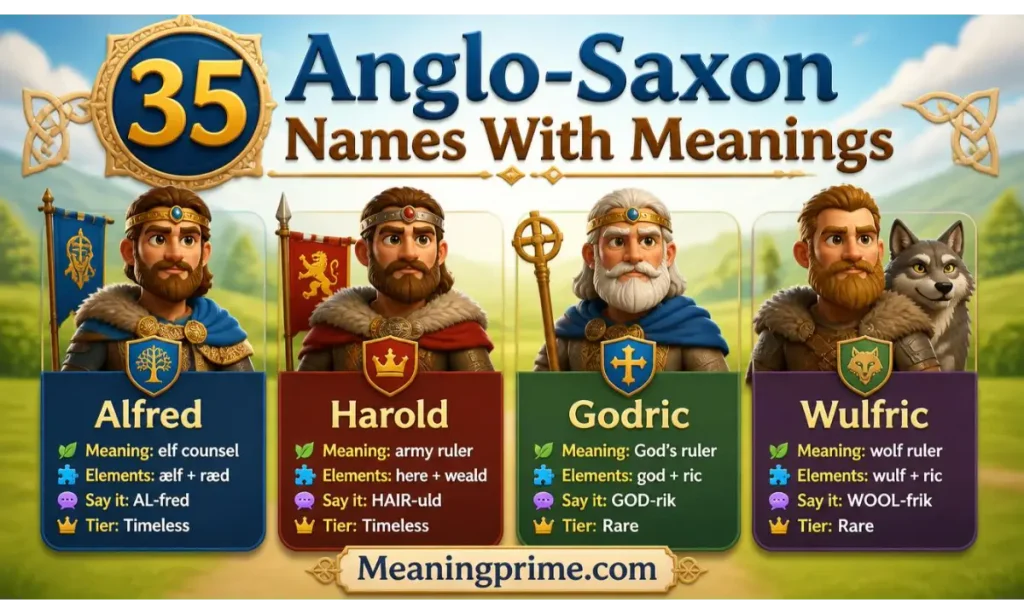
Here are 35 Anglo-Saxon names with meanings, split into 17 boys’ names and 18 girls’ names. Every one of these Anglo-Saxon names with meanings shows the Old English elements, a pronunciation tip and a tier. Timeless names are easy to use today. Rare names are uncommon but wearable. Historic names tie to famous figures and suit adventurous parents.
Alfred
Meaning: elf counsel | Elements: ælf + ræd | Say it: AL-fred | Tier: Timeless
King Alfred the Great defended Wessex against Viking armies and championed learning in English. Nicknames like Alf and Alfie keep it friendly. Few names carry this much history so lightly.
Æthelred
Meaning: noble counsel | Elements: æthel + ræd | Say it: ATH-el-red | Tier: Historic
Æthelred II earned the nickname “Unready,” a pun meaning “poorly advised.” The meaning is lovely. The baggage is real.
Edmund
Meaning: wealthy protector | Elements: ēad + mund | Say it: ED-mund | Tier: Timeless
King Edmund of East Anglia died at Viking hands in 869 and became a saint. The name feels sturdy, classic and refreshingly short.
Edward
Meaning: wealthy guardian | Elements: ēad + weard | Say it: ED-werd | Tier: Timeless
Several Anglo-Saxon kings carried this name, including Edward the Confessor. It never left English use. That means zero explaining.
Harold
Meaning: army ruler | Elements: here + weald | Say it: HAIR-uld | Tier: Timeless
Harold Godwinson, the last Anglo-Saxon king, fell at Hastings in 1066. His name likely blended Old English and Old Norse influence.
Cedric
Meaning: uncertain | Elements: none (literary coinage) | Say it: SED-rik | Tier: Timeless
Heads-up: Sir Walter Scott invented this in Ivanhoe, probably misspelling Cerdic, the founder of Wessex. It sounds Saxon but isn’t a true Old English name.
Godric
Meaning: God’s ruler | Elements: god + ric | Say it: GOD-rik | Tier: Rare
Saint Godric of Finchale lived as a hermit in northern England for decades. Today it feels medieval yet easy to say.
Leofric
Meaning: beloved ruler | Elements: lēof + ric | Say it: LAY-oh-frik | Tier: Rare
Leofric, Earl of Mercia, was the husband of Lady Godiva. A short form like Leo makes it surprisingly wearable.
Oswald
Meaning: divine power | Elements: ōs + weald | Say it: OZ-wuld | Tier: Timeless
King Oswald of Northumbria died in battle in 642 and was later honored as a saint. Ozzy works as a cheerful nickname.
Wulfric
Meaning: wolf ruler | Elements: wulf + ric | Say it: WOOL-frik | Tier: Rare
Germanic culture linked the wolf with fierce loyalty. This one suits parents who want drama in a pronounceable shape.
Beorn
Meaning: warrior | Elements: beorn | Say it: BAY-orn | Tier: Rare
In Old English the word meant “warrior” or “man of rank.” It echoes Old Norse björn (“bear”). Tolkien gave it to a shape-shifting bear in The Hobbit.
Cuthbert
Meaning: famously bright | Elements: cūþ + beorht | Say it: KUTH-bert | Tier: Rare
Saint Cuthbert, bishop of Lindisfarne, died in 687. His nickname Cuddy still lives on in northern England.
Æthelstan
Meaning: noble stone | Elements: æthel + stān | Say it: ATH-el-stan | Tier: Historic
Æthelstan became the first king of all England in the 920s. Spellings like Athelstan or the nickname Stan make it easier.
Hereward
Meaning: army guardian | Elements: here + weard | Say it: HAIR-eh-ward | Tier: Historic
Hereward the Wake led a fenland rebellion against the Normans around 1070. Few names say “resistance” so loudly.
Dunstan
Meaning: dark stone | Elements: dunn + stān | Say it: DUN-stan | Tier: Rare
Saint Dunstan served as Archbishop of Canterbury and died in 988. Stan offers an easy everyday shortcut.
Godwin
Meaning: friend of God | Elements: god + wine | Say it: GOD-win | Tier: Rare
Earl Godwin of Wessex fathered Harold, the last Anglo-Saxon king. Some scholars hear “good friend” instead of “God’s friend.”
Edwin
Meaning: wealthy friend | Elements: ēad + wine | Say it: ED-win | Tier: Timeless
King Edwin of Northumbria ruled in the early seventh century. Nicknames like Ed or Win give it a friendly feel.
Æthelflæd
Meaning: noble beauty (commonly glossed) | Elements: æthel + flæd | Say it: ATH-el-flad | Tier: Historic
Alfred’s daughter ruled Mercia as “Lady of the Mercians” until 918 and fought the Danes. The “beauty” gloss is debated. Her legend isn’t.
Edith
Meaning: wealth and battle | Elements: ēad + gȳð | Say it: EE-dith | Tier: Timeless
Edith of Wessex was queen to Edward the Confessor. The name never vanished. Edie gives it a modern twist.
Eadgifu
Meaning: wealth gift | Elements: ēad + gifu | Say it: AY-ahd-yih-voo | Tier: Historic
Eadgifu of Kent was queen to Edward the Elder and mother of two kings. Try the spelling Edgiva for an easier route.
Ealdgyth
Meaning: old battle | Elements: eald + gȳð | Say it: AY-ald-yooth | Tier: Historic
Ealdgyth married Harold Godwinson. “Old” here probably means “venerable.” Expect a few spelling lessons.
Mildred
Meaning: gentle strength | Elements: milde + þrȳð | Say it: MIL-dred | Tier: Timeless
Saint Mildrith of Minster-in-Thanet died around 700. Her name became Mildred. Millie is its sweetest modern nickname.
Winifred
Meaning: blessed reconciliation | Elements: Welsh Gwenfrewi | Say it: WIN-ih-fred | Tier: Timeless
Not truly Old English. The name is Welsh in origin, though English speakers later linked it to “friend of peace.” Winnie is the classic short form.
Frideswide
Meaning: peace and strength | Elements: friþ + swīþ | Say it: FRIDZ-wide | Tier: Rare
Saint Frideswide, Oxford’s patron saint, died around 727. Almost nobody shares it. Your child would own it.
Hilda
Meaning: battle | Elements: hild | Say it: HIL-da | Tier: Timeless
Saint Hilda ran Whitby Abbey and hosted the Synod of Whitby in 664. Short, strong and vintage-chic. It also works as a middle name for a modern first pick.
Leofrun
Meaning: beloved secret | Elements: lēof + rūn | Say it: LAY-oh-froon | Tier: Rare
Records show several Anglo-Saxon women with this name. Almost no modern parents use it. That’s exactly its charm.
Osburh
Meaning: divine fortress | Elements: ōs + burh | Say it: OZ-burkh | Tier: Historic
Osburh was King Alfred’s mother, who reportedly inspired his love of books. Pronounce the ending with a throaty “kh.” Not easy, yet memorable.
Wulfhild
Meaning: wolf battle | Elements: wulf + hild | Say it: WOOLF-hild | Tier: Rare
Anglo-Saxon noblewomen and nuns carried this fierce pairing. It sounds bold yet stays easy to pronounce.
Godgifu
Meaning: gift of God | Elements: god + gifu | Say it: GOD-yih-voo | Tier: Historic
Godgifu became Godiva, the Mercian noblewoman who, legend says, rode through Coventry. The real woman was a major religious patron.
Cyneburh
Meaning: royal fortress | Elements: cyne + burh | Say it: KIN-eh-burkh | Tier: Rare
Tradition names Cyneburh as a daughter of King Penda of Mercia who became an abbess at Castor. It takes practice but looks lovely in print.
Æthelthryth
Meaning: noble strength | Elements: æthel + þrȳð | Say it: ATH-el-threeth | Tier: Historic
Saint Æthelthryth founded the abbey at Ely and died in 679. Her name gave us Audrey, a ready-made modern option.
Ealhswith
Meaning: temple strength | Elements: ealh + swīþ | Say it: AY-alh-swith | Tier: Historic
Ealhswith, a Mercian noblewoman, married Alfred the Great. The first element means “temple,” a rarity among name parts.
Ælfgifu
Meaning: elf gift | Elements: ælf + gifu | Say it: ALF-yee-voo | Tier: Historic
Several queens used this name, including a wife of King Edmund I. Elgiva is the polished spelling.
Eadburh
Meaning: wealth fortress | Elements: ēad + burh | Say it: AY-ad-burkh | Tier: Rare
Saint Eadburh of Winchester, a daughter of Edward the Elder, lived as a nun. The name feels soft in sound yet sturdy in meaning. Try it as a middle name first.
Mildburg
Meaning: gentle fortress | Elements: milde + burh | Say it: MILD-burkh | Tier: Rare
Saint Mildburg served as abbess of Wenlock and died around 727. Milburga and Milly offer easier routes.
Anglo-Saxon Boy Names (Male Names and Meanings)
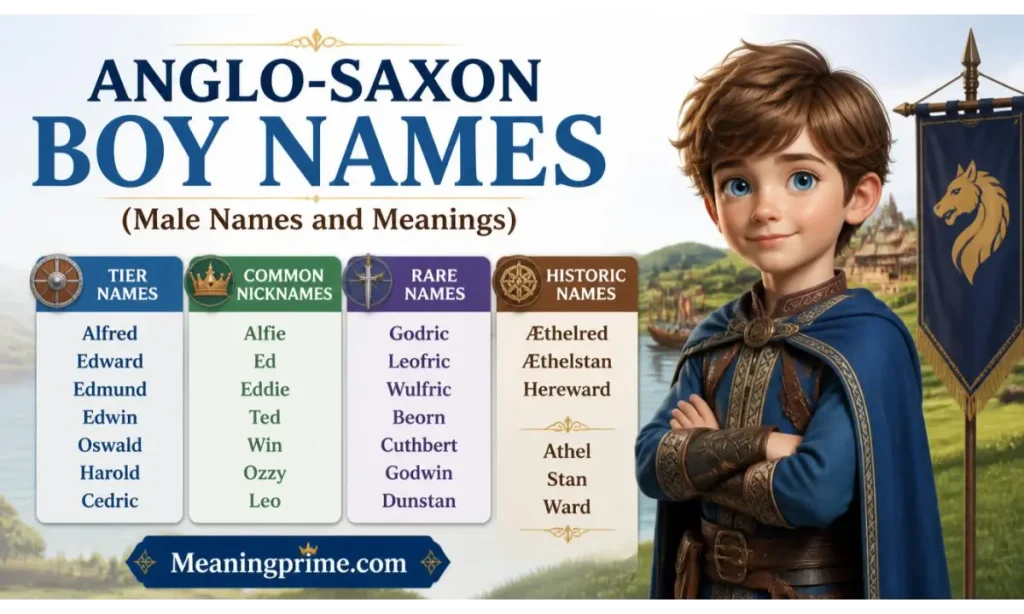
Searching for Anglo-Saxon names with meanings for boys? This tier table pulls all 17 together so you can compare them at a glance.
Anglo-Saxon names with meanings for boys, sorted by tier
| Tier | Names | Common Nicknames |
|---|---|---|
| Timeless | Alfred, Edward, Edmund, Edwin, Oswald, Harold, Cedric | Alfie, Ed, Eddie, Ted, Win, Ozzy |
| Rare | Godric, Leofric, Wulfric, Beorn, Cuthbert, Godwin, Dunstan | Leo, Wulf, Cuddy, Stan |
| Historic | Æthelred, Æthelstan, Hereward | Athel, Stan, Ward |
Pick Timeless if you want familiar and friendly. Choose Rare if you like a name with a little grit. Go Historic only when you love the backstory enough to explain it at every school gate. These Anglo-Saxon names with meanings for boys also pair well with modern middle names.
Anglo-Saxon Girl Names (Female Names and Meanings)
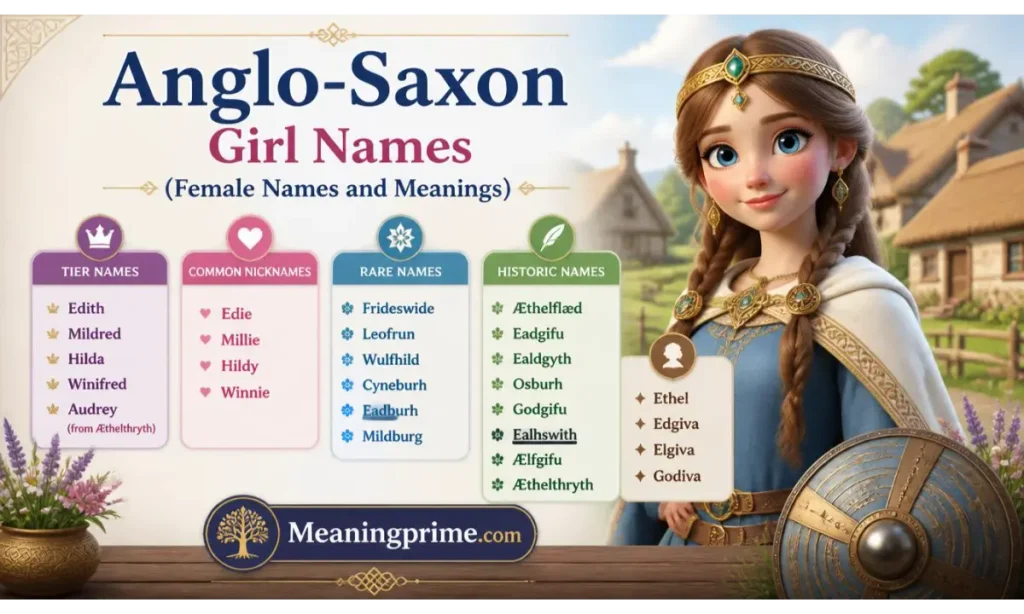
The girl list shows how varied Anglo-Saxon names with meanings can be. Many end in -gifu (“gift”), -burh (“fortress”) or -hild (“battle”). They feel soft and strong at once.
Anglo-Saxon names with meanings for girls, sorted by tier
| Tier | Names | Common Nicknames |
|---|---|---|
| Timeless | Edith, Mildred, Hilda, Winifred, Audrey (from Æthelthryth) | Edie, Millie, Hildy, Winnie |
| Rare | Frideswide, Leofrun, Wulfhild, Cyneburh, Eadburh, Mildburg | Frida, Milly, Hild |
| Historic | Æthelflæd, Eadgifu, Ealdgyth, Osburh, Godgifu, Ealhswith, Ælfgifu, Æthelthryth | Ethel, Edgiva, Elgiva, Godiva |
Want an easy on-ramp? Start with Edith, Hilda or Audrey. Adventurous parents might try Frideswide or Wulfhild. Both groups will find that female Anglo-Saxon names with meanings often tell a story of faith, leadership and loyalty.
Strong and Badass Anglo-Saxon Names
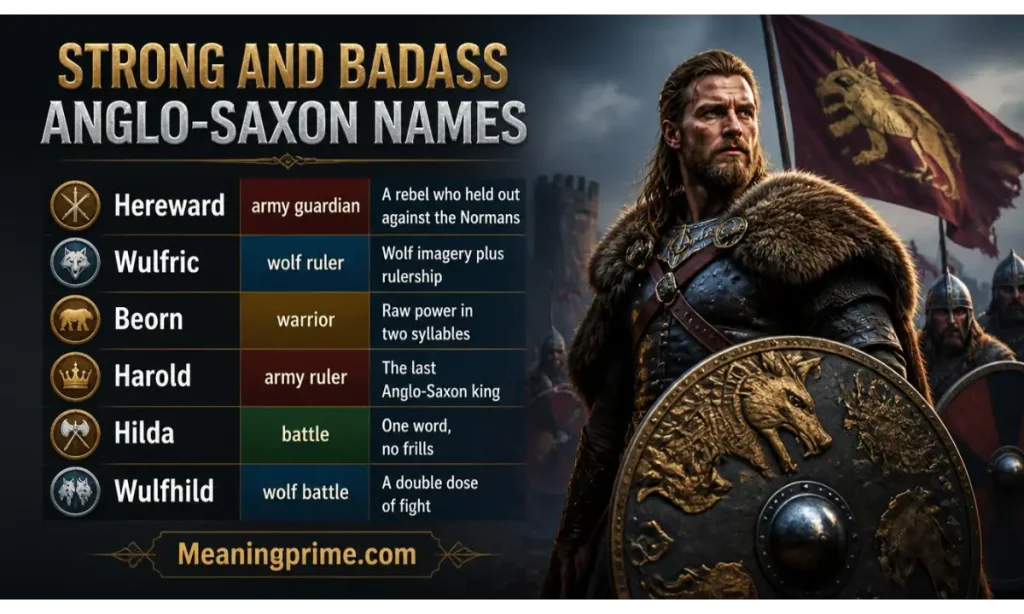
Want a name that sounds like it carries a shield? These are the strongest Anglo-Saxon names with meanings from the list above.
| Name | Meaning | Why It Hits Hard |
|---|---|---|
| Hereward | army guardian | A rebel who held out against the Normans |
| Wulfric | wolf ruler | Wolf imagery plus rulership |
| Beorn | warrior | Raw power in two syllables |
| Harold | army ruler | The last Anglo-Saxon king |
| Hilda | battle | One word, no frills |
| Wulfhild | wolf battle | A double dose of fight |
| Æthelflæd | noble beauty | A queen who led armies |
Strength in Anglo-Saxon names with meanings often came from words for war, wolves and fortresses. Yet fierce names can hide gentleness too, like Mildred’s “gentle strength.”
Rare Anglo-Saxon Names
Most lists recycle Edward and Alfred. If you crave true rarity, try these lesser-known Anglo-Saxon names with meanings.
Rare Anglo-Saxon names for boys:
- Æthelwulf (noble wolf): King Alfred’s father
- Eadwig (wealth and war): a teenage king of England in the 950s
- Ælfheah (high elf): the archbishop later honored as Saint Alphege
- Cenric (bold ruler): an early West Saxon king
- Uhtric (dawn ruler): built on ūht, the pre-dawn hours
- Wynnstan (joy stone): cheerful and compact
Rare Anglo-Saxon names for girls:
- Ælfthryth (elf strength): a tenth-century queen of England
- Leofgifu (beloved gift): sweet and easy to spell
- Hildeburh (battle fortress): a queen in the epic Beowulf
Rare Anglo-Saxon names with meanings need a plan. Offer a nickname and a simpler spelling. You’ll save your child a thousand corrections.
Common Old English Name Elements and Their Meanings
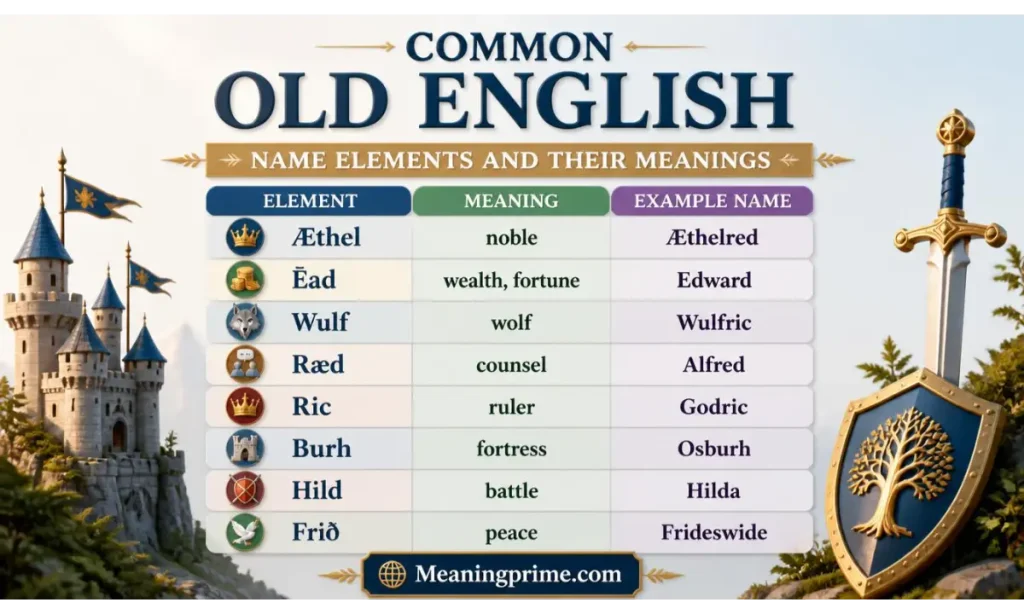
Learn these roots and you can decode almost any Anglo-Saxon name. This table also helps you understand other Anglo-Saxon names with meanings you’ll meet online.
Old English name elements and example names
| Element | Meaning | Example Name |
|---|---|---|
| Æthel | noble | Æthelred |
| Ēad | wealth, fortune | Edward |
| Wulf | wolf | Wulfric |
| Ræd | counsel | Alfred |
| Ric | ruler | Godric |
| Burh | fortress | Osburh |
| Hild | battle | Hilda |
| Frið | peace | Frideswide |
| Lēof | beloved | Leofric |
| Weard | guardian | Hereward |
| Stān | stone | Æthelstan |
| Wine | friend | Godwin |
| Gifu | gift | Godgifu |
| Beorht | bright | Cuthbert |
| Mund | protector | Edmund |
| Þrȳð | strength | Mildred |
You can mix and match, with one caution. Endings like -ric, -weard and -mund usually marked men. Endings like -gifu, -burh and -flæd usually marked women. Prefixes such as æthel-, ēad- and wulf- worked for both. Invented combinations can sound authentic without being real historical names. Treat homemade Anglo-Saxon names with meanings as Old English inspired, and double-check any element before you commit.
Are Anglo-Saxon Names Still Used Today?
Yes, Anglo-Saxon names with meanings live on, just in a quieter way. Edward, Alfred, Edith and Edmund never fully vanished, thanks to royal courts and church calendars. Alfred enjoyed a Victorian revival. Alfie has been a chart regular in England and Wales. Audrey and Ethel are shortened echoes of Anglo-Saxon originals.
Parents keep returning for good reasons. These names are short, sturdy and packed with meaning. Anglo-Saxon names with meanings also appeal to fantasy writers, gamers and history lovers who want authentic character names.
Modern Anglo-Saxon Names for Boys and Girls
Looking for modern Anglo-Saxon names that fit a playground today? These work well right now.
- Boys: Edward, Alfred, Edwin, Oswald, Edmund and Harold
- Girls: Edith, Hilda, Mildred, Audrey, Ethel and Winifred (a Welsh import)
Modern Anglo-Saxon names with meanings tend to be short, familiar and nickname-friendly. They also age well, from toddler to boardroom.
Anglo-Saxon Names vs. Viking Names
People often mix up Anglo-Saxon names with meanings and Viking names, because both love war, wolves and wisdom. The languages differ, though. Anglo-Saxons spoke Old English. Vikings spoke Old Norse. They collided in England between the ninth and eleventh centuries, especially in the Danelaw.
Anglo-Saxon names with meanings compared with Viking names
| Name | Language | Meaning |
|---|---|---|
| Wulfric | Old English | wolf ruler |
| Æthelstan | Old English | noble stone |
| Cnut | Old Norse | knot |
| Sweyn | Old Norse | boy, attendant |
| Ragnar | Old Norse | counsel army |
| Ivar | Old Norse | bow warrior |
Some names are hybrids. Ælfcytel joins Old English ælf with Old Norse kettill. Harold sits in the overlap. Want a cool Viking name? Ragnar and Ivar lead the pack. If you’d like the same tough impression with English roots, Hereward and Beorn deliver.
How to Choose and Pronounce an Anglo-Saxon Name
Choosing from Anglo-Saxon names with meanings is half poetry and half logistics. Say the full name aloud with your surname. Check the initials. Then test it on a stranger at a coffee shop.
Short, familiar picks like Edith, Alfred or Oswald make excellent middle names. They add heritage without forcing every teacher to learn Old English. If you love a harder name, modernize the spelling. Æthel becomes Ethel or Athel, Eadgifu becomes Edgiva and Ælfgifu becomes Elgiva.
A few pronunciation rules cover most names:
- Æ sounds like the “a” in “cat.”
- þ and ð both sound like “th.”
- g before a front vowel often sounds like “y,” which is why -gifu is “yih-voo.”
- h after a vowel can sound throaty, as in -burh.
Anglo-Saxon Nicknames and Short Forms
Nicknames make Anglo-Saxon names with meanings easy to wear. Alfred becomes Alfie. Edward becomes Ed, Eddie or Ted. Mildred turns into Millie, while Edith turns into Edie. Hilda picks up Hildy, while Oswald becomes Ozzy and Leofric shortens to Leo. Cuthbert’s old pet form Cuddy is still charming.
How to Say Hello in Old English
Old English had no exact “hi.” Still, Wes hāl (“be well,” said “wess HAHL”) worked as a greeting. It gave us the word “wassail.” You can also shorten it to Hāl. To grab someone’s attention, Old English poets used Hwæt, which roughly means “listen.”
Frequently Asked Questions
What are some strong Anglo-Saxon names?
Hereward, Wulfric, Beorn, Harold and Oswald top the boys’ list. For girls, Hilda, Wulfhild and Æthelflæd stand out. These Anglo-Saxon names with meanings lean on words like “wolf,” “battle” and “army.”
How do you say “hi” in Anglo-Saxon?
Old English had no exact “hi.” Still, Wes hāl (“be well”) worked as a greeting. You say it “wess HAHL.”
Are Viking names and Anglo-Saxon names the same?
No. Anglo-Saxon names with meanings come from Old English, while Viking names come from Old Norse. The two mixed in England, creating hybrids like Ælfcytel.
What are some modern Anglo-Saxon names?
Edward, Alfred, Edwin and Oswald work well for boys. Edith, Hilda, Mildred and Audrey suit girls. They’re the easiest Anglo-Saxon names with meanings to use today.
Why did most Anglo-Saxon names disappear after 1066?
Norman rulers favored French and biblical names. Parents copied the new elite, and Anglo-Saxon names with meanings slowly lost ground. Historians note the old two-part system was already fading before the Conquest. Only names tied to kings and saints, such as Edward and Edith, held on.
Conclusion
Anglo-Saxon names with meanings do more than sound old. Each one packs a tiny wish about strength, peace or wisdom into a few syllables. From timeless Edward and Alfred to rare Leofrun and Wulfric to historic Æthelflæd, these 35 picks show how much range this tradition holds.
Browse the Anglo-Saxon names with meanings above, choose your tier, test the pronunciation and use the element guide to find the meaning you love. Then say the name out loud ten times. If it still makes you smile, you’ve found your name.