
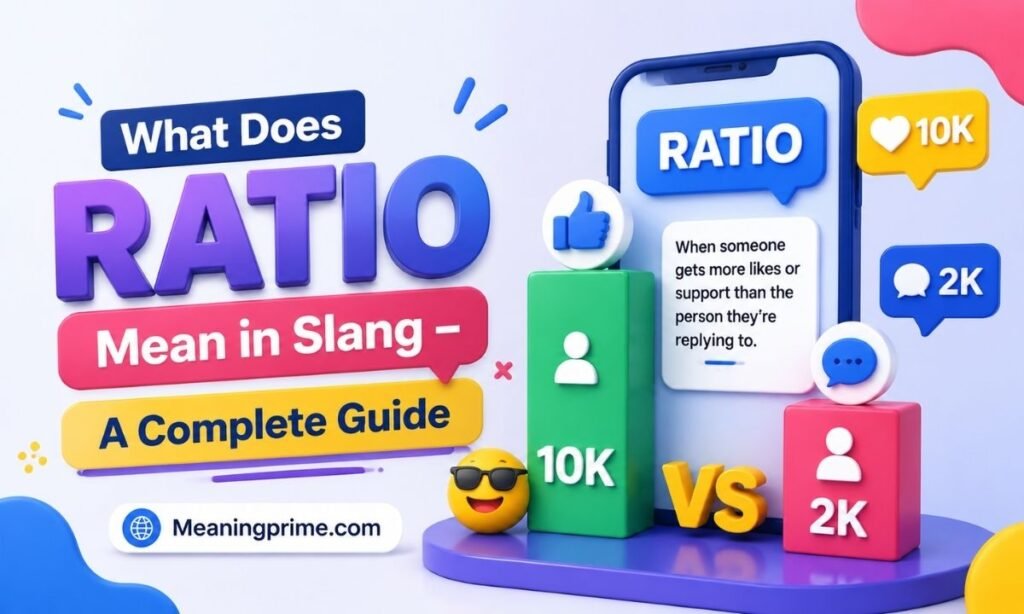

If you’ve ever seen someone comment “ratio” under a post and wondered if they were doing math homework in public, you’re not alone. It’s one of those internet words that looks harmless but actually carries a whole vibe of public judgment behind it. Once you get it, you’ll start noticing it everywhere — group chats, comment sections, even IRL arguments.
This guide breaks down exactly what ratio means, where it came from, and how people actually use it today. We’ll cover everything from the basic math behind it to newer terms like L+Ratio and ratio bait. You’ll also learn how it shows up differently across platforms, and how to tell if you’ve been ratioed yourself. By the end, you’ll be able to use it (or survive it) without embarrassing yourself online.
Quick Answer
“Ratio” means a post or comment got more replies or criticism than likes, which signals it’s unpopular, controversial, or just a bad take. Saying “ratio” to someone is basically telling them their opinion is about to get publicly disagreed with. It started on Twitter/X but now shows up on TikTok, Instagram, and in everyday texting too.
What Does Ratio Mean in Slang?
In slang, ratio describes the balance between a post’s likes and its replies or comments. When the replies pile up faster than the likes do, people say the post “got ratioed,” meaning the crowd showed up to disagree rather than approve. It’s less about actual math and more about vibes — a public scoreboard for whether people liked what you said.
The term works as both a warning and a reaction. Someone might type “ratio” the moment they see a bad take, almost predicting the pile-on before it even happens. Over time it’s grown from a Twitter-only joke into general internet slang used across nearly every platform with a comment section.
The Simple Math Behind a Ratio
Here’s the part most guides skip: a “good” post usually gets way more likes than replies, because liking something takes zero effort while replying takes actual energy. So when replies outnumber likes, it means people cared enough to argue back instead of just approving quietly.
For example, if a tweet gets 40 likes but 900 replies, that’s a heavy ratio — a sign that the internet showed up to push back hard. Compare that to a tweet with 5,000 likes and only 60 replies, which usually means people agreed and moved on without needing to say anything.
Ratio Meaning in Text or DMs
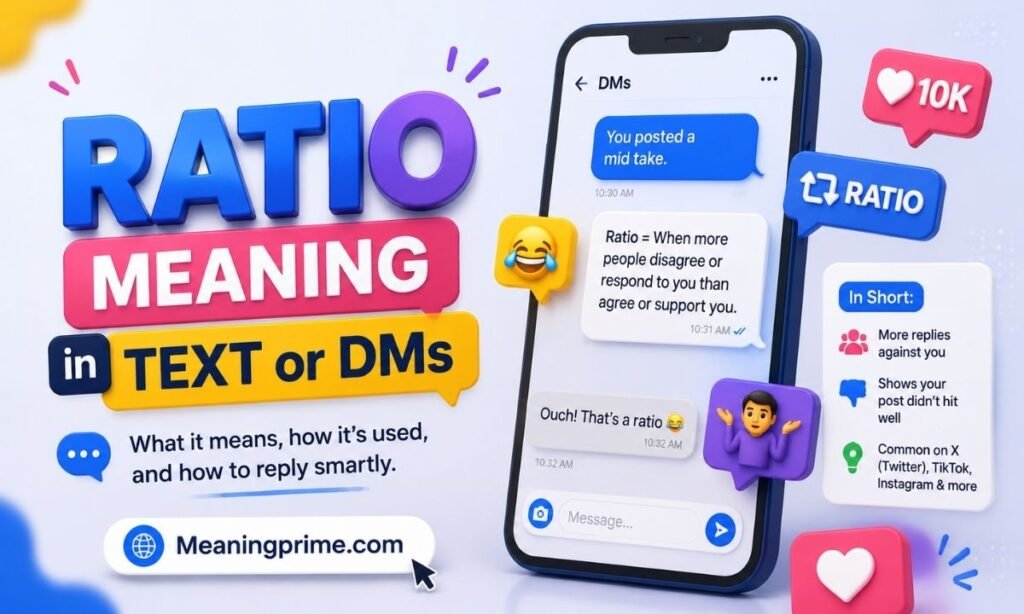
Outside of public posts, “ratio” has jumped into private texting and group chats as a playful jab. If a friend sends a bold opinion, someone might just reply “ratio” as a one-word way of saying “I disagree and so would everyone else.” It doesn’t need actual likes or replies to count — it’s become shorthand for disagreement in general.
In this context, it’s rarely mean-spirited. It’s more like a verbal eye-roll, used to tease a friend for a questionable opinion rather than to genuinely start a fight. The tone almost always depends on who’s saying it and how well you know them.
- “Pineapple on pizza is actually elite.” → “Ratio.”
- “I think Mondays are underrated.” → “Hard ratio.”
- “You’re wrong and I’m ratioing you right now.” → used as a direct callout
Used this way, ratio has basically become a Gen Z version of “nobody agrees with you,” minus the actual numbers.
Ratio Meaning on Social Media
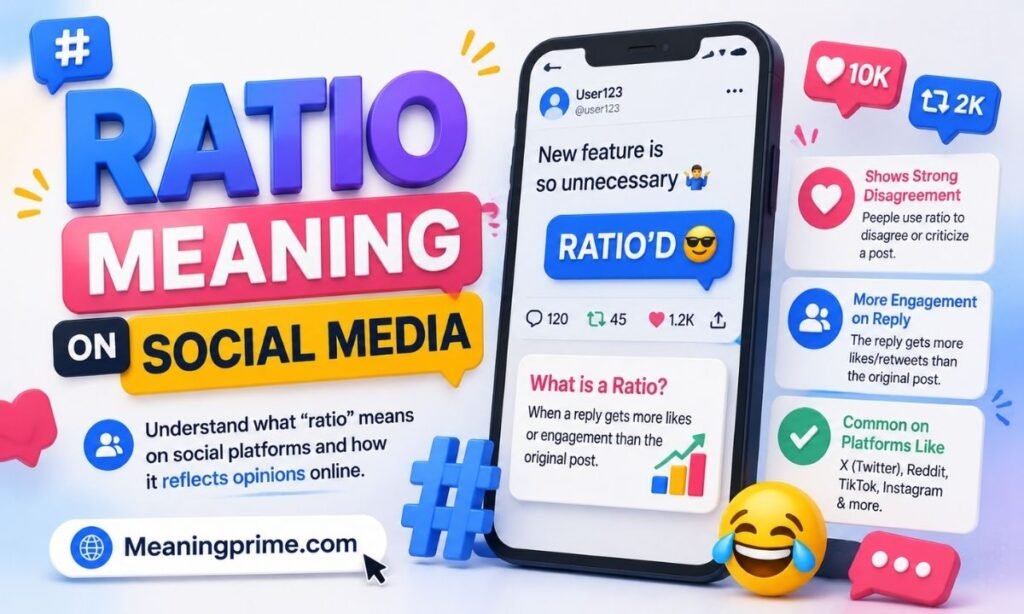
On social platforms, ratio is treated almost like a public verdict. It’s the internet’s way of measuring whether a post landed well or flopped, using visible numbers everyone can see and judge for themselves. That transparency is exactly what makes it feel so personal when it happens to you.
Different platforms show it slightly differently, but the core idea stays the same everywhere: more disagreement-driven engagement than approval-driven engagement.
Ratio on Twitter/X
Twitter/X is where ratio culture was born and where it’s still most intense. A tweet is considered ratioed when its reply count clearly beats its like or repost count, especially if the gap is large. Political tweets, hot takes, and brand statements get ratioed constantly because they attract instant reactions.
Quote-tweets (or quote-posts) count too — if people are quoting a tweet just to mock it, that’s part of the ratio as well. This is also why brands and public figures are extra careful about what they post, since a bad ratio can trend for hours.
Ratio on TikTok, Instagram & Snapchat
On TikTok, ratio usually shows up in the comment section rather than the post itself — a comment that gets more replies than likes is considered “ratioed” by the community. Instagram works similarly, especially under controversial photos or captions where people flood the replies to disagree.
Snapchat doesn’t have public like/reply counts the same way, so ratio culture is weaker there, but it still gets used jokingly in story replies or group chats when someone posts a questionable opinion.
What Does Ratio Mean in an Argument or Debate?
Outside social media, people now use “ratio” during real arguments — online or even spoken aloud among friends — to mean “the majority disagrees with you.” If someone makes a claim during a group debate and everyone pushes back at once, someone might jokingly say “that’s a ratio” to sum up the vibe.
It works as informal social proof: the idea that if enough people push back on an opinion, that opinion is probably weak or unpopular. It’s not a factual argument, just a way of pointing out that the room (or the comment section) has spoken.
Ratioed or Ratio’d — Where It Came From
Both spellings mean the same thing, and you’ll see them used interchangeably. “Ratioed” is more common in writing, while “ratio’d” shows up often in memes and casual typing because it mimics how people abbreviate other slang.
The term traces back to March 2017, when a Twitter user pointed out that if a tweet’s reply-to-repost ratio crossed roughly 2:1, something had gone wrong for the poster. Weeks later, writer Luke O’Neil expanded on the idea in an Esquire piece about “The Ratio,” which helped the term spread beyond a small circle of Twitter users. It picked up serious momentum again around 2020, when fan communities (“stans”) started using it as a tool to publicly challenge accounts they disagreed with, and it’s been part of everyday internet vocabulary ever since.
What Does “Holy Ratio” Mean?
“Holy ratio” is just an exaggerated, dramatic version of calling out a ratio — similar to saying “holy cow” but for internet disasters. People use it when a post gets an extremely one-sided reply-to-like gap, way beyond a normal ratio.
It’s meant to be funny rather than serious, almost like narrating the scene as it unfolds. You’ll usually see it as a standalone comment, screenshotted alongside the ratioed post as a reaction.
Ratio Meme Meaning
As a meme, “ratio” is often used as a dismissive one-word reply to shut down an opinion, regardless of whether an actual reply count is involved. It’s become a meta-joke — people reply “ratio” even on posts with barely any engagement, just to be funny.
Meme culture has also spawned combo replies like “ratio + fell off + L,” stacking multiple insult-memes into one comment for comedic effect. None of it is meant to be taken literally; it’s internet theater more than genuine criticism.
Modern Ratio Vocabulary
Ratio has spawned its own mini-vocabulary that’s worth knowing if you want to actually keep up in comment sections.
| Term | Meaning |
| Ratioed | A post got more replies/criticism than likes |
| Ratio’d | Same meaning, alternate spelling |
| L+Ratio | “You lost the argument AND got ratioed” — a combo insult |
| Ratio bait | A post made deliberately controversial to attract a ratio |
| Win the ratio | When your reply outperforms the original post |
L+Ratio
“L+Ratio” combines two insults into one: “L” means “loss,” and “ratio” adds the public disagreement on top. It’s typically used to pile on someone who’s already losing an online argument, treating it as a final mic-drop line rather than a genuine debate point.
Ratio Bait
Ratio bait describes content posted specifically to provoke outrage and rack up replies, often by creators who don’t actually care about the negativity. Since replies still count as engagement, some accounts intentionally post unpopular takes just to boost visibility through the algorithm.
Tone Variations of Ratio
The word can shift meaning completely depending on tone, so context always matters more than the word itself.
Funny: “I’m the greatest gamer alive.” / “Ratio incoming.” / “We’ll see.”
Sarcastic: “I forgot my keys again.” / “Wow, ratio yourself.”
Romantic: “I’m always right, babe.” / “Ratio.” / “Rude, but fair.”
Angry: “Your comment was out of line.” / “You got ratioed for a reason.”
Playful: “Tea is better than coffee.” / “Ratio, no debate.”
Reading the room matters here — the exact same word can feel like a joke between friends or genuinely dismissive depending on who says it and how.
Grammar — How to Use “Ratio” Correctly
Ratio can function as a noun (“that tweet was a total ratio”) or as a slang verb (“you got ratioed”). As a verb, it almost always appears in past tense with “-ed,” since you’re describing something that already happened to a post.
It’s strictly informal, so it doesn’t belong in professional emails, school assignments, or formal writing. Save it for texting, comment sections, and casual conversations with people who already know internet slang.
How to Tell If You Got Ratioed (and What to Do)
You’ve likely been ratioed if your reply or comment count is noticeably higher than your like count, especially if people are quoting your post just to disagree. A flood of notifications from strangers, rather than your usual followers, is another clear sign.
If it happens, the best move is usually to stay calm rather than argue with every reply — engaging more often just extends the ratio’s lifespan. Deleting the post, muting notifications for a bit, or simply letting it fade out are all reasonable ways to handle it.
Is Ratio Rude or Safe to Use?
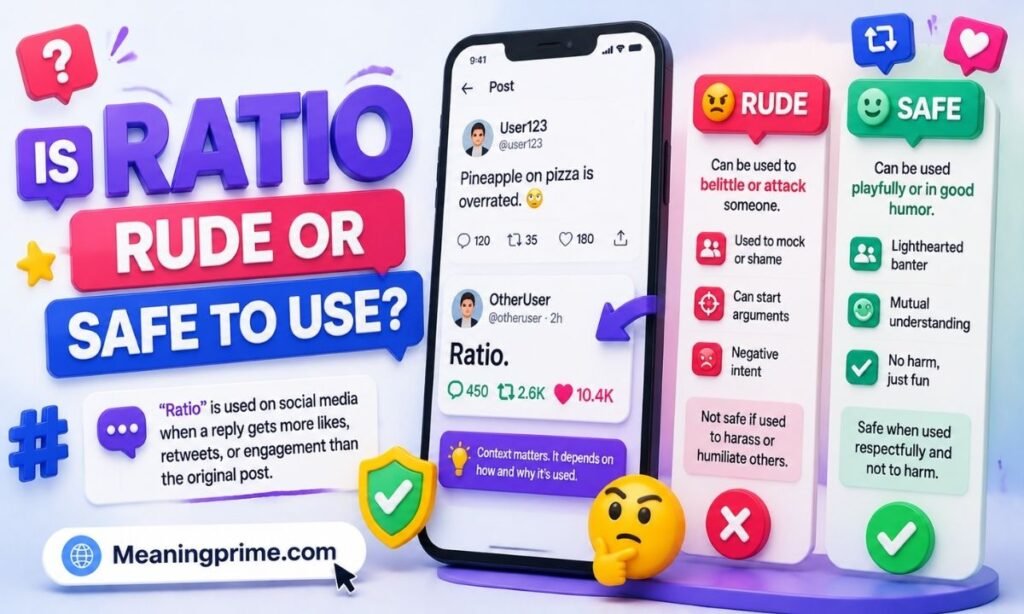
Ratio itself isn’t a slur or a banned word — it’s considered pretty mild as far as internet slang goes. It can still feel dismissive or mocking depending on tone, so it’s worth reading the situation before typing it.
It’s completely safe to use with friends or in casual online spaces, but it’s best avoided in formal settings like school assignments, workplace chats, or professional social media accounts.
Ratio vs. Similar Slang Terms
| Term | Meaning | Formality | Where It’s Used |
| Ratio | More replies/criticism than likes | Informal | Twitter/X, TikTok, Instagram |
| Roasted | Harshly teased or mocked | Informal | Anywhere, verbal or online |
| Clapped back | Fired back with a sharp reply | Informal | Comment sections, texting |
| L | A loss or failure | Informal | Gaming, memes, comments |
| Cooked | Done for, in trouble | Informal | TikTok, group chats |
FAQs
What is ratio in Gen Z slang?
It means a post got more disagreement (replies/comments) than approval (likes), signaling it was unpopular.
What is ratio insult?
It’s used as an insult to say someone’s opinion is unpopular or that they’re publicly losing an argument.
Why are people saying ratio?
They’re either predicting or pointing out that a post is getting more pushback than support.
What does it mean when you say ratio?
You’re telling someone their post or opinion is likely to get more criticism than approval.
What does ratio mean in text or DMs?
It’s used casually to disagree with a friend’s opinion, even without actual like or reply counts involved.
Conclusion
At its core, ratio is just the internet’s way of keeping score on public opinion — more replies than likes means the crowd pushed back instead of agreeing. It started as a Twitter-specific joke in 2017 but has since spread into everyday texting, TikTok comments, and even real-life arguments among friends.
It’s not a bad word or an insult with real weight behind it, just casual internet slang that thrives on tone and context. Use it lightly with people who get the reference, skip it in formal settings, and you’ll never get caught off guard by it again.