

You’ve seen the acronym in a caption, a TikTok comment, or maybe someone used it to describe a friend’s whole vibe, and now you’re stuck wondering what it actually means. Is it a compliment? A stereotype? Something you shouldn’t repeat without knowing the backstory?
That confusion is fair, because ABG slang carries more history than a quick Google definition usually gives it credit for. This guide breaks down what ABG actually means, where it came from, what the aesthetic looks like today, and how to use the term without stepping on anyone’s toes.
Quick Answer
ABG stands for “Asian Baby Girl,” a slang term describing a bold, confident fashion and lifestyle aesthetic tied to Asian American youth culture. It covers a specific look (think sharp winged eyeliner, lash extensions, streetwear-meets-glam outfits) as well as a nightlife-forward personality type. The term can be used as playful self-identification or, depending on who’s using it and how, as a flattening stereotype.
ABG Slang Meaning — What Does ABG Mean?
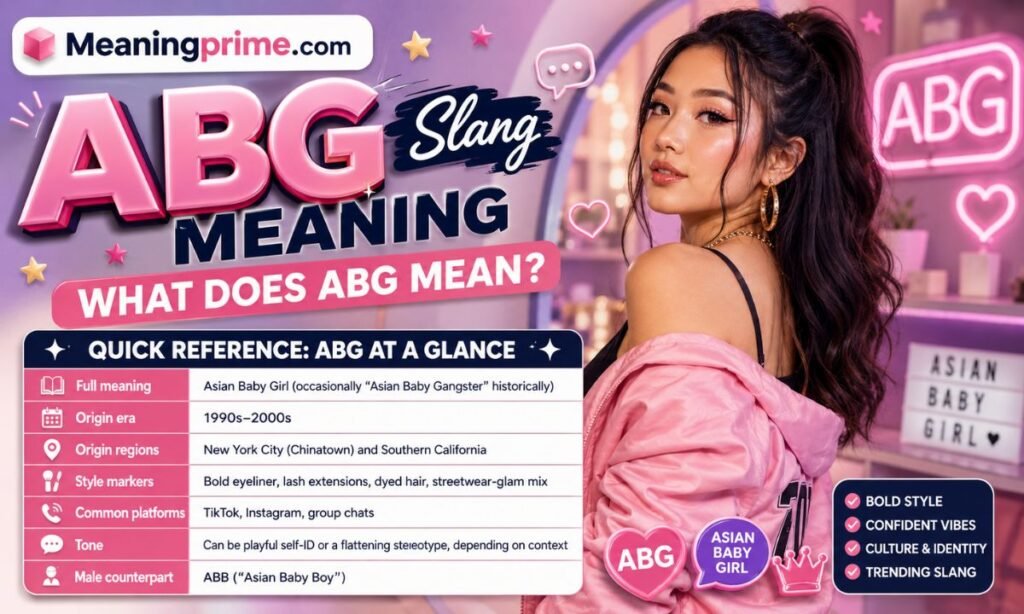
At its core, ABG slang meaning points to “Asian Baby Girl.” It’s a label that started inside Asian American communities to describe young women with a distinct style: dyed or balayage hair, dramatic makeup, and an outgoing, party-ready energy that pushed back against quieter, more reserved stereotypes often placed on Asian women.
There’s also an older, edgier layer to the term. Some early usage tied ABG to “Asian Baby Gangster,” referencing rougher subcultures in Asian American nightlife and street scenes decades before the softer, fashion-focused version took over. Today, when people ask what is ABG mean in casual conversation, they’re almost always talking about the aesthetic, not the gang-adjacent origin story.
Quick Reference: ABG at a Glance
| Category | Details |
| Full meaning | Asian Baby Girl (occasionally “Asian Baby Gangster” historically) |
| Origin era | 1990s–2000s |
| Origin regions | New York City (Chinatown) and Southern California |
| Style markers | Bold eyeliner, lash extensions, dyed hair, streetwear-glam mix |
| Common platforms | TikTok, Instagram, group chats |
| Tone | Can be playful self-ID or a flattening stereotype, depending on context |
| Male counterpart | ABB (“Asian Baby Boy”) |
Where Did the ABG Aesthetic Come From?
The ABG slang meaning you see online today didn’t start on TikTok. The look traces back to the 1990s, with roots in New York’s Chinatown, where young Asian American women developed an alternative, edgy style as a direct response to the “quiet, obedient” stereotype that older generations and mainstream media had assigned them. Dramatic makeup and daring hairstyles became a way to claim space rather than shrink into it.
Around the same time, a parallel scene grew on the West Coast. Southern California’s rave culture and import-car scene (the world of tuner magazines and car-show models) gave rise to a bolder, nightlife-heavy version of the aesthetic. Some of that early style also drew from Japanese gyaru fashion, which similarly rejected conventional beauty standards through tanned skin, bleached hair, and heavy makeup.
By the 2010s, the term had crossed from niche subculture into wider internet slang. Facebook groups like “subtle asian traits” gave Asian diaspora communities a shared space to joke about, celebrate, and debate the ABG label, and YouTube tutorials on “how to look like an ABG” turned the aesthetic into something people could actively learn and try on. That’s the version of the term most people encounter now.
What Is an ABG Girl? The ABG Aesthetic Explained
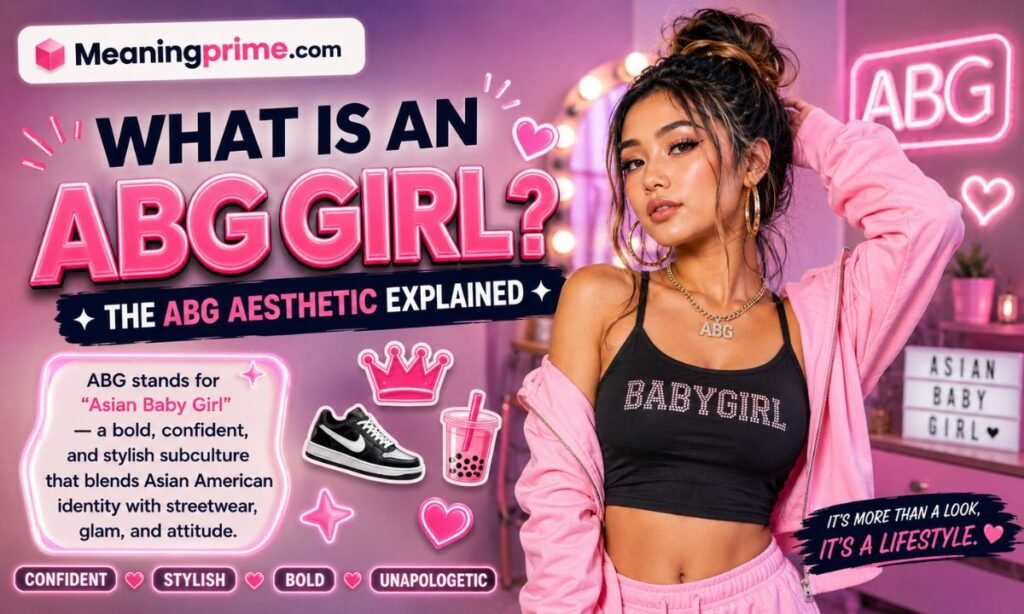
So what does that look like in practice? If someone asks what is an ABG girl, they’re usually picturing a fairly specific set of style choices, not just a personality trait.
Common ABG aesthetic markers include:
- Sharp, winged eyeliner and thick lash extensions
- Dyed or balayage hair, often in warm or bold tones
- Streetwear pieces mixed with glam accessories (think a graphic hoodie paired with statement jewelry)
- A confident, extroverted social presence, both online and in person
- A strong association with nightlife, raves, and boba culture
None of these traits are exclusive to any one person, and plenty of people who fit the look wouldn’t describe themselves using the label at all. The ABG aesthetic is really a shorthand for a recognizable style, not a rulebook anyone has to follow.
ABG in Today’s Internet Culture
On social media, ABG slang now functions less like a rigid definition and more like a vibe descriptor. People use it to caption a night-out photo, tag an outfit, or jokingly call out a friend who’s leaning into the aesthetic that week.
It shows up in a few recurring ways:
- Self-identification — someone owning the label as part of their personal style
- Compliment or tease — friends using it to describe each other’s fits or energy
- Content trend — “ABG makeover” or transformation videos on TikTok and Instagram
ABG in a Sentence (Real Usage Examples)
- “Her makeup tonight is giving full ABG energy.”
- “Ngl I went full ABG mode for the concert.”
- “That’s such an ABG fit, I love it.”
Meet ABB — The Male Counterpart
Less commonly known, but worth mentioning: ABG has a male equivalent called ABB, short for “Asian Baby Boy.” It follows a similar pattern, describing a stylized, confident look and social energy among young Asian American men, often tied to streetwear, car culture, or a similar nightlife scene. It’s used far less often than ABG, but you’ll still spot it in the same online spaces.
Is ABG Slang Offensive? Self-Expression vs. Stereotype
This is the question that actually matters most, and it doesn’t have a one-line answer. Whether ABG slang lands as fun or offensive depends heavily on context.
When someone from the Asian American community uses ABG to describe their own style, it’s generally read as self-expression, even reclaiming a label that used to carry more judgment. The tricky part comes when the term gets used to flatten a whole group of people into one stereotype, treating every Asian woman with winged liner and highlighted hair as somehow the same “type.”
A few things worth keeping in mind:
- Self-ID is different from labeling someone else. Calling yourself an ABG is your call. Slapping the label on someone without knowing them can feel reductive.
- Tone matters. Using it as a lighthearted style descriptor lands differently than using it to mock or dismiss someone.
- Origin awareness helps. Knowing the term grew out of real cultural pushback against older stereotypes makes it easier to use respectfully.
There’s genuine, ongoing debate within Asian American communities about whether the aesthetic itself pushes back against old stereotypes or accidentally creates a new one. Both readings show up in real conversations, and that nuance is worth holding onto rather than flattening into a simple yes-or-no answer.
ABG vs. Similar Internet Aesthetics
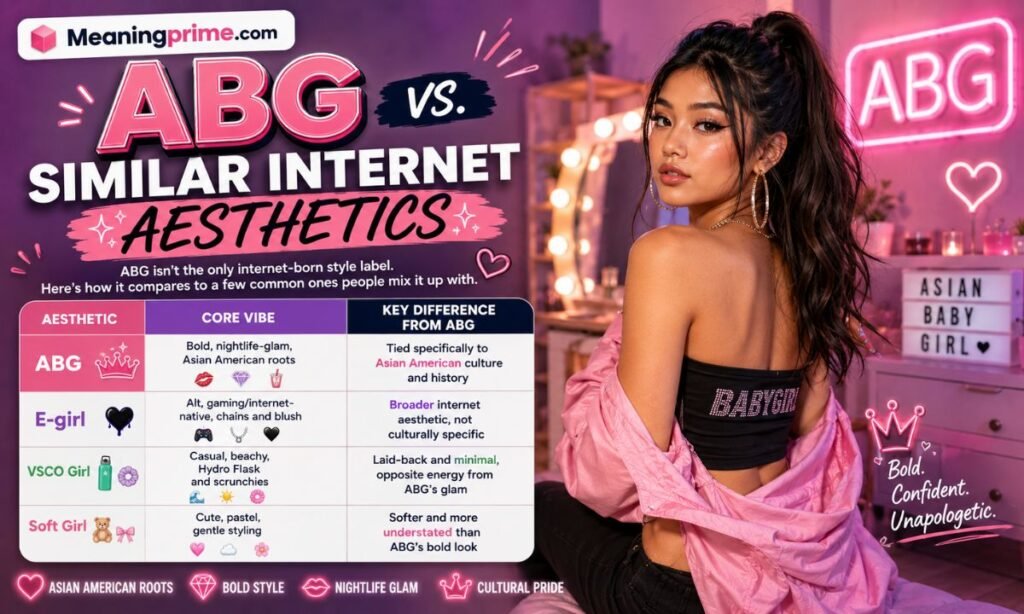
ABG isn’t the only internet-born style label. Here’s how it compares to a few common ones people mix it up with.
| Aesthetic | Core Vibe | Key Difference from ABG |
| ABG | Bold, nightlife-glam, Asian American roots | Tied specifically to Asian American culture and history |
| E-girl | Alt, gaming/internet-native, chains and blush | Broader internet aesthetic, not culturally specific |
| VSCO Girl | Casual, beachy, Hydro Flask and scrunchies | Laid-back and minimal, opposite energy from ABG’s glam |
| Soft Girl | Cute, pastel, gentle styling | Softer and more understated than ABG’s bold look |
ABG Meaning Medical — And Other Non-Slang Definitions
Outside of slang, ABG has a couple of completely unrelated meanings you might run into. In healthcare, ABG stands for Arterial Blood Gas, a common test that measures oxygen and carbon dioxide levels in someone’s blood. In military and aviation contexts, ABG can refer to an Air Battle Group. Neither of these has any connection to the slang usage. Context (a hospital chart versus a TikTok caption) makes it obvious which one you’re dealing with.
FAQs
What is the ABG stereotype?
The ABG stereotype describes Asian American women assumed to fit a specific look and personality: bold makeup, dyed hair, and an outgoing, nightlife-loving energy. It started as a way to push back against older, more restrictive stereotypes, but it can itself become limiting when applied too broadly.
What does ABG mean in slang terms?
In slang, ABG stands for “Asian Baby Girl,” referring to a fashion aesthetic and personality type associated with Asian American youth culture, especially nightlife and social media style.
What does an ABG girl look like?
Typically, sharp eyeliner, lash extensions, dyed or balayage hair, and a streetwear-meets-glam outfit style, paired with a confident, socially active presence.
What does “baddie ABG” mean?
It combines two aesthetic labels — “baddie” (a bold, done-up, confident look popular across many communities) and ABG — to describe someone whose style leans extra glam and polished within the ABG aesthetic specifically.
What does ABG stand for in slang?
ABG stands for “Asian Baby Girl.” Some early, less common usage also tied it to “Asian Baby Gangster,” though that meaning has largely faded from everyday use.
Is ABG slang offensive?
Not inherently. It depends on context, tone, and who’s using it. Self-identification is generally seen as fine, while using it to stereotype someone based only on their appearance can come across as reductive or disrespectful.
Where did the ABG aesthetic actually originate?
It traces back to the 1990s, with roots in New York’s Chinatown and a parallel scene in Southern California’s rave and import-car culture, with some style influence from Japanese gyaru fashion.
What’s the difference between ABG and ABB?
ABG (“Asian Baby Girl”) describes the aesthetic among young women, while ABB (“Asian Baby Boy”) is the less commonly used male counterpart with a similar style and energy.
Can non-Asian people use the term ABG?
People outside Asian American communities do use the term online, but it’s worth knowing its cultural roots first. Using it to describe the aesthetic thoughtfully is different from applying it carelessly to label someone.
Conclusion
ABG slang isn’t just a TikTok buzzword that popped up out of nowhere. It’s a term with real roots in Asian American communities, born out of pushing back against older, narrower stereotypes and building something bolder and more visible instead.
Like most slang tied to a specific culture, how it lands depends on who’s saying it and why. Understanding the history behind ABG makes it a lot easier to use the term the way it was meant: as a nod to a real aesthetic and community, not a shortcut for making assumptions about someone.