

You’re in a group chat with an Australian friend, and out of nowhere they call you a “drongo.” Your stomach drops for a second. Did you just get insulted? Should you be offended, or is this some weird form of affection you haven’t cracked the code on yet?
Here’s the good news: you’re not overthinking it, but you’re also not in trouble. Australian slang insults work on a completely different logic than insults do almost anywhere else, and once you get the hang of it, you’ll actually start using them yourself without sounding like you’re reading off a cheat sheet.
Quick Answer
Most Australian slang insults, like “drongo,” “bogan,” or “galah,” aren’t meant to wound. They’re a form of playful teasing used between friends to show familiarity and humor. Tone, relationship, and setting decide whether a word is a joke or a genuine jab, not the word itself.
Aussie Insults Aren’t Always Insults — Here’s the Real Rule
Australians grew up on a steady diet of teasing. Calling your mate an idiot for locking his keys in the car isn’t cruelty; it’s basically a greeting. The rule of thumb is simple: if the delivery is relaxed and there’s a grin behind it, you’re being included, not attacked.
Strangers are a different story. A word that sounds like harmless Australian slang among mates can land as genuinely rude coming from someone you’ve just met. Context does most of the heavy lifting here, and reading it correctly is the actual skill, not memorizing definitions.
The Aussie Insult Severity Scale
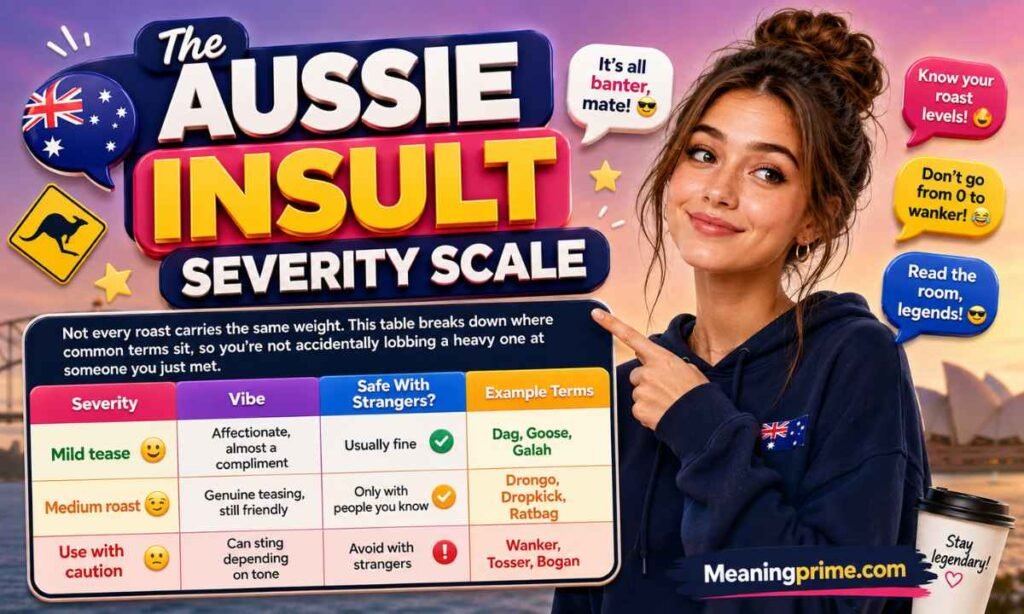
Not every roast carries the same weight. This table breaks down where common terms sit, so you’re not accidentally lobbing a heavy one at someone you just met.
| Severity | Vibe | Safe With Strangers? | Example Terms |
| Mild tease | Affectionate, almost a compliment | Usually fine | Dag, Goose, Galah |
| Medium roast | Genuine teasing, still friendly | Only with people you know | Drongo, Dropkick, Ratbag |
| Use with caution | Can sting depending on tone | Avoid with strangers | Wanker, Tosser, Bogan |
10 Aussie Slang Insults You’ll Actually Hear
These are the ones that show up constantly in real conversation, not the obscure ones nobody actually says out loud anymore.
Drongo
means someone who’s done something a bit silly. “You left the oven on again? You absolute drongo.” Practically a term of endearment once you’re friends.
Bogan
describes a rough-around-the-edges lifestyle: old cars, loud music, zero pretension. Fine among mates; aimed at a stranger it can feel classist.
Galah borrows its name from a noisy pink cockatoo and means someone loud or foolish. “You spilled your drink again, you galah” is about as gentle as it gets.
Dropkick
labels someone useless or lazy in a moment, usually said with an eye-roll rather than real anger.
Wanker
is stronger stuff, reserved for someone arrogant or full of themselves. Best kept for venting about someone else, not said to their face unless you’re both in on it.
Tosser
sits near wanker, someone self-important and a bit much. Blunt, so timing matters.
Dag
might be the most affectionate insult here. It means socially awkward in an endearing way, the kind of thing you’d call someone you adore.
Ratbag
describes a mischievous troublemaker, often a kid or mate who’s pulled a harmless prank. Leans nostalgic, rarely harsh.
Goose
is pure gentle mockery. Mismatched shoes or a forgotten umbrella earns you this one.
Gronk
is a newer favorite online, meaning someone acting clumsy or clueless. Popular in gaming chats and group texts.
Bonus Round — Aussie Insult Idioms & Similes
Single words aren’t the whole story. Australians also love stacking insults into wildly specific comparisons, and this is where the real creativity lives.
- “Useless as an ashtray on a motorbike” — completely pointless
- “A few snags short of a barbie” — not the sharpest tool in the shed
- “Flat out like a lizard drinking” — impossibly busy, sometimes used sarcastically about someone doing nothing
- “A book short of a library” — a gentler way of calling someone a bit dim
- “Mad as a cut snake” — acting erratic or unpredictable
These idioms rarely feel mean because they’re too absurdly specific to take seriously. That’s the whole point of Aussie slang phrases like these.
It’s Not All Roasts — Aussie Slang for Girls & Compliments
Not every bit of Aussie slang aimed at people is a jab. There’s a whole vocabulary for the opposite end of things too.
For women, “sheila” is an old-school, slightly dated term, while “legend” and “champion” get used for anyone who’s done something great. Calling someone a “spunk” means you think they’re attractive. “Deadly,” borrowed from Aboriginal English, means genuinely excellent. For a pretty girl, “she’s a stunner” lands warmly without sounding forced.
Australian slang swings just as hard toward warmth as toward teasing, often in the same conversation.
How to Tell If You’re Being Roasted or Actually Insulted
There’s a genuine skill to reading this correctly, and it comes down to four things.
Listen to the tone. Relaxed and amused signals a joke; flat or sharp is a warning sign.
Consider the relationship. Close friends get away with almost anything; strangers have a much smaller window.
Read the setting. A pub with mates is a different world than a work meeting or a first date.
Watch what happens next. Smiling and the conversation still flowing means you’re fine. A cold shift is your cue to dial it back.
How to Roast Back Like a Local
Once you’re confident you’re being teased rather than attacked, the polite move is often to give a little back. This is where Australian slang really comes alive as a social skill instead of just vocabulary.
Keep your comeback light and quick. If someone calls you a drongo, a simple “takes one to know one” or a mild insult right back usually lands well. The goal isn’t to win, it’s to keep the banter moving. Overthinking it reads as more awkward than getting the wording slightly wrong.
Generational & Regional Differences in Aussie Roasting
Gen Z blends classic slang with internet culture, so “gronk,” “flog,” and “sus” show up constantly in gaming chats and texts.
Millennials lean on older standbys like bogan, drongo, and wanker, often with a layer of self-aware sarcasm from social media.
Older generations favor galah, ratbag, and dag, and you’ll hear these far more face-to-face than typed out online.
Regionally, “bogan” feels universal, while certain idioms show up more in rural areas than cities like Sydney or Melbourne, where slang shifts faster thanks to constant cultural mixing.
Where to Find More — Slang Books, Reddit & Urban Dictionary
Printed slang dictionaries and pocket guides exist for travelers and language learners, handy for browsing beyond insult-specific terms. Online, Reddit threads on Australian English are genuinely useful, since real Australians debate and correct each other on current usage there, catching shifts faster than most static guides. Crowdsourced sites work similarly, though take individual entries with a grain of salt since not every submission reflects how a term is actually used day to day.
Frequently Asked Questions
What are Australian slang words?
Australian slang words are informal, often shortened or altered expressions Australians use in everyday speech, covering everything from greetings to insults to compliments, and they shift constantly with culture and generation.
What’s the most common Australian slang insult?
“Bogan” and “drongo” are two of the most widely recognized and frequently used slang insults across Australia.
Are Australian insults always meant to be offensive?
No. Most are used affectionately between friends as a form of teasing, though tone and relationship determine how a word actually lands.
How do Aussies say “cool”?
“Deadly,” “grouse,” and “choice” are all common ways Australians express that something is impressive or cool.
How do Aussies say “sorry”?
Aussies typically just say “sorry” the same as anywhere else, though “my bad” and a casual “ah, sorry mate” are common informal versions.
What do Australians call a pretty girl?
“Spunk” and “stunner” are both common compliments, while “sheila” is an older, more dated term for a woman generally.
How to flirt in Australian slang?
Compliments like “you’re a spunk” or “you’re deadly” work well, paired with relaxed, self-deprecating humor, which tends to land better in Australian flirting than anything overly formal.
Is it safe for tourists to use this slang?
Generally yes, especially with mild terms, but it’s safer to use these with people you’ve built some rapport with rather than complete strangers.
What’s the best way to respond if an Aussie calls you a name?
Laugh it off and give a light comeback if you’re comfortable. If the tone feels genuinely unkind rather than playful, it’s fine to say so directly.
Is Australian slang changing in 2026?
Yes. Social media and gaming culture continue introducing new terms like “gronk” while reviving older classics, keeping the language in constant motion.
Conclusion
Aussie “insults” are, more often than not, a sign you’re being let into the joke rather than pushed out of it. The words themselves matter far less than the tone, the relationship, and the setting they show up in, and once you can read those three things, the whole system clicks into place.
Start small. Try one term out with a close friend, pay attention to how locals actually use it around you, and let your ear catch up before your mouth does. That’s how Australian slang stops being a foreign dictionary and starts feeling like a language you’re actually fluent in.