


It’s late. You’re scrolling baby-name lists. Everything feels either too trendy or too stiff. That’s why classic British names meanings pull so many parents back to the old favorites.
This guide shares classic British names meanings for 74 timeless picks across boy, girl and unisex lists. You’ll find origins, nicknames, royal links and fresh 2025 popularity data. Whether you love Arthur, Beatrice or Rowan, there’s a name here for you.
Quick Answer: Classic British names meanings trace back to Old English, Norman, Latin, Hebrew and Celtic roots. Timeless picks include William (“resolute protector”), Alice (“noble”) and Florence (“flourishing”), while Robin and Rowan work for any child. Most are still in use today. That makes classic British names meanings feel both rich in heritage and fresh.
What Are Some Classic British Names?
Think of the names that have lived on royal family trees, in Dickens novels and on school registers for centuries. For boys, William, George, Arthur and Henry lead the pack. For girls, Elizabeth, Alice, Charlotte and Florence appear again and again. Robin and Rowan are unisex classics. Each of these classic British names meanings comes with a story. You’ll find them all below.
What Is a Typical British Name?
“Typical” and “classic” aren’t quite the same thing. Typical means common right now. The Office for National Statistics (ONS) reports that Olivia topped the girls’ list in England and Wales for the tenth year running in 2025. Muhammad led the boys’ list for the third straight year, followed by Noah and Leo. Classic names hold steady across generations instead. Plenty of classic British names meanings still reach today’s top ten, including Arthur, George, Florence and Ivy.
What Is a Fancy British Name?
A fancy British name sounds a little aristocratic. Think Percival (an Arthurian knight), Augustus (Latin for “venerable”), Henrietta, and three Shakespeare favorites: Rosalind, Cordelia and Cressida. These names are rarer than William or Alice. Your child will seldom share one with a classmate. Treat them as the dressed-up cousins of the classic British names meanings in this guide.
What Is the Most Famous British Name?
No official winner exists. Still, royal names get the most airtime. Elizabeth, Victoria, William, Charles and George appear on coins, castles and street signs across the country. Arthur holds a legendary spot too, thanks to the king of the Round Table. When people search for classic British names meanings, these royal picks are usually the first they meet.
Classic British Boy Names and Their Meanings
Looking for traditional British names for a boy? These classic British names meanings come from kings, saints and storytellers. Many have friendly nicknames built in.
Royal and Historic Names
These classic British names meanings carry instant gravitas.
- William (“resolute protector”): Norman rulers carried this Germanic name across the Channel in 1066. Prince William keeps it in the headlines. Try Will, Liam or Billy.
- Edward (“wealth guardian”): An Old English name worn by medieval kings such as Edward the Confessor. Ned and Ted are the classic short forms.
- Arthur (“bear,” possibly): Celtic roots link it to the legendary king of Camelot. Prince Louis carries it as a middle name.
- Henry (“home ruler”): Eight English kings used this name. Harry is the familiar pet form.
- Charles (“free man”): Monarchs have worn this name for centuries. Charlie adds a playful twist.
- George (“farmer”): Greek in origin. Six British kings took the name. It still sits in the 2025 boys’ top ten.
Old English Heritage Names
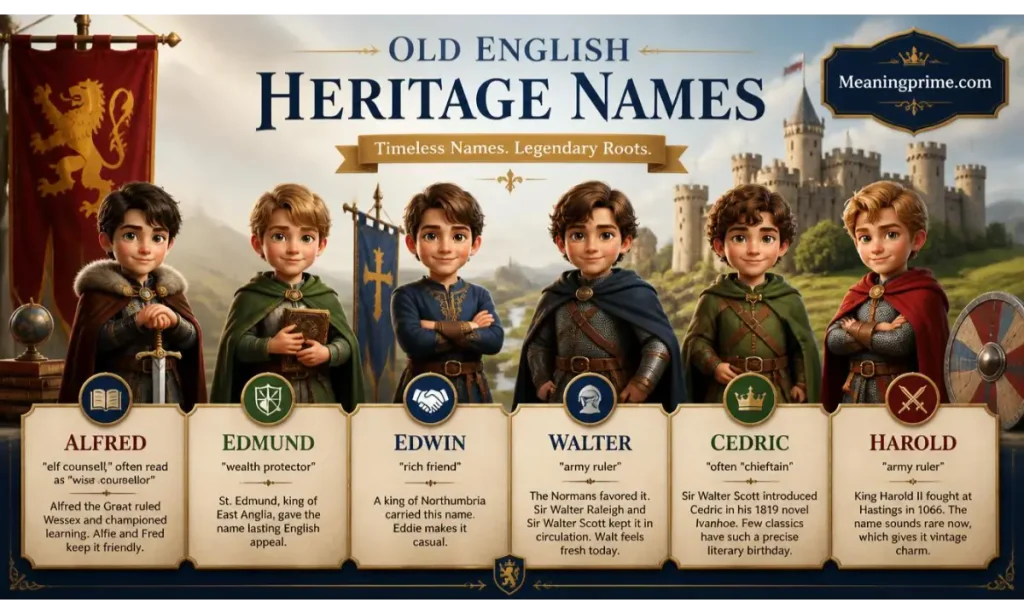
These names reach back to Anglo-Saxon England. Many classic British names meanings here pair two ideas, like “wealth” and “guardian.”
- Alfred (“elf counsel,” often read as “wise counselor”): Alfred the Great ruled Wessex and championed learning. Alfie and Fred keep it friendly.
- Edmund (“wealth protector”): St. Edmund, king of East Anglia, gave the name lasting English appeal.
- Edwin (“rich friend”): A king of Northumbria carried this name. Eddie makes it casual.
- Walter (“army ruler”): The Normans favored it. Sir Walter Raleigh and Sir Walter Scott kept it in circulation. Walt feels fresh today.
- Cedric (often “chieftain”): Sir Walter Scott introduced Cedric in his 1819 novel Ivanhoe. Few classics have such a precise literary birthday.
- Harold (“army ruler”): King Harold II fought at Hastings in 1066. The name sounds rare now, which gives it vintage charm.
Gentle Traditional Names
Not every classic roars. These classic British names meanings sound calm and steady.
- Samuel (“God has heard”): Hebrew in origin and long loved in Britain. Diarist Samuel Pepys recorded London life in the 1660s. Sam is the easy short form.
- Thomas (“twin”): Aramaic roots. Novelist Thomas Hardy gave it literary weight. Tom and Tommy come naturally.
- Hugh (“mind” or “spirit”): Short, crisp and Norman. Hughie is the old-fashioned nickname.
- Reginald (“counsel and power”): Victorian and formal. Reggie lightens it.
- Frederick (“peaceful ruler”): Fred and Freddie are the usual nicknames. Freddie joined the boys’ top ten in 2025.
- James (“supplanter”): The English form of Jacob. Kings of Scotland and England shared it. Jamie and Jim are the nicknames.
Friendly British Favorites
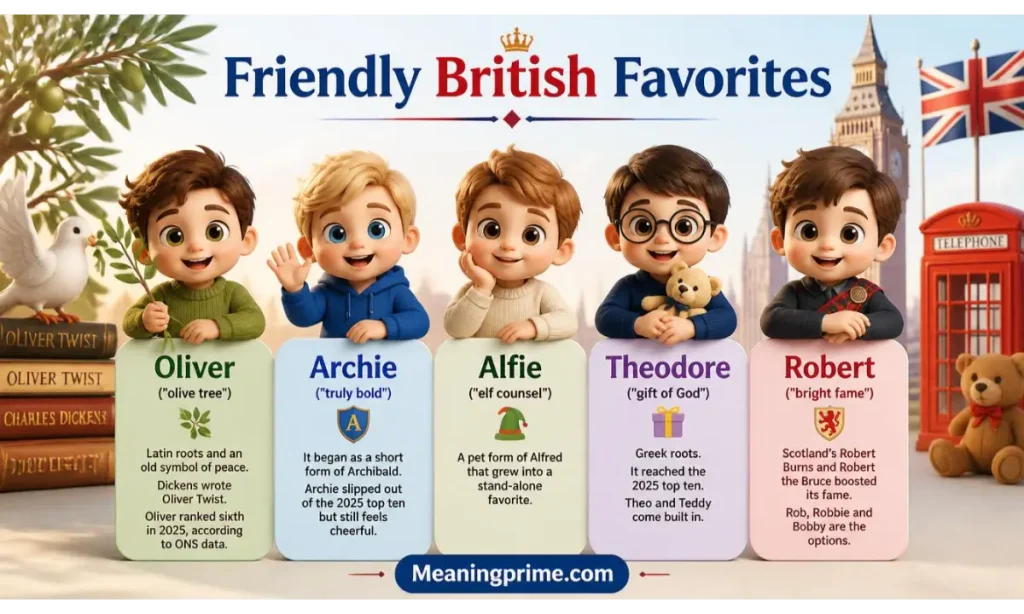
These names feel like a smile. Few classic British names meanings sound warmer.
- Oliver (“olive tree”): Latin roots and an old symbol of peace. Dickens wrote Oliver Twist. Oliver ranked sixth in 2025, according to ONS data.
- Archie (“truly bold”): It began as a short form of Archibald. Archie slipped out of the 2025 top ten but still feels cheerful.
- Alfie (“elf counsel”): A pet form of Alfred that grew into a stand-alone favorite.
- Theodore (“gift of God”): Greek roots. It reached the 2025 top ten. Theo and Teddy come built in.
- Robert (“bright fame”): Scotland’s Robert Burns and Robert the Bruce boosted its fame. Rob, Robbie and Bobby are the options.
- Harry (“home ruler”): Medieval English speakers used it as Henry’s pet form. Shakespeare’s Henry V rallies his troops as “Harry.”
Uncommon Old English and Anglo-Saxon Boy Names
Want something rarer? These Anglo-Saxon names for males add depth to classic British names meanings.
| Name | Meaning | Quick Note |
|---|---|---|
| Oswald | “divine power” | A saint and Northumbrian king |
| Leofric | “dear ruler” | Earl of Mercia and husband of Lady Godiva |
| Godwin | “good friend” | Earl Godwin, father of King Harold II |
| Wilfred | “desires peace” | Poet Wilfred Owen; Wilf is the nickname |
| Dunstan | “dark stone” | Archbishop of Canterbury in the 900s |
| Aldred | “old counsel” | Rare, with a medieval feel |
Classic British Girl Names and Their Meanings
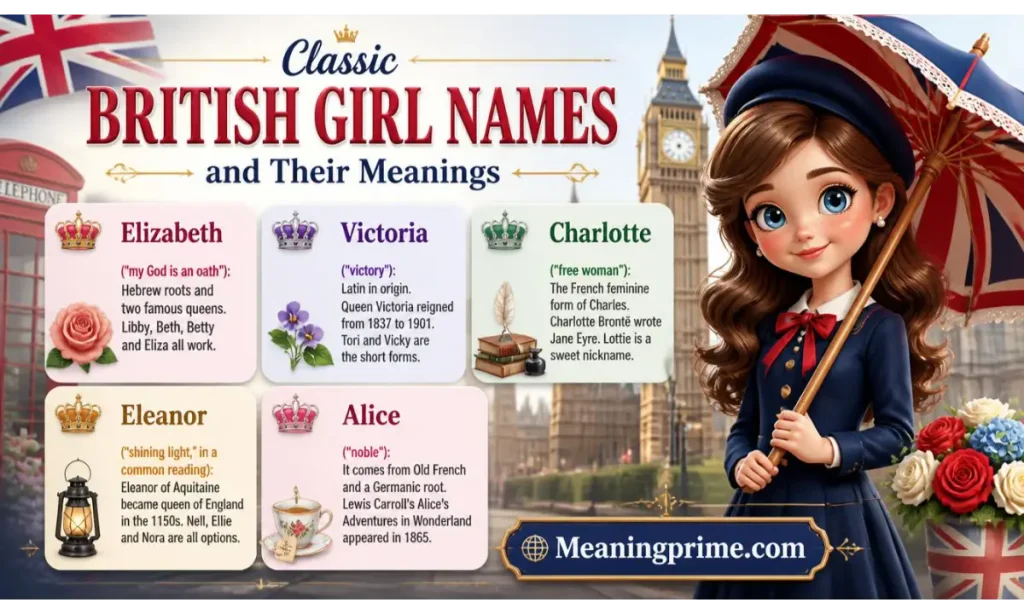
Classic British names for girls range from queenly to cottage-garden sweet. Each of these classic British names meanings comes with nicknames and a story.
Royal and Elegant Names
Elegant names carry confidence. These classic British names meanings feel polished without feeling distant.
- Elizabeth (“my God is an oath”): Hebrew roots and two famous queens. Libby, Beth, Betty and Eliza all work.
- Victoria (“victory”): Latin in origin. Queen Victoria reigned from 1837 to 1901. Tori and Vicky are the short forms.
- Charlotte (“free woman”): The French feminine form of Charles. Charlotte Brontë wrote Jane Eyre. Lottie is a sweet nickname.
- Eleanor (“shining light,” in a common reading): Eleanor of Aquitaine became queen of England in the 1150s. Nell, Ellie and Nora are all options.
- Alice (“noble”): It comes from Old French and a Germanic root. Lewis Carroll’s Alice’s Adventures in Wonderland appeared in 1865.
Vintage Charm Names
Vintage names feel grandmotherly in the loveliest way. Many classic British names meanings here come with ready-made nicknames.
- Beatrice (“she who brings joy”): Latin roots. Shakespeare gave it to the sharp-witted heroine of Much Ado About Nothing. Bea is the favorite short form.
- Harriet (“home ruler”): The feminine form of Harry. Hattie and Hetty are charming nicknames.
- Florence (“flourishing”): Florence Nightingale made it famous. It ranked fifth for girls in 2025.
- Matilda (“strength in battle”): Empress Matilda claimed the English throne in the 12th century. Roald Dahl’s heroine gave it new fans. Tilly is the nickname.
- Clara (“bright” or “clear”): Latin roots. It’s short and crisp. It pairs well with long surnames.
Nature and Floral Classics
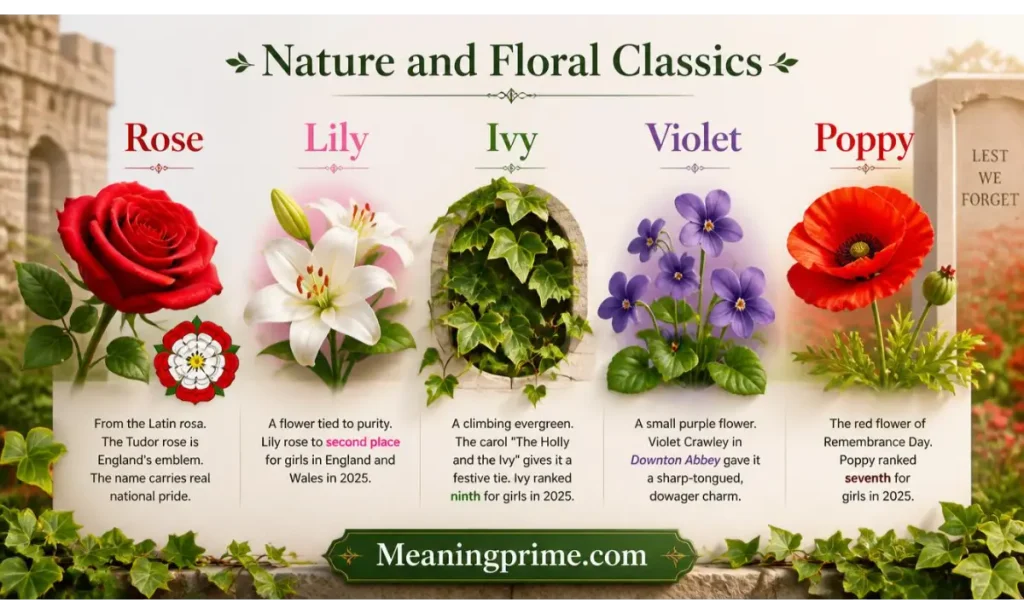
British gardens inspired this group. They add bloom to classic British names meanings.
- Rose: From the Latin rosa. The Tudor rose is England’s emblem. The name carries real national pride.
- Lily: A flower tied to purity. Lily rose to second place for girls in England and Wales in 2025.
- Ivy: A climbing evergreen. The carol “The Holly and the Ivy” gives it a festive tie. Ivy ranked ninth for girls in 2025.
- Violet: A small purple flower. Violet Crawley in Downton Abbey gave it a sharp-tongued, dowager charm.
- Poppy: The red flower of Remembrance Day. Poppy ranked seventh for girls in 2025.
Soft Traditional Names
These names have a smooth, gentle rhythm. They sit comfortably between vintage and modern.
- Amelia (“industrious”): Germanic roots. Amelia slipped to third in 2025 but remains hugely popular.
- Josephine (“God will add”): The French feminine of Joseph. Josie and Jo are the nicknames.
- Penelope (“weaver,” in a common reading): In Homer’s Odyssey, Penelope waits faithfully for Odysseus. Penny and Nell are possible nicknames.
- Margaret (“pearl”): Greek roots. St. Margaret of Scotland made it a royal favorite. Maggie, Meg and Peggy are the nicknames.
- Elsie: It began as a Scottish short form of Elspeth, itself a form of Elizabeth. Elsie ranked eighth for girls in 2025.
Old English Names for Girls
Anglo-Saxon women’s names sound antique in the best way. Here are six classic British names meanings with real medieval roots.
| Name | Meaning | Quick Note |
|---|---|---|
| Edith | “prosperous in war” | Queen Edith, wife of Edward the Confessor |
| Hilda | “battle” | St. Hilda was Abbess of Whitby |
| Audrey | “noble strength” | From St. Æthelthryth, also called St. Audrey |
| Ethel | “noble” | An Edwardian favorite, rare today |
| Mildred | “gentle strength” | Saint Mildred of Kent |
| Edwina | “rich friend” | The feminine form of Edwin |
Nice English Names for Girls: Sweet and Simple Picks
Sometimes you want a name that’s kind and easy. These four fit nicely among classic British names meanings.
- Grace (“favor” or “blessing”): Latin roots. Grace Darling helped rescue shipwreck survivors off Northumberland in 1838. Gracie is the nickname.
- Hazel: Named for the hazel tree. It feels woodsy and calm.
- Emma (“whole” or “universal”): Germanic roots. Jane Austen’s Emma appeared in 1815. Emmie is a cute short form.
- Lucy (“light”): Latin roots. Lucy Pevensie, in C. S. Lewis’s Narnia books, made it a children’s classic. Lulu is a playful nickname.
Classic British Unisex Names and Their Meanings
Gender-neutral names have deep roots in Britain. Surnames, birds and trees all became first names for anyone. These classic British names meanings prove it.
Nature and Folklore Unisex Names
Nature lends these classic British names meanings an easy, outdoorsy feel.
- Rowan (“little red one,” or the rowan tree): Gaelic roots. British folklore credits rowan trees with protective powers.
- Robin (“bright fame”): A pet form of Robert. Robin Hood and the beloved garden bird give it double appeal.
- Wren: A tiny songbird. Sir Christopher Wren designed St. Paul’s Cathedral after the Great Fire of London.
- Ash: The tree, from Old English. It’s short, sleek and rooted in woodland.
Place and Surname-Style Unisex Names
British families have long turned surnames and place names into first names. Check these classic British names meanings against your own family tree.
- Sidney (traced to an Old English place name): Elizabethan poet Sir Philip Sidney carried it as a surname.
- Morgan (“sea-born,” Welsh): Morgan le Fay appears in Arthurian legend.
- Ellis (“my God is Yahweh”): It comes from Elijah via Elias. It also has Welsh roots.
- Rory (“red king,” Gaelic): Popular in Scotland and Ireland.
- Lindsay: Linked to the Lindsey region of Lincolnshire. Scottish clans also use it.
Short Modern-Classic Unisex Names
Short names feel current yet remain old. Tuck these classic British names meanings into your shortlist if you like brevity.
- Alex (“defender of mankind”): Greek roots. It’s short for Alexander or Alexandra. It works for anyone.
- Charlie (“free man”): A pet form of Charles and Charlotte. It has a royal link and a casual tone.
- Frankie: Short for Francis or Frances. It has a spirited, playful sound.
- Kit: Short for Christopher or Katherine. Playwright Christopher Marlowe was known as Kit.
- Jamie: A pet form of James with Scottish flavor.
Classic British Names Meanings by Origin
Names show where a family or a language has been. This quick table sorts classic British names meanings by root. It also explains why so many sound alike.
| Origin | Typical Flavor | Example Names |
|---|---|---|
| Old English | Earthy Anglo-Saxon strength | Alfred, Edmund, Edwin, Edith, Hilda |
| Norman French and Germanic | Courtly and royal | William, Henry, Walter, Charlotte, Alice |
| Latin and Greek | Classical and literary | Victoria, Beatrice, Oliver, Theodore, Penelope |
| Hebrew | Biblical | Samuel, Elizabeth, Josephine, Thomas (Aramaic) |
| Celtic, Welsh and Gaelic | Folk and legend | Morgan, Rory, Rowan, Arthur (possibly) |
Notice the patterns. Old English names often combine two ideas, such as “wealth” and “guardian.” Norman names arrived after 1066 and quickly turned royal. Reading classic British names meanings this way makes the whole list easier to remember.
Celtic, Irish and Welsh Roots
Britain’s Celtic fringes added plenty of color. Morgan comes from Welsh. Rory and Rowan come from Gaelic. Irish names such as Rory often appear among classic British names meanings because families move and mix across the islands. Ireland keeps its own naming traditions. Many Irish favorites feel at home in UK nurseries too. If you’re drawn to Celtic sounds, these classic British names meanings add a lyrical edge.
Are Classic British Names Still Popular Today?
Classic doesn’t mean dusty. The latest ONS figures for 2025 births in England and Wales show old favorites near the top. Olivia led the girls’ list, with Lily second and Amelia third. Parents used more than 35,000 different girls’ names. Even so, the top ten names covered just 9.1% of births. Clearly, many families are returning to classic British names meanings.
Classic Names Climbing the Charts
Look at the girls’ top ten. Florence sits fifth, Poppy seventh, Elsie eighth and Ivy ninth. All four appear in our lists. Boys show the same pattern. Arthur, Oliver, George and Theodore sit among the top ten, and Freddie replaced Archie there. Parents love the ease and warmth of these classic British names meanings.
Welsh and Scottish Favorites
Britain isn’t one naming market. In Wales, Mali ranked fourth for girls and Osian tenth for boys. Neither makes the top 100 in England, according to ONS. Reports based on National Records of Scotland data put Freya on top for girls in Scotland and Noah on top for boys. If heritage matters to you, local favorites can add meaning to the classic British names meanings you already like.
How to Choose a Classic British Name
A long list can feel overwhelming. Say each name aloud with your surname. Picture it on a toddler and on a CEO. Check the nicknames. These quick filters turn classic British names meanings into a real shortlist.
How to Pair English Names With Surnames and Middle Names
Rhythm matters. A long surname such as Featherstone pairs well with a short first name like Hugh or Rose. A short surname such as Reid can carry Frederick or Josephine. Many families also repeat a grandparent’s classic in the middle slot. Alfred or Margaret can sit comfortably between a modern first name and a surname. Choose classic British names meanings for the middle name if your first name is unusual.
Check the Nicknames
Every classic comes with built-in short forms. William becomes Will or Billy. Elizabeth can turn into Beth, Libby or Eliza. Ask yourself which version you’d happily hear at the school gate. If you dislike every nickname, keep looking. Even the most polished classic British names meanings can’t stop a child’s friends from shortening them.
Frequently Asked Questions
What makes a British first name “classic”?
A classic stays in steady use across generations. It ties to British history, royalty or literature. That staying power gives classic British names meanings their lasting appeal.
Are classic British names still popular for modern babies?
Yes. ONS data for 2025 shows Florence, Elsie, Ivy, Arthur and Theodore in the top ten. Plenty of classic British names meanings sit right alongside modern trends.
Do classic British names have specific origins?
Most trace to Old English, Norman French, Latin, Greek, Hebrew or Celtic roots. Reading classic British names meanings by origin helps you spot the pattern.
How can I choose a classic name that feels personal?
Match the meaning to a value you care about. Say it with your surname and check the nicknames. Family history can narrow classic British names meanings fast.
Do classic British names work for both formal and everyday use, and with modern middle names?
Yes. They suit a school register and a boardroom alike. They also pair well with short or contemporary middle names. Many classic British names meanings offer friendly short forms such as Freddie or Elsie.
Conclusion
From William to Wren, these classic British names meanings show how old names stay young. Boys’ lists lean royal and Anglo-Saxon. Girls’ lists mix queens with flowers. Unisex picks borrow from birds, trees and place names. Whichever list you choose from, classic British names meanings give your child a name with history.
Your next step is simple. Pick three favorites, say them with your surname and check the nicknames. The one that still feels right after a week is likely your answer. Keep exploring classic British names meanings until a name feels like your child.