

You open a message, and two letters sit in front of everything else: “TW.” Maybe it’s a joke. Maybe it’s a typo. Or maybe your friend is about to share something heavy, and you’re not sure how to react. That tiny moment of doubt is exactly why so many people search for the TW meaning in text.
The answer is simple, and the context is easy to learn. This guide explains what TW stands for, where you’ll spot it, how to write one, and how to reply without awkwardness. You’ll also get the rare alternate meanings, platform tips, and an honest look at what research says about whether warnings really help.
Quick Answer: The TW meaning in text is “Trigger Warning.” People type it before a message, caption, or video to warn you that sensitive content is coming, such as grief, violence, or abuse.
- Full form: Trigger Warning
- Purpose: A heads-up so you can prepare, skip, or come back later
- Where you’ll see it: Texts, TikTok, Instagram, Snapchat, WhatsApp, Reddit, X, Discord
- Rare alternatives: Twitter, total weight, trans woman, Trust Wallet
In nearly every chat, the TW meaning in text is a trigger warning. The words right after it confirm that.
Definition & Meaning
TW usually stands for “trigger warning.” A trigger warning is a short notice placed before content that may upset some readers. It gives you a moment to decide what happens next.
Here’s the useful part about the TW meaning in text: the letters almost always sit right before the sensitive topic. You might see “TW: violence,” “TW: grief,” or “TW // mental health.” The topic after the letters tells you what’s coming.
Dictionary sources describe a trigger warning as a notice placed before material that may be very upsetting to some people, especially people with related experiences. In other words, it’s a courtesy label. It doesn’t judge the content. It simply flags it.
You’ll also see it written with slashes, hashtags, or all lowercase, like “tw//grief” or “#tw.” Those variations change nothing. Once you understand the TW meaning in text, you can read every version at a glance.
Full Form and Meaning
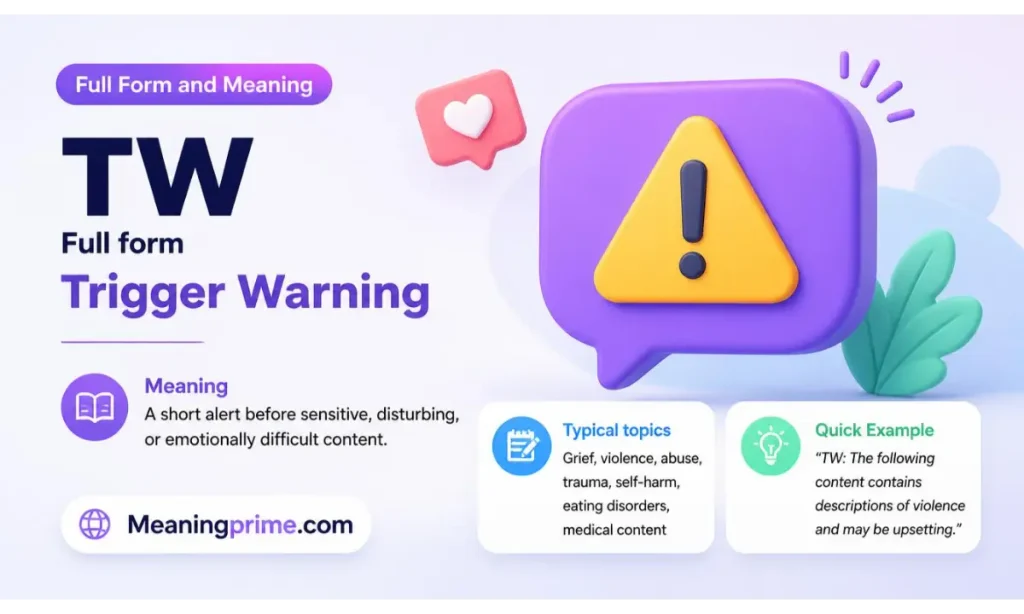
Let’s keep this part crisp.
| Item | Detail |
|---|---|
| Abbreviation | TW |
| Full form | Trigger Warning |
| Meaning | A short alert before sensitive, disturbing, or emotionally difficult content |
| Typical topics | Grief, violence, abuse, trauma, self-harm, eating disorders, medical content |
In plain words, TW says, “Heads up, the next part may be hard to read.” That’s the whole idea behind the TW meaning in text.
People use it to give others a choice. You can read on, prepare yourself, or skip it. Nobody forces you into anything. The warning hands you the steering wheel for a second.
Quick Example
Picture this caption: “TW: This post describes a car accident.”
The letters tell you what’s inside before you read a single detail. If you’re having a rough week, you can scroll past. If you feel ready, you can keep going. That’s the TW meaning in text in one sentence.
Defining the Term and Its Core Purpose
Think of a trigger warning like the rating on a movie or the “loud noise ahead” sign on a game level. You still choose whether to watch or play. You just get a little context first.
The core purpose is care. When someone adds TW, they’re saying, “I know not everyone is in the same place today.” That small gesture builds trust in group chats, comment sections, and communities where people share personal stories.
It also isn’t about censorship. Nobody removes the content or hides the truth. The writer still tells the story. The reader simply gets a fair chance to prepare.
Why does this matter so much? Because online spaces mix everyone together. A joke, a news clip, and a painful memory can appear on the same screen within seconds. A two-letter label creates a tiny pause in that chaos, and the TW meaning in text is built around that pause.
In short, the TW meaning in text has less to do with two letters and more to do with a habit of looking out for each other.
Other Meanings of TW: When It Doesn’t Mean Trigger Warning
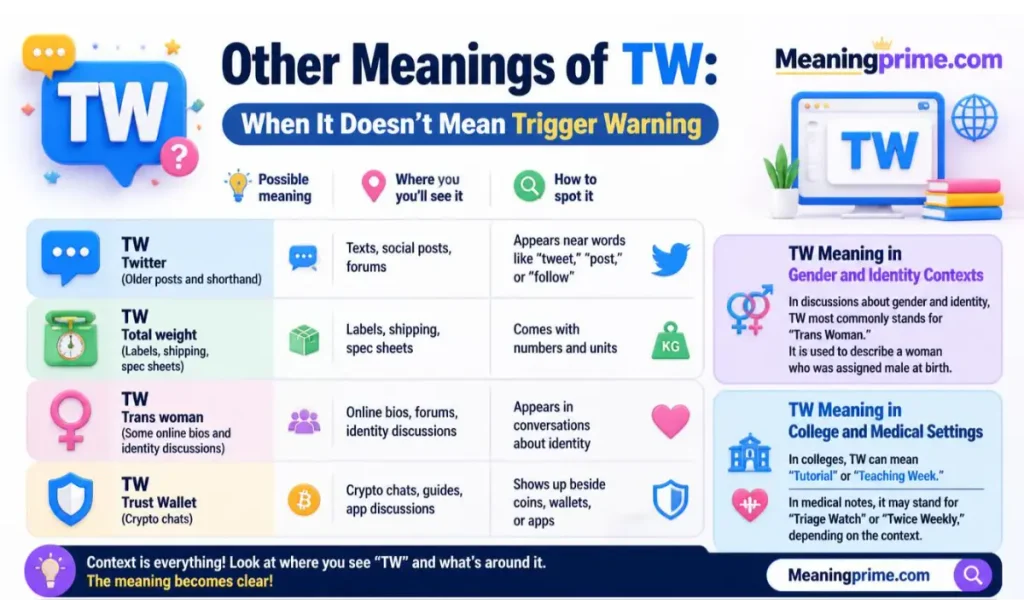
Trigger warning wins by a wide margin. Still, TW can mean other things, and context decides which one you’re reading. Here’s a quick way to sort them out.
| Possible meaning | Where you’ll see it | How to spot it |
|---|---|---|
| Trigger Warning | Texts, social posts, forums | Sits right before a heavy topic |
| Older posts and shorthand | Appears near words like “tweet,” “post,” or “follow” | |
| Total weight | Labels, shipping, spec sheets | Comes with numbers and units |
| Trans woman | Some online bios and identity discussions | Appears in conversations about identity |
| Trust Wallet | Crypto chats | Shows up beside coins, wallets, or apps |
Here’s a simple rule. If TW sits before a sensitive subject, it means trigger warning. If numbers, crypto terms, or identity discussions surround it, check the surrounding words first. The TW meaning in text rarely stays mysterious for more than one sentence of context.
TW Meaning in Gender and Identity Contexts
Some people search “what does TW mean in gender” because they saw it in a bio or comment. In certain online spaces, “tw” can be short for “trans woman.” Dictionary listings include this meaning.
Context matters here. If someone describes themselves that way, take them at their word. If you aren’t sure, read the rest of the sentence before you assume anything. When it sits next to a heavy topic instead, it’s the usual trigger warning.
TW Meaning in College and Medical Settings
On college campuses, professors sometimes add content notes to a syllabus or a lecture slide. They might flag a film clip or a case study before class starts. The label may say “content note” or “trigger warning,” and students understand it either way.
In medical or technical settings, “TW” can appear as “total weight” on charts, labels, or shipping documents. That’s rare in everyday chat. A friend texting you “TW” almost never means weight.
The Evolution and History of the Concept
The phrase has a surprisingly specific past. According to Psychology Today, the term started on feminist internet message boards in the late 1990s. Early users added it to warn readers about graphic descriptions of crimes, typically sexual assault.
From there, the habit spread. Blogging platforms and forums adopted it. Tumblr and Twitter helped carry it into everyday use during the 2010s. Later, TikTok and Instagram made it a normal part of captions and video overlays.
Universities and media outlets joined in. Debates followed. Some people saw warnings as basic kindness. Others worried they encouraged avoidance. Both sides kept talking, which is probably why the term stayed visible for so long. That long road explains why the TW meaning in text feels so familiar to people who grew up online, and slightly puzzling to anyone who didn’t.
Today, the TW meaning in text covers far more than its original use. People attach it to grief, illness, breakups, news stories, and even flashing lights. The core idea hasn’t changed. It’s still a courtesy that says, “Be ready for what’s next.”
Usage in Various Contexts and Daily Interaction
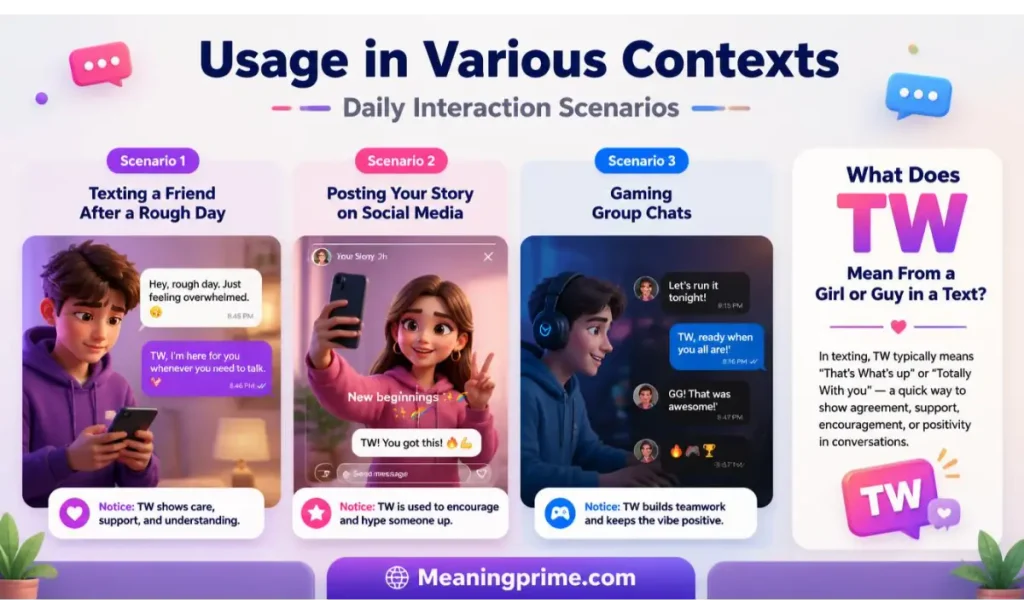
You’ll meet TW in group chats, private messages, captions, and comment threads. In texting, people often use it before a difficult life update. In public posts, creators use it to label the topic of a video or story.
The TW meaning in text stays the same across all of them. Only the setting changes. Let’s look at three everyday scenarios.
Scenario 1: Texting a Friend After a Rough Day
You: Hey, got a minute? TW: I had a scary experience at the doctor today.
Your friend: Thanks for the heads-up. I’m here. Go ahead.
The warning didn’t make the conversation awkward. It made it smoother. Your friend knew exactly what mood to bring.
Scenario 2: Posting Your Story on Social Media
Caption: “I’m finally sharing my recovery story. TW: blood and medical trauma. Please take care of yourself before reading.”
Notice the format. The TW comes first. It names the topic. Then a gentle line invites readers to look after themselves.
Scenario 3: Gaming Group Chats
You: Posting clips from the new horror game. TW for flashing lights and jump scares.
Warnings aren’t only about emotional topics. Gamers use them for sensory triggers too. Flashing lights can affect some players, so a quick label protects them.
What Does TW Mean From a Girl or Guy in a Text?
People often ask what TW means “from a girl” or “from a guy.” The gender of the sender doesn’t change anything. The TW meaning in text stays “trigger warning” no matter who types it.
What matters is the tone and the relationship. A close friend may use TW before venting. A crush may use it before sharing something personal. Either way, it’s a sign that they trust you with something that feels heavy.
Not sure what they meant? Just ask. A simple “Is that a trigger warning?” clears up the TW meaning in text without any drama.
Notice How in Each of These Examples
In every case, the writer isn’t being dramatic. They’re giving context. They name the topic, keep it short, and let you decide how to read.
Still unsure whether you should add one to your own message? When in doubt, add it. A small label costs you five seconds. Skipping it can cost someone else a bad afternoon.
Addressing Misconceptions and Clarifications
Some people believe that using a trigger warning means you’re fragile or overly sensitive. That’s a myth. Noticing that people react differently to content shows empathy and awareness.
Another worry is that warnings silence hard topics. They don’t. The post still exists. The conversation still happens. The warning only adds a sentence before it.
People also assume the TW meaning in text only applies to dramatic stories. In reality, someone may add it before a post about a pet’s passing or a stressful move. Small topics can weigh heavily on certain days.
Here are a few quick myth-and-fact pairs:
| Myth | Reality |
|---|---|
| TW is censorship | It labels content. It never blocks it |
| TW is only for extreme trauma | People use it for many topics, big and small |
| Using TW means you’re oversensitive | It shows consideration for readers |
| TW is a medical tool | It’s an etiquette habit, not treatment |
TW vs. Spoiler Alert
A spoiler alert protects a plot twist. A trigger warning protects emotional well-being. One saves you from learning how a movie ends. The other prepares you for a topic that may hit hard. Don’t swap them. The TW meaning in text belongs to the second group.
Do Trigger Warnings Actually Work?
This is where it gets interesting. In 2023, researchers Victoria Bridgland, Payton Jones, and Benjamin Bellet published a meta-analysis in Clinical Psychological Science. They combined 12 studies on warnings.
Their findings, summarized by the Association for Psychological Science:
- Warnings slightly raised anxiety before people viewed the content.
- Warnings didn’t reduce distress afterward.
- People viewed troubling content at about the same rate with or without a warning.
- Warnings didn’t change how well people understood what they read.
The authors concluded that warnings shouldn’t be treated as a mental-health tool. Earlier experiments from other researchers reached a similar view, finding that warnings had little effect on distress.
So should you stop using them? Not necessarily. Those studies measured stress levels, not courtesy or choice. A label still tells readers what’s ahead, and many people value that. One researcher suggested that emotional-regulation skills could help people use warnings better. The takeaway: treat TW as a considerate heads-up, not a cure. That’s the honest TW meaning in text today.
Similar Terms and Alternatives
TW isn’t your only option. Different platforms and communities use other labels for the same job. Picking the right one makes your message clearer.
- CW (Content Warning): A broader label for sensitive material
- Content note: A softer, informational version
- Spoiler: Plot reveals only
- Sensitive content: Often applied by apps automatically
- NSFW: Adult or explicit material
You can also skip abbreviations altogether. “Heads up: this post mentions loss” works fine. Sometimes plain words are clearer than letters, especially for readers who don’t know slang.
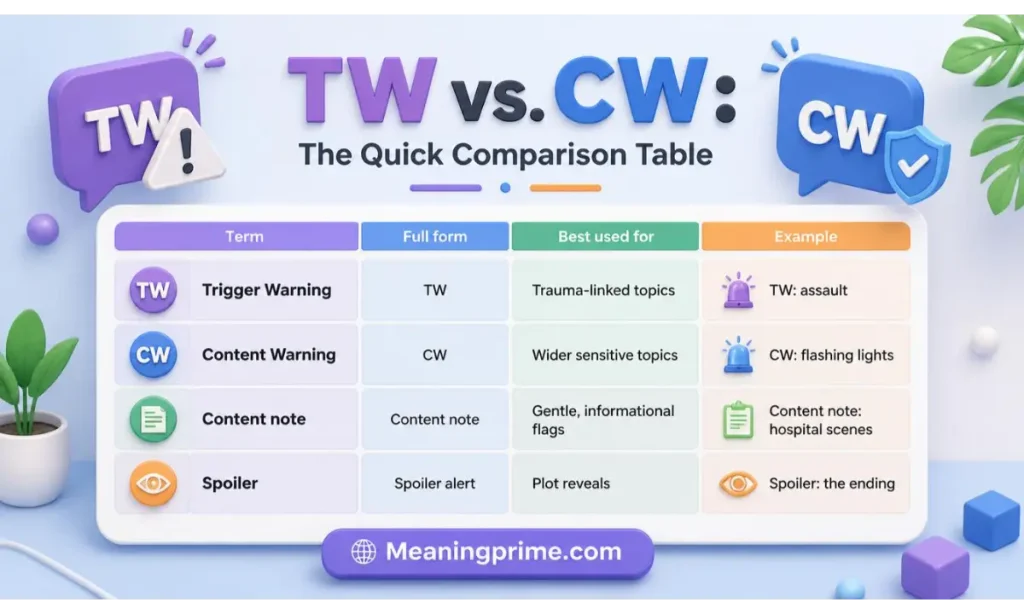
TW vs. CW: The Quick Comparison Table
| Term | Full form | Best used for | Example |
|---|---|---|---|
| TW | Trigger Warning | Trauma-linked topics | TW: assault |
| CW | Content Warning | Wider sensitive topics | CW: flashing lights |
| Content note | Content note | Gentle, informational flags | Content note: hospital scenes |
| Spoiler | Spoiler alert | Plot reveals | Spoiler: the ending |
In practice, many communities treat TW and CW as close cousins. If your topic ties to trauma, TW fits well. If it’s broader, CW works. Either way, the TW meaning in text stays centered on emotional safety.
How to Write a Good TW (With Examples)
Writing a clear warning takes five seconds and a little thought. Follow these steps.
- Name the topic. “TW: self-harm” helps more than “TW: sensitive stuff.” Specific wording lets people judge for themselves.
- Put it first. Place it before the content, not after. A warning at the end arrives too late.
- Keep it short. A few words are enough. Don’t write a paragraph.
- Add breathing room. In captions, leave a line or two before the story begins.
- Don’t overuse it. If every post has one, readers stop noticing.
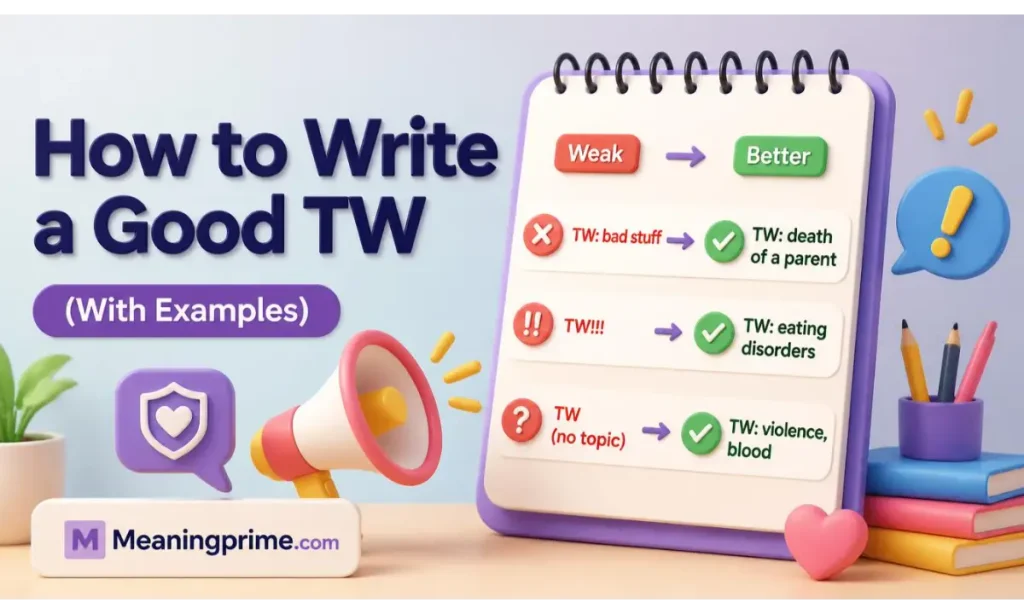
Here’s a quick comparison.
| Weak | Better |
|---|---|
| TW: bad stuff | TW: death of a parent |
| TW!!! | TW: eating disorders |
| TW (no topic) | TW: violence, blood |
Think of it like a road sign. It doesn’t stop traffic. It simply tells drivers what’s ahead, which is exactly how the TW meaning in text is meant to work.
You don’t need perfect wording. You need honest wording. That’s what makes the TW meaning in text work in practice.
Responding to a Trigger Warning
Replying well matters as much as writing well. When someone adds TW, they’re showing care. Match that care in your answer.
If you aren’t ready for the topic, scroll past. You don’t owe anyone a read. If the person is a friend, a short thank-you goes a long way.
Timing matters too. Reply within a day or two if you can, since people who share heavy things often feel exposed afterward. Even a short heart or a kind line shows you understood the TW meaning in text and took it seriously.
Casual, Supportive, and Professional Replies
| Situation | Reply idea |
|---|---|
| Casual | “Thanks for the heads-up. I’ll read this later.” |
| Supportive | “I appreciate the warning. I’m here if you want to talk.” |
| Skipping it | “That’s a heavy one for me today, so I’ll pass. Thank you for flagging it.” |
| Professional | “Thank you for the note. I’ll review this when I have the time.” |
Pick whichever fits your relationship. Warm and brief always beats long and formal.
What Not to Say
Avoid replies that dismiss the writer. Skip lines like “Why so sensitive?” or “It’s just a post.” Don’t roll your eyes in text either. Warnings are optional courtesy, so mocking someone for offering one discourages kindness. Reading the TW meaning in text correctly includes responding kindly.
Regional and Cultural Differences
Trigger warnings appear most often in English-speaking online spaces, especially in the United States, Canada, the United Kingdom, and Australia. As social platforms connect the world, the habit is spreading.
Norms vary. In some communities, people discuss painful topics openly without labels. In others, labels are standard. If you join an international group chat, don’t be surprised when habits differ.
Some apps also adjust their sensitive-content prompts by region, so a user in Karachi, Manchester, and Toronto may each see slightly different labels on the same app. Local etiquette still shapes how often people actually type the letters.
Still, the heart of it travels well. Being thoughtful about what you share needs no translation. The TW meaning in text may be an English shorthand, but the courtesy behind it is universal.
TW Meaning in Urdu and Roman Urdu Chats
Many Urdu speakers searching for the TW meaning in text want to know whether the abbreviation changes in Urdu conversations. Generally, it doesn’t. People type “TW” in English letters, even in Roman Urdu messages.
For example: “TW: thori heavy baat hai, parhna ho to parho.” That mixes the English label with casual Roman Urdu. The label does the warning work. The rest explains the mood. You’ll see the same pattern on WhatsApp and Instagram.
Usage in Online Communities and Dating Apps
Every platform has its own flavor. Here’s how TW shows up in the places you probably scroll most.
| Platform | Typical use |
|---|---|
| TikTok | Video overlays, captions, hashtags |
| Captions, Stories text | |
| Snapchat | Stories, group chats |
| Group chats, status updates | |
| Post titles and flair | |
| X | Opening line of a post |
| Discord | Channel messages with spoiler tags |
TW Meaning in Text on TikTok and Instagram
On TikTok, creators put “TW” in video captions, hashtags, or text overlays. Dexerto notes that creators usually place it at the start so viewers can decide whether to keep watching. A clip about grief or mental health might open with it.
Instagram works similarly. You’ll see TW at the start of a caption or on a Stories text sticker. The TW meaning in text stays consistent here, though some posts also get automatic blur screens from the app.
TW Meaning on Snapchat
On Snapchat, TW appears in Stories and group chats. Because Snaps disappear quickly, people often put the warning in the very first line. If someone sends one in a chat, the TW meaning in text is still trigger warning.
TW Meaning on WhatsApp
WhatsApp chats move fast, especially in big groups. Writing “TW: hospital talk” before a long message helps everyone. Put the warning on the first line. That way it shows in the notification preview, and people can choose when to open it. The TW meaning in text holds in status updates too.
TW on Reddit, X, and Discord
Reddit users often start post titles with TW or add a content flair. On X, people open the post with it. On Discord, many servers pair a TW with spoiler tags, so the details stay hidden until someone clicks.
Dating Apps and Bios
On dating apps, you might spot TW in a bio. It usually sets a boundary or flags a heavier topic someone prefers to discuss early. For example, a person might mention a loss. It’s personal, so respond with respect. Anyone who understands the TW meaning in text will appreciate a gentle question far more than a flood of curiosity.
Most platforms also offer tools. You can mute words, hide hashtags, or limit sensitive content in settings. Use them if you want fewer surprises.
Hidden Meanings and Tone Matters
Tone changes everything. Most people use TW sincerely. A few use it sarcastically, attaching it to something harmless to poke fun at the idea.
So read the room. Look at the rest of the post. Is the writer thoughtful or joking? If someone seems to mock mental health through the label, you can mute or skip them. You don’t have to engage. Sarcasm exists, but it’s the exception, so treat the TW meaning in text as sincere unless the post clearly says otherwise.
TW Meaning for Gen Z
Gen Z shapes how the label evolves. Some younger users add a playful TW to everyday exaggerations, like “TW: I ate the last slice.” It’s a joke, and everyone knows it. Real warnings usually name a real topic. That’s the clue.
So when you ask about TW meaning in text among Gen Z, the answer is still trigger warning. The twist is the humor around it.
Emoji and Punctuation Clues
Small details signal intent. A heavy or sad emoji next to TW usually suggests a genuine warning. A laughing emoji suggests a joke. A colon followed by a clear topic (“TW: grief”) reads as serious. A lowercase “tw lol” reads casual. When both tone and topic align, you can trust your read of the TW meaning in text.
Professional Communication and Workplace Etiquette
Emails and workplace chats call for different language. “TW” can look cryptic to coworkers who don’t use slang. So describe the content in plain words.
Instead of “TW,” try: “Please note this report includes details about a difficult incident.” It’s clear. It’s respectful. It works for everyone.
If you work in journalism, healthcare, education, or human resources, check your organization’s guidelines first. Many already have formal rules for sensitive material. Follow them. If a colleague does use TW in a message, answer in the same respectful tone. Knowing the TW meaning in text helps you respond without making the moment awkward. In professional settings, the TW meaning in text matters less than clear, polite wording.
Frequently Asked Questions
What does TW mean in text messages?
The TW meaning in text messages is “trigger warning.” It tells the reader that the message ahead may involve sensitive or upsetting topics.
What is a TW on social media?
On social media, a TW is a short label placed before a post or video. It warns viewers about topics like grief, violence, or abuse so they can decide whether to continue.
What does TW mean from a girl?
It means the same thing from anyone: trigger warning. If a girl sends it, she’s likely flagging something heavy. The TW meaning in text doesn’t change with gender.
Can TW mean something other than trigger warning?
Yes, but rarely. It can stand for Twitter, total weight, trans woman, or Trust Wallet. Surrounding words usually make the TW meaning in text clear.
Is TW the same as CW?
Not exactly. TW means trigger warning and often relates to trauma. CW means content warning and covers broader sensitive topics. People sometimes use them interchangeably.
Conclusion
You now know that the TW meaning in text is “trigger warning,” a quick heads-up before sensitive content. You’ve seen how it appears in texts, TikTok, Instagram, Snapchat, WhatsApp, and more. You’ve also learned the rare alternatives and the honest research on what warnings can and can’t do.
Here’s the takeaway. Name the topic, keep it short, and read the tone. Reply kindly when someone shares one. A few letters can’t fix everything. Yet they can make someone’s scroll a little gentler, and that’s a good reason to remember the TW meaning in text.