
You’re scrolling late at night when a soft whisper and a slow tap fill your headphones. Your shoulders drop. Your scalp tingles. Then you spot the caption, “ASMR,” and wonder if it’s a real thing or just another internet word.
This guide explains the ASMR meaning in plain English. You’ll learn what the letters stand for, where the word came from, and how people use it on YouTube, TikTok, and in chat. We’ll also cover triggers, food and mukbang videos, AI ASMR, and what research says about why it feels so relaxing.
Quick Answer: ASMR stands for Autonomous Sensory Meridian Response. It’s a calm, tingling feeling some people get from soft sounds or slow visuals, like whispering or tapping. Online, the ASMR meaning also covers the video genre built around those triggers. People use it casually for anything soothing, too.
What Does ASMR Mean?
Let’s start with the basics. The ASMR meaning is Autonomous Sensory Meridian Response, a pleasant tingling feeling that some people get from certain sounds or visuals. It usually starts on the scalp and drifts down the neck and spine.
Think of it as a feeling first and an internet label second. Researchers describe it as tingling in the crown of the head, set off by whispering, tapping, and slow hand movements. That’s the scientific core of the ASMR meaning. Everything online builds on it.
ASMR Full Form in Plain English
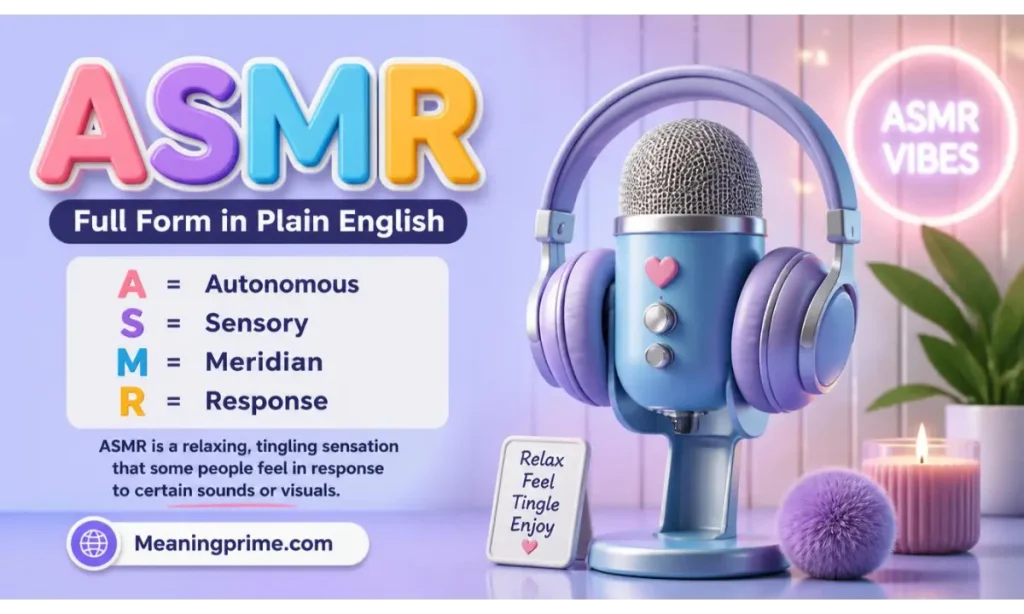
Here’s the ASMR full form, one word at a time. “Autonomous” means it happens on its own. “Sensory” points to sound, sight, or touch. “Meridian” is simply part of the name that stuck. Don’t read it as a medical claim. “Response” means your body reacts.
Search for “ASMR stands for” anywhere. You’ll land on the same phrase. The ASMR meaning never changes. Only the way people use it does.
What ASMR Feels Like
People describe it as a soft, static-like fizz. It often begins at the top of the head. Some feel it in the neck, shoulders, or back. Many also feel calm, sleepy, or oddly content afterward.
Survey data cited in a PLOS ONE study suggests many people first notice ASMR between ages 5 and 10. That’s why the ASMR meaning feels familiar to so many adults. They had the tingles long before they had a name for them.
Is ASMR Slang or a Scientific Term?
Neither, strictly. It started as a coined label, not an official medical diagnosis. Dictionary.com treats it as an informal term and notes the idea existed before the word did.
That’s why the ASMR meaning sits between science and slang. Researchers study it, although the science is still young. Meanwhile, the internet keeps remixing it.
Origin and Popularity of ASMR
Where did this word come from? According to Dictionary.com, a woman named Jennifer Allen coined it in 2010. She wanted a neutral name for a feeling people were already discussing online.
Once the name existed, the ASMR meaning spread fast. People could finally search for it. Creators began making videos on purpose. Viewers found others who felt the same tingles.
Who Coined the Term ASMR?
Jennifer Allen, a cybersecurity professional by trade, created the term in 2010. She wanted a neutral, science-friendly name. The phrase stuck. Researchers still use it today. For many fans, knowing who coined it makes the ASMR meaning feel less mysterious.
Mini Timeline
- 2010: Jennifer Allen coins “ASMR.”
- Mid-to-late 2010s: Creators like ASMR Darling and Gibi ASMR build big YouTube audiences.
- 2015: An early survey of people who experience ASMR explores triggers and mood.
- 2018: A PLOS ONE study links ASMR videos to lower heart rates.
- 2020: The Cleveland Clinic Journal of Medicine tells doctors to take notice.
- 2025: AI-generated ASMR clips go viral on TikTok.
That’s a quick trip from a niche forum word to a mainstream ASMR meaning.
Why ASMR Became So Popular
Life is loud. ASMR is a quiet corner you can carry in your pocket. Many viewers watch to relax or fall asleep. The videos are free and easy to find.
Headphones add a sense of closeness, as if someone is speaking right beside you. That mix explains why the ASMR meaning now reaches far beyond hobbyist forums.
ASMR Meaning in Different Contexts
The same three letters can mean slightly different things depending on where you see them. Below are seven everyday contexts. Each one adds a layer to the ASMR meaning.
What Does ASMR Mean in Social Media?
On social media, ASMR means two things at once. It’s the tingly feeling itself. It’s also a content category built around calming triggers. A caption with #asmr usually promises soft sounds, close-up visuals, or satisfying actions. Creators use it so the right audience can find them. In short, the ASMR meaning online is part feeling, part genre.
1. On YouTube
YouTube is where long-form ASMR lives. Titles often include the word itself, like “ASMR Calligraphy Sounds,” as Dictionary.com points out. Videos run from a few minutes to several hours, often built for sleep.
Creators use quality microphones. Many use binaural audio, which mimics 3D sound. Role-plays like spa days and checkups are common. On this platform, the ASMR meaning leans toward long, slow relaxation.
2. On TikTok
What does ASMR mean on TikTok? Short, satisfying clips. Dexerto notes that whispering and tapping appear alongside visual triggers like repetitive, satisfying actions. Think soap cutting, keyboard clicks, or hair brushing.
Here, the ASMR meaning is closer to a quick sensory hit than a full sleep session.
3. In Everyday Use
Outside video, people use “ASMR” as a casual compliment. Rain on a window, a crisp page turn, or a perfect cup of coffee can all earn the label. Someone might say, “That rain sounds like pure ASMR.”
They’re borrowing the feeling, not the formal definition. That relaxed habit is now part of the modern ASMR meaning.
4. In Texting and Chat
In chat, ASMR isn’t shorthand like LOL or BRB. It’s a reference. Send “this is so ASMR” with a video. You mean the clip is soothing or satisfying. Sometimes it’s a joke about a very quiet moment.
If you’re unsure about the ASMR meaning in chat, read the context. It almost always means “calming.”
5. In Gen Z Slang
Among Gen Z users, ASMR often works as a vibe word. It can describe a cozy room, a tidy desk, or a satisfying keyboard click. People also use it ironically, like “ASMR for my anxiety.”
The ASMR meaning Gen Z users lean on is basically “this feels soothing and looks satisfying.” Tone and context do the heavy lifting.
6. On Spotify and Audio Apps
Not every fan wants a screen. Audio-only ASMR lives on podcasts, playlists, and sleep tracks. You can set your phone on the nightstand and let the sound play.
In these spaces, the ASMR meaning shrinks to its purest form: sound that soothes, with no visuals attached.
7. In Science and Research
Researchers treat ASMR as a measurable experience. A 2018 PLOS ONE study found that ASMR videos raised pleasant feelings only in people who experience ASMR.
Here, the ASMR meaning is narrower: a reliable tingling response with real physical signals. The Cleveland Clinic Journal of Medicine adds that the underlying mechanisms aren’t well understood yet.
| Context | What ASMR Means | Example | Main Purpose |
|---|---|---|---|
| YouTube | Long, slow relaxation videos | Whispered role-play | Sleep and calm |
| TikTok | Short, satisfying clips | Soap cutting | Quick stress relief |
| Everyday talk | A soothing feeling | “That rain is so ASMR.” | Describe calm |
| Chat | A reference to something soothing | “This clip is so ASMR 😌” | Share a vibe |
| Gen Z slang | Cozy, satisfying “vibes” | “Clean desk = ASMR” | Express comfort |
ASMR Videos and Popular Creators
ASMR videos are recordings built to trigger tingles or calm. They usually feature close-up sounds, slow movement, and gentle voices. You’ll find them on YouTube, TikTok, and Instagram. Anyone searching for the ASMR meaning will bump into them quickly.
What Are ASMR Videos?
Most ASMR videos follow a simple recipe: a microphone, a trigger, and a slow pace. Some are pure sound. Others add role-play or personal attention, like a pretend haircut. Titles usually name the trigger.
Gibi ASMR
Gibi ASMR is one of the best-known creators. IZEA’s creator roundup says she started in 2016 and fills her channel with tingles, cosplay, and role-plays. Fans often begin here because the stories give the sounds a clear theme.
Jojo’s ASMR
Jojo’s ASMR is another big name. In a Headspace podcast, he describes a childhood tingling sensation that grew into a decade-long career. His focus is helping people wind down and fall asleep, often with everyday objects like apples and erasers.
What Is an ASMRtist?
An ASMRtist is a creator who makes ASMR content. The word blends “ASMR” and “artist,” and Dictionary.com includes it in its entry. Fans use it the way people say “streamer.” Knowing the term helps you follow the ASMR meaning inside the community.
ASMR Triggers and Types of ASMR Content
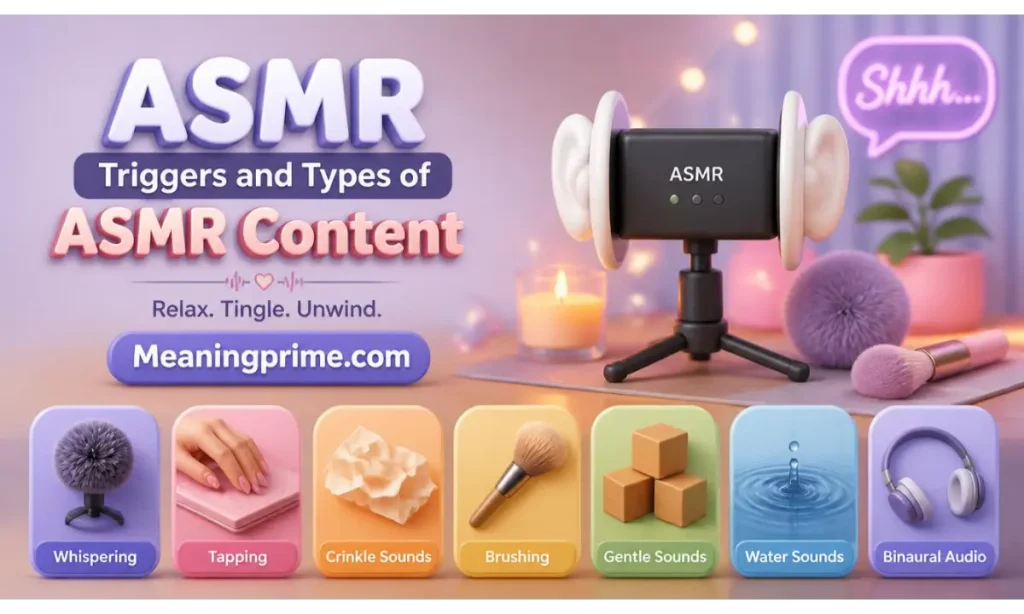
Triggers are the sounds or sights that set off the tingles. They differ from person to person. The PLOS ONE paper lists whispering, personal attention, crisp sounds, and slow movements as common ones. Learning your own triggers is the fastest way to grasp the ASMR meaning for yourself.
Sound-Based Triggers
Sound is the biggest category. Whispering, tapping, scratching, crinkling, page turning, and brushing all fit. The Cleveland Clinic Journal of Medicine notes that low-pitched audio triggers may work more reliably than visual ones. So if whispers do nothing for you, try soft tapping or a deeper voice.
Visual Triggers
Some people respond to what they see. Slow hand movements, tidy patterns, and careful, precise actions all count. Think folding towels or painting with small strokes. Visuals often work best when paired with sound.
Role-Play and Personal Attention
Role-plays recreate everyday scenes like a haircut, a spa visit, or a checkup. The creator speaks straight to you. That feeling of personal attention is a major trigger for many viewers. Some medical role-plays even use props like penlights, according to the journal article above.
Food ASMR Meaning
Food ASMR focuses on eating and food sounds. Crunching, sizzling, slurping, and pouring are typical. The food ASMR meaning is simple: food content made for the sounds, not just the taste.
One caution applies. Chewing sounds can bother people with misophonia, a strong negative reaction to certain noises. Start at a low volume.
Mukbang ASMR Meaning
Mukbang is a Korean-born eating broadcast. In mukbang ASMR, the host eats large meals near a microphone. You hear every bite. The mukbang ASMR meaning blends a social meal with a sound-triggered video. Some viewers feel calm. Others feel the opposite.
ASMR Massage Meaning
ASMR massage videos recreate the sounds and visuals of a massage, often a scalp, hair, or back session. The sounds come from oil, brushing, and light scratching. Many creators use binaural microphones. Some videos show a real person, while others use a prop. The goal is relaxation and comfort.
AI ASMR Meaning
AI ASMR means videos made fully or mostly with AI tools. Creator Handbook describes AI voices, sound effects, and visuals. Viral examples include glass fruit being sliced or “lava” snacks.
According to Know Your Meme, the trend surged on TikTok in June 2025, boosted by Google’s Veo 3. The AI ASMR meaning differs from the classic one because no human whisper sits behind it. Some viewers find it relaxing. Others say it lacks human closeness.
| Trigger or Type | What It Looks or Sounds Like | Why People Like It | Watch Out For |
|---|---|---|---|
| Whispering | Soft, close voice | Feels personal | Can bother some people |
| Tapping | Nails on glass or wood | Steady rhythm | Sharp sounds can annoy |
| Role-play | Haircut, spa, checkup | Story plus attention | Long runtimes |
| Food and mukbang | Crunching, slurping | Satisfying texture | Misophonia |
| Massage | Brushing, oil sounds | Calm and comfort | Loud volume spikes |
| AI ASMR | Glass fruit slicing | Novelty | Lacks human closeness |
Why ASMR Feels Relaxing
So why does a whisper feel like a warm blanket? Nobody has the full answer yet. Still, research offers a few solid clues. They make the ASMR meaning feel less like magic.
What Research Shows So Far
The PLOS ONE study tested over 1,000 people online and measured heart rate in a lab. ASMR videos raised pleasant feelings only in people who experience ASMR. Their heart rates dropped. Skin conductance rose.
A 2015 survey of nearly 500 people found about 80 percent said ASMR affected their mood. The effect faded after several hours. You may see that number misquoted as “the share of people who feel ASMR.” It isn’t. It describes people who already experience it.
The Cleveland Clinic Journal of Medicine also reports that ASMR-capable people scored higher on a mindfulness scale than matched controls.
What Scientists Still Don’t Know
Plenty. Researchers haven’t pinned down a single mechanism. Studies are small. Some recruit mostly women, like a 2022 Springer study with 33 women and five men.
The journal article says therapeutic uses deserve more investigation. In plain English, ASMR is promising and not proven medicine.
Why Some People Feel Nothing
Not everyone gets tingles. Some people feel calm without them. Others feel nothing at all. The Springer paper notes that annoyed or “cringeworthy” reactions have been documented too.
Healthline adds that heavy viewers may develop “ASMR immunity,” where the same triggers stop working. If you feel nothing, you’re not broken. Try different triggers, a quiet room, or headphones before giving up.
Examples of ASMR in Conversations
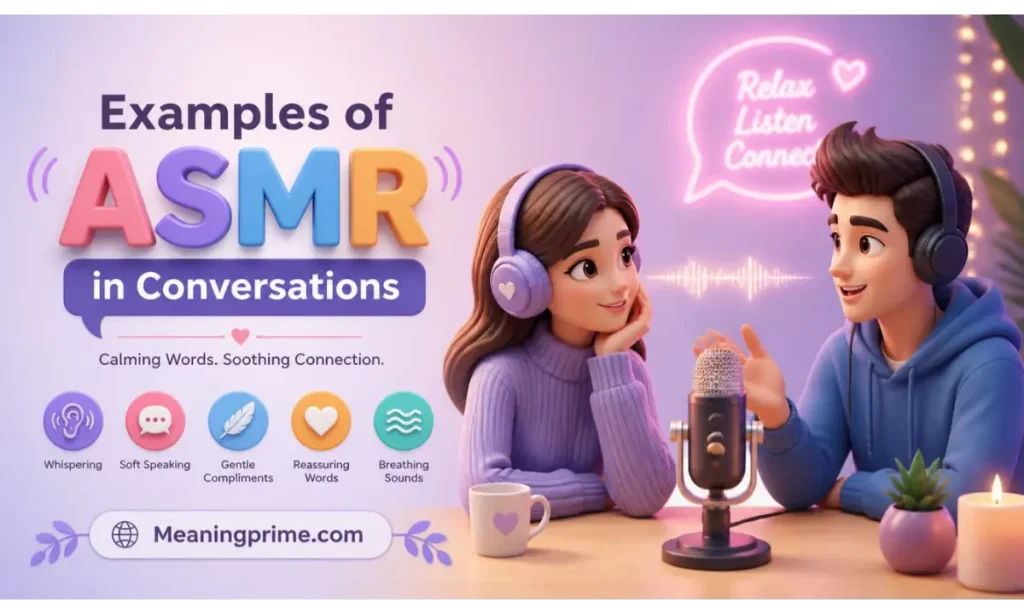
Real chats make the ASMR meaning click faster than any definition. Here are three quick examples.
Example 1: A Sleep Chat
Maya: Can’t sleep again 😩
Leo: Try ASMR tapping videos. They knock me out every time.
Here, ASMR names a video genre made for sleep.
Example 2: A TikTok Comment
“This soap-cutting clip gives me serious ASMR vibes 😍”
The commenter means satisfying and soothing. They probably didn’t feel literal tingles.
Example 3: Formal Use
“The study compared people who experience ASMR with people who don’t.”
In formal writing, the ASMR meaning stays close to the science.
Similar or Related Terms
These terms often show up beside the ASMR meaning. Mixing them up is easy. Here’s a quick glossary.
| Term | Meaning | Relation to ASMR |
|---|---|---|
| Satisfying videos | Visually pleasing clips, like soap cutting | Often overlap with ASMR |
| White noise | Steady background sound | Masks noise; has no triggers |
| Binaural audio | 3D-style sound recording | Creates a sense of closeness |
| Triggers | Sounds or visuals that set off ASMR | The core concept |
| Tingles | The physical sensation | ASMR’s signature feeling |
| Frisson | Sudden chills from music or awe | Similar but distinct from ASMR |
| Misophonia | Strong dislike of certain sounds | Can clash with some triggers |
| ASMR immunity | Triggers stop working | Linked to heavy viewing |
Don’t swap them freely. White noise isn’t ASMR. Satisfying videos aren’t always tingly.
How to Use the Word “ASMR” Correctly
Using the word right takes two minutes. It keeps your captions clear and your chats natural. Match your usage to the real ASMR meaning. You’ll sound like you know the community.
Do
- Use it for tingles set off by sound or visual triggers.
- Use it for the video genre (“I watch ASMR to sleep”).
- Use it casually for soothing things when your audience will get the vibe.
Don’t
- Don’t treat it as medical advice or a cure.
- Don’t call every background sound ASMR. White noise has no triggers.
- Don’t use it like a texting abbreviation such as LOL.
Example Sentences
- “I fall asleep to ASMR whispering videos.”
- “Her scalp massage ASMR is so calming.”
- “That clean desk setup is pure ASMR.”
Common Mistakes or Misinterpretations
A few myths follow the ASMR meaning around. Let’s clear them up.
Mistake 1: Thinking ASMR Is a Medical Term
It isn’t a diagnosis. Researchers study it. It’s still not an official condition. The journal article says potential therapeutic uses should be investigated, not assumed.
Mistake 2: Confusing ASMR With General Relaxation
ASMR ties to specific triggers and often brings tingles. A warm bath is relaxing. It isn’t ASMR.
Mistake 3: Assuming Everyone Feels It
Not everyone does. The PLOS ONE study found the mood boost only in people who experience ASMR. Feeling nothing is perfectly normal.
Mistake 4: Assuming It’s Sexual by Design
ASMR isn’t built as sexual content. Creators and researchers describe it as calming. Some people find it intensely pleasant. A few creators blur the line. That’s not the core ASMR meaning.
| Myth | Fact |
|---|---|
| ASMR is a medical diagnosis | It’s a coined term with early-stage research |
| Everyone feels ASMR | Some people feel nothing |
| ASMR means any relaxing sound | It involves specific triggers |
| ASMR is always sexual | Not by design; it’s mostly aimed at calm |
Frequently Asked Questions
What does ASMR mean in social media?
On social media, ASMR means content built around calming sounds and visuals, plus the tingly feeling it can cause. The ASMR meaning also stretches to a casual way of saying something looks or sounds soothing.
What does ASMR mean on TikTok?
On TikTok, ASMR usually tags short, satisfying clips with whispering, tapping, or soap cutting. The ASMR meaning there is about vibe more than science.
What is an example of ASMR?
A classic example is someone whispering while gently tapping a glass. Others include page turning, hair brushing, soap cutting, and spa role-plays. What works depends on your triggers.
Why do girls watch ASMR?
People of all genders watch ASMR for relaxation, sleep, and comfort. No research points to a girl-specific reason. Some studies recruit mostly women, which can make it look more female than it is.
Can everyone feel ASMR?
No. The PLOS ONE study found that ASMR videos boosted pleasant feelings only in people who experience it. Others may feel calm, nothing, or even annoyance.
Conclusion
To sum up, the ASMR meaning is Autonomous Sensory Meridian Response: a tingly, calming feeling set off by soft sounds or slow visuals. Online, the term stretches to cover a video genre, a casual compliment, a chat reference, and even AI-made clips.
Try it with curiosity. Test a few triggers, keep the volume low, and skip it if it irritates you. It helps many people relax. It isn’t a proven treatment, though. If anxiety or sleep problems weigh on you, talk to a health professional too. Now you know the ASMR meaning well enough to explain it to anyone.