


The phone rings at an odd hour. Your stomach drops before you even answer. Work and plans stop mattering. Someone still expects an explanation. That’s usually when people search for the family emergency meaning, hoping to find the right words and the right rules.
This guide explains the family emergency meaning in plain English. You’ll find real examples, workplace and school rules, leave basics, and message templates you can copy today. Everything here protects your privacy and your peace of mind.
Quick Answer: The family emergency meaning is simple: a sudden, serious situation involving a close relative that needs immediate action. Think hospitalization, accident, death, or urgent caregiving. Most employers and schools accept it as a valid reason for short-notice absence, although pay and proof rules vary.
What Does Family Emergency Mean?
The family emergency meaning comes down to one idea: a sudden, serious problem involving a relative that can’t wait. Someone you love faces danger, illness, loss, or urgent need. You respond right away. Normal responsibilities take a back seat. A stressful week doesn’t qualify. A midnight call from the hospital does.
Most people use the phrase at work, at school, and in travel or legal paperwork. In each setting, the family emergency meaning stays the same. Only the paperwork and the pay change.
Family Emergency Simple Meaning
Here’s the quickest way to say it. A family emergency is an unexpected, serious situation involving a close family member that needs immediate attention. If waiting would make things worse, it usually counts.
Family Emergency Definition Explained
Break the phrase into two parts. Family points to relatives or household members who rely on you. Emergency points to a serious situation that demands action now.
| Word | What It Signals |
|---|---|
| Family | Relatives or close household members |
| Emergency | A serious situation that needs immediate action |
People also use the phrase as a privacy shield. Saying “family emergency” lets you step away without sharing painful details. That’s a big part of the family emergency meaning in daily life.
Family Emergency Meaning in English
In everyday English, the phrase carries a heavy tone. Native speakers picture hospital waiting rooms, car accidents, sudden illness, or a death in the family. They rarely picture a scheduling clash.
Knowing the family emergency meaning in English helps you use the phrase honestly and read it correctly.
Family Emergency Meaning in Hindi and Urdu
Many readers want the phrase in their own language. In Hindi, people write पारिवारिक आपातकाल or परिवार में अचानक गंभीर स्थिति. In Urdu, you can say خاندانی ہنگامی صورتحال or گھر میں اچانک سنگین مسئلہ.
Each version describes an urgent family matter. The family emergency meaning travels well across languages because the idea is universal.
Family Urgency Meaning
You may have seen “family urgency” online. It isn’t a standard English phrase. It’s usually a clumsy version of “urgent family matter” or “family emergency.” The family emergency meaning is clearer to HR teams and teachers.
What Is Considered a Family Emergency?
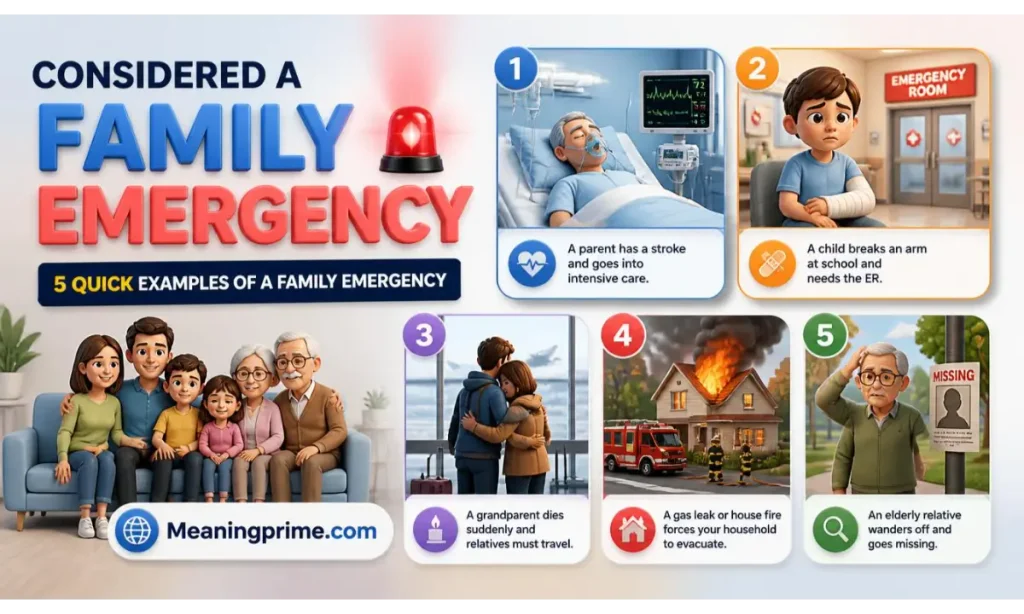
A situation usually qualifies when three things line up. It’s unexpected. It’s serious. It needs action now. Ask yourself one question: would delaying help make this worse? If so, you’re probably facing a true family emergency. That’s the practical family emergency meaning most employers apply.
5 Quick Examples of a Family Emergency
People often ask for five fast examples. Here they are:
- A parent has a stroke and goes into intensive care.
- A child breaks an arm at school and needs the ER.
- A grandparent dies suddenly and relatives must travel.
- A gas leak or house fire forces your household to evacuate.
- An elderly relative wanders off and goes missing.
Each one is sudden, serious, and urgent. That pattern sits behind every family emergency meaning in an HR handbook.
9 Key Family Emergency Examples
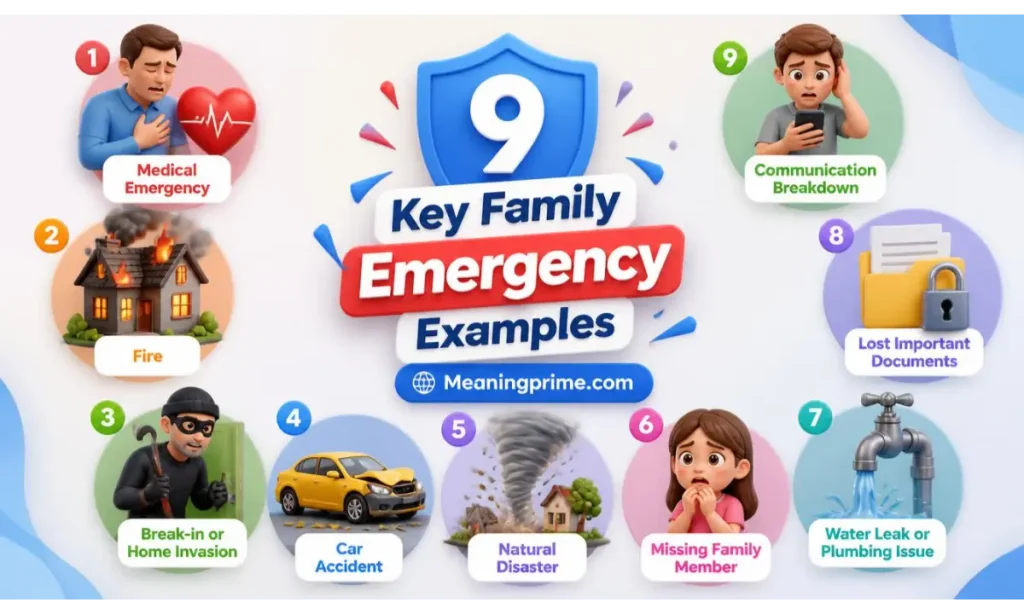
These nine examples cover most real-life situations. Each one shows the family emergency meaning in action.
1. Family Medical Emergency
Heart attacks, strokes, emergency surgery, severe injuries, and ICU admissions all qualify. Picture a midnight call: your mother collapsed. Doctors are rushing her into surgery. No reasonable employer expects normal work after that. A routine checkup is different. It’s inconvenient, not urgent.
2. Death in the Family
A death ranks among the most serious situations anyone faces. You may need to arrange a funeral, travel, and support relatives. Many employers offer bereavement or compassionate leave for this reason. Policies often name spouses, parents, children, and siblings first.
3. Accidents and Sudden Family Incidents
Car crashes, serious falls, and violent incidents demand immediate action. Say your brother’s motorcycle crashes on the highway. You head to the hospital at once. Under any fair reading of the family emergency meaning, that counts.
4. Child-Related Emergencies
Parents get sudden calls from schools and daycares. A child gets hurt on the playground, spikes a dangerous fever, or needs hospital care. An unexpected childcare breakdown can also qualify in some workplaces.
5. Elder Care Emergencies
Aging parents can need help with little warning. A fall, sudden confusion, stroke symptoms, or a caregiver who doesn’t show up can all trigger a crisis.
6. Natural Disasters and Domestic Emergencies
Floods, fires, gas leaks, and storm damage can make a home unlivable overnight. When your household is at risk, the situation overlaps with a family emergency. A gas leak that forces everyone outside at midnight is a clear case.
7. Mental Health and Emotional Crises
Severe mental health crises can be just as urgent as physical ones. A relative who expresses thoughts of self-harm needs immediate support. If someone is in danger, contact your local emergency services first. Employers vary here. Still, the family emergency meaning does include serious cases.
8. Safety Emergencies
Domestic abuse, threats, or a missing child or relative belong here. Safety is the priority. You can keep details private and still say you have a family emergency.
9. Family Emergencies During Travel
Distance makes any crisis harder. A relative’s hospitalization while you’re abroad or a death during vacation can disrupt a trip. Some airlines once offered discounted bereavement fares. Fewer do now. You’ll usually rely on flexible tickets, travel insurance, or the airline’s emergency policy.
What Does NOT Count as a Family Emergency?
Planned events rarely qualify. A birthday party, a vacation, a family dinner, or a surgery scheduled weeks ago won’t usually count. The family emergency meaning depends on urgency. Planned events lack it. In the UK, for example, you generally can’t claim emergency time off for something you knew about in advance.
| Situation | Counts as an Emergency? |
|---|---|
| Heart attack | Yes |
| Sudden childcare collapse | Often |
| Planned surgery weeks ahead | Usually no |
| Routine checkup | No |
| Family vacation | No |
Gray Areas That Depend on Context
Some situations sit in the middle. Sudden divorce crises, severe emotional breakdowns, addiction emergencies, and financial collapse can all land here. One employer may accept them. Another may not. If you’re unsure, ask HR before you assume. The family emergency meaning can stretch or shrink depending on who reads it.
What Makes a Family Issue Serious?
Seriousness usually comes down to risk, urgency, and dependency. Is someone in danger? Does the situation need action today? Does someone depend on you for care?
Family Emergency vs Personal Emergency vs Domestic Emergency
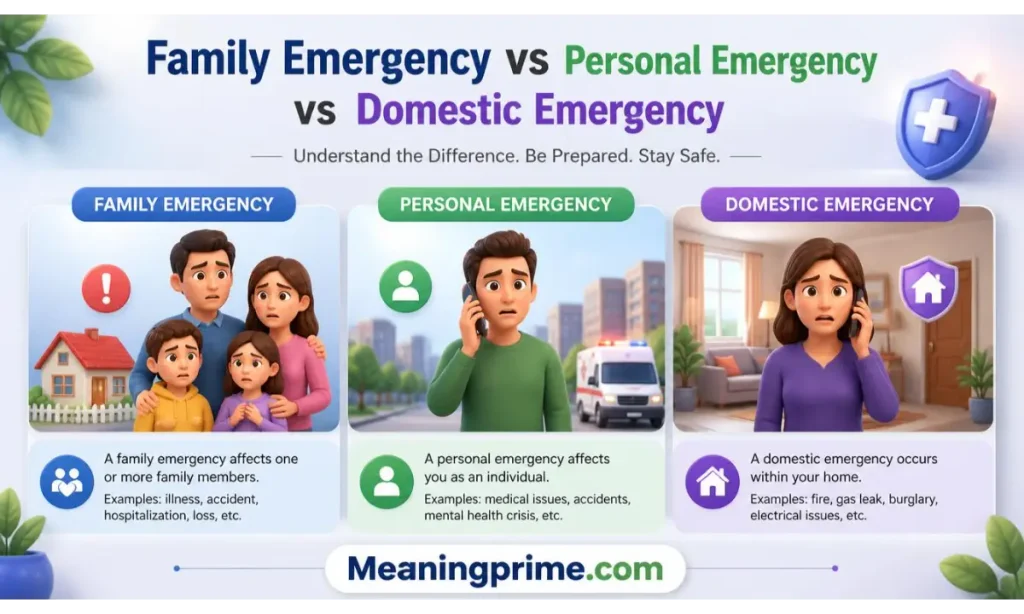
A personal emergency affects you directly. A family emergency affects a relative. A domestic emergency involves the home itself. Many policies treat them differently. That’s why the family emergency meaning matters when you request leave.
| Type | Who or What Is Affected | Example |
|---|---|---|
| Personal emergency | You | A sudden injury |
| Family emergency | A relative | A parent’s hospitalization |
| Domestic emergency | The household | A burst pipe or fire |
Personal Emergency Meaning
A personal emergency is an unexpected, serious event that affects you directly and keeps you from working. Some policies group it with family matters. Others keep it separate. Compared with the family emergency meaning, a personal emergency centers on you rather than a relative.
Immediate vs Extended Family: Who Counts?
Immediate family usually means a spouse, parents, children, and siblings. Extended family covers grandparents, aunts, uncles, cousins, and in-laws. Some employers approve leave only for immediate relatives. UK law uses the term “dependant,” which includes a spouse, partner, child, grandchild, parent, or someone who relies on you for care. So the family emergency meaning shifts with the policy wording.
Cultural Differences in Family Emergency Meaning
In many cultures, cousins feel like siblings and grandparents often live in the same home. An uncle may act as a second father. A crisis involving those relatives carries the same weight. If your situation falls outside the standard definition, explain the relationship in one honest line.
What to Say Instead of Family Emergency
Sometimes you want a softer or more formal phrase. Maybe you’re writing to a client. Maybe you want to share less. The family emergency meaning stays intact with each alternative below.
Another Word for Family Emergency
- Urgent family matter
- Family crisis
- Critical family situation
- Serious family matter requiring immediate attention
- Urgent personal matter
When to Use Each Alternative
| Phrase | Best For |
|---|---|
| Urgent family matter | Managers and general emails |
| Family crisis | Close colleagues |
| Critical family situation | Formal emails and HR |
| Urgent personal matter | Sharing minimal detail |
Whichever you choose, keep it honest. The family emergency meaning holds only when the situation is real.
Family Emergency at Work
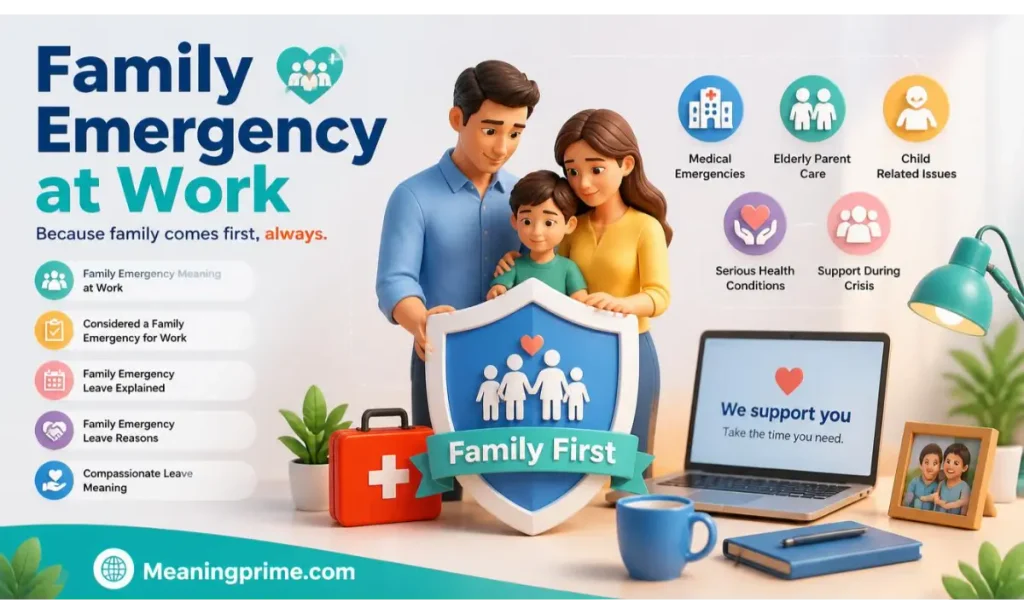
Workplaces use the phrase more than any other setting. It signals that you need to leave now with little notice. Employers generally respect that, although processes differ.
Family Emergency Meaning at Work
At work, the phrase means a serious family situation that needs your immediate attention away from your duties. Employers expect real urgency. Most also respect your privacy. The family emergency meaning at work is practical, not dramatic. You need time. Your team needs a plan.
What Is Considered a Family Emergency for Work?
Most workplaces accept hospitalizations, serious accidents, deaths, urgent childcare or eldercare gaps, and household disasters. Planned appointments and ordinary scheduling problems usually don’t count. Your company handbook has the final word. If it doesn’t list qualifying events, explain honestly and ask what options exist.
Family Emergency Leave Explained
Family emergency leave is time off for an urgent family situation. It might be paid, unpaid, or drawn from PTO or sick days. Some companies offer a dedicated policy. Others handle requests case by case. Policies usually spell out who qualifies, how long you can stay away, and what documents you need. Vacation is planned. Emergency leave happens suddenly.
Family Emergency Leave Reasons
| Reason | Usually Accepted? |
|---|---|
| Death in the family | Yes |
| Child’s hospitalization | Yes |
| Parent’s emergency surgery | Yes |
| Serious family accident | Yes |
| Urgent eldercare gap | Often |
| Planned family event | No |
Compassionate Leave Meaning
Compassionate leave is time off during an emotionally difficult family situation, such as a death or a terminal illness. Some countries protect it by law. Others leave it to employers. It can be paid or unpaid. Read your policy closely, because the family emergency meaning in HR documents can differ from everyday speech.
How Do I Request Leave Due to a Family Emergency?
Follow these steps:
- Tell your manager as soon as you can, by call or message.
- State that it’s a family emergency and give a rough timeframe.
- Offer to hand off urgent tasks if you’re able.
- Follow up with HR in writing and ask which leave type applies.
- Keep documents such as hospital letters in case someone asks.
Can Employers Ask About a Family Emergency?
Yes, within reason. Employers may ask for a general explanation and sometimes documentation, such as a hospital letter, funeral notice, or doctor’s note. However, privacy laws often limit how much medical detail they can demand. If you feel pressured, ask HR which details are required and why. The family emergency meaning gives you a right to urgency, not an obligation to overshare.
Family Emergencies and Remote Work
Remote work changes the picture. Tell your manager what you can realistically do and what you can’t. Working from home doesn’t make a crisis smaller.
Family Emergency Leave and Your Legal Rights
Laws differ a lot by country. The notes below are general information, not legal advice. Check your local labor rules or speak with a qualified professional. The family emergency meaning in law often looks narrower than everyday usage.
United States (FMLA)
The US has no single federal law for emergency leave. The Family and Medical Leave Act, or FMLA, can provide up to 12 weeks of unpaid, job-protected leave in a year. It applies to eligible employees at covered employers, generally those with 50 or more workers. It covers serious health conditions of the employee, a spouse, a child, or a parent. It doesn’t cover bereavement. Eligibility usually requires about 12 months with the employer and roughly 1,250 hours worked.
United Kingdom, Australia and Canada
In the UK, employees can take a reasonable amount of time off for an emergency involving a dependant. There’s no set limit on how often. Employers don’t have to pay for it. You can’t use it for something you knew about beforehand.
In Australia, the Fair Work Act lets employees use personal or carer’s leave to support an immediate family or household member facing an unexpected emergency. Compassionate leave exists separately.
In Canada, rules depend on the province or on whether the employer is federally regulated. Some provinces offer unpaid emergency or family responsibility leave.
Is a Family Emergency a Valid Excuse?
In most workplaces and schools, yes. Hospitalizations, deaths, serious accidents, and urgent childcare problems rarely get questioned. However, repeated vague claims can raise eyebrows. The family emergency meaning works as an excuse only when it’s true.
Last-Minute Family Emergency Excuses: Real Reasons vs Fake Ones
Real emergencies are often last-minute by nature. A fall, a crash, or a sudden hospital call leaves no time to plan. Send a short message right away. Add one useful detail, such as when you’ll update them.
Invented emergencies are different. They collapse under follow-up questions and damage trust. If you simply need time off, say so honestly and request personal leave. That path is safer than an excuse that could cost you your job.
Family Emergency at School or College
Students face crises too. Schools often allow makeup exams, deadline extensions, and attendance flexibility. Contact your teacher or professor as early as possible. Explain briefly and save documentation. Ask for a specific accommodation, like a new exam date. Silence is the biggest mistake. The family emergency meaning is widely understood in academic settings.
How to Explain a Family Emergency Professionally
Stay calm and keep it short. You don’t owe anyone a dramatic story. A strong message reflects the true family emergency meaning: serious, urgent, and brief.
How Do I Say I Have a Family Emergency?
Say it directly. For example: “I’m dealing with an urgent family emergency and need to leave immediately.” Another option: “A serious family situation has come up. I need to step away.” Add a follow-up line such as “I’ll update you as soon as I can.”
How to Tell Your Boss
Timing matters most. Tell your manager as soon as you can. Stay honest and keep details brief. If possible, name the person who can cover urgent tasks. A phone call works for very urgent cases. A short text works when you can’t talk.
Can You Say “Family Emergency” Without Details?
Yes. Most workplaces respect that. You can say, “I have a family emergency.” You can also say, “I’m handling an urgent family matter.” Detailed medical explanations usually aren’t required at the start.
Notification Etiquette and Mistakes to Avoid
Keep notifications clear, short, respectful, and honest. Then steer clear of these mistakes:
- Disappearing without notice
- Giving conflicting stories
- Sharing too many private details
- Using dramatic language
Family Emergency Message Templates
Here are ready-to-use messages. Adjust names and details to fit. A good template mirrors the family emergency meaning: urgent, short, and honest.
Short Family Emergency Message to Boss
Hi [Name], I have a family emergency and need to leave right away. I’ll update you as soon as I can. Thank you for understanding.
Text Message to a Manager
Hi [Name], I’m dealing with a family emergency and won’t be in today. I’ll keep you posted. Please text me if anything urgent comes up.
Emergency Leave Email
Subject: Emergency Leave Request – [Your Name]
Dear [Manager’s Name],
I’m facing an urgent family emergency and need time away from work starting [date]. I expect to be out until [date or “further notice”]. [Colleague’s name] can cover [task] while I’m away. I’ll update you as soon as I have more information.
Thank you for your understanding.
[Your Name]
Message to a Teacher or Professor
Dear Professor [Name],
I’m dealing with an urgent family emergency and may miss class on [date]. I’d appreciate guidance on makeup work or a new deadline. I can provide documentation if needed.
Thank you for your understanding.
[Your Name]
Family Emergency and Privacy
You don’t owe the entire office your family’s private story. Medical conditions, addiction, abuse, and financial trouble are deeply personal. Share what your employer needs to approve leave and nothing more. A key part of the family emergency meaning is that it protects sensitive details while staying honest about urgency.
Family Emergency and Mental Health
A crisis hits the mind as hard as the schedule. People often feel anxiety, poor sleep, exhaustion, and decision fatigue. That overload is real.
Be gentle with yourself. Ask someone to take one task off your plate. If your distress feels unmanageable, speak with a doctor, a counselor, or a crisis support line in your country.
What to Do During a Family Emergency
Panic clouds judgment. Start with the basics. The family emergency meaning is urgency. Urgency calls for a clear head.
Immediate Response Steps
| Step | Why It Helps |
|---|---|
| Confirm the facts | Prevents confusion |
| Call emergency services if anyone is in danger | Protects safety |
| Inform close family | Coordinates support |
| Notify your workplace or school | Avoids conflict later |
| Gather key documents | Handles logistics |
Delegate where you can. One person can’t manage everything alone.
Emergency Contacts Worth Having Ready
Keep these where you can find them fast: phone numbers for close relatives and neighbors, doctors and your preferred hospital, medication lists, insurance details, and guardian paperwork. Update the list twice a year.
How Families Can Prepare
Create an emergency contact list. Organize medical information. Agree on who handles childcare, transportation, and hospital updates. Talk openly about what counts as an emergency in your family. Shared expectations make the family emergency meaning easier to act on when stress runs high.
Warning Signs of a Growing Crisis
Not every emergency arrives suddenly. Watch for worsening health, caregiver burnout, mental health decline, financial strain, and escalating conflict. Reach out for help sooner rather than later.
Common Myths About Family Emergencies
- Myth: Only death counts. Medical crises, accidents, and caregiving emergencies qualify too.
- Myth: Employers need every detail. They usually need basic information only.
- Myth: Emergency always means paid leave. Pay varies by employer and by law.
- Myth: Any family problem qualifies. Urgency is the real test.
Clearing up these myths sharpens the family emergency meaning for everyone.
Frequently Asked Questions
What does family emergency mean?
It means a sudden, serious situation involving a family member that needs immediate attention. The family emergency meaning centers on urgency, such as a hospitalization, accident, or death.
What is considered a family emergency for work?
Hospitalizations, serious accidents, deaths, urgent childcare or eldercare gaps, and household disasters usually qualify. Planned events generally don’t. Your employer’s policy has the final say.
What is another word for family emergency?
Common alternatives include urgent family matter, family crisis, and critical family situation. Each carries the same urgency with a slightly different tone.
How do I request leave due to a family emergency?
Tell your manager as soon as possible. State that it’s a family emergency, give a rough timeframe, and follow up with HR in writing. Keep any documents in case someone requests them.
Can my employer ask for proof of a family emergency?
Yes, within reason. They may request basic documentation, such as a hospital letter or funeral notice. Privacy rules often limit how much medical detail they can demand.
Conclusion
At its core, the family emergency meaning is simple. A sudden, serious situation involving someone you love demands your attention right now. Urgency separates it from ordinary family stress. Planned events rarely qualify. Real crises almost always do.
When your moment arrives, communicate early, keep it brief, and protect your privacy. Check your workplace policy and local laws. Be kind to yourself too. Life changes without warning. The family emergency meaning reminds us that people come first.