

Somebody sends you one text: “IDGAF.” Now you’re staring at your screen, wondering if they’re joking, angry, or just done with the conversation. Searching for the IDGAF meaning in text is a smart move, because those five letters can feel like a casual shrug or a slammed door.
This guide breaks down the IDGAF meaning in text and the nine different vibes it can carry. You’ll get origin facts, platform examples, reply ideas, and tone clues you can use right away. Read on, and you’ll decode that message like a pro.
Quick Answer: The IDGAF meaning in text is “I Don’t Give a F***.” It shows strong indifference, though the tone can be playful, confident, or angry. It contains profanity, so skip it at work and school.
- IDGAF meaning in text: I Don’t Give a F***
- Tone: Blunt, casual, emotional
- Safer swap: IDC (“I don’t care”)
IDGAF Meaning in Text
The IDGAF meaning in text is simple on paper. It stands for “I Don’t Give a F***.” It tells the reader you don’t care about a topic, an opinion, or an outcome. Because it includes profanity, it lands harder than a plain “I don’t care.”
Tone does the heavy lifting. Among close friends, IDGAF can sound like a goofy shrug. During an argument, it can feel like a slammed door. Sometimes it even works as armor, a quiet way of saying your opinion won’t shake me.
Think of it as a volume knob. The letters stay the same while the context turns the feeling up or down. That’s why the IDGAF meaning in text always depends on who sends it, when they send it, and which emoji tags along.
Quick Summary
Here’s the IDGAF meaning in text at a glance:
| Detail | Quick Answer |
|---|---|
| Full form | I Don’t Give a F*** |
| Tone | Blunt, emotional, informal |
| Best for | Close friends, memes, captions |
| Avoid in | Work emails, school, family chats |
| Milder swaps | IDC, IDRC |
Background and Origin
Understanding the IDGAF meaning in text starts with its timeline. The phrase behind the abbreviation is older than the shorthand itself. Once chat rooms and texting took off, typing fewer letters saved time (and thumbs). Here’s the verified timeline:
| Year | Milestone |
|---|---|
| 2003 | The earliest known Urban Dictionary definition appears on April 2 |
| 2006 | NetLingo adds the term on June 15 |
| 2009 | Blood On the Dance Floor releases a track titled “I.D.G.A.F.” on June 14 |
| 2012 | A joke recasts it as “I Don’t Give Away Food” and spreads as a Twitter copypasta |
| 2022 | Twitter users turn it into the “IDGAF Wars,” a contest over who seems least bothered |
Notice something? The IDGAF meaning in text never changed. Only the culture around it did. Major artists, including Dua Lipa and Drake, have released songs with the title. Those releases pushed the abbreviation even deeper into everyday speech.
Slang usually works that way. A phrase sticks around when it saves effort and says something people actually feel.
IDGAF Meaning in Gen Z Slang
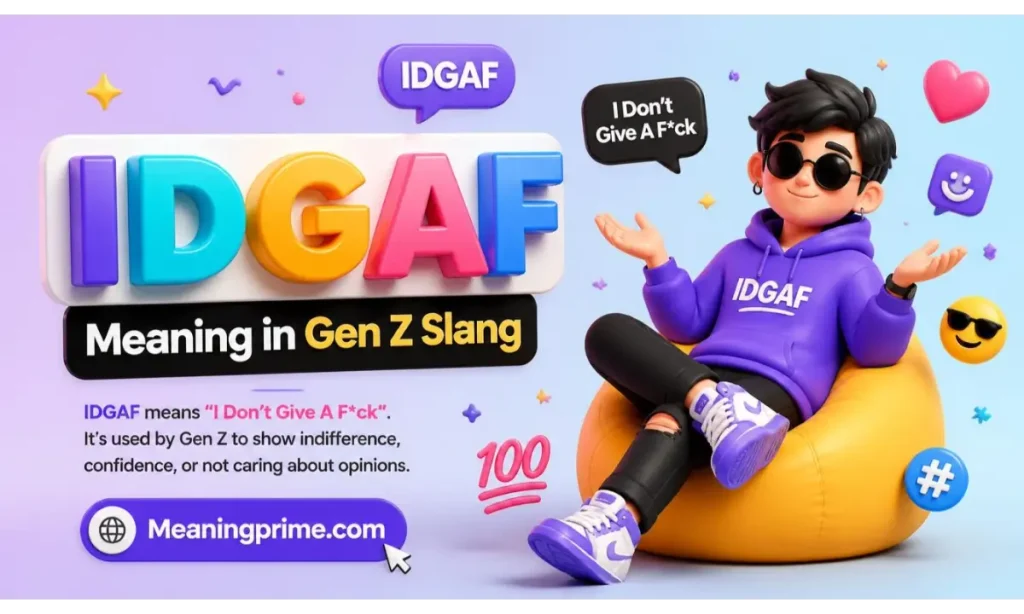
Ask a teenager about the IDGAF meaning in text, and you’ll probably hear “I’m unbothered.” For Gen Z, the phrase often signals confidence more than anger. It shows up in self-love captions, group-chat jokes, and comment-section clapbacks.
Still, Gen Z knows the edge is real. Aimed straight at a person, IDGAF stays rude. Tone markers such as lowercase letters and a laughing emoji (“idgaf 😂”) soften it fast. Think of lowercase as a quiet voice and all caps as a raised one. Without those clues, the IDGAF meaning in text is easy to misjudge.
9 Bold Meanings of IDGAF in Text
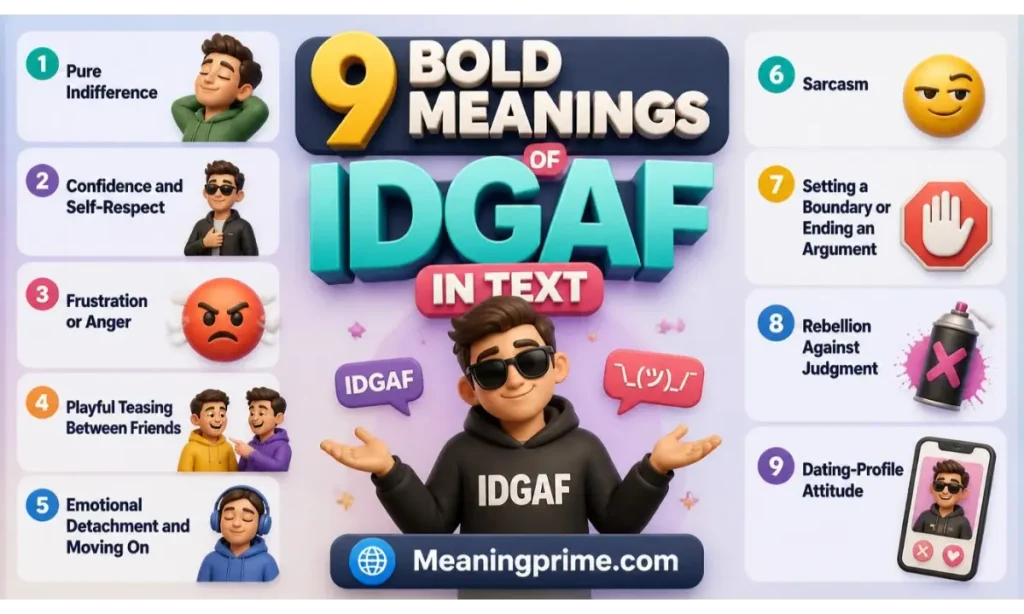
The IDGAF meaning in text stays fixed, yet the feeling behind it shifts a lot. Here are nine bold meanings, each with examples you can borrow or decode.
1. Pure Indifference
Sometimes IDGAF means exactly what it says. You truly have no preference. The outcome won’t matter to you.
- “IDGAF which pizza we order. Surprise me.”
- “Honestly, idgaf what time we leave.”
Nobody’s angry here. The sender is just relaxed, maybe a little lazy.
2. Confidence and Self-Respect
Here the phrase becomes a power move. The sender stops chasing approval and starts trusting their own taste.
- “New haircut, IDGAF who likes it 😎”
- “Wearing the loud jacket anyway. IDGAF.”
It’s self-trust packed into five letters. Instagram captions often carry this version.
3. Frustration or Anger
Now the mood turns sharp. After a long argument, IDGAF can mean “I’m done.” Short sentences and hard periods give it away.
- “You keep repeating yourself. IDGAF anymore.”
- “Fine. IDGAF.”
Don’t mistake this version for a joke. It’s the harshest side of the IDGAF meaning in text.
4. Playful Teasing Between Friends
Between close friends, the phrase becomes a running gag. Laughing emojis give the game away.
- “You’re late again? IDGAF, I already ate 😂”
- “IDGAF if you win. I’m still taking the last fry.”
Nobody feels attacked. Everyone’s grinning. Group chats run on this energy.
5. Emotional Detachment and Moving On
People also use IDGAF to close a chapter. It can sound brave. Sometimes it hides hurt.
- “They left me on read, but IDGAF now.”
- “idgaf anymore. I’m healing.”
If a friend sends this after a breakup, check in gently. A quick “You okay?” goes a long way.
6. Sarcasm
Sarcasm flips the meaning upside down. The sender actually cares a lot but pretends not to.
- “Oh sure, IDGAF that you used my charger 🙄”
- “IDGAF about the spoilers, obviously.”
Eye-roll emojis and exaggerated punctuation are your clues. Here the IDGAF meaning in text turns inside out.
7. Setting a Boundary or Ending an Argument
Occasionally IDGAF works like a stop sign. The sender wants the debate over.
- “Believe what you want. IDGAF.”
- “I’m not explaining myself again. IDGAF.”
It’s blunt. Still, it can protect someone’s peace when a conversation keeps looping. Just don’t aim it at someone who’s trying to help.
8. Rebellion Against Judgment
Teens and young adults often use IDGAF to push back against rules, labels, or gossip.
- “Judge me all you want. IDGAF.”
- “Haters can keep talking. IDGAF.”
This version shows independence more than hostility toward any one person. Think of it as a verbal eye-roll at the crowd.
9. Dating-Profile Attitude
On dating apps, IDGAF signals a no-games vibe.
- “Honest about what I want. IDGAF about games.”
- “Life’s short. IDGAF about drama.”
Some readers find that refreshing. Others read it as guarded. Either way, the IDGAF meaning in text on a profile says “I won’t chase.”
The nine meanings at a glance:
| # | Meaning | Typical Clue |
|---|---|---|
| 1 | Pure indifference | “Surprise me,” casual tone |
| 2 | Confidence | Sunglasses emoji, caption |
| 3 | Frustration | Hard periods, short lines |
| 4 | Playful teasing | Laughing emojis |
| 5 | Moving on | “Anymore,” “now” |
| 6 | Sarcasm | Eye-roll emoji |
| 7 | Boundary | “Believe what you want” |
| 8 | Rebellion | “Judge me,” “haters” |
| 9 | Dating attitude | Profile bio, “games,” “drama” |
How to Use IDGAF Naturally in a Sentence
Using the IDGAF meaning in text well means matching the sentence to the vibe. The abbreviation fits at the start, in the middle, or at the end of a message.
- Start: “IDGAF what they say.”
- Middle: “Honestly, I IDGAF about that anymore.”
- End: “They can complain all day. IDGAF.”
- Standalone: “IDGAF.”
A few habits help. Pair it with a clear subject, such as “what they think” or “who wins.” Add an emoji when you’re joking. Skip it with people you don’t know well, because overuse makes your messages sound aggressive.
Knowing the IDGAF meaning in text is one thing. Using it with good timing is another. If you only want to say something isn’t important, IDC or “I don’t mind” feels friendlier.
Usage in Different Contexts
The IDGAF meaning in text stays steady across settings. The stakes, however, change a lot.
In Text Messages
Friends send it to show they’ve stopped worrying about something. “They ignored me, but IDGAF.” Or “IDGAF anymore. I’m moving on.”
On Social Media
Captions, tweets, comments, and memes use it to show confidence or independence. “Living my best life. IDGAF 😎” and “Haters keep talking. IDGAF” are classic examples.
In Gaming
Players drop it after a loss or when they want to look relaxed. “We lost, but IDGAF. Run it back.” In Discord voice chats, it often pairs with laughter.
In Everyday Conversations
Close friends type it during casual debates about food, plans, or opinions. “IDGAF where we eat. Just pick.” Say it out loud and it sounds even harsher, so choose your moment.
In Professional Settings
Skip it. Profanity, even abbreviated, reads as disrespectful at work. The IDGAF meaning in text doesn’t earn a free pass just because it’s short. Try “I’m flexible” or “I have no strong preference” instead.
Meaning Across Different Platforms
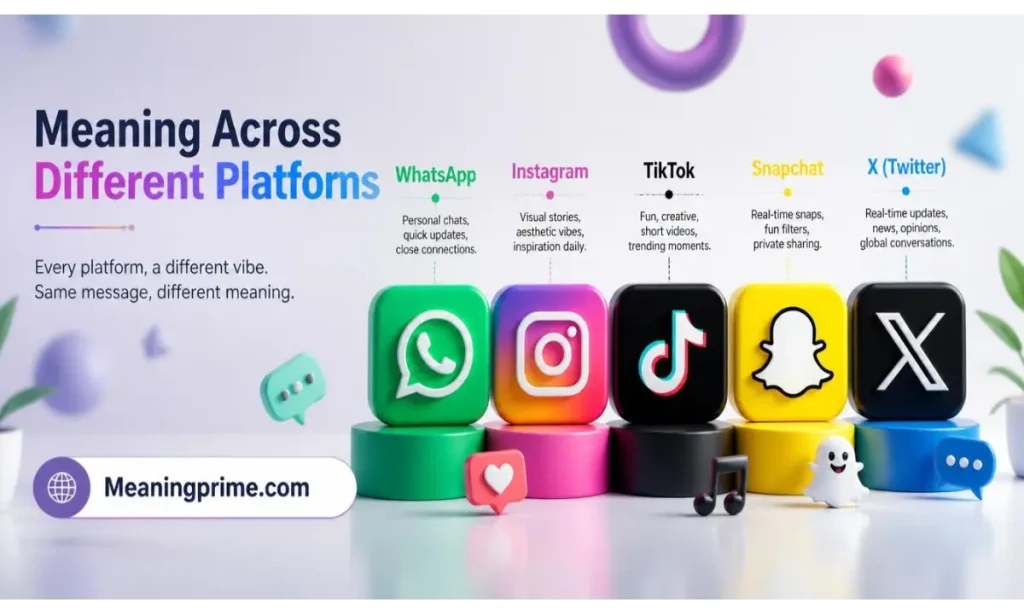
The IDGAF meaning in text doesn’t change by app. The tone does.
Family and friends use it casually. Watch out for group chats that include relatives. “IDGAF what happened yesterday.”
Captions about self-expression love it. “Being myself because IDGAF anymore.” Stories add emojis that soften the blow.
TikTok
Creators use it in bold-opinion videos and trend captions. Comments often echo it with jokes and laughing emojis, which keeps the mood light.
Snapchat
Private chats between friends carry the most honest versions. Messages disappear fast, so people feel free to vent.
X (Twitter)
Short, strong opinions live here. The platform also gave the IDGAF meaning in text its own meme era with the 2022 “IDGAF Wars.”
One pattern repeats everywhere. Public posts lean confident, and private chats lean raw. Same letters, different audience.
Does IDGAF Mean Anything in Other Fields?
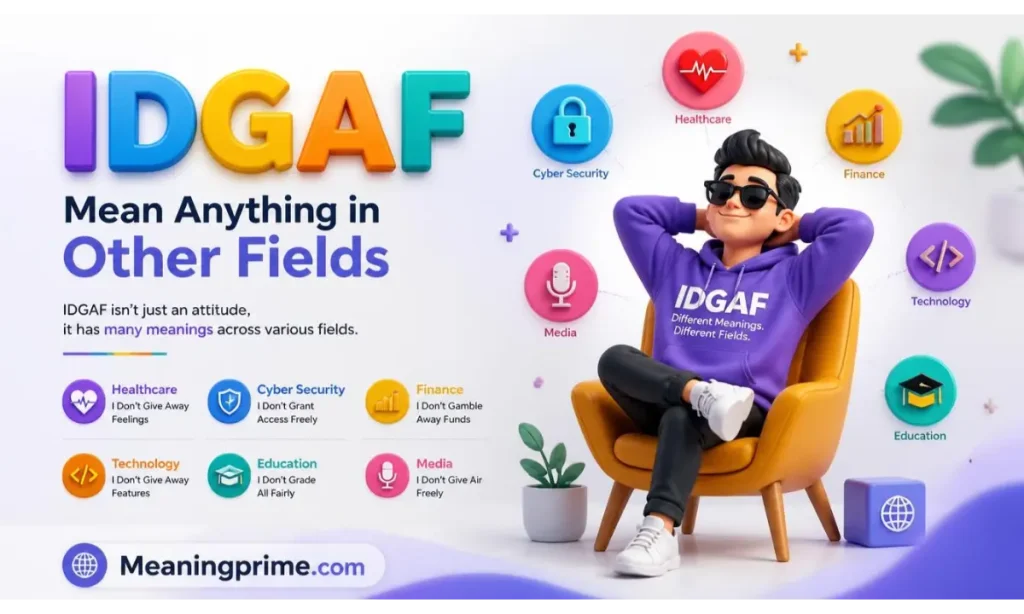
No. Unlike abbreviations that double as medical or technical terms, IDGAF lives almost entirely in slang. The only twist is the 2012 joke version, “I Don’t Give Away Food,” which people post when someone asks to share a snack. Everywhere else, the IDGAF meaning in text is the profane one. If you spot it in a technical document, it’s probably just someone’s casual comment.
Common Misconceptions and Mistakes
Plenty of people misread this one. Here are the usual traps:
- “It’s polite because it’s short.” Not true. Initials don’t clean up the profanity.
- “It always means anger.” Often it’s a joke or a confidence boost.
- “Everyone finds it funny.” Parents, teachers, and bosses usually don’t.
- “It’s fine in a first message.” With new matches or new groups, it can read cold.
- “It’s identical to IDC.” IDC is much milder.
Before you hit send, think about the IDGAF meaning in text from the reader’s side, not just yours.
Similar Terms and Alternatives
Want the same message with less heat? This table compares the IDGAF meaning in text with its closest cousins.
| Term | Meaning | Tone |
|---|---|---|
| DGAF | Don’t Give a F*** | Strong, more general |
| IDC | I Don’t Care | Mild |
| IDRC | I Don’t Really Care | Softer |
| IDFC | I Don’t Freaking Care | Strong but cleaner |
| IDGAFF | I Don’t Give a Flying F*** | Strong, dramatic |
| GAF | Give a F*** | Opposite: you care |
| “No preference” | Plain English | Friendly, safe anywhere |
Choose by audience, not by habit. The IDGAF meaning in text is the loudest option in the group.
IDC Meaning in English
IDC means “I don’t care.” It’s the standard, family-friendly version of IDGAF. English speakers use it for light dismissals like “IDC what we watch.” It can still sound curt when typed flatly, so add a friendly emoji.
IGAF, IDGAC, IDGAS & Other IDGAF Look-Alikes
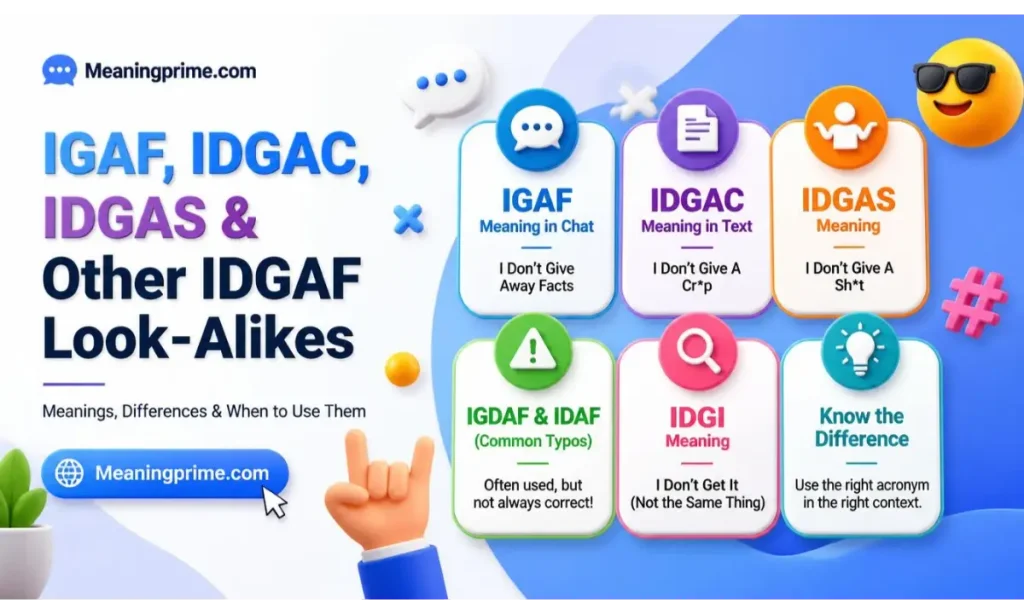
Searches for odd versions of the IDGAF meaning in text pop up constantly. Some are real variants. Others are plain typos.
IGAF Meaning in Chat
IGAF drops the “D” and flips the message. It reads “I give a f***,” which means you care a lot. People use it ironically or by accident. One missing letter swaps the whole meaning, so check the context.
IDGAC Meaning in Text
IDGAC is the toned-down cousin: “I Don’t Give a Crap.” It’s less harsh yet still casual. “IDGAC what they wear.”
IDGAS Meaning
IDGAS means “I Don’t Give a S***.” It sits close to IDGAF in strength, with a different swear word. Treat it exactly like the IDGAF meaning in text when you judge the tone.
IGDAF and IDAF (Common Typos)
Thumbs scramble letters. IGDAF is almost always a typo for IDGAF. IDAF looks like another missing-letter slip. Readers usually guess the intended phrase from context. If you’re unsure, just ask.
IDGI Meaning (Not the Same Thing)
IDGI means “I don’t get it.” It has nothing to do with caring less. “Wait, IDGI. Can you explain the joke?” The IDGAF meaning in text is about attitude, while IDGI is about confusion.
IDGAF vs Similar Expressions
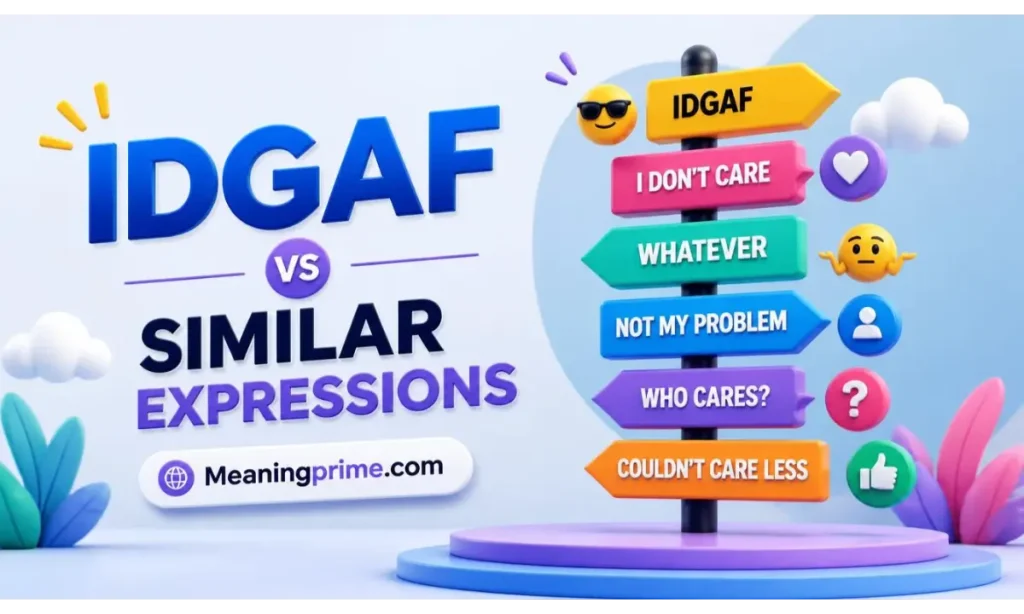
Picture a heat scale. IDRC sits at a gentle warm. IDC lands in the middle. DGAF and IDGAF run hot. The “I” in IDGAF makes it feel more personal, because the speaker owns the statement. DGAF often sounds like a general attitude. That small difference explains why the IDGAF meaning in text hits harder in a direct reply.
How to Respond to IDGAF
Your reply depends on what the IDGAF meaning in text is doing in that moment.
If it’s a joke:
Friend: “IDGAF what movie we watch 😂”
You: “Perfect. I’m picking the scary one.”
If they sound upset:
Friend: “IDGAF anymore.”
You: “That sounds heavy. Want to talk?”
If they’re feeling confident:
Friend: “They can judge. IDGAF.”
You: “Own it. You look great.”
If it’s aimed at you:
Friend: “IDGAF what you think.”
You: “Okay. I’ll give you space, and we can talk later.”
Stay calm. Short replies usually beat long defenses. Matching heat with heat rarely helps, and reading the IDGAF meaning in text correctly keeps small fights small.
Relevance in Online Conversations and Dating Apps
On dating apps and social platforms, people use IDGAF to look confident, independent, or drama-free. “IDGAF about toxic relationships.” “Life’s too short. IDGAF what others think.” Used in a first message, however, it can seem rude or guarded. The IDGAF meaning in text works best once you already know someone’s sense of humor. Until then, a friendlier line wins.
Popularity and Trends Over Time
IDGAF has lasted because it’s quick, expressive, and instantly recognizable. Interest tends to spike when a meme goes viral, a celebrity uses the phrase, or a song with the title gets attention. The 2022 “IDGAF Wars” showed how far the attitude can stretch. Even now, the IDGAF meaning in text stays widely recognized across apps and age groups.
What Does IDGAF Say About the Speaker’s Tone?
The words never change, but the signals around them do. Use this guide to read the IDGAF meaning in text like a detective:
| Signal | Likely Tone |
|---|---|
| Lowercase letters, laughing emoji | Playful |
| Sunglasses emoji, caption style | Confident |
| Period after it, no emoji | Cold or done |
| Eye-roll, extra punctuation | Sarcastic |
| Aimed at a person (“IDGAF what YOU think”) | Hostile |
No single clue is perfect. Read the whole message and consider the relationship. Taken together, those signals decode the IDGAF meaning in text far better than the five letters alone.
Frequently Asked Questions
What does IDGAF stand for in Gen Z slang?
In Gen Z slang, IDGAF stands for “I Don’t Give a F***.” It usually signals confidence or being unbothered, although the IDGAF meaning in text can turn harsh in arguments.
Is IDGAF a rude word?
It can be. It includes profanity, so context decides. It’s fine with close friends and risky with almost everyone else.
What’s the difference between IDGAF and IDC?
IDC means “I don’t care” and sounds milder. IDGAF adds profanity and stronger emotion, so the IDGAF meaning in text feels sharper.
Can I use IDGAF at work or school?
It’s best to avoid it. Say “I have no preference” or “I’m flexible” instead.
What do IDGI and IGDAF mean?
IDGI means “I don’t get it.” IGDAF is usually a typo of IDGAF. Neither changes the IDGAF meaning in text, but check the context before you reply.
Conclusion
The IDGAF meaning in text never shifts: “I Don’t Give a F***.” What changes is the vibe, which can be playful, confident, sarcastic, or cold. Nine bold meanings, one phrase. Tone, emojis, punctuation, and your history with the sender tell you which one you’ve got.
Use it only with people who get the joke. Keep it out of work, school, and family chats, and reach for IDC when you want the same message with less edge. Once you read context well, the IDGAF meaning in text stops being confusing and starts being easy.