

You got a text back. Just three letters: “IDTS.” No smiley, no explanation, nothing. Your brain immediately starts spinning — is this person annoyed with you? Are they joking? Did you just get quietly shut down?
That confusion is exactly why so many people search for the IDTS meaning in text. This guide breaks down what it actually stands for, how the tone shifts depending on who’s texting you, and what to say back so you don’t overthink a three-letter reply.
Quick Answer Box
IDTS stands for “I Don’t Think So.” People use it to express doubt, disagreement, or skepticism in texts, DMs, and comments. It’s informal, common across every major platform, and its tone depends heavily on punctuation, emojis, and the relationship between the two people texting.
What Does IDTS Mean in Text & Chat?
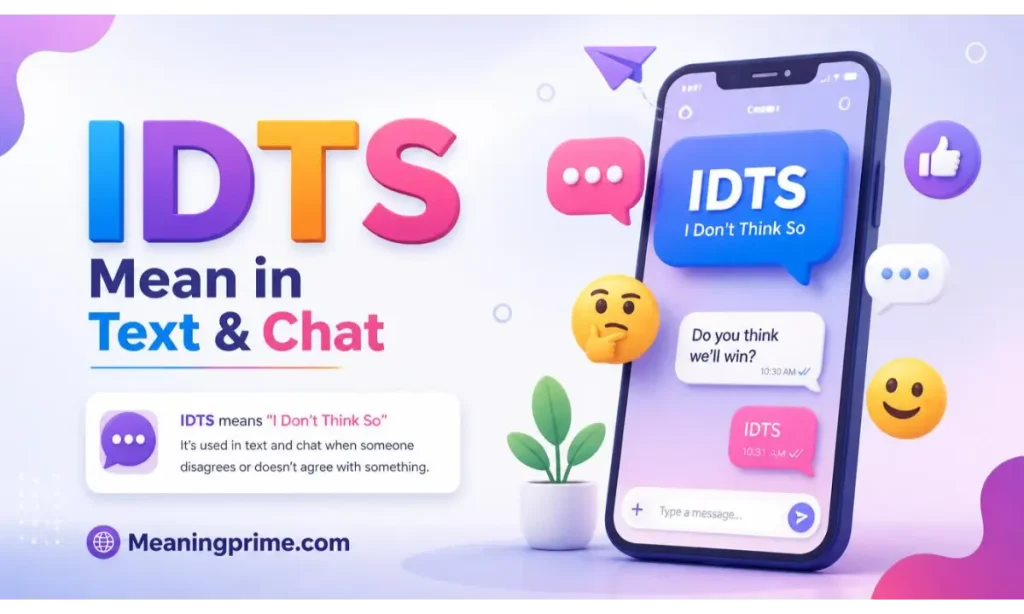
In texting and online messaging, IDTS means “I Don’t Think So.” People use it when they doubt something, disagree with a statement, or think an outcome is unlikely.
Here’s a typical exchange:
- Friend: “Do you think the store’s still open?”
- You: “IDTS, it’s already 9 PM.”
That’s the whole point of the IDTS meaning in text — it’s a fast, low-effort way to push back on something without writing out a full sentence. Whether it sounds playful or blunt depends entirely on what surrounds it.
Full Form, Stands For & Short Meaning of IDTS
The full form of IDTS is simple: I Don’t Think So.
There’s no secret alternate expansion floating around texting culture. It’s just a shortened version of a phrase people already say out loud constantly.
Short meaning, in plain terms:
- Expresses doubt about something
- Politely disagrees with a statement
- Signals uncertainty
- Suggests an outcome probably won’t happen
Typing four sentences to say “I doubt it” gets old fast. IDTS solves that problem in four keystrokes.
Origin, History & First Known Use of IDTS
IDTS grew out of the same era that gave us LOL, BRB, and IDK — early SMS texting and instant messaging platforms from the 2000s, back when character limits and slow flip-phone keyboards made shortcuts genuinely useful.
There’s no exact date anyone can point to as its “first use.” It just slowly became part of how people typed casual disagreement, and it stuck around because it’s short, clear, and easy to type with one thumb.
How People Use IDTS in Daily Conversations
Context changes everything about how IDTS lands, so let’s look at where it actually shows up.
Texting Examples
- “IDTS we’re finishing this project today.”
- “IDTS she knows about the surprise.”
- “IDTS that’s the right answer.”
Social Media Usage
On platforms like X and TikTok, people drop IDTS in comment threads to push back on predictions or hot takes.
- User 1: “This team’s winning the championship.”
- User 2: “IDTS, they’ve looked rough all season.”
Casual Situations
Between friends, it’s basically a shrug in text form.
- “You think it’ll rain later?”
- “IDTS, the sky looks clear.”
IDTS Meaning Across WhatsApp, Instagram, TikTok & Snapchat
The core meaning of IDTS in text doesn’t change from app to app, but the vibe does shift a little.
WhatsApp conversations tend to be private and personal, so IDTS shows up between close friends or family without much filtering.
Example: “IDTS I can make it tonight.”
On Instagram, people toss IDTS into comments or DMs when reacting to a post or opinion.
Example: “IDTS that’s the best outfit from the drop.”
TikTok
TikTok comment sections run on debate, so IDTS shows up constantly when people argue about trends or predictions.
Example: “IDTS this sound blows up again.”
Snapchat
Snapchat keeps things casual between friends, and IDTS fits right into that quick back-and-forth.
Example: “IDTS Jake’s actually coming.”
How to Read the Tone Behind IDTS
Here’s the part most guides skip: the letters never change, but the tone absolutely does. Reading IDTS correctly means paying attention to what surrounds it, not just the acronym itself.
A few clues that shift the tone:
- Punctuation — “IDTS.” with a period can read as flat or serious. “IDTS!” feels more animated.
- Emojis — “IDTS 😂” softens it into a joke. “IDTS 😒” leans annoyed.
- Message length — A bare “IDTS” alone can feel dismissive. “IDTS, but who knows 🤷” feels open and casual.
- The relationship — A close friend typing IDTS reads totally differently than a coworker doing the same.
- The platform — A quick Snapchat “IDTS” is more throwaway than the same word in a serious group chat.
If you’re not sure how someone meant it, it’s usually fine to just ask. A quick “wait, are you being serious?” clears things up faster than guessing.
Different Meanings of IDTS in Other Fields
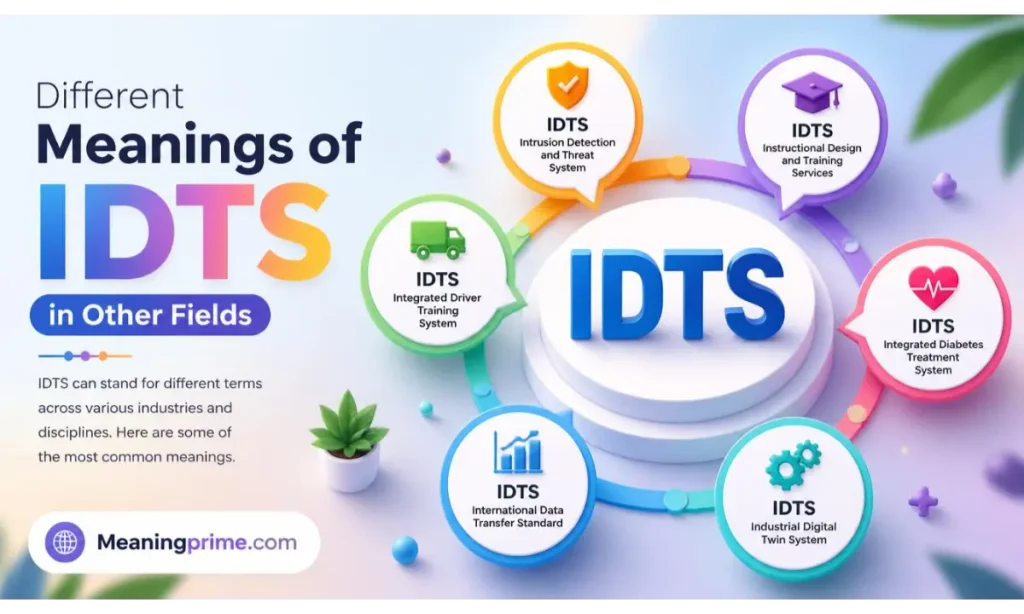
Texting culture isn’t the only place these four letters pop up, though the everyday IDTS meaning in text stays dominant almost everywhere online.
IDTS Meaning in Medical Field
In some healthcare and clinical documents, IDTS can stand for terms tied to infectious disease or transitional care programs. If you spot IDTS in a hospital report or medical context, don’t assume it means “I Don’t Think So” — check the surrounding paperwork or ask the provider directly.
IDTS Meaning in Business
In business and corporate settings, IDTS occasionally refers to internal department names, technical service teams, or company-specific shorthand that varies by organization. There’s no single universal business definition, so it depends entirely on the company using it.
Outside of specialized documents like these, though, the texting meaning is what you’ll run into 99% of the time.
Common Confusions, Mistakes & Wrong Interpretations
People mix IDTS up more often than you’d expect, mostly because it looks similar to other popular acronyms.
Common mistakes:
- Reading it as “I Don’t Think” — People sometimes drop the final “So” mentally and misread the whole point.
- Confusing it with IDK — IDK means “I Don’t Know” (lack of information). IDTS means “I Don’t Think So” (doubt or disagreement). They’re not interchangeable.
- Assuming it’s automatically rude — It usually isn’t. Tone depends on context, not the acronym itself.
Is IDTS Rude or Flirty?
Neither, most of the time. IDTS is a neutral disagreement marker, not an insult and not a come-on. That said, when someone pairs it with playful teasing — “IDTS you’re actually that good at bowling 👀” — it can carry a light flirty edge. Without extra context, though, just read it as plain disagreement.
Terms People Often Confuse With IDTS
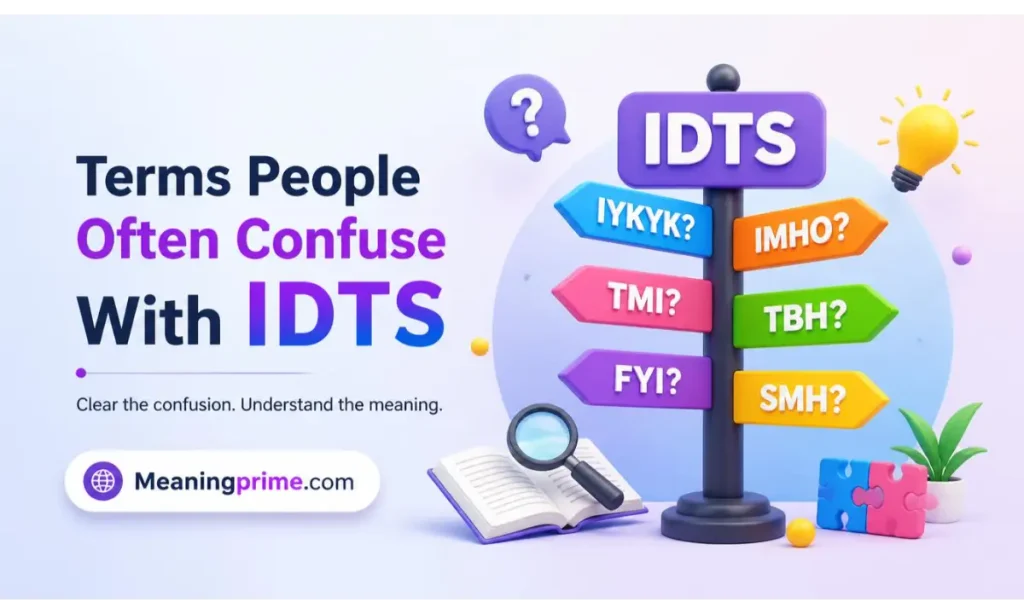
A handful of similar-looking acronyms trip people up constantly, so here’s a quick rundown of each one.
IDT Meaning in Text
IDT usually stands for “I Don’t Think” — basically an unfinished version of IDTS, missing the “So” at the end. Some people use it interchangeably with IDTS, though it reads slightly more casual or clipped.
IDTG Meaning in Chat
IDTG typically means “I Don’t Think,” similar to IDT, though it shows up far less often. Context usually makes the intended meaning obvious either way.
LDTS Meaning in Text
LDTS isn’t a widely recognized standard acronym — it’s most often a typo for IDTS, since the L and I sit right next to each other on a keyboard. If you see LDTS in a message, it’s almost certainly meant to say IDTS.
IDRT Meaning in Text
IDRT generally stands for “I Don’t Really Think” or shows up as a typo variant of IDTS or IDT. Like LDTS, it’s usually a quick typing slip rather than a distinct term.
ISTG Meaning in Text
ISTG stands for “I Swear To God,” which is a completely different phrase from IDTS despite the visual similarity. People use ISTG for emphasis or frustration, not for expressing doubt — so don’t confuse the two just because both are four-letter texting acronyms.
When You Should Avoid Using IDTS
IDTS works great in casual conversation, but it doesn’t belong everywhere.
Skip IDTS in:
- Work emails or professional Slack messages
- School assignments or formal writing
- Conversations with someone unfamiliar with texting slang
- Serious or sensitive topics that deserve a full explanation
In those situations, just write “I don’t think so.” It reads clearer and avoids any risk of sounding careless.
Similar Terms, Alternatives & Related Slang
| Term | Meaning | Usage |
|---|---|---|
| IDTS | I Don’t Think So | Expressing doubt or disagreement |
| IDK | I Don’t Know | Showing uncertainty or lack of knowledge |
| IMO | In My Opinion | Sharing a personal view |
| TBH | To Be Honest | Giving an honest take |
| NGL | Not Gonna Lie | Admitting something honestly |
| IDC | I Don’t Care | Showing indifference |
| ISTG | I Swear To God | Adding emphasis or frustration |
| IMHO | In My Humble Opinion | Offering a softer personal opinion |
These acronyms show up together constantly, so knowing the differences helps you read group chats faster.
Examples of IDTS in Real Chat Situations
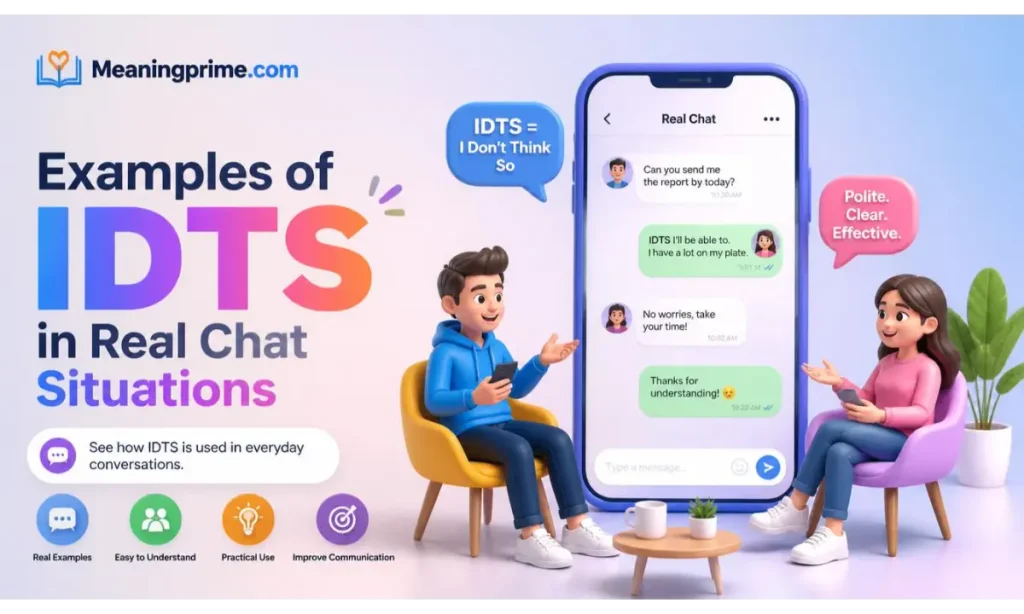
- “You think they’ll cancel school tomorrow?” — “IDTS 😂”
- “Will tickets still be available?” — “IDTS 😊”
- “Do you think he likes me?” — “IDTS, but you never know 🤔”
- “Can we finish this in an hour?” — “IDTS 😅”
- “Is that place open this late?” — “IDTS 🍔”
- “Will our team pull it off tonight?” — “IDTS after last week 😬”
- “Think she noticed the surprise?” — “IDTS 🎉”
- “Was that the easiest test we’ve had?” — “IDTS 😂”
- “Is the package coming today?” — “IDTS per the tracking info 📦”
- “You think that rumor’s true?” — “IDTS 🤔”
How to Reply When Someone Says IDTS
The right response depends on your relationship with the sender and how the message felt.
Casual Replies
- “Maybe you’re right.”
- “We’ll find out.”
- “Fair enough.”
- “Guess we’ll see.”
Friendly Replies
- “Haha, you might be onto something.”
- “Let’s wait and see.”
- “You could be right, honestly.”
Funny Replies
- “Challenge accepted.”
- “Now I have to prove you wrong.”
- “Famous last words 😂”
Formal Replies
- “Thanks for your perspective.”
- “I understand your concern.”
- “That’s certainly possible.”
Is IDTS Still Popular? Trends & Online Usage
Yes — IDTS is still very much active, even though it’s not as universally known as LOL or IDK.
Usage trends worth knowing:
- More common among younger texters and Gen Z
- Shows up constantly in group chats and comment sections
- Stays steady rather than trending up or down sharply
- Understood widely enough that it rarely needs explaining
Who uses it most: teenagers, young adults, and frequent texters who value speed over full sentences.
Quick Facts About IDTS
| Factor | Details |
|---|---|
| Meaning | I Don’t Think So |
| Category | Texting abbreviation |
| Tone | Casual, informal |
| Common platforms | WhatsApp, Instagram, TikTok, Snapchat, SMS |
| Popularity | Moderately popular, especially with younger users |
| Formal or informal | Informal |
| Purpose | Express doubt or disagreement |
| Confused with | IDK, IDT, ISTG, LDTS |
Frequently Asked Questions
What is IDTS’s full form?
IDTS stands for “I Don’t Think So.” It’s a texting abbreviation used to express doubt, disagreement, or skepticism about something someone said.
What does IDTS mean in Gen Z language?
Among Gen Z, IDTS carries the same core meaning — “I Don’t Think So” — but it’s often paired with emojis or a casual tone to soften or emphasize disagreement in group chats and comments.
What does LDTS mean in text?
LDTS isn’t a recognized standalone acronym. It’s almost always a keyboard typo for IDTS, since the L key sits right next to the I key.
What is IDT slang?
IDT is short for “I Don’t Think,” essentially an unfinished version of IDTS without the final “So.” People sometimes use it interchangeably with IDTS in casual texts.
Is IDTS rude?
Not usually. IDTS is a neutral way to express doubt. Tone depends on the words and emojis around it rather than the acronym itself.
Is IDTS the same as IDK?
No. IDK means “I Don’t Know,” which shows a lack of information. IDTS means “I Don’t Think So,” which expresses disagreement or doubt.
Can IDTS be used in professional communication?
It’s better to avoid it. Writing out “I don’t think so” reads clearer and more appropriate in emails or workplace messages.
Is IDTS still used in 2026?
Yes. Newer slang keeps popping up, but IDTS remains a recognizable part of everyday texting vocabulary.
Conclusion
At its core, the IDTS meaning in text comes down to one simple phrase: “I Don’t Think So.” It’s a quick, casual way to express doubt or disagreement without writing out a full sentence — and once you know how to read the tone around it, those three letters stop feeling confusing.
Use it freely in casual chats with friends, but save the full phrase for work emails or formal writing. Now that you know the difference between IDTS, IDT, ISTG, and the typo-prone LDTS, you’ll never second-guess a confusing text again.