

Mythological names carry stories that survived thousands of years. Parents keep choosing them because they sound powerful and feel timeless. Each one links your child to a hero, a goddess or a trickster.
This guide covers mythological names meaning origins from Greek, Norse, Celtic, Egyptian, Hindu, Roman and other ancient cultures. You’ll see what each name means, where it comes from and how it feels today. Read the myth first. Then pick the name you love.
Quick Answer: Mythological names come from the gods, heroes and legends of ancient cultures. Athena means “wisdom” in spirit. Odin points to “frenzy” and Aurora means “dawn.” The best mythological names balance a meaningful story, an easy sound and everyday wearability.
12 Timeless Greek Mythological Names and Meanings
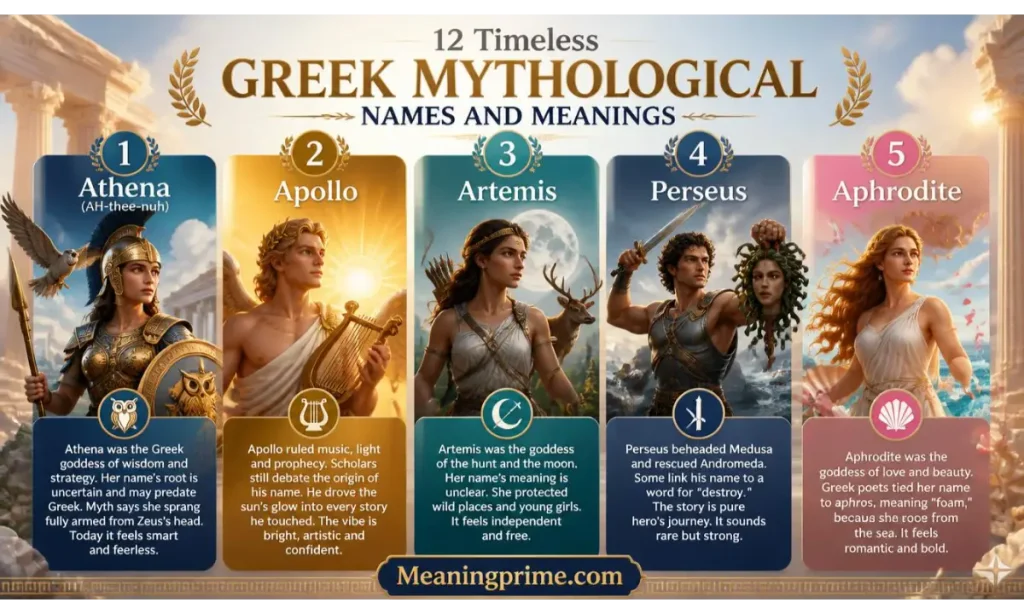
Greek mythological names top most baby lists. They’re familiar and elegant. Their meanings often reach back to light, wisdom and the natural world.
1. Athena (AH-thee-nuh)
Athena was the Greek goddess of wisdom and strategy. Her name’s root is uncertain and may predate Greek. Myth says she sprang fully armed from Zeus’s head. Today it feels smart and fearless.
2. Apollo
Apollo ruled music, light and prophecy. Scholars still debate the origin of his name. He drove the sun’s glow into every story he touched. The vibe is bright, artistic and confident.
3. Artemis
Artemis was the goddess of the hunt and the moon. Her name’s meaning is unclear. She protected wild places and young girls. It feels independent and free.
4. Perseus
Perseus beheaded Medusa and rescued Andromeda. Some link his name to a word for “destroy.” The story is pure hero’s journey. It sounds rare but strong.
5. Aphrodite
Aphrodite was the goddess of love and beauty. Greek poets tied her name to aphros, meaning “foam,” because she rose from the sea. It feels romantic and bold.
6. Hermes
Hermes carried messages between gods and mortals. His name may come from herma, a stone marker. He’s clever and quick. The name suits a lively, curious child.
7. Orion
Orion was a giant hunter placed among the stars. The name’s origin is uncertain. Today it feels adventurous and celestial.
8. Calliope (kuh-LYE-uh-pee)
Calliope means “beautiful voice.” She was the muse of epic poetry. The name sounds musical and warm. It’s a lovely pick for a creative child.
9. Demeter
Demeter was the goddess of grain and harvest. Many read her name as “mother.” Her grief over her daughter explains the seasons. It feels grounded and nurturing.
10. Helios
Helios means “sun.” He pulled the sun across the sky in a golden chariot. It’s a short, radiant name for a boy.
11. Persephone (per-SEF-uh-nee)
Persephone became queen of the underworld. Scholars debate her name’s meaning, but it’s often tied to “bringer of destruction.” Her story blends spring and shadow. The vibe is mysterious and graceful.
12. Penelope (peh-NEL-uh-pee)
Penelope waited twenty years for Odysseus. Her name may link to “weaver.” She outwitted her suitors with a loom. It feels loyal, clever and classic.
10 Strong Norse Mythological Names and Their Origins

Norse mythological names sound sharp and brave. Most come from Old Norse. They suit families who want a name with weight.
Odin
Odin’s name comes from óðr, meaning “frenzy” or “fury.” He ruled wisdom and war. He gave up an eye for knowledge. The vibe is serious and commanding.
Freya
Freya means “lady.” She was the goddess of love, magic and battle. She rode a chariot pulled by cats. It’s a popular, graceful choice.
Thor
Thor means “thunder.” He wielded the hammer Mjölnir to protect gods and humans. The name is short and mighty.
Loki
Loki’s origin is debated. He was the shape-shifting trickster of Norse myth. He made trouble and saved the day in turns. The name feels playful and unpredictable.
Tyr
Tyr was the god of justice and bravery. His name connects to an old word for “god.” He sacrificed his hand to bind a wolf. It’s rare and noble.
Sif
Sif means “bride” or “kin by marriage.” She was Thor’s wife, famed for her golden hair. The name is tiny and distinctive.
Balder
Balder was the beloved god of light and peace. His name likely means “lord” or “prince.” His death shook the world. It feels gentle and kind.
Skadi
Skadi was the giantess goddess of winter and skiing. Her name may mean “harm” or “shadow.” She chose her husband by his feet. It suits a tough, outdoorsy child.
Sigurd
Sigurd means “victory guardian.” He slew the dragon Fafnir in Norse legend. It sounds heroic and old-world.
Idun
Idun kept the golden apples that kept the gods young. Her name is often read as “ever young.” It feels fresh and rare.
10 Celtic and Irish Mythological Names with Deep Roots
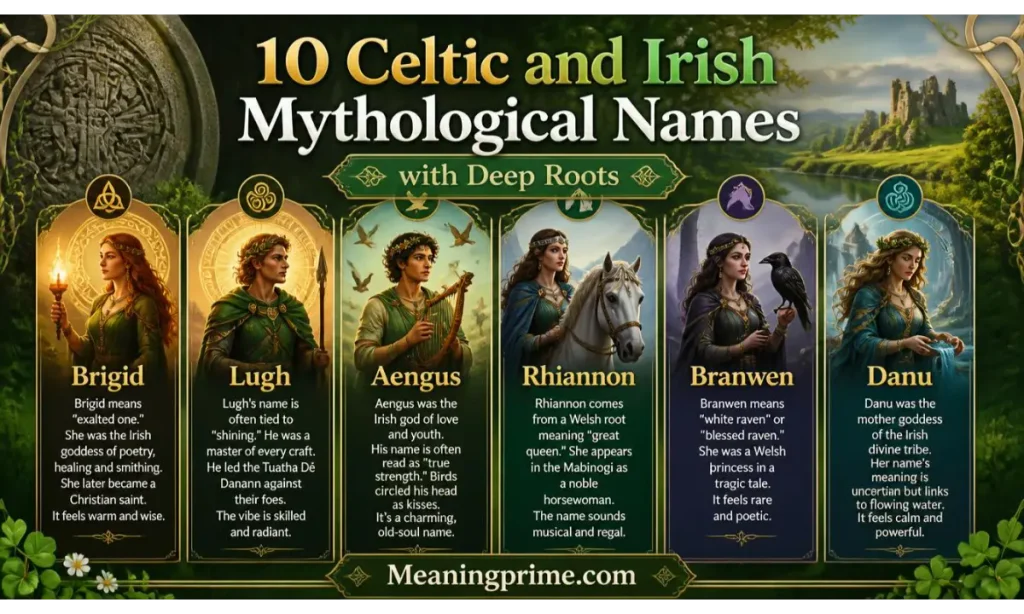
Celtic mythological names feel lyrical and earthy. They come from Irish and Welsh tales. Many link to nature, craft and magic.
Brigid
Brigid means “exalted one.” She was the Irish goddess of poetry, healing and smithing. She later became a Christian saint. It feels warm and wise.
Lugh
Lugh’s name is often tied to “shining.” He was a master of every craft. He led the Tuatha Dé Danann against their foes. The vibe is skilled and radiant.
Aengus
Aengus was the Irish god of love and youth. His name is often read as “true strength.” Birds circled his head as kisses. It’s a charming, old-soul name.
Rhiannon
Rhiannon comes from a Welsh root meaning “great queen.” She appears in the Mabinogi as a noble horsewoman. The name sounds musical and regal.
Branwen
Branwen means “white raven” or “blessed raven.” She was a Welsh princess in a tragic tale. It feels rare and poetic.
Danu
Danu was the mother goddess of the Irish divine tribe. Her name’s meaning is uncertain but links to flowing water. It feels calm and powerful.
Nuada
Nuada was a king with a silver hand. His name’s roots are unclear. The story is about resilience. It’s unusual and strong.
Fionn
Fionn means “fair” or “white.” He was the legendary Irish hero who tasted the Salmon of Knowledge. It’s friendly and heroic.
Morrigan
Morrigan is often read as “phantom queen” or “great queen.” She was a goddess of fate and battle. The vibe is dark and striking.
Aine (AWN-ya)
Aine means “radiance.” She was the Irish goddess of summer and love. It feels sunny and elegant.
6 Egyptian Mythological Names Full of Mystery
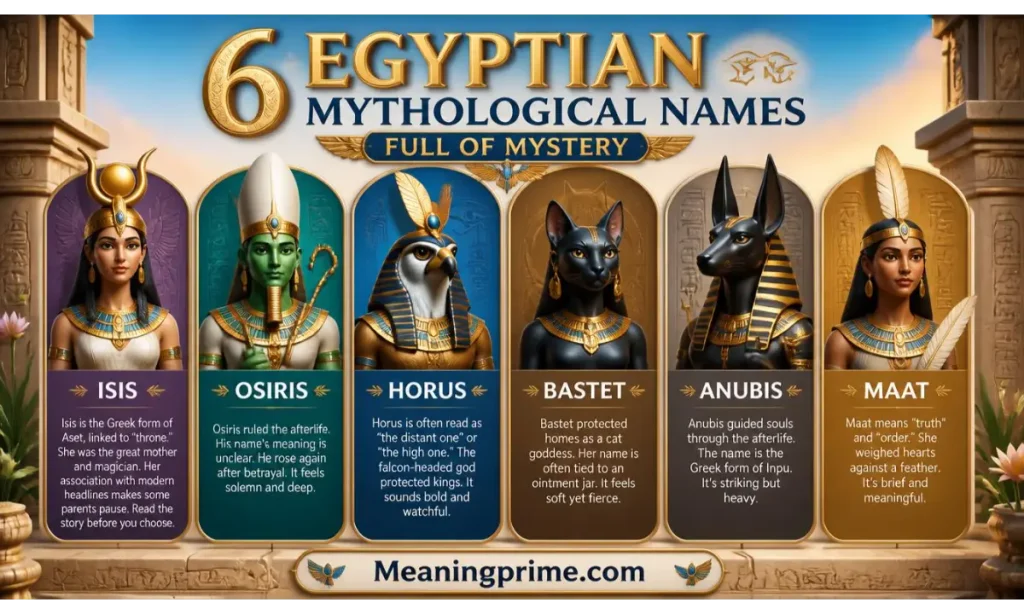
Egyptian mythological names reach back to the Nile. Most reflect royalty, justice and rebirth.
Isis
Isis is the Greek form of Aset, linked to “throne.” She was the great mother and magician. Her association with modern headlines makes some parents pause. Read the story before you choose.
Osiris
Osiris ruled the afterlife. His name’s meaning is unclear. He rose again after betrayal. It feels solemn and deep.
Horus
Horus is often read as “the distant one” or “the high one.” The falcon-headed god protected kings. It sounds bold and watchful.
Bastet
Bastet protected homes as a cat goddess. Her name is often tied to an ointment jar. It feels soft yet fierce.
Anubis
Anubis guided souls through the afterlife. The name is the Greek form of Inpu. It’s striking but heavy.
Maat
Maat means “truth” and “order.” She weighed hearts against a feather. It’s brief and meaningful.
6 Hindu Mythological Names with Divine Meanings
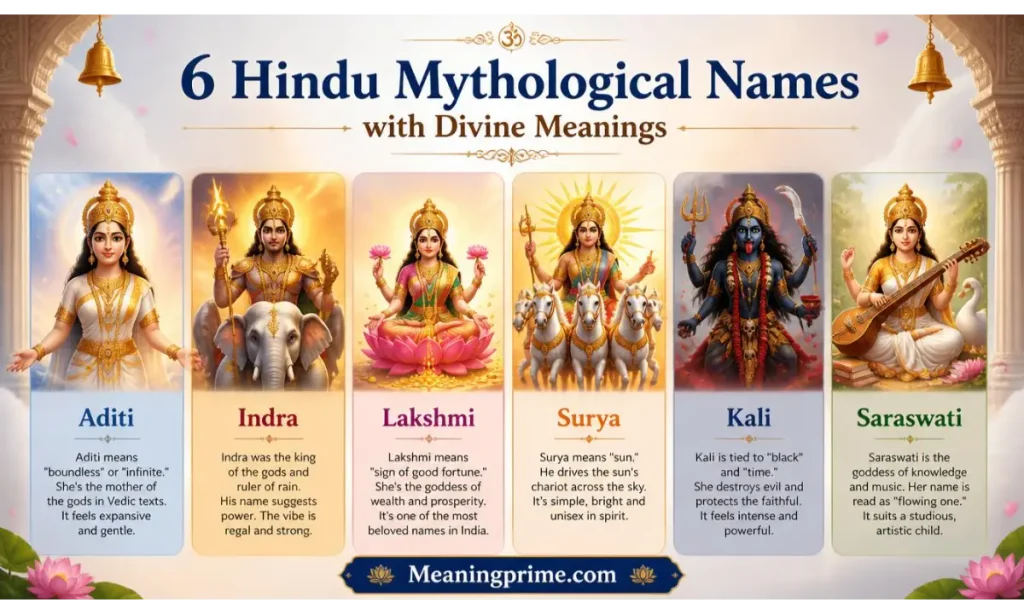
Hindu mythological names come from Sanskrit. They often carry layered meanings tied to light, wealth and knowledge.
Aditi
Aditi means “boundless” or “infinite.” She’s the mother of the gods in Vedic texts. It feels expansive and gentle.
Indra
Indra was the king of the gods and ruler of rain. His name suggests power. The vibe is regal and strong.
Lakshmi
Lakshmi means “sign of good fortune.” She’s the goddess of wealth and prosperity. It’s one of the most beloved names in India.
Surya
Surya means “sun.” He drives the sun’s chariot across the sky. It’s simple, bright and unisex in spirit.
Kali
Kali is tied to “black” and “time.” She destroys evil and protects the faithful. It feels intense and powerful.
Saraswati
Saraswati is the goddess of knowledge and music. Her name is read as “flowing one.” It suits a studious, artistic child.
6 Roman Mythological Names Meaning Origins and Uses
Roman mythological names often mirror Greek ones. Latin gave them softer, more modern sounds. Several are already common baby names.
Aurora
Aurora means “dawn.” She was the Roman goddess who opened the sky each morning. It feels dreamy and hopeful.
Diana
Diana is tied to “heavenly” or “divine.” She was the Roman goddess of the hunt and moon. It’s classic and graceful.
Luna
Luna means “moon.” She was the Roman moon goddess. The name is gentle and extremely popular today.
Minerva
Minerva was the goddess of wisdom and craft. Her name may link to “mind.” It feels scholarly and bold.
Juno
Juno ruled marriage and was queen of the gods. The name’s roots are debated. It sounds crisp and modern.
Flora
Flora was the goddess of flowers and spring. Her name means “flower.” It’s sweet and fresh.
9 Rare Mythological Names from Around the World
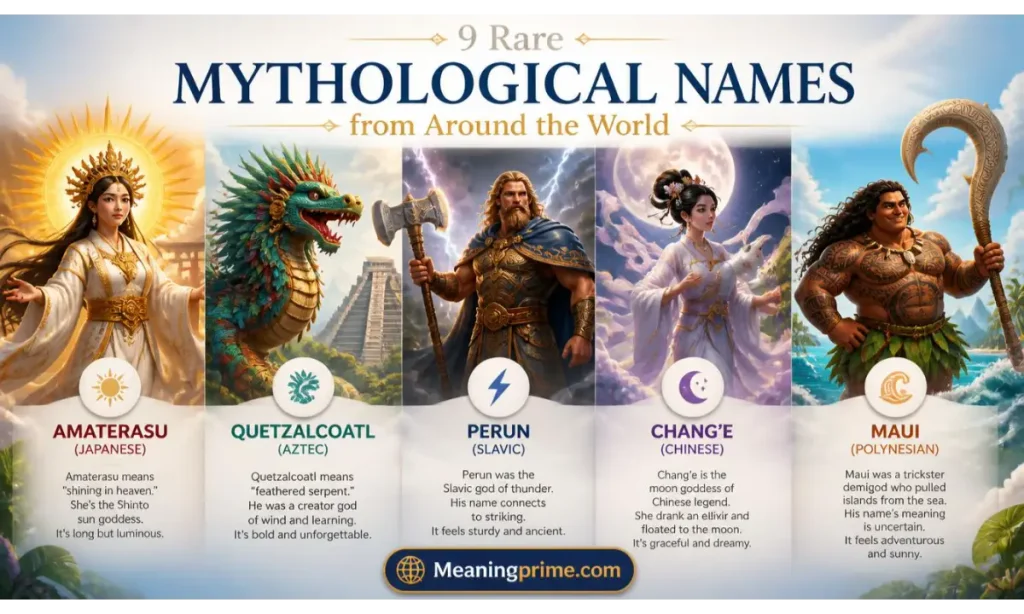
Want less common mythological names? These come from cultures beyond the usual lists. Each offers a distinct sound and a vivid story.
Amaterasu (Japanese)
Amaterasu means “shining in heaven.” She’s the Shinto sun goddess. It’s long but luminous.
Quetzalcoatl (Aztec)
Quetzalcoatl means “feathered serpent.” He was a creator god of wind and learning. It’s bold and unforgettable.
Perun (Slavic)
Perun was the Slavic god of thunder. His name connects to striking. It feels sturdy and ancient.
Chang’e (Chinese)
Chang’e is the moon goddess of Chinese legend. She drank an elixir and floated to the moon. It’s graceful and dreamy.
Maui (Polynesian)
Maui was a trickster demigod who pulled islands from the sea. His name’s meaning is uncertain. It feels adventurous and sunny.
Inanna (Mesopotamian)
Inanna means “lady of heaven.” She was one of the oldest known goddesses. The name is bold and rare.
Oshun (Yoruba)
Oshun is the Yoruba goddess of rivers, love and beauty. She’s honored across West Africa and the Americas. It feels sweet and strong.
Pele (Hawaiian)
Pele is the Hawaiian goddess of volcanoes. She shapes new land with fire. The name is fierce and fiery.
Ixchel (Maya)
Ixchel is the Maya goddess of the moon, weaving and healing. Many read her name as “lady rainbow.” It’s rare and mystical.
8 Gender-Neutral Mythological Names with Strong Meanings
Many mythological names work for any child. These eight cross gender lines easily.
Phoenix
Phoenix is the bird that rises from its own ashes. The word echoes a Greek term for “crimson.” It symbolizes renewal.
Atlas
Atlas was the Titan who held up the sky. His name links to “enduring.” It feels solid and ambitious.
Morgan
Morgan appears in Welsh and Arthurian legend. It’s often read as “sea-born.” Morgan le Fay made it magical.
Rowan
Rowan isn’t a deity. It comes from Celtic tree lore, where the rowan tree guards against harm. The name echoes an Irish word for “red.” It’s calm and earthy.
Paris
Paris was the Trojan prince whose choice sparked the Trojan War. His name’s origin is uncertain. It feels worldly and stylish.
Pallas
Pallas is an epithet of Athena. Some read it as “maiden.” It’s rare and elegant.
Zephyr
Zephyr was the Greek west wind. He’s soft and fresh. The name feels airy and light.
Io
Io was a priestess loved by Zeus. She’s also the name of a moon of Jupiter. It’s two letters of pure mystery.
Mythological Names for Boys vs. Girls
Parents often search for mythological names by gender. This quick sort helps you shop.
Mythological Names for Boys
Strong picks include Apollo, Orion, Perseus, Thor, Sigurd, Fionn, Horus, Helios and Atlas. They sound heroic and bold.
Mythological Names for Girls
Beautiful options include Athena, Freya, Penelope, Brigid, Lakshmi, Aurora, Luna and Calliope. They sound graceful and strong.
Cool and Ethereal Mythological Names
Looking for cool mythological names? Try Loki, Phoenix, Zephyr or Pallas. They feel edgy and new. Want ethereal mythological names? Aine, Aurora, Luna, Chang’e and Amaterasu glow with light. They suit dreamy families. For truly rare picks, look at Branwen, Idun, Ixchel and Nuada. Few children will share them.
Mythological Names Meaning Origins at a Glance: Quick-Pick Table
Use this table to compare mythological names meaning origins fast.
| Name | Pronunciation | Culture | Meaning | Best for |
|---|---|---|---|---|
| Athena | AH-thee-nuh | Greek | Wisdom goddess | Smart, bold girl |
| Orion | oh-RYE-un | Greek | Starry hunter | Adventurous boy |
| Freya | FRAY-uh | Norse | “Lady” | Graceful girl |
| Thor | THOR | Norse | “Thunder” | Mighty boy |
| Brigid | BRIJ-id | Celtic | “Exalted one” | Creative girl |
| Fionn | FYUN | Celtic | “Fair” | Friendly boy |
| Horus | HOR-us | Egyptian | “The high one” | Watchful boy |
| Maat | MAHT | Egyptian | “Truth” | Fair-minded girl |
| Lakshmi | LUHK-shmee | Hindu | Good fortune | Hopeful girl |
| Surya | SOOR-yuh | Hindu | “Sun” | Bright child |
| Aurora | uh-ROR-uh | Roman | “Dawn” | Dreamy girl |
| Luna | LOO-nuh | Roman | “Moon” | Gentle girl |
| Maui | MOW-ee | Polynesian | Trickster hero | Playful boy |
| Phoenix | FEE-niks | Greek | Reborn bird | Any child |
| Zephyr | ZEF-er | Greek | West wind | Any child |
How to Choose a Mythological Name That Fits Your Child
Mythological names meaning origins matter, but the full picture matters more. These two checks help.
Check the Whole Story, Not Just the Meaning
Myths are rarely tidy. Many heroes betray, trick or suffer. Read the full tale before you decide. A lovely meaning can hide a dark ending. Choose a story you’re comfortable telling.
Test the Sound with Your Surname
Say the full name aloud. Try it shouted across a playground. Try it on a graduation stage. Watch for clashing sounds or awkward rhythms. Short surnames pair well with longer names like Calliope. Long surnames suit short ones like Tyr or Io.
Mythological Names to Think Twice About
Some mythological names carry baggage. Isis has strong modern associations. Loki and Anubis may feel odd in some settings. Hermes is also a luxury brand. Kali and Pele are sacred in living faiths, so use them with respect. Pop culture can also change a name’s feel. Research first and ask relatives for honest reactions. None of these names is wrong. They just deserve a careful look.
Frequently Asked Questions
What makes mythological names timeless?
Mythological names last because their stories last. Each carries a clear meaning and a memorable character. Parents also love their links to nature, power and wisdom. Cultures keep retelling these myths, so the names never fade.
Which mythological names are most popular for babies right now?
Luna, Aurora, Athena, Atlas, Orion and Freya have been rising in recent years. Phoenix and Zephyr also attract modern parents. Check your local baby name data for exact rankings. Trends shift by region.
Are mythological names suitable for modern children?
Yes. Many mythological names already feel modern, like Luna and Atlas. Pick names with easy spelling and pronunciation. Read the story so you know what your child’s name represents. Most children enjoy having a name with a legend behind it.
Which mythological names work for both boys and girls?
Phoenix, Rowan, Morgan, Zephyr, Paris, Pallas, Io and Atlas all work for any child. Many of these mythological names feel fresh and balanced. They also avoid heavy gender expectations.
Which cultures have the richest mythological names?
Greek and Norse myths offer the largest pools of names. Celtic, Egyptian and Hindu traditions run just as deep. Roman, Polynesian, Slavic and Yoruba cultures add rare gems. Any of these can supply mythological names meaning origins you’ll love.
Conclusion
A mythological name carries a story across thousands of years. The best mythological names balance meaning, sound and everyday wearability. You’ve seen over 60 options from many ancient cultures.
Read the myth before you commit. Say the full name aloud. Then choose the one whose story you’d happily tell your child.