

You saw “NTR” pop up in a comment section, a group chat, or under an anime clip, and now you’re stuck. Is it a joke? An insult? Some kind of inside reference you’re missing? That little three-letter mystery has a way of making you feel like you walked into a conversation halfway through.
Good news: it’s not as confusing as it looks once someone actually breaks it down for you. This guide covers every common NTR meaning in text — from its anime roots to how Gen Z uses it as a joke — so you’ll never have to nod along pretending you get it again.
Quick Answer: NTR usually stands for “Netorare,” a Japanese slang term tied to betrayal, cheating, or someone losing a partner to another person. Online, it’s often used jokingly (think “my dog likes my roommate more now, NTR”), but it started as a specific genre label in anime and manga. NTR can also stand for unrelated things like “Nothing To Report” or “Need To Respond,” depending on where you see it.
What Does NTR Mean?
At its core, the NTR meaning in text comes down to one idea: something or someone got taken away, and it stings. Whether that’s a serious anime plot device or a joke about your best friend stealing your seat at lunch depends entirely on where you’re seeing it.
NTR Meaning in Text
In casual texting and chat apps, NTR usually points to betrayal, jealousy, or a person “losing” someone’s attention to a third party. It’s rarely used literally these days. Instead, people stretch it to cover almost any situation where someone feels replaced.
A friend might type “bro got NTR’d” after watching their crush start talking to someone else. It’s dramatic on purpose — that’s the joke.
NTR Full Meaning (What NTR Stands For)
NTR stands for “Netorare,” a Japanese word that gets shortened the same way English speakers turn “laughing out loud” into “LOL.” The full term is longer and more specific than the acronym suggests, which is exactly why it got clipped down for chat speed.
What Is the Meaning of NTR in English
There’s no single clean English word for it, which is part of why the term stuck around instead of getting translated. The closest English equivalents are “cheating,” “romantic betrayal,” or “getting replaced,” but none of them fully capture the tone. NTR carries a specific flavor — dramatic, almost theatrical — that a plain English word doesn’t quite deliver.
NTR Meaning in Text — Japanese Origin
The word breaks down from 寝取られ (netorare), combining “ne” (sleep) and “torareru” (to have something taken from you). Put together, it roughly translates to “having your partner taken while you slept” — a poetic way of describing betrayal you didn’t see coming.
Online communities shortened this mouthful to three letters because, honestly, nobody’s typing “netorare” in a fast-moving group chat.
NTR Meaning in Anime
This is where the term actually started, and it’s worth understanding if you spend any time in anime or manga spaces.
NTR Meaning in Text (Anime Chats & Fandom Use)
Anime fans use NTR constantly in reviews, forum threads, and Discord servers. You’ll see comments like “does this show have NTR in it?” as a genuine content warning, not a joke. Fans want to know ahead of time because betrayal storylines aren’t everyone’s thing.
NTR as a Story Genre
In anime, manga, and visual novels, NTR functions as an actual genre tag — similar to how “horror” or “romance” tells you what to expect. Stories tagged NTR center on a character losing their partner to someone else, usually told from the perspective of the person left behind. It’s aimed at adult audiences and treated as its own storytelling category rather than a throwaway plot twist.
That’s worth knowing because it explains why the term carries more weight in anime circles than a typical meme term does. When someone brings it up seriously in a fandom space, they’re usually talking about genuine story content, not making a joke.
Why It’s a Controversial Trope Among Fans
Anime communities are genuinely split on this one. Some fans avoid NTR-tagged content entirely because the emotional tone can feel heavy or upsetting. Others find the genre compelling precisely because it leans into uncomfortable feelings most stories avoid. You’ll see heated debates in comment sections about whether a show “went NTR” unexpectedly, since it can change the entire viewing experience for someone who wasn’t expecting it.
Does NTR Mean Anything Else?
Here’s where a lot of guides skip something important: NTR isn’t exclusively an anime term. Context matters more than the letters themselves.
NTR as “Nothing To Report” or “Need To Respond”
In work chats, group texts, or even military and customer-service contexts, NTR can simply mean “Nothing To Report” — a quick way to say everything’s fine, nothing new happening. In other settings, it shows up as “Need To Respond,” flagging a message that requires a reply, often soon.
Neither of these has anything to do with anime or betrayal. They’re just efficient shorthand, the same way “TBD” or “FYI” saves keystrokes.
How to Tell Which Meaning Is Being Used
The setting tells you everything. If NTR shows up in a work email or a status update, it’s almost certainly “Nothing To Report.” If it’s dropped in an anime Discord or a meme caption about someone’s dog liking a sibling better, you’re looking at the Netorare-based slang meaning. Context is really the only decoder ring you need here.
NTR Meaning in Urdu
For readers searching this in Urdu-speaking spaces, the concept translates roughly to “دھوکہ” (dhoka), meaning betrayal or deception, or “کسی کا محبوب چھن جانا,” which describes someone’s partner being taken away. The English acronym NTR itself doesn’t have a direct Urdu equivalent since it’s rooted in Japanese internet culture, but the underlying idea — losing someone to betrayal — translates clearly across languages. You’ll mostly see the English acronym used as-is even in Urdu-language chats and social media captions, since slang terms like this tend to stay in their original form online.
NTR Meaning in Relationship
Outside of anime, NTR has picked up a second life describing real relationship dynamics — usually exaggerated for effect.
Romantic Betrayal Context
When someone uses NTR to describe an actual relationship situation, they’re typically talking about a partner’s attention shifting to someone else. It’s rarely used to describe something as serious as a full affair. More often it’s applied to smaller moments: a partner texting an ex, liking someone else’s posts a little too enthusiastically, or spending more time with a friend than usual.
How Couples Use NTR in Chat (Jokingly vs Seriously)
Most couples who use the term are joking, poking fun at mild jealousy rather than accusing each other of anything real. “Don’t start the NTR allegations” is a common lighthearted response to a partner teasing about someone else. Occasionally, though, someone uses it with real frustration behind it — and tone in a text thread is genuinely hard to read, so this is one place where the term can land wrong if you’re not careful.
NTR Meaning in Social Media
Different platforms shape how the term gets used, so here’s a breakdown of where you’ll actually run into it.
NTR on Snapchat
Snapchat captions use NTR almost entirely for jokes — relationship memes, jealousy bait, or anime-themed snaps. A caption like “she replied to him first… NTR moment” is typical: dramatic on purpose, not meant literally.
NTR on TikTok
TikTok is arguably the biggest driver of NTR going mainstream outside anime spaces. Anime edit videos, reaction clips, and “POV” relationship skits use the term constantly, often layered over exaggerated acting for comedic effect. If you’ve seen the term trending, TikTok is probably why.
NTR on Instagram & WhatsApp
Instagram usage mirrors TikTok — mostly captions on anime reels or relationship-humor posts. WhatsApp sees it far less often, but it does pop up in gaming groups or anime fan chats where members already share the same slang vocabulary.
NTR on Discord & Reddit
This is where the more serious, fandom-specific usage lives. Anime and manga Discord servers use NTR as a genuine content tag, warning members before spoilers or discussions. Reddit threads in anime subreddits do the same, often debating whether a series “counts” as NTR or just has minor betrayal elements.
Real Chat Examples of NTR in Use
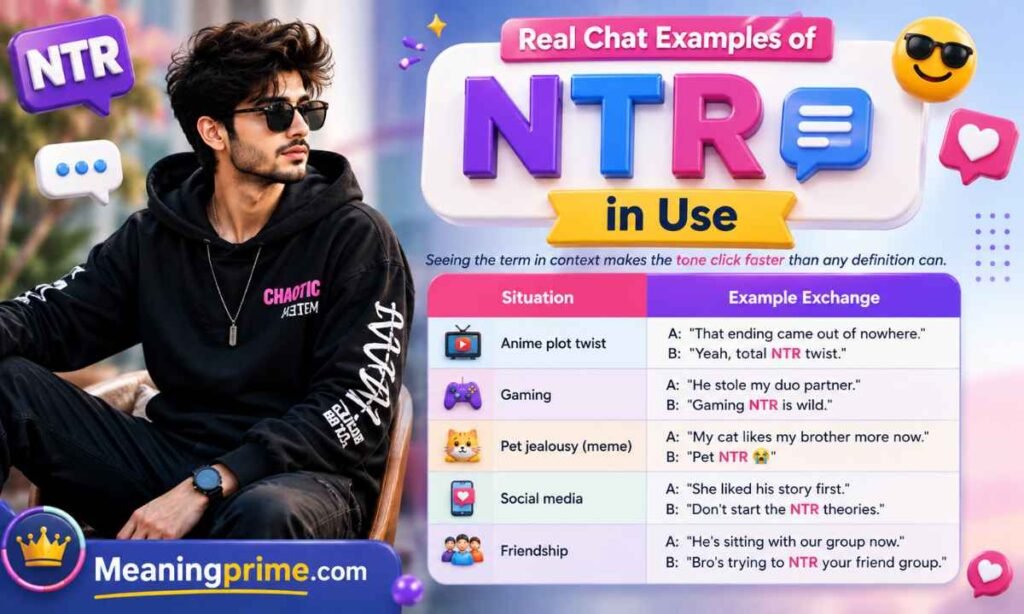
Seeing the term in context makes the tone click faster than any definition can.
| Situation | Example Exchange |
| Anime plot twist | A: “That ending came out of nowhere.” B: “Yeah, total NTR twist.” |
| Gaming | A: “He stole my duo partner.” B: “Gaming NTR is wild.” |
| Pet jealousy (meme) | A: “My cat likes my brother more now.” B: “Pet NTR 😭” |
| Social media | A: “She liked his story first.” B: “Don’t start the NTR theories.” |
| Friendship | A: “He’s sitting with our group now.” B: “Bro’s trying to NTR your friend group.” |
Notice how loose the usage gets outside anime spaces — snacks, pets, and seating arrangements all count now. That elasticity is exactly why the term spread so far beyond its original context.
NTR vs Similar Slang Terms
| Term | Meaning | Common Context | Tone |
| NTR | Betrayal or romantic replacement | Anime, memes, chats | Dramatic or joking |
| Simp | Overly devoted admirer | TikTok, texting | Mocking, light |
| Ghosted | Suddenly ignored, no explanation | Dating apps, texting | Sad, blunt |
| Third Wheel | Extra person in a romantic situation | Everyday conversation | Playful |
| Cuffed | In a committed relationship | Texting, social media | Neutral to playful |
NTR stands apart from these because it’s the only one with roots in a specific media genre rather than starting as pure internet shorthand.
Is NTR Appropriate to Use?
Is NTR Rude or Offensive?
Not inherently. It’s not a slur or a profanity, but it does reference relationship betrayal and, in its original anime context, mature storytelling themes. That combination means it can land as awkward or inappropriate depending on who’s reading it and how well they know the term.
Should You Use It at School or Work?
Generally, no. It’s niche internet slang tied to informal fandom and meme culture, so it doesn’t translate well to professional emails, school assignments, or workplace chats. Save it for casual conversations with people who already speak the same internet language you do.
Who Uses NTR — and Why It Went Mainstream
Gen Z vs Millennial Usage
Gen Z tends to use NTR loosely, applying it to almost any jealousy-adjacent moment for comedic effect. Millennials who grew up closer to early anime fandom culture are more likely to know its original genre-specific meaning and use it more precisely.
How TikTok Popularized the Term
TikTok’s anime edit community played a huge role in pushing NTR into wider slang usage. Once creators started applying it to non-anime situations — pets, siblings, gaming teammates — the term detached from its original niche and became a flexible meme label anyone could use, whether or not they’d ever watched anime with NTR themes.
How to Reply When Someone Says NTR
If you’re unsure how to respond, tone-match whatever the sender is going for:
- Playing along: “The betrayal is unreal 😭”
- Taking it seriously: “That actually sounds rough.”
- Neutral and simple: “Ah, I get what you mean now.”
- Flirty (relationship context): “No NTR happening here, don’t worry.”
When in doubt, mirroring their energy is the safest move — matching a joke with a joke, or a genuine complaint with genuine sympathy.
Frequently Asked Questions
What does NTR mean in text?
In text messages, NTR usually refers to betrayal, jealousy, or someone being emotionally replaced, often used jokingly rather than literally.
What does NTR mean in slang?
As slang, NTR describes any situation — real or exaggerated — where someone loses attention or affection to another person, borrowed from its original anime meaning.
What does NTR stand for in chat?
In most chat contexts, it stands for “Netorare.” In work or formal messaging, it can instead mean “Nothing To Report” or “Need To Respond.”
What is full form NTR?
The full form is “Netorare,” a Japanese term describing romantic betrayal, though the acronym also has unrelated meanings like “Nothing To Report” in non-slang contexts.
What did NTR stand for?
NTR originally stood for “Netorare” within Japanese anime and manga culture before internet users adopted the shortened acronym for broader slang use.
Is NTR the same as “Need To Respond”?
No — that’s a completely different, unrelated meaning that shows up mostly in professional or work-related messaging rather than slang or anime contexts.
Is NTR always about anime?
No. While it originated in anime and manga, it’s now used casually online for everyday jealousy or betrayal jokes that have nothing to do with anime at all.
Is it okay to use NTR casually?
Yes, among friends or online communities familiar with the term. It’s best avoided in formal or professional settings since it’s still niche internet slang.
Why do gamers say NTR?
Gamers use it jokingly when a teammate, duo partner, or favorite player gets “taken” by another team or player, applying the betrayal concept to gaming loyalty instead of romance.
Conclusion
NTR is one of those terms where the letters stay the same but the meaning shifts completely depending on where you spot it. In anime and manga spaces, it’s a specific, genre-defining term about betrayal. Everywhere else online, it’s mostly a flexible joke format for anything from a cheating partner to a disloyal pet.
The real skill isn’t memorizing every definition — it’s reading the room. Check the platform, check the tone, and you’ll know exactly which NTR you’re dealing with before you type your reply.