
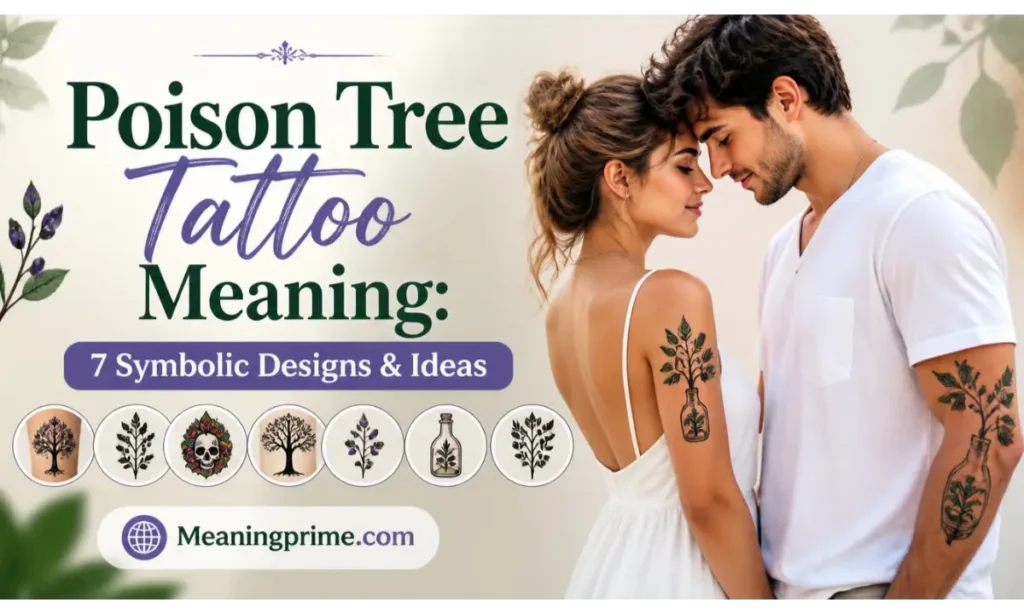

You spotted it on someone’s forearm and couldn’t stop thinking about it. Maybe the photo has sat in your camera roll for months. You keep asking what the poison tree tattoo meaning really is before you commit to permanent ink. That hesitation makes sense, because this design carries a heavy story.
This guide breaks down the poison tree tattoo meaning step by step. You’ll get the story behind William Blake’s poem and what each branch and apple stands for. You’ll also see seven design ideas plus tips on color and placement. By the end, you’ll know whether it fits your story.
Quick Answer: The poison tree tattoo meaning centers on suppressed anger, hidden resentment, and the damage unspoken feelings can cause. It comes from William Blake’s 1794 poem “A Poison Tree.” For many wearers, it also stands for healing, self-awareness, and the choice to speak up before bitterness grows.
What Is a Poison Tree Tattoo?
A poison tree tattoo shows a tree that feels wrong at first glance. Picture gnarled branches, dark twisting roots, shadowy bark, and sometimes one gleaming piece of forbidden fruit. It’s a visual metaphor, not a botanical portrait of a real poisonous plant.
Most tree tattoos celebrate life, family, and growth. This one flips that script. The poison tree tattoo meaning is about what happens when emotions stay buried and nothing gets said out loud. In short, it’s anger that grows in silence.
The Origins: William Blake’s “A Poison Tree” (1794)
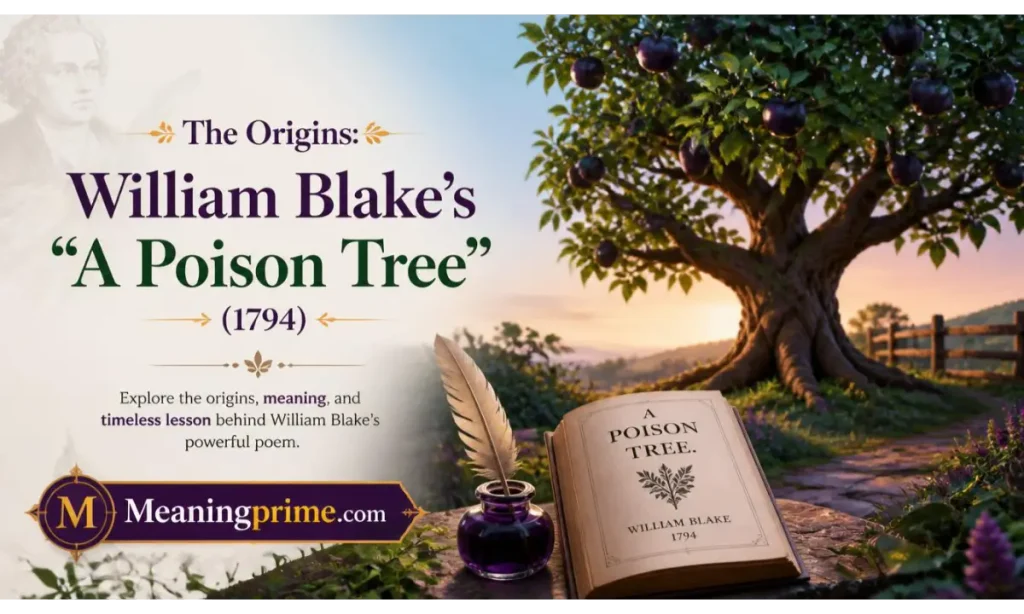
English poet William Blake published “A Poison Tree” in Songs of Experience in 1794. The poem runs just sixteen lines. It still lands hard. When the narrator tells a friend he’s angry, the anger fades. When he hides it from a foe, it grows.
He waters that hidden wrath with fear and false smiles. Soon it becomes a tree with one bright apple. The foe slips into the garden, eats the fruit, and ends up dead beneath the branches. That’s why every poison tree tattoo meaning circles back to suppressed anger and its consequences.
Why Blake First Called It “Christian Forbearance”
Blake’s early draft used another title: “Christian Forbearance.” The name was a jab. Forbearance means patiently enduring wrongs. Blake seemed to suspect that polite, silent endurance often hides something uglier. His poem shows quiet politeness rotting into poison. That context sharpens any poison tree tattoo meaning you’re weighing, because the design questions silence as much as anger.
What Does Blake’s “A Poison Tree” Symbolize?
The tree symbolizes anger fed in secret. The daily watering stands for fear, deceit, and fake politeness. The apple represents a tempting result that looks harmless but carries real danger. The ending adds a dark twist, since the narrator feels glad instead of guilty. Resentment can feel satisfying even while it destroys. That nuance gives the poison tree tattoo meaning its depth.
Echoes in Scripture and Myth
Blake’s apple naturally recalls the Tree of Knowledge in Eden. Other traditions offer looser echoes. Greek myth guards golden apples in the Garden of the Hesperides. Norse myth places the serpent Níðhöggr at the roots of Yggdrasil. Buddhist thought often warns that clinging to anger harms the person who carries it. Treat these as echoes, not official sources. No single myth defines the poison tree tattoo meaning, because Blake built his own metaphor.
Poison Tree Tattoo Meaning: Core Symbolism
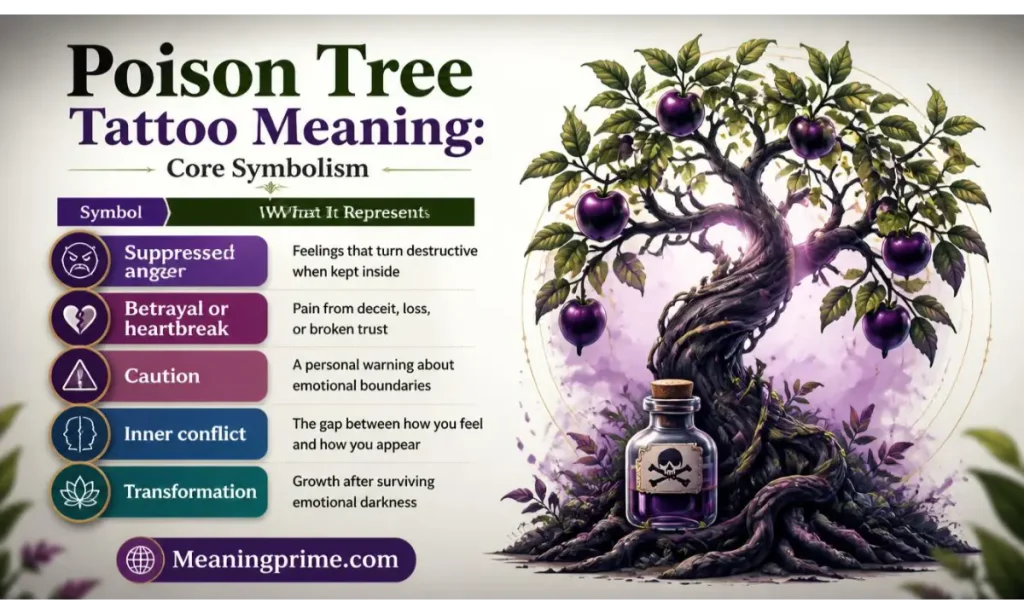
Symbolism shifts from person to person. Still, a few readings come up again and again.
| Symbol | What It Represents |
|---|---|
| Suppressed anger | Feelings that turn destructive when kept inside |
| Betrayal or heartbreak | Pain from deceit, loss, or broken trust |
| Caution | A personal warning about emotional boundaries |
| Inner conflict | The gap between how you feel and how you appear |
| Transformation | Growth after surviving emotional darkness |
| Self-awareness | Facing your shadow side instead of denying it |
| Protection | A reminder to guard your peace |
| Lessons learned | The cost of bitterness and the wisdom after it |
What makes this tattoo special is that it doesn’t celebrate darkness. It acknowledges it. People who understand the poison tree tattoo meaning have usually looked at their own capacity for hurt and chosen to face it. That’s self-awareness, not self-destruction.
What Each Part of the Tree Represents
Every part of the design can carry its own message. Pick one or two to emphasize. The tattoo then reads cleaner.
| Design Element | Possible Symbolism |
|---|---|
| Roots | Buried memories and hidden feelings |
| Twisted branches | Inner conflict or years of resentment |
| Dead branches | Loss, exhaustion, or an ending |
| Single apple | Temptation, consequence, or a hidden trap |
| Snake | Betrayal, deception, or temptation |
| Thorns | Pain, defense, and personal boundaries |
| Fresh leaves | Recovery and renewal |
Mixing these parts is how artists tailor a poison tree tattoo meaning to one person’s story.
Poison Tree vs. Tree of Life

People often confuse the two. They aren’t the same.
| Poison Tree | Tree of Life | |
|---|---|---|
| Core idea | Anger left to fester | Connection and renewal |
| Look | Bare, twisted, shadowed | Full canopy, balanced roots |
| Mood | Reflective, mysterious | Peaceful, hopeful |
| Origin | Often Blake’s poem | Many cultures and faiths |
Still, a bare poison tree can sprout again in spring, which is why some wearers see it as a fresh start. Mixing up the two symbols changes the poison tree tattoo meaning entirely.
Who Gets a Poison Tree Tattoo — and Why
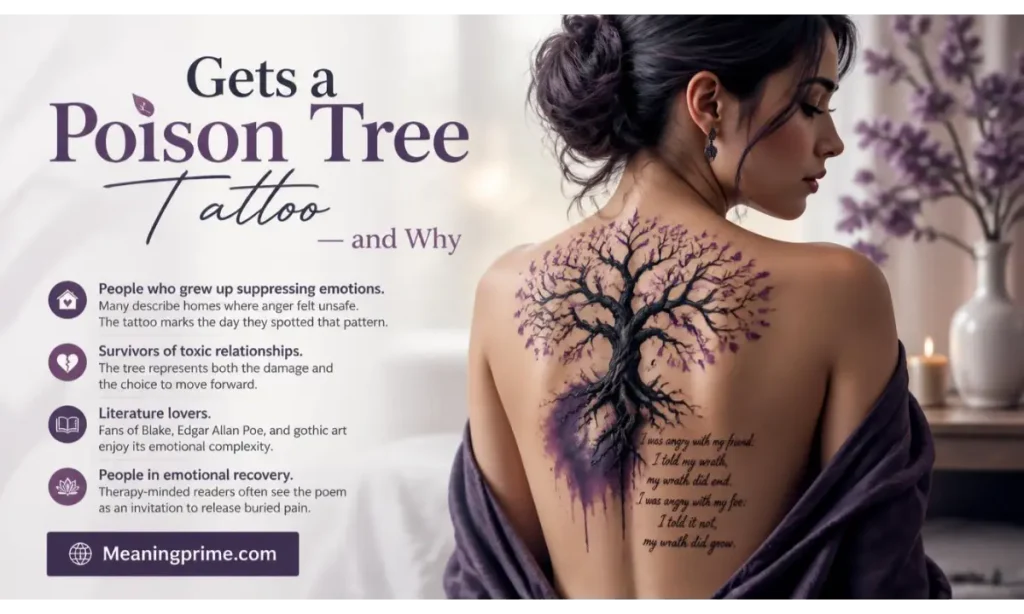
Few people pick this design on impulse. Most have a clear reason that fits one of four groups.
- People who grew up suppressing emotions. Many describe homes where anger felt unsafe. The tattoo marks the day they spotted that pattern.
- Survivors of toxic relationships. The tree represents both the damage and the choice to move forward.
- Literature lovers. Fans of Blake, Edgar Allan Poe, and gothic art enjoy its emotional complexity.
- People in emotional recovery. Therapy-minded readers often see the poem as an invitation to release buried pain.
Each group brings a slightly different poison tree tattoo meaning to the same image.
Poison Tree Tattoo Meaning for Women
For many women, the poison tree tattoo meaning centers on releasing what no longer serves them. That could be a friendship that soured or years of being told to stay agreeable. Delicate linework along the ribs or spine suits this mood. So does a watercolor tree on the shoulder. Some add a bird leaving the branches to show they’ve moved on. The symbolism stays the same for everyone. Only the styling varies.
Poison Tree Tattoo Meaning for Men
Men often connect the design with strength through restraint. Real power, the thinking goes, means deciding what to do with anger instead of letting it rot. Bold black and grey forearm or calf pieces are common. Others choose a large back scene with the tree, the apple, and a figure beneath it. The poison tree tattoo meaning itself doesn’t change. Style and scale do.
Poison Tree Tattoo Meaning X: The XXXTentacion Connection
Searchers often add an “X” to this phrase. Many mean the rapper XXXTentacion, whose fans link the poison tree design to him. Reports about his tattoos vary widely. It’s best not to treat any single detail as settled. The theme fans connect with stays consistent: anger, regret, and growth. If that link brought you here, the poison tree tattoo meaning above still applies. Your tattoo can honor a favorite artist and still carry your own story.
Popular Design Variations
The poison tree isn’t one fixed image. Artists reshape it in many ways. Each version bends the poison tree tattoo meaning in a new direction. Here are seven designs worth knowing, plus extra ideas to pair with them.
Black and Grey Gothic Style
Twisted, leafless branches and deep shadows define this classic take. Ravens, skulls, or a full moon add atmosphere. Black and grey also ages well, which matters for a piece you’ll wear for decades. Choose it when you want the poison tree tattoo meaning to feel heavy and reflective.
Blake-Inspired Illustration
Some wearers echo Blake’s own etching style with fine, engraved-looking lines. A few add a short handwritten phrase from the poem along a branch or beneath the roots. This version makes the literary link obvious and personal.
Half-Dead, Half-Living Tree
One side blooms. The other decays. This design shows healing and pain living side by side, not a tidy ending. Choose it when you want the recovery message visible without explaining it.
Serpent and Fruit Motif
A snake coils around the branches beside a glowing apple. The pairing nods to Eden and to Blake’s poem at once. Keep the rest of the tree simple, because too many symbols make the piece hard to read.
Heartfruit Design
Here the forbidden fruit takes the shape of a heart. It spotlights love’s darker side: attraction that harms, or affection that turns toxic over time. This version gives the poison tree tattoo meaning a romantic edge.
Minimalist Line Art
A sparse outline of a bare tree says plenty without shouting. It suits first tattoos and small spaces like the wrist or ankle. Ask your artist to simplify the roots. Shrinking every detail blurs the lines.
Watercolor Style
Watercolor trades gothic heaviness for emotional intensity. Deep reds, muted greens, and inky blacks blend into something raw and alive. Soft color washes can fade faster than bold linework. Plan for touch-ups.
More Poison Tree Tattoo Ideas: Elements to Pair With Your Design
Want extra detail? These companions each add a layer of meaning:
- Ravens or crows: mystery and mortality
- A crescent or full moon: secrets and quiet reflection
- A skull: endings and consequences
- Birds in flight: freedom and moving on
- Gothic script or a short phrase: a personal vow
- Flowers around the roots: beauty after hardship
Choose one or two. The poison tree tattoo meaning reads strongest when the design has room to breathe.
Color Meanings in Poison Tree Tattoos
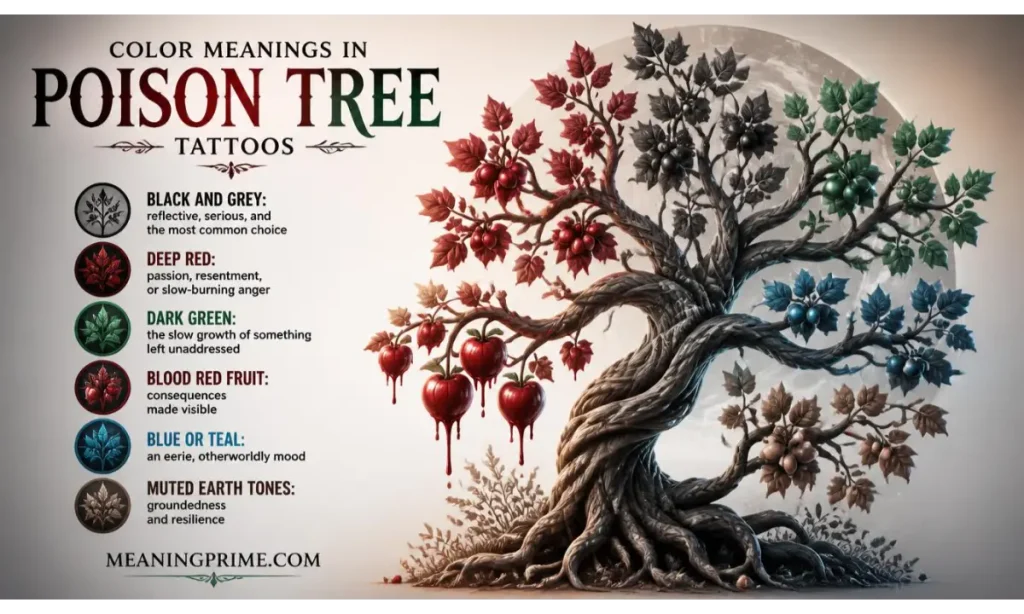
Color changes how this tattoo feels. Treat these meanings as starting points, since personal experience matters most.
- Black and grey: reflective, serious, and the most common choice
- Deep red: passion, resentment, or slow-burning anger
- Dark green: the slow growth of something left unaddressed
- Blood red fruit: consequences made visible
- Blue or teal: an eerie, otherworldly mood
- Muted earth tones: groundedness and resilience
A single red apple on a black and grey tree makes a striking focal point. Ask your artist for two or three digital mockups before you decide. Seeing the poison tree tattoo meaning in different palettes helps you choose with confidence.
Best Placement Options for a Poison Tree Tattoo

Where you put the tattoo adds its own message.
| Placement | What It Communicates |
|---|---|
| Forearm | Openness; you’re not hiding your story |
| Back | A statement piece; what you carry or left behind |
| Ribs | Private; a reminder meant for you |
| Chest | Emotional weight carried close to the heart |
| Spine | Strength rising from the core |
| Neck | Boldness and exposed emotion |
| Thigh or calf | Grounded, easy to show or cover |
| Wrist or ankle | Subtle, intimate lessons learned |
Fine lines and tiny text hold up best on smooth, low-movement skin. A skilled artist can also bend the tree to follow your body’s natural lines. Pick the spot that fits the poison tree tattoo meaning you want to carry.
Poison Tree Tattoo on the Forearm
The forearm is the most popular choice for a simple reason. A tree’s vertical shape follows the arm naturally, with roots near the wrist and branches spreading toward the elbow. You’ll see it daily, which turns it into a quiet reminder. Others see it too. That visibility mirrors the poison tree tattoo meaning itself: facing your feelings instead of hiding them.
Psychological Dimension: Why This Symbol Resonates So Deeply
Blake’s idea matches how many therapists talk about emotions today. Anger that never gets voiced doesn’t simply vanish. It often resurfaces as tension, resentment, or sudden outbursts. Researchers still debate how strongly chronic suppression affects physical health. Big claims deserve caution. The everyday lesson is simpler. Naming a feeling early usually costs less than burying it.
Carl Jung’s idea of the shadow self fits neatly here. The shadow holds the traits we hide or deny. Facing it is the first step toward integration. Wearing a poison tree is a bit like doing shadow work in ink. It turns the poison tree tattoo meaning into an act of honesty with yourself.
Different communities read the poem differently. Goth culture leans into its bottled-up fury and tragic ending. Therapy culture often reads it as an invitation to release buried pain. Many wearers carry both readings.
Common Misconceptions About the Poison Tree Tattoo
A few myths follow this design around. Let’s clear them up.
- “It’s an evil symbol.” Rarely. Most wearers choose it for self-awareness.
- “The wearer is always angry.” Usually the opposite. Many get it after learning to handle anger better.
- “It needs the apple.” No. Plenty of strong designs skip it.
- “You must have read the poem.” No. Many people fall for the artwork first and find Blake later.
- “It’s a curse or witchcraft symbol.” That mix-up comes from folklore about real poisonous plants.
Clearing up these myths keeps the poison tree tattoo meaning honest. It also helps when coworkers or family ask about your ink.
Related Tattoos Compared: Poison Ivy, Semicolon, Medusa & Butterfly

People often search these designs alongside the poison tree. Here’s how each one differs.
Poison Ivy Tattoo Meaning
A poison ivy tattoo usually signals danger hidden inside beauty. It can stand for toxic attraction, protection, or a warning to keep your distance. It’s less about suppressed anger and more about defense and allure.
Semicolon Tattoo Meaning
A semicolon tattoo represents a story that continues when it could have stopped. It’s tied to mental health awareness, including struggles with depression, addiction, and thoughts of self-harm or suicide. It carries its own weight. Treat it as a separate symbol. If any of this feels close to home, talking with a trusted person or a mental health professional can help.
Medusa Tattoo Meaning
Medusa tattoos often stand for survival, rage, and reclaimed power after harm or injustice. The poison tree shows anger buried and growing. Medusa shows anger turned into protection.
Butterfly Tattoo Meaning
Butterflies stand for transformation, freedom, and rebirth. They pair gently with a poison tree. A butterfly resting on a bare branch can show someone emerging from pain.
How to Choose and Personalize Your Design
Start with the feeling, not the artwork. Ask what you want people to sense when they see it.
| If Your Story Is | Consider |
|---|---|
| Suppressed anger | A Blake-inspired tree with one apple |
| Betrayal | Broken branches, thorns, or a snake |
| A toxic relationship | Heartfruit or dark fruit |
| Healing | Fresh leaves, flowers, or sunlight |
| Gothic taste | Black and grey with a moon and ravens |
Then try a simple formula: past experience + emotional meaning + visual symbol. For example, betrayal + healing + a broken tree with new leaves equals survival and growth. Small personal details make your poison tree tattoo meaning impossible to copy. Hide a date in the roots. Or add one broken branch for a relationship that ended.
When you meet your artist, bring your formula, a short story behind it, and two or three reference images. Ask whether the design will stay readable in ten years. Finally, ask yourself whether the poison tree tattoo meaning will still feel true long after the ink heals.
Frequently Asked Questions
What is the meaning of the poison tree?
A poison tree symbolizes anger or resentment that grows when you hide it. The idea comes from William Blake’s 1794 poem, where unspoken wrath turns into deadly fruit. The poison tree tattoo meaning also includes healing and self-awareness.
Is a poison tree tattoo negative, or can it mean healing?
It isn’t negative by default, since the design acknowledges darkness instead of celebrating it. Many people choose it to mark recovery. Fresh leaves on the branches make that healing reading obvious.
Does a poison tree tattoo have to reference William Blake?
No. Blake’s poem is the best-known origin. Plenty of people connect with the imagery personally or simply love dark botanical art. The poison tree tattoo meaning stays yours to define.
Is a poison tree tattoo one to avoid?
Not inherently. Think twice only if you’re choosing it on impulse. Also pause if the story doesn’t feel true to you, since it’s a permanent reminder of heavy themes. Sketch it, sleep on it, and test the idea before you commit.
How long does a poison tree tattoo take to complete?
Small minimalist designs often take two to four hours. Detailed gothic or realistic pieces can take eight to twelve hours across several sessions. Your artist’s pace and the design’s detail set the real timeline.
Conclusion
The poison tree tattoo meaning runs deeper than a dark tree on skin. Rooted in William Blake’s poem, it speaks to suppressed anger, betrayal, and the cost of staying silent. Yet healing sits right beside the warning, which is why so many wearers choose it as a marker of growth.
Here’s the takeaway: this tattoo marks the choice to speak, not the anger itself. Pick details that each have a reason. Talk the design through with a skilled artist. Let the poison tree tattoo meaning stay yours. Done well, it becomes a quiet promise to handle feelings before they turn to poison.