

You get a message with three letters and nothing else. STD. Your stomach drops for a second, then you wonder whether you’re overreacting. That reaction is normal, because the STD meaning in text can feel serious, awkward or completely harmless depending on who sent it.
This guide clears up the confusion without judgment. You’ll learn the most common STD meaning in text, the other meanings that show up at work, school and online, and how to reply with confidence. You’ll also get plain-language health basics. That way you know what’s accurate and what’s guesswork.
Quick Answer
The STD meaning in text is usually “sexually transmitted disease.” Context can change that, though. At work it may mean short-term disability. In math it means standard deviation. Not sure what someone meant? Ask them. It beats guessing.
In short, the STD meaning in text is health-related far more often than it’s slang.
STD Meaning in Text: Quick Definition
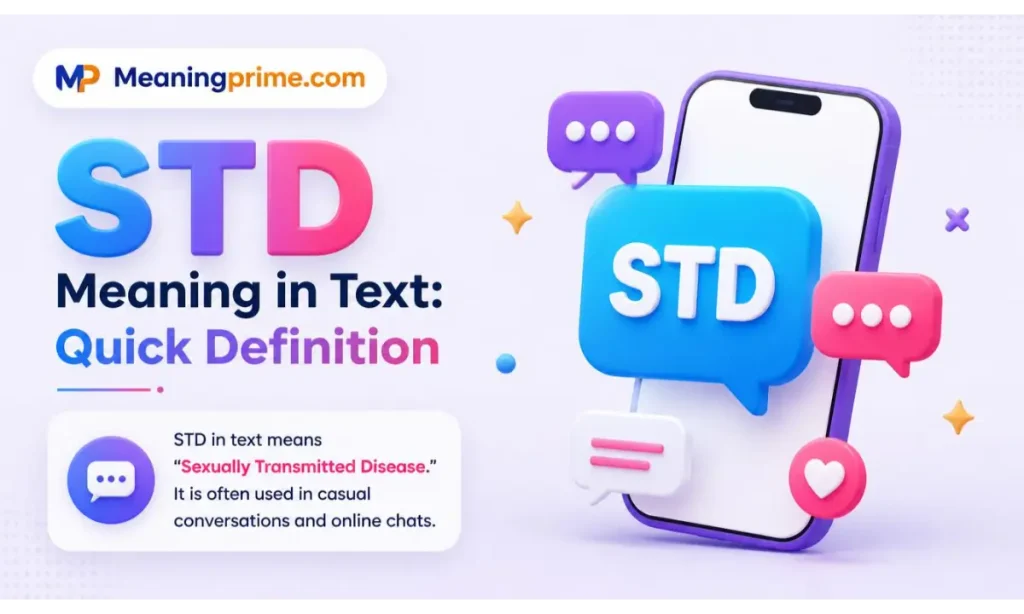
The STD meaning in text starts with a medical term. STD meaning in text refers to “sexually transmitted disease,” an illness spread through sexual contact. Merriam-Webster lists this meaning first. Its examples include gonorrhea, genital herpes, chlamydia, hepatitis B and HIV.
Texting adds a twist. People type fast, skip context and assume you’ll follow along. So the STD meaning in text can shift with the sender, the app and the topic. A clinic reminder, an HR note and a friend’s group chat may all use the same three letters differently.
Here’s a quick reference before we dig deeper.
| Where you see it | Likely meaning | Example |
|---|---|---|
| Health chat | Sexually transmitted disease | “I booked an STD screening.” |
| HR or insurance email | Short-term disability | “Your STD claim was approved.” |
| Math or research | Standard deviation | “The STD is 2.4.” |
| Product listing | Standard | “STD edition ships free.” |
| Phone numbers (India, UK) | Subscriber trunk dialling | “Dial the STD code first.” |
| School chat | State testing day | “Good luck on STD tomorrow.” |
9 Meanings of STD in Text and Everyday Life
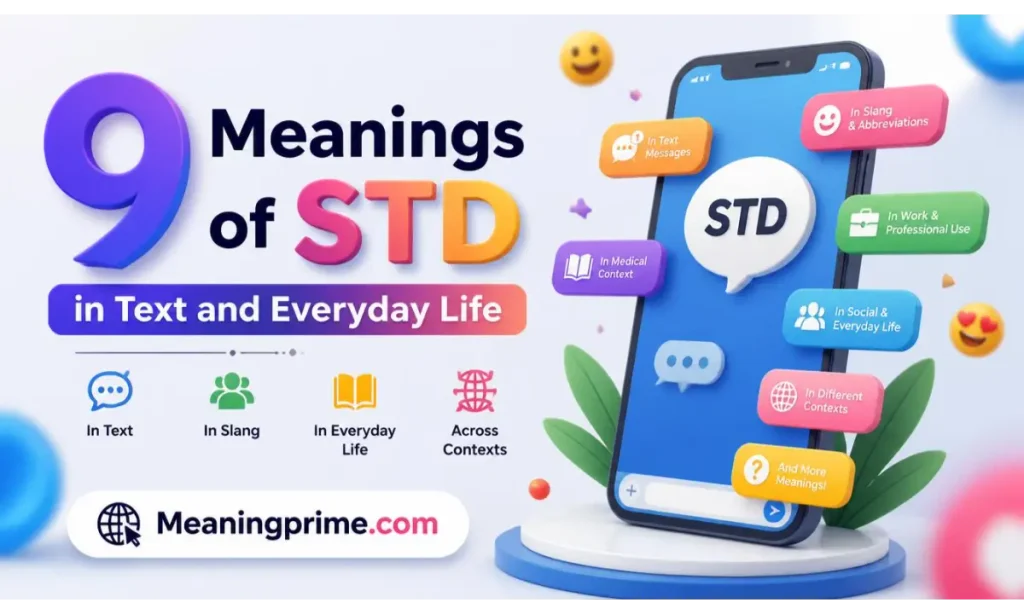
Most people know one meaning. Real life offers nine.
1. STD = Sexually Transmitted Disease
This is the one most readers expect. Clinics, schools and public health campaigns use it constantly. If a message mentions testing, partners, symptoms or protection, you’re almost certainly looking at the STD meaning in text. Many health professionals now prefer “STI” (sexually transmitted infection). We’ll cover why below.
2. STD = Standard
Retail and tech listings often shorten “standard” to “std.” You’ll see “STD edition,” “STD size” or “STD settings.” Nobody’s talking about health there. They mean the basic version of a product.
3. STD = Standard Deviation (Statistics)
Students and analysts write STD for standard deviation, a measure of how spread out data is. A message like “The STD is 3.2” belongs in a math class. It doesn’t belong in a doctor’s office. Formal writing often uses “SD” or “std. dev.” instead.
4. STD = Short-Term Disability (Work and Business)
Employers and insurers use STD for short-term disability coverage. It replaces part of your pay when illness or injury keeps you off work for a while. An HR note such as “Your STD claim was approved” makes perfect sense in that setting. Check the sender and subject line before you panic.
5. STD = Subscriber Trunk Dialling
In India, the UK and some other countries, STD once meant dialing long-distance calls without an operator. Many Indian phone numbers still carry an “STD code,” which works like an area code. So “Dial the STD code first” is a phone instruction.
6. STD = Doctor of Sacred Theology
This Catholic academic degree comes from the Latin Sacrae Theologiae Doctor. You’d spot it after a name, such as “Rev. John Smith, STD.” It has no link to health at all.
7. STD = Save the Date
Wedding and event planners send “save the date” notices all the time. The shortened “STD” is rare. Some people use it jokingly. Spelling it out is smarter because the short form confuses readers. It’s a perfect example of why the STD meaning in text depends on context.
8. STD = State Testing Day (School Slang)
Some students on TikTok use STD for state testing day, as in “Good luck on STD tomorrow.” This looks like informal, community-made slang rather than an established term. Treat it as a niche school usage. Expect blank stares outside that circle.
9. STD = Standard Library (Programming)
Developers use “std” for the standard library in languages such as C++, where “std::” is a namespace prefix. If the message includes code, errors or “#include,” it’s a programming note.
Nine meanings, one rule: read the surrounding message before you decide. The STD meaning in text always follows the context.
STD Meaning in Social Media
Social platforms move fast. Abbreviations spread even faster. Still, the STD meaning in text on social media mostly stays medical. Awareness campaigns, testing reminders and health education posts use it in its standard sense. Memes and comment sections sometimes twist it. That’s where confusion starts.
Comment sections deserve extra caution. Short replies like “STD lol” strip away tone and context. Readers fill in the blanks themselves. When tone isn’t clear, assume good intent and ask a follow-up before reacting.
STD Meaning on Instagram
On Instagram, you’ll usually see STD in health education posts, clinic announcements and public health infographics. In captions, it means sexually transmitted disease. In DMs, the STD meaning in text works the same way as in any private message. The surrounding conversation matters most. If a stranger sends something unclear or sensitive, you don’t have to engage.
STD Slang Meaning on TikTok
TikTok creators invent slang quickly. One viral clip claimed “std” means state testing day. Other videos use it for health awareness. Because trends move so fast, a TikTok-only meaning may not hold anywhere else. When you spot the STD meaning in text on TikTok, check the comments and the video’s topic first.
STD Meaning in Chat and Messaging Apps
In WhatsApp, iMessage or Snapchat, short messages carry little context. A lone “STD?” could ask about health, a product version or a deadline. Reply with a simple question: “Do you mean the health term?” Confirming the STD meaning in text takes seconds. It also saves you an awkward misunderstanding.
STD in Slang and Gen Z Conversations
What’s the STD meaning in text for Gen Z? Mostly the medical one. Younger users tend to talk about testing and protection openly, which makes the term feel less taboo than it did for older generations. They treat it as a health topic, not a punchline.
That said, slang evolves. A few websites claim STD stands for “Send To Delete” or “Same To You.” Reliable sources don’t back those claims. Major dictionaries don’t list them either. Anyone searching for STD meaning in text slang should know the dependable answer is still the medical one. If you do meet a strange definition, ask the sender.
Tone helps here. A short, friendly question like “Wait, what do you mean?” keeps things light. It also shows you care more about understanding than about guessing.
STD Meaning at Work and in Business
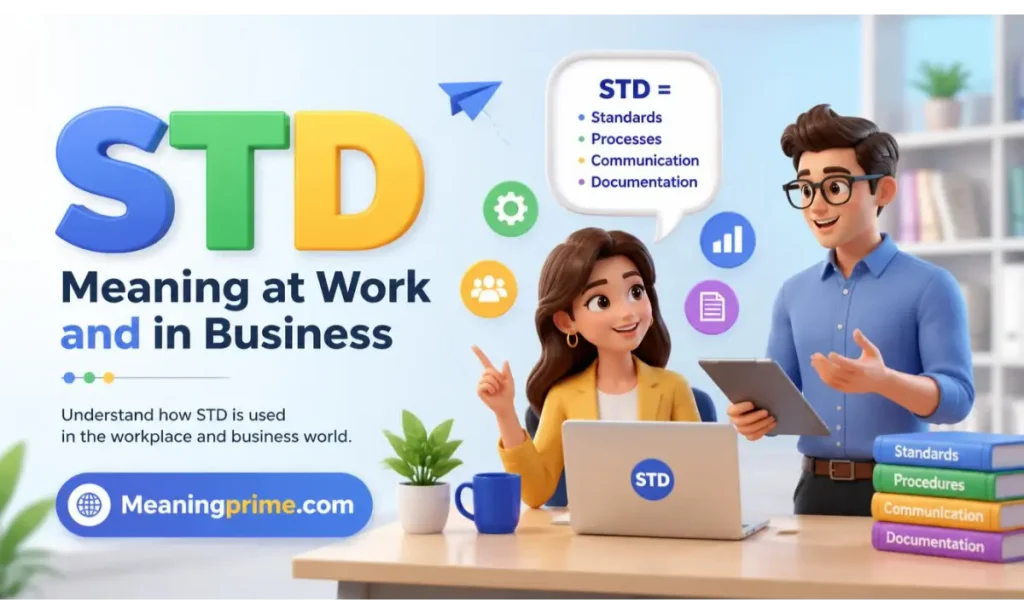
Work messages use STD differently. Short-term disability is the big one. HR departments, benefits portals and insurers all use the abbreviation. A line like “Your STD paperwork is due Friday” concerns leave and income. It isn’t about anyone’s private health.
Business writing also uses “std” for “standard” in pricing, packaging and specs. “STD terms and conditions” simply means the usual terms. Workplace messages tend to be formal. So the STD meaning in text at work rarely points to the medical definition. When in doubt, check who sent it and which department they work in.
Privacy matters too. Employers generally treat disability and leave information as confidential. HR messages about it are usually brief and formal. If you receive one, keep it to yourself and follow the instructions inside.
STD Abbreviation in English: Dictionary Meanings
Dictionaries confirm the range. Merriam-Webster gives sexually transmitted disease and Doctor of Sacred Theology. Open dictionaries add standard, standard deviation, subscriber trunk dialling, short-term disability, standard library and save the date.
That spread explains why the STD meaning in text isn’t one fixed answer. It’s a shared shortcut that different communities borrowed for their own needs.
Think of it like the word “bat.” A baseball player, a zoologist and a cricket fan all picture something different. Nobody’s wrong. They just live in different contexts.
Is STD Ever Used as a Joke?
Sometimes. People joke about nearly everything online. But this topic carries real stigma. Jokes can hurt anyone who’s dealt with a diagnosis. Using the STD meaning in text as a punchline can come across as careless even when you mean no harm.
You may also see made-up “funny” acronyms built from the same letters. Those inventions aren’t real meanings. A good rule: if a joke would make someone feel judged, skip it. Treat the STD meaning in text as a health topic first and a joke last.
Real-Life Conversations Using STD in Text
Examples make this easier. Here are three realistic scenarios.
Text Message Conversation
Jordan: Hey, I booked my annual checkup. I might ask about an STD screening too.
Sam: Good idea. I did mine last month. Want the clinic’s number?
Meaning: Jordan is talking about routine sexual health testing. Here the STD meaning in text is medical and responsible.
Health Conversation Example
Alex: Quick question before we get serious. Have you ever had an STD test?
Riley: Yes, in March. Everything came back negative. How about you?
Meaning: This is an adult health conversation. The STD meaning in text is direct and respectful. Nobody’s joking.
Work Message Example
HR: Your STD claim is approved. Payments start next week.
Taylor: Thanks. Do I need to send updated forms?
Meaning: Short-term disability. The workplace setting makes the STD meaning in text clear.
Emotional and Psychological Meaning
Words carry feelings. When someone brings up the STD meaning in text, they may feel nervous, embarrassed or relieved. A person sharing a test result is trusting you. A person asking about testing may care about your health and theirs. Read it as responsibility, not as an accusation.
Stigma is the real obstacle here. Many people avoid testing because they fear judgment. Calm, respectful replies lower that fear. When you respond with kindness, you help the STD meaning in text feel less loaded.
Starting the conversation yourself takes courage too. If you want to bring up testing with a partner, keep it simple and calm. Something like “I’d like us both to get tested. I’m happy to go with you” frames it as teamwork. It doesn’t point a finger at anyone.
Common Misunderstandings About STD in Text
Misunderstanding 1: Assuming It’s Slang
Many readers assume STD is casual internet slang. It isn’t. It’s an established medical abbreviation. Most uses are serious. Treat the STD meaning in text as a health term unless the context clearly says otherwise.
Misunderstanding 2: Trusting Unverified “Slang” Meanings
Some websites list meanings such as “Send To Delete” or “Same To You.” Reliable sources don’t confirm them. Repeating them can cause embarrassing mix-ups, especially if the other person means the medical term. Don’t let a made-up definition replace the real STD meaning in text. Stick with documented meanings and ask when you’re unsure.
How to Respond When Someone Uses STD in Text
Your reply sets the tone. Try these steps:
- Pause and read the context. Check the sender, the topic and the earlier messages.
- Ask if you’re unsure. “Just checking, do you mean the health term?” works well.
- Stay calm and kind. If someone shares a diagnosis, thank them for telling you.
- Keep it private. Never forward or screenshot sensitive health messages.
- Suggest next steps gently. Testing or a visit to a healthcare provider can help.
Here are a few sample replies:
- “Thanks for telling me. I appreciate you trusting me.”
- “I’m glad you got tested. Want to go together?”
- “I’m not sure what you mean by STD here. Can you clarify?”
A good response matters, because the STD meaning in text often arrives with real feelings attached. Responding calmly is part of the job.
STD vs. STI: What’s the Difference?
The terms overlap heavily. STI (sexually transmitted infection) means a bacterium, virus or parasite has entered the body. STD describes the stage when that infection causes symptoms or illness. Many infections never cause symptoms. That’s why STI is the broader term. Several health organizations now prefer it, although the CDC uses both.
| Term | What it means | Key point |
|---|---|---|
| STI | Infection with or without symptoms | Broader and more precise |
| STD | Infection that has caused disease or symptoms | Still common in everyday speech |
For texting purposes, the STD meaning in text points to the same topic whichever term the sender picks.
STD Basics: Testing, Symptoms, Prevention and Treatment
Once you understand the STD meaning in text, the next question is usually practical. These basics are general information. A healthcare provider can advise you on your own situation.
Testing
Testing is the only reliable way to know. Many infections cause no symptoms. People can carry and pass them on without realizing. The CDC recommends yearly chlamydia and gonorrhea screening for sexually active women under 25. It also recommends that everyone aged 13 to 64 get tested for HIV at least once. Your provider may suggest more frequent testing based on partners and risk.
Symptoms
Possible signs include unusual discharge, pain when urinating, sores or bumps, itching, rash, lower abdominal pain and flu-like symptoms. None of these proves an infection. And having no symptoms doesn’t mean you’re in the clear.
Prevention
Condoms and dental dams lower risk. Vaccines exist for HPV and hepatitis B. Regular testing and honest talks with partners help too. So does avoiding shared needles.
Treatment
Treatment depends on the infection. Bacterial infections such as chlamydia, gonorrhea and syphilis can be cured with antibiotics. Viral infections such as herpes and HIV can’t be cured. Medication can still manage them well. Early care protects you and your partners.
How to Tell Which STD Meaning Applies
Look for clues in the message. This table speeds things up.
| Clue in the message | Likely meaning |
|---|---|
| Testing, partners, clinic, symptoms | Sexually transmitted disease |
| HR, leave, insurance, claim | Short-term disability |
| Data, charts, research, numbers | Standard deviation |
| Product, edition, package, settings | Standard |
| Area code, long-distance calls | Subscriber trunk dialling |
| Code, “#include,” “std::” | Standard library |
| Exams, school, students | State testing day (informal) |
| Wedding, invitation, event | Save the date |
| Name followed by a degree | Doctor of Sacred Theology |
Three questions help. Who sent it? Where did it appear? What came before it? Those answers settle the STD meaning in text almost every time. If two clues conflict, simply ask.
Related STD Terms You’ll See in Messages
Related phrases often appear beside the main term:
- STD test: a screening for infections
- STD panel: several tests done together
- STD screening: testing when no symptoms are present
- STD clinic: a healthcare center focused on sexual health
- STD awareness: educational campaigns
- STD prevention: steps that reduce risk
Each of these narrows the STD meaning in text toward health.
You might also see “STI test” or “sexual health check” in the same chats. They’re close cousins. Providers use them to describe the same kind of screening, just with slightly different wording.
Frequently Asked Questions
What does STD mean in text?
It usually means sexually transmitted disease. Context can change it to short-term disability at work or standard deviation in math. The STD meaning in text always depends on who’s talking and why.
What is STD in slang?
It isn’t established slang. Dictionaries list it as a medical term. Informal uses, like “state testing day” on TikTok, stay within small groups.
What does STD mean in Gen Z?
Gen Z mostly uses it in the medical sense, with more openness about testing and protection. For this generation, the STD meaning in text rarely leaves the health topic.
What does STD stand for in chat?
In chat, it most often stands for sexually transmitted disease. In other chats it can mean standard, short-term disability or standard deviation. Ask for clarity if the message feels unclear.
What does STD mean in social media?
On social media, it nearly always points to sexual health content. Some creators use it differently in niche circles. Check the context first. The STD meaning in text on social platforms seldom strays from health.
Conclusion
The STD meaning in text is almost always sexually transmitted disease. Work chats, classrooms, phone systems and math can reuse the same three letters though. Check the sender, the setting and the surrounding words. The answer usually jumps out.
If someone shares something sensitive, respond with respect and keep it private. And if you have questions about testing or symptoms, a healthcare provider is the right next step. Once you know where to look, the STD meaning in text isn’t hard to decode.