


You’re scrolling through a group chat and someone just described their food poisoning in way more detail than anyone asked for. Someone replies with a single word: “TMI.” You get the gist, but you’re not 100% sure where the term came from or if it’s okay to use on your crush, your boss, or your grandma.
That’s exactly what this guide clears up. Below, you’ll find the full TMI meaning in text, where it came from, how it shows up differently on Instagram versus TikTok versus a group chat with your best friends, and exactly what to say if someone hits you with a “TMI” of your own.
Quick Answer
TMI stands for “Too Much Information.” People text it when someone shares details that are unnecessary, overly personal, or just plain awkward for the situation. It’s usually playful, not an insult, though tone and context decide whether it lands as a joke or a gentle hint to dial it back.
What Does TMI Mean in Text & Chat?
TMI is short for “Too Much Information,” and it’s one of the most recognizable acronyms in texting today. People use it the moment a conversation crosses from “interesting” into “I didn’t need to picture that.”
Here’s a simple example:
- Friend: “I told my coworkers all about my stomach issues during lunch.”
- You: “TMI 😂”
That reply isn’t harsh. It’s a quick, lighthearted way of saying the details went a little further than expected. Most of the time, that’s the whole TMI meaning in text: a joke, not a judgment.
Full Form, Stands For & Short Meaning of TMI
| Term | Full Form |
|---|---|
| TMI | Too Much Information |
TMI has one dominant, widely accepted meaning in texting and online slang, and it isn’t up for much debate. If a friend, coworker, or stranger online types “TMI” at you, they almost always mean the same thing.
Short Meaning of TMI
In plain terms:
“You just told me more than I wanted or needed to know.”
That’s it. No hidden layers, no sarcasm required. People use it with coworkers, siblings, partners, strangers on the internet, and everyone in between.
Origin, History & First Known Use of TMI
The phrase “too much information” predates texting by decades. Some sources trace the shortened form back to 1988, reportedly used by a Wall Street Journal reporter, though that early claim isn’t well documented.
What’s better documented: TMI’s first known internet dictionary entry landed on Urban Dictionary on October 9, 2002, posted by a user named DocGonzo, who defined it as “way more than you need/want to know about someone.” Around that same period, a UK-based online forum noted that Americans had been using the phrase since the 1990s, partly thanks to sketches on Saturday Night Live.
Once instant messaging, then texting, then social media took over daily communication, TMI rode right along with them. It went from a spoken reaction at the dinner table to one of the most-used acronyms in group chats and comment sections.
How People Use TMI in Daily Conversations
The TMI meaning in text stays consistent, but the situations where it pops up vary a lot. TMI shows up whenever someone shares something a little too personal, a little too graphic, or a little too random for the moment.
Texting Examples
- “I really didn’t need the play-by-play of your dentist appointment. TMI!”
- “You described the entire procedure step by step. TMI 😂”
- “Okay, TMI, but thanks for the honesty.”
Casual Situations
Friends toss TMI around constantly, usually about:
- Embarrassing stories from the weekend
- Health or body-related updates
- Relationship or dating details
- Awkward run-ins or mishaps
Tone carries almost all the weight here. Said among close friends, TMI is rarely more than a laugh and a reminder to maybe save some details for later.
TMI Meaning in Social Media & Across Platforms
TMI doesn’t stay locked inside text messages. It shows up constantly across social apps, though the flavor shifts slightly depending on where you see it. Understanding the TMI meaning in text actually makes it easier to spot in comments, captions, and stories too, since the core idea never really changes.
| Platform | How TMI Typically Shows Up |
|---|---|
| Comments on stories or posts with very personal captions | |
| TikTok | Comments reacting to overly detailed storytimes |
| Snapchat | Private chats between close friends after an embarrassing share |
| Group or one-on-one chats reacting to oversharing |
What Does TMI Mean on Instagram?
On Instagram, people drop “TMI” in comments when a caption or story reveals something unexpectedly personal, like a detailed health update or an overshare about a breakup. It’s usually said with a laughing emoji, not a scolding tone.
What Does TMI Mean on TikTok?
TikTok creators sometimes lean into TMI on purpose. Storytime videos thrive on oversharing, so comment sections fill up with “TMI but I’m not mad about it” or similar reactions. Here, TMI often reads as entertained rather than uncomfortable.
TMI on Snapchat & WhatsApp
These apps tend to be more private, so TMI here usually reacts to something shared one-on-one or in a small friend group, often something the sender wouldn’t post publicly.
Does the Meaning Change Across Platforms?
No. Wherever you see it, the core TMI meaning in text stays the same: too much information. What changes is the tone, from playful on TikTok to more intimate and personal on Snapchat.
TMI Meaning in K-Pop
If you spend time in K-pop fan spaces, you’ll see TMI used a bit differently, and it’s actually a positive thing there. Idols and fans use “TMI” to introduce small, fun personal facts, like a favorite snack or a random daily habit, during interviews, lives, or fan interactions.
So when a fan account posts “idol TMI,” they mean a cute or random personal detail, not a complaint about oversharing. It’s one of the few contexts where TMI flips from mildly negative to genuinely welcome.
TMI Meaning From a Girl (And From a Guy)
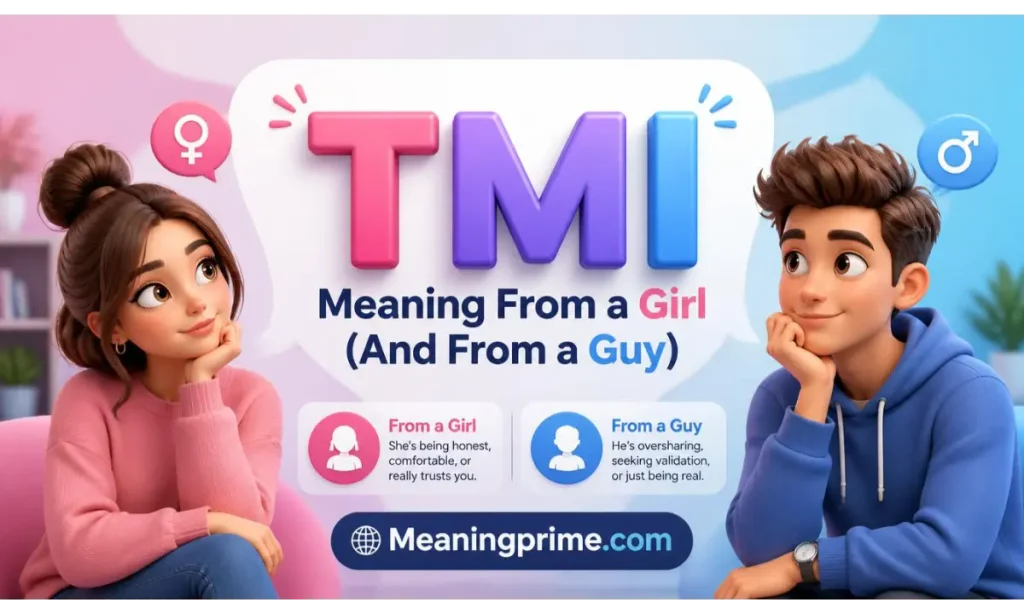
A common search is what TMI means “from a girl” or “from a guy,” and the honest answer is: the meaning doesn’t change based on gender. Whoever sends it, TMI still means someone shared more than expected.
That said, the context often differs slightly by relationship:
- From a girl to a close friend, it’s usually playful teasing.
- From a guy in a group chat, it often reacts to an overly graphic story.
- In dating conversations, either person might use TMI to signal that a topic (an ex, a past relationship, health details) came up too early.
On a first date or early in texting someone new, TMI can gently flag that a topic felt premature, without shutting the conversation down completely.
TMI Meaning in Friendship
Among close friends, TMI usually isn’t a boundary at all. It’s practically a badge of trust. Best friends often share things they’d never tell anyone else, and TMI becomes the running joke that acknowledges it.
- “You know I love you, but that was TMI.”
- “TMI, but also please continue.”
The closer the friendship, the more TMI tends to function as affectionate teasing rather than an actual complaint.
Is TMI Rude? Understanding the Tone
TMI sits in a gray zone. It can be a joke or a genuine signal of discomfort, and figuring out which one is happening comes down to context.
When It’s Playful
Among friends, over a lighthearted topic, paired with an emoji or laughing tone, TMI is almost always just banter. Nobody’s actually offended.
When It Signals Real Discomfort
Sent without emojis, in response to something genuinely sensitive, or from someone you don’t know well, TMI can mean the person actually wants the topic to stop. Reading the room matters more than the word itself.
TMI Meaning in Medicine & Other Fields
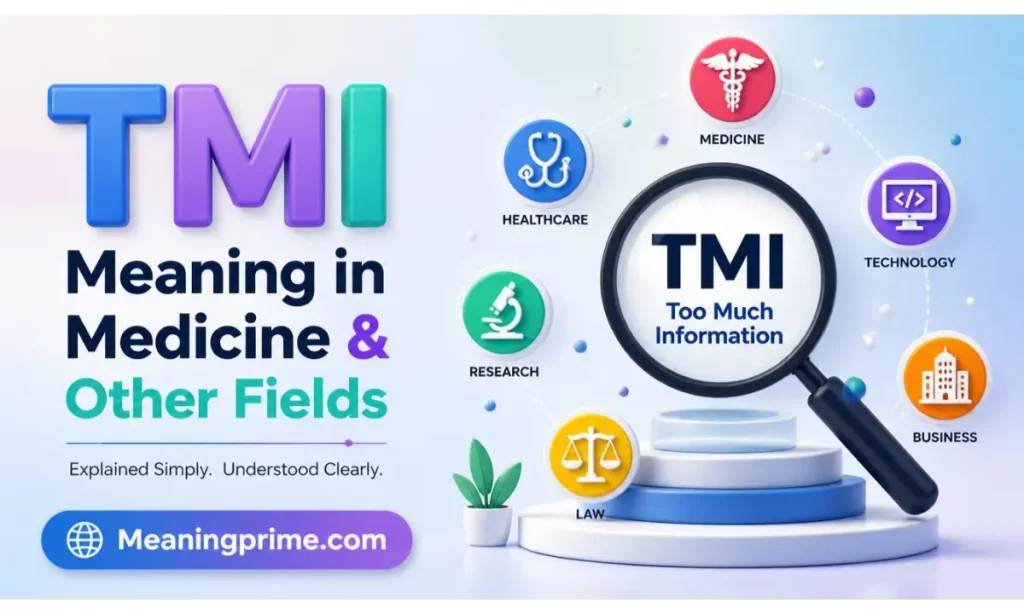
Outside of texting, TMI occasionally stands for something else entirely, and a few of these acronyms get searched almost as often as the slang version.
| Field | Alternate Meaning |
|---|---|
| Medicine | TIA (Transient Ischemic Attack) is sometimes confused with TMI, though they’re not the same abbreviation |
| History/Energy | Three Mile Island, the site of the 1979 nuclear accident |
| Business | Technical Manual Index |
| Legal | TM, the trademark symbol, is occasionally miswritten as “TMI” |
| Medical shorthand | Traumatic Brain Injury is abbreviated TBI, not TMI, though the two get mixed up in searches |
In everyday texting, social media, and group chats, though, TMI almost always means Too Much Information. The other meanings live in specialized fields and rarely show up in casual conversation.
Common Confusions, Mistakes & Wrong Interpretations
A few misunderstandings pop up again and again.
Assuming TMI always means someone’s upset Most of the time, it’s a joke, not a complaint.
Thinking TMI stands for “Tell Me Immediately” This is a common guess, but it’s incorrect. TMI has meant “Too Much Information” since its earliest documented use, and “Tell Me Immediately” isn’t a recognized alternate definition anywhere in internet slang history.
Confusing TMI with bragging or gossip TMI is about oversharing personal details. Bragging is self-promotion. Gossip focuses on someone else’s business. They overlap sometimes, but they’re not the same thing.
Treating every TMI as a serious criticism Context and tone decide that, not the word itself.
Similar Terms, Alternatives & Related Slang
| Term | Meaning | Typical Use |
|---|---|---|
| TMI | Too Much Information | Oversharing personal details |
| Oversharing | Revealing more than necessary | General conversations |
| Spill the tea | Share gossip or updates | Social media slang |
| Info dump | Giving excessive detail on a topic | Casual chats |
| Trauma dump | Unloading heavy emotional details unexpectedly | Mental health-adjacent talk |
| Word vomit | Speaking without much filter | Everyday speech |
Is This TMI? A Quick Self-Check
Not sure if what you’re about to send counts as TMI? Run through this before you hit send:
- Audience: Would a close friend react differently than a coworker would?
- Platform: Is this a private DM or a public comment section?
- Relationship: How well do you actually know this person?
- Necessity: Does the story need this specific detail to make sense?
If you hesitate on more than one of these, there’s a decent chance you’re about to overshare.
Examples of TMI in Real Chat Situations
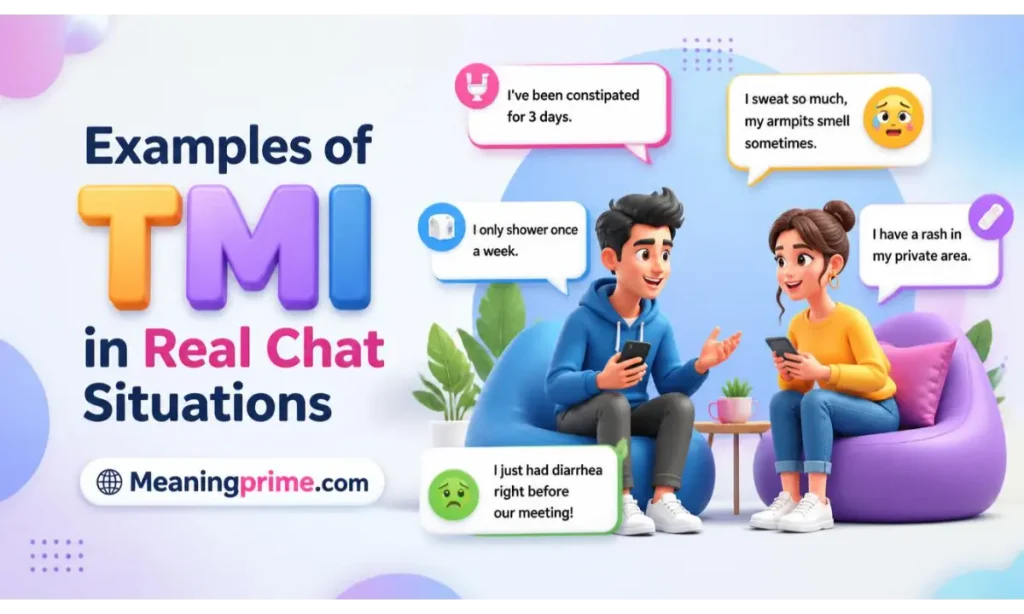
- “The group chat didn’t need every detail about your recovery. TMI 😂”
- “Thanks for explaining, but that was definitely TMI 😊”
- “You told a first date your entire relationship history? TMI 🤔”
- “Okay, TMI, but I’m glad you’re feeling better.”
- “Family dinner took a TMI turn real fast 😅”
- “Your gym injury story got way too detailed. TMI 😬”
- “Wasn’t expecting that level of detail before 9 a.m. TMI.”
- “You told the whole office that? TMI 🤯”
How to Reply When Someone Says TMI
The right reply depends heavily on who’s saying it.
To a Friend
- “Haha, my bad, got carried away.”
- “You haven’t even heard the worst part yet.”
- “Noted. I’ll save the details next time.”
To a Crush or Date
- “Sorry, too soon? I’ll pace myself next time.”
- “Noted, I’ll ease into the heavier stuff.”
- “Fair. Let’s talk about something lighter.”
To a Coworker or Boss
- “Apologies, I got a bit too detailed there.”
- “Good call, I’ll keep it professional.”
- “Understood, thanks for the heads-up.”
Can TMI Be Used at Work? Professional Etiquette
TMI is casual slang, so using the word itself with your boss might feel a little too relaxed depending on your workplace culture. The bigger issue, though, is avoiding the behavior TMI describes.
Do:
- Keep personal health, financial, or relationship details general with coworkers unless you’re close.
- Redirect a conversation if it veers into territory that feels too personal for the setting.
Don’t:
- Share graphic medical details in team meetings or group chats.
- Assume casual friendliness with a coworker means every topic is fair game.
A quick, professional version of TMI, like “I’ll spare you the details,” works better in formal settings than the acronym itself. If a coworker overshares with you, a warm but simple redirect, such as changing the subject or offering a brief “totally get it, let’s circle back to the project,” usually smooths things over without anyone feeling embarrassed.
Why Do People Overshare?
Oversharing usually isn’t random. A few common reasons drive it:
- Nervousness: Talking fills silence, and details spill out faster than intended.
- Bonding: Sharing something personal can feel like it builds closeness quickly.
- Venting: Sometimes people just need to get something off their chest, regardless of the audience.
None of these are bad instincts. They just don’t always match the setting, which is exactly where TMI steps in. Once you understand the TMI meaning in text, it gets a lot easier to catch yourself mid-overshare instead of realizing it three paragraphs too late.
There’s also a timing factor worth mentioning. Early in a friendship or relationship, people tend to overshare because they’re excited or nervous, not because they lack judgment. Give it time, and most people naturally calibrate what feels appropriate to share and when.
Is TMI Still Popular? Trends & Online Usage
Yes, TMI hasn’t slowed down. New slang comes and goes constantly, but TMI has stuck around because it’s short, universally understood, and still genuinely useful.
Who Uses TMI Most?
- Teenagers and young adults
- Social media creators, especially storytime TikTokers
- Coworkers in casual, informal workplaces
- Long-time internet users who’ve used it for decades
Where Is TMI Commonly Seen?
- Text messages
- TikTok and Instagram comments
- Snapchat and WhatsApp chats
- Online forums and group chats
Quick Facts About TMI
| Factor | Details |
|---|---|
| Meaning | Too Much Information |
| Category | Internet and texting slang |
| Tone | Usually playful, sometimes mildly critical |
| First documented online use | Urban Dictionary, October 2002 |
| Common platforms | Texting, Instagram, TikTok, Snapchat, WhatsApp |
| Formal or informal | Informal |
Frequently Asked Questions
What does TMI mean on Snapchat?
On Snapchat, TMI means “Too Much Information,” typically used in private chats after someone shares an overly personal or unexpected detail.
Is TMI rude or offensive?
Generally not. TMI is usually playful, especially among friends, though tone and context can occasionally make it feel more like criticism.
What is TMI in Gen Z slang?
For Gen Z, TMI still means “Too Much Information,” used constantly across texting and comment sections, often paired with laughing emojis to keep the tone light.
What does TMI mean from a girl vs. a guy?
The meaning doesn’t change by gender. Whether a girl or a guy sends it, TMI signals that someone shared more detail than expected or needed.
Can TMI be used in professional settings?
The acronym itself is informal and best kept for casual conversations. In professional settings, it’s better to avoid oversharing in the first place rather than calling it out with slang.
What else could TMI stand for?
Outside slang, TMI occasionally appears as shorthand in specific fields, like “Technical Manual Index” in business contexts, though these uses are rare compared to “Too Much Information.”
Is TMI still used today, or has its meaning changed?
Yes, TMI is still widely used, and its core meaning hasn’t changed since its earliest documented use. It remains one of the most consistent acronyms in internet slang.
Conclusion
At its core, the TMI meaning in text hasn’t changed in decades: someone shared more than you needed to know, and you’re calling it out, usually with a laugh. Whether it shows up on Instagram, in a group chat, or from a K-pop idol sharing a random fun fact, the meaning stays consistent even as the tone shifts by platform and relationship.
Now that you know where TMI came from, how to use it, and how to reply when it’s used on you, you’re set for basically any chat where oversharing shows up. And honestly, in a world of constant texting and posting, that’s a pretty useful acronym to have in your back pocket.