

You’re mid-scroll, laughing at something dumb you just admitted in the group chat, and someone claps back with “DTTM 😭” — and now you’re just sitting there like… wait, are they mad at me? You genuinely can’t tell if you started beef or just made a friend laugh so hard they lost the ability to type real words.
That’s basically the whole DTTM experience. It’s everywhere, it’s blunt, and its entire meaning can flip depending on who sends it and what emoji shows up next to it. Here’s exactly what DTTM means, how it shows up across every app you actually use, and how to reply without making things weird.
Quick answer: DTTM most often stands for “Don’t Talk To Me.” It’s used across texting, Snapchat, Instagram, TikTok, and WhatsApp to signal annoyance, embarrassment, or a need for space — and it can be dead serious or completely joking depending on the tone and the emoji attached.
What Does DTTM Mean in Text?
The most common reading is simple: DTTM stands for “Don’t Talk To Me.” People type it when they’re annoyed, overwhelmed, embarrassed, or just done with a topic for the next five minutes. It’s less a hard rule and more a mood flag. You’re not necessarily banning someone from your life forever, you’re just broadcasting the current vibe.
Example:
A: did you really send that to your crush
B: yes 😭
A: what happened
B: DTTM.
Here, DTTM isn’t anger. It’s pure secondhand embarrassment talking, and everyone in the chat knows it.
What Does DTTM Mean in Slang?
As internet slang, DTTM works like a tiny emotional shortcut. Instead of typing a whole paragraph about how your day went, you fire off four letters and let the other person fill in the blanks. It usually carries one of these energies: irritation, disappointment, feeling overwhelmed, or straight-up comedic drama. Drop a 😭 or 😂 next to it and the meaning flips fast, from “leave me alone” to “I’m being dramatic, please stay right there and keep talking to me.”
What Does DTTM Mean on Snapchat?
On Snap, DTTM shows up in captions, Stories, and quick chat replies way more than it does as a serious standalone statement. Snaps disappear fast, so the phrase feels impulsive — perfect for reacting to something cringe in the moment and moving on before anyone screenshots it.
Example:
“forgot my homework again. DTTM.”
That’s not a cry for help. That’s just Tuesday.
What Does DTTM Mean on Instagram?
Instagram tends to bring out the dramatic side of DTTM. You’ll spot it in meme captions, comment sections under celebrity drama, and story replies to something painfully relatable.
Example:
“just waved back at someone who wasn’t waving at me. DTTM.”
Nobody’s actually spiraling here. It’s comedy, delivered in four letters.
What Does DTTM Mean on TikTok?
TikTok comment sections basically run on DTTM at this point. It shows up under cringe compilations, relationship fails, and “why did I do that” storytimes, usually stacked next to a few crying-laughing emojis for effect.
Example:
“when you accidentally like a photo from 2018. DTTM.”
It’s less an insult and more a caption for secondhand embarrassment everyone can relate to.
What Does DTTM Mean in Text — Funny?
This is where DTTM earns its main character energy. Among friends, it basically functions as punctuation for “I cannot believe you just said that.”
A: I just called my teacher “mom.”
B: no way 😂
A: DTTM.
Nobody here is mad at anyone. It’s a comedic exit line, not a confrontation, and the conversation usually keeps going right after.
What Does DTTM Mean in Text on iPhone?
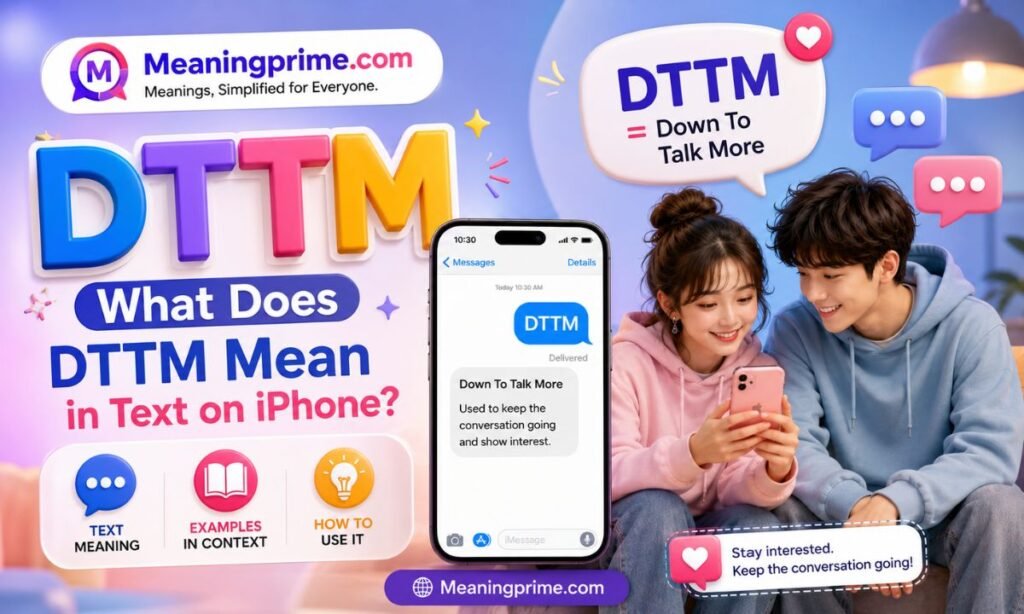
Nothing about the actual meaning changes on iPhone specifically — DTTM reads the same whether it lands in a blue bubble or a green one. One thing worth knowing: iOS predictive text usually won’t suggest DTTM on its own since it’s slang, not a dictionary word, so if autocorrect turns it into something weird mid-type, that’s just autocorrect doing its usual chaos, not a hidden meaning. One real signal to watch for, though: if someone reads a DTTM in iMessage and just leaves it on read with no reply, that silence often means they meant it literally. That’s your cue to actually give them the space.
What Does DTTM Mean in Text — Urban Dictionary Style?
Go digging through slang dictionaries and crowd-sourced definitions, and you’ll find a few flavors of DTTM floating around beyond the main one:
- Don’t Talk To Me — the dominant, everyday meaning by a mile
- Doing Too Much — a rarer read, used when someone’s overreacting or going way overboard for the situation
- Down To The Minute — occasionally shows up in scheduling talk to stress being exact on time
- Don’t Text The Mobile — a niche one, meaning avoid messaging a specific phone, often during a meeting or while driving
Ninety-nine percent of the time in a casual chat, “Don’t Talk To Me” is the correct read. The rest are context-dependent long shots.
What Does BTTM Mean in Text?
Quick note since these two get mixed up constantly: BTTM is a completely different term. It’s most commonly short for “bottom,” used in dating profiles and LGBTQ+ community slang to describe a relationship or role preference. Less commonly, people use it literally to mean “at the bottom” of a page, thread, or list. If you landed here looking for BTTM and found DTTM instead, that’s a totally different four letters doing a totally different job — worth double-checking which one actually showed up in your message.
How to Tell If Someone’s Actually Mad or Just Being Dramatic
Since tone doesn’t come through in plain text, here’s a quick gut-check before you spiral:
- Emoji attached (😂😭🙄) → probably joking
- Just a period and nothing else → could be genuinely serious
- Sent mid-argument → take it seriously
- Sent right after a funny story → 100% dramatic, not angry
- No reply after they send it → give them the space they just asked for
How to Reply to a DTTM Text (By Vibe)
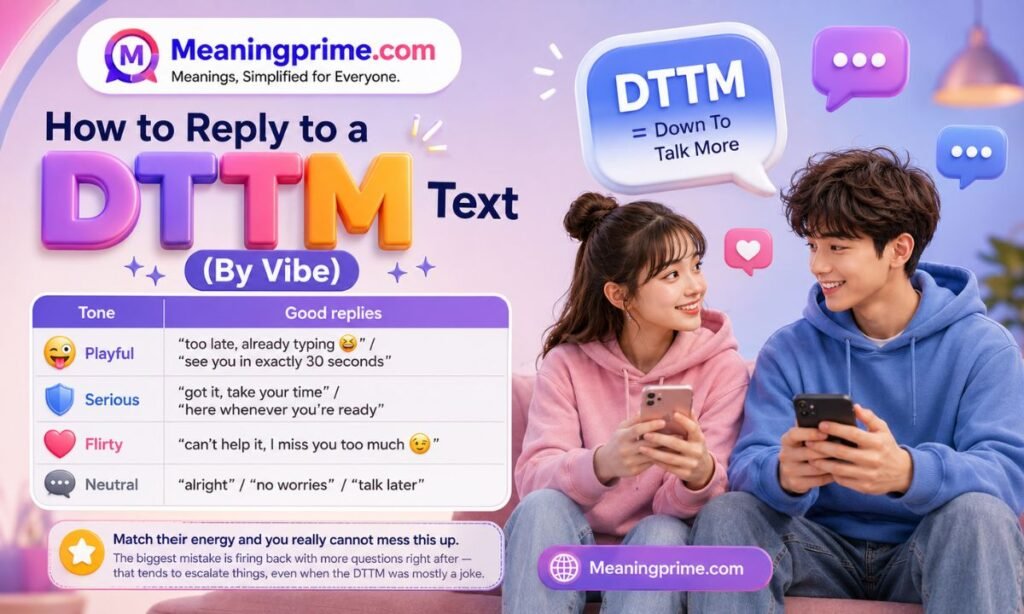
| Tone | Good replies |
| Playful | “too late, already typing 😆” / “see you in exactly 30 seconds” |
| Serious | “got it, take your time” / “here whenever you’re ready” |
| Flirty | “can’t help it, I miss you too much 😉” |
| Neutral | “alright” / “no worries” / “talk later” |
Match their energy and you really cannot mess this up. The biggest mistake is firing back with more questions right after — that tends to escalate things, even when the DTTM was mostly a joke.
DTTM vs Similar Slang Terms
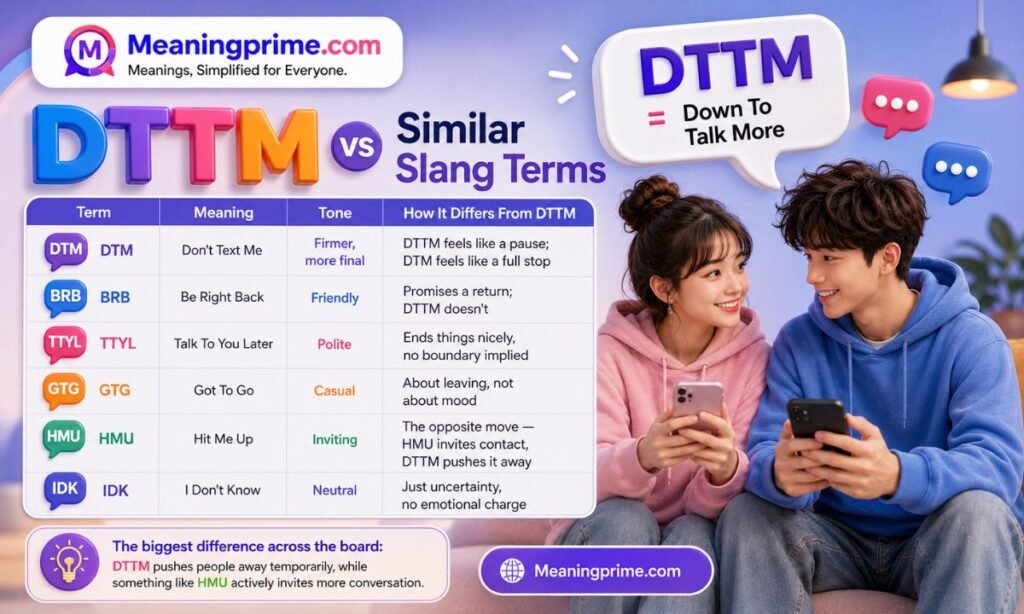
| Term | Meaning | Tone | How It Differs From DTTM |
| DTM | Don’t Text Me | Firmer, more final | DTTM feels like a pause; DTM feels like a full stop |
| BRB | Be Right Back | Friendly | Promises a return; DTTM doesn’t |
| TTYL | Talk To You Later | Polite | Ends things nicely, no boundary implied |
| GTG | Got To Go | Casual | About leaving, not about mood |
| HMU | Hit Me Up | Inviting | The opposite move — HMU invites contact, DTTM pushes it away |
| IDK | I Don’t Know | Neutral | Just uncertainty, no emotional charge |
The biggest difference across the board: DTTM pushes people away temporarily, while something like HMU actively invites more conversation.
Where Did DTTM Come From?
Like most texting shorthand, DTTM grew out of the SMS era, back when character limits and slow keypad typing made every saved letter worth it. “Don’t talk to me” existed as a phrase long before texting did, obviously, but shrinking it to four letters fit the pace of early 2000s chat rooms and flip-phone messaging. TikTok gave it a second life more recently, turning it from a private texting habit into a public caption people use for laughs rather than actual silence — you’ll see it under cringe videos and reaction clips way more than in a private DM these days.
Wait — DTTM Doesn’t Always Mean “Don’t Talk to Me”
Step outside casual texting and DTTM picks up totally different jobs. In databases and spreadsheets, DTTM commonly labels a “Date Time” field, basically a timestamp column developers use to track exactly when something happened in a system. It shows up the same way in medical records and system logs, where an accurate timestamp matters a lot more than anyone’s mood. Some people also use DTTM loosely to mean “Doing Too Much” when calling out someone who’s overreacting. And there’s even “Dial the Truth Ministries,” an organization whose name happens to abbreviate the same way — proof that four letters can live a lot of separate lives depending on where you spot them.
Is DTTM Rude? Should You Use It at Work or School?
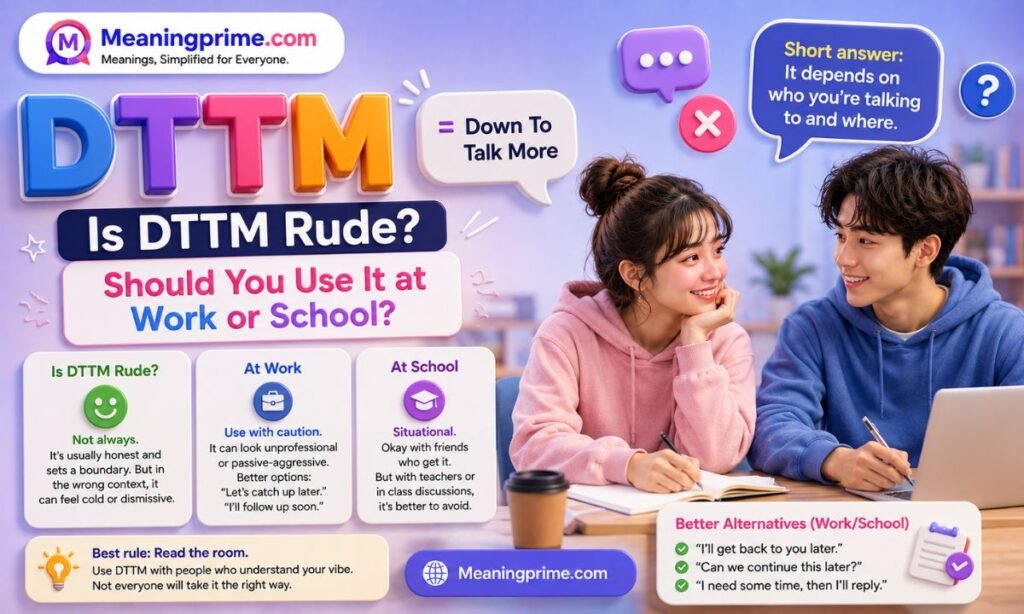
Not inherently. Context decides everything. Dropped cold in the middle of a heated argument, it can feel like a door slamming. Dropped after something embarrassing with a laughing emoji, it’s just banter. At school, it’s fine among friends who already get your texting style. At work, skip it entirely — swap it for something like “I need a minute” or “let’s pick this up later” so nobody reads you as short-tempered over Slack or email.
Frequently Asked Questions
What does DTTM mean in text?
DTTM most commonly means “Don’t Talk To Me.” People use it to signal they need space, are annoyed, or are being playfully dramatic, depending on the emoji and context around it.
What does ddtm mean in text?
DDTM isn’t a separate term — it’s just a typo of DTTM, usually from an extra letter slipping in while typing fast. It carries the exact same meaning: “Don’t Talk To Me.”
What does DTK mean in texting?
DTK most commonly stands for “Don’t Tell K,” used when someone wants information kept secret from a specific person whose name starts with K. It’s often used around surprise parties or gifts.
What does DKM mean in texting?
DKM stands for “Don’t Kill Me.” People use it after saying something funny, wild, embarrassing, or slightly controversial, as a lighthearted way to brace for a reaction.
What does DTM mean in text slang?
DTM stands for “Don’t Text Me.” It’s a firmer, more final cousin of DTTM — where DTTM often feels like a temporary pause, DTM reads as a harder boundary.
Conclusion
DTTM is one of those tiny acronyms that carries a surprising amount of range. Ninety percent of the time, it means “Don’t Talk To Me,” used to vent, joke, or set a quick boundary across Snapchat, Instagram, TikTok, WhatsApp, and regular texts. The other ten percent covers everything from database timestamps to “Doing Too Much” callouts, which is exactly why context always wins over the letters themselves.
Next time DTTM lands in your notifications, check the emoji, check the relationship, and check what was just said before it. Once you’ve got that down, four letters stop being confusing and start being just another quick, useful piece of digital shorthand.