

You’re scrolling through a group chat and someone just replied “FFS” to a photo you sent. No emoji, no context. Are they mad at you? Joking around? Venting about something totally unrelated? That three-second confusion is exactly why so many people search for what FFS actually means.
Here’s the good news: it’s not complicated once you know the context clues to look for. This guide breaks down what does FFS mean in slang, how it shifts tone depending on who’s saying it, and when you should probably leave it out of your reply entirely.
Quick Answer
FFS stands for “for f**k’s sake.” It’s an internet slang term used to express frustration, annoyance, disbelief, or exasperation — sometimes seriously, sometimes as a joke between friends. It’s informal and mildly crude, so it’s best kept out of work emails, school assignments, or conversations with people you don’t know well.
What Does FFS Mean? (Text, Chat & Slang Meaning)
At its core, FFS is a minced version of a much older exclamation. People have said “for goodness’ sake” or “for God’s sake” for generations when something annoys them — FFS just swaps in a stronger word and shrinks it down for fast typing.
In texting and chat apps, FFS shows up when someone’s patience runs out. Maybe the Wi-Fi cut out mid-video-call, a friend cancelled last minute, or an app crashed for the third time today. It’s less a formal statement and more a digital sigh — a way to vent without writing three full sentences.
- “FFS, my order got cancelled again.”
- “Can you double-check before sending? FFS.”
- “FFS… not this again.”
Whether someone types it in caps or lowercase, the underlying feeling stays the same: something just tipped them from mildly annoyed to genuinely fed up.
Is FFS an Acronym?
Yes — technically, FFS is an initialism, since you say each letter rather than pronouncing it as one word (unlike acronyms like NASA). It’s not a typo, and it’s not random keyboard slang either. It’s a deliberate shortcut for a longer phrase, the same way BRB stands in for “be right back.”
FFS Meaning in Social Media
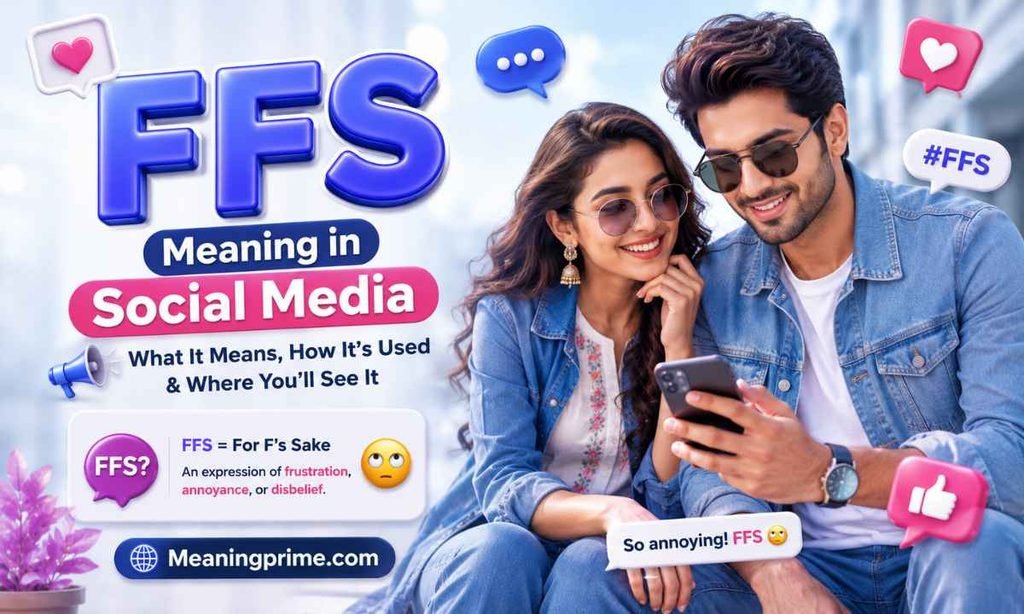
FFS shows up differently depending on which app you’re scrolling through, though the underlying frustration stays consistent.
FFS Meaning on TikTok
On TikTok, FFS pops up constantly in comment sections and rant-style videos. Creators use it in captions when venting about a bad day, and commenters drop it under clips that show something relatable and mildly infuriating — a burnt dinner, a delayed flight, a printer that won’t cooperate.
FFS Meaning on Instagram
On Instagram, you’ll mostly see FFS in captions describing everyday chaos — a missed alarm, a spilled coffee, a Monday that started wrong. It’s less about arguing with someone and more about narrating your own bad luck to followers.
FFS Meaning on Snapchat & WhatsApp
Snapchat stories often pair FFS with a quick photo of whatever went wrong that moment — a real-time reaction rather than a planned post. In WhatsApp group chats, it tends to appear during stressful group planning, like when someone changes the venue for the third time.
Tone & Context: Funny, Sarcastic, Angry, Playful or Sweet
Text strips out tone of voice, which is exactly why FFS can land so differently depending on who sends it and how well you know them.
Funny & Playful Tone
Among close friends, FFS is often exaggerated for comic effect.
A: I dropped my whole pizza slice-first. B: FFS. Tragedy of the century.
Sarcastic Tone
Sometimes it’s less about real anger and more about dramatizing a small inconvenience.
A: I spilled water all over my notes. B: FFS, the universe really has it out for you today.
Angry Tone
In a genuine disagreement, FFS carries real irritation.
A: Stop cutting me off mid-sentence. B: FFS, just let me finish.
Romantic / Affectionate Tone
Interestingly, FFS can flip into something almost warm. Between partners or close friends, it sometimes emphasizes fondness rather than frustration — like “FFS, you’re actually amazing” when someone does something unexpectedly kind. The swear-adjacent word adds emphasis, not hostility.
Real Chat Examples
| Situation | Message |
| Phone dies right after charging | “FFS, you just charged it an hour ago.” |
| Missed the bus by seconds | “FFS, that’s so unlucky.” |
| Plans changed last-minute | “FFS, seriously? Again?” |
| Forgot the wallet at home | “FFS, check your bag first.” |
| Game crashes mid-match | “FFS, not again.” |
| Assignment deadline forgotten | “FFS, panic mode activated.” |
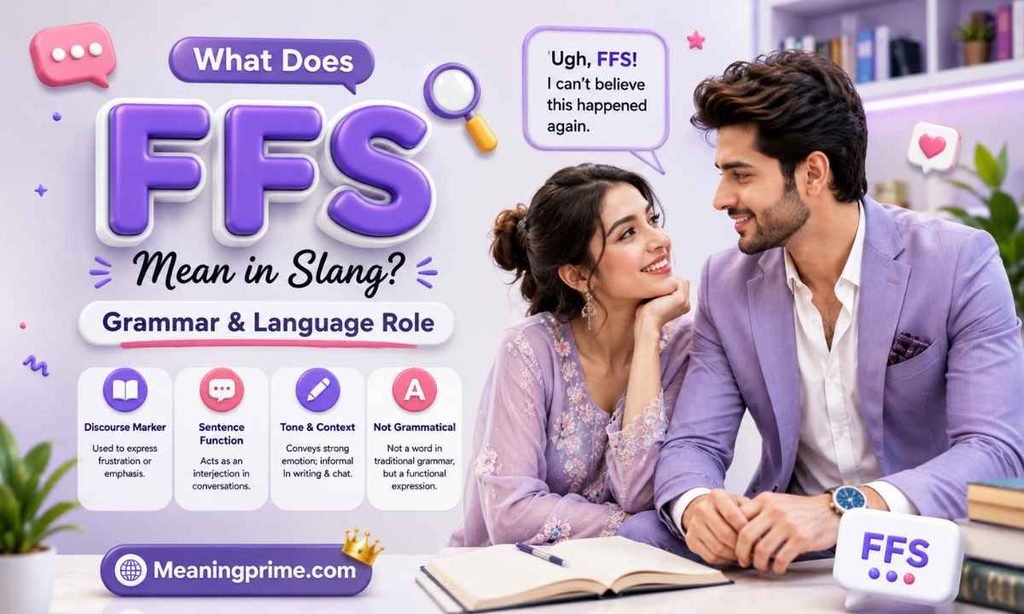
Grammar & Language Role
Part of Speech & Sentence Position
FFS functions as an interjection — it doesn’t need a full sentence around it to make sense. It can open a message (“FFS, listen to me”), sit in the middle (“Why, FFS, does this keep happening?”), or close one out (“You forgot again, FFS”).
Can It Replace a Full Sentence?
Absolutely. Sent alone, it communicates a complete emotional reaction.
A: I accidentally broke your headphones. B: FFS.
No further explanation needed — the frustration and mild disbelief are already clear.
Formal vs. Informal Use
FFS sits firmly in casual territory. It doesn’t belong in work emails, academic writing, customer service messages, or any conversation where you’re representing yourself professionally. Save it for friends, siblings, or people who already know your sense of humor.
How to Reply When Someone Says FFS
| Reply style | Example |
| Funny | “Drama level: expert.” |
| Serious | “What happened? You okay?” |
| Flirty | “Relax, I’ve got this handled.” |
| Neutral | “That does sound stressful.” |
Reading the room matters here. If someone’s genuinely upset, a joke reply can land badly — check the context before picking your tone.
FFS vs. Other Slang (Comparison Table)
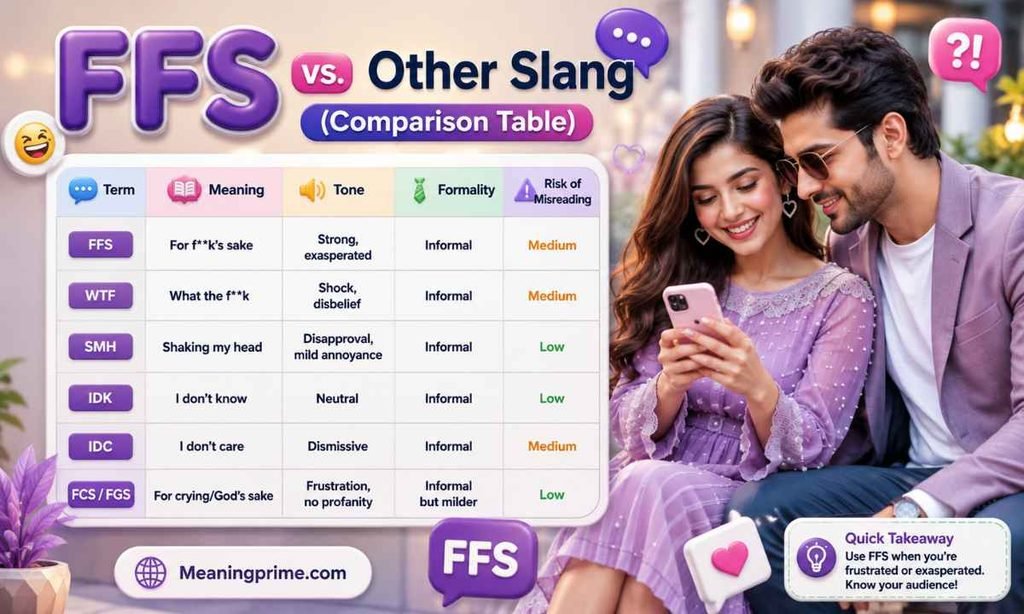
| Term | Meaning | Tone | Formality | Risk of Misreading |
| FFS | For f**k’s sake | Strong, exasperated | Informal | Medium |
| WTF | What the f**k | Shock, disbelief | Informal | Medium |
| SMH | Shaking my head | Disapproval, mild annoyance | Informal | Low |
| IDK | I don’t know | Neutral | Informal | Low |
| IDC | I don’t care | Dismissive | Informal | Medium |
| FCS / FGS | For crying/God’s sake | Frustration, no profanity | Informal but milder | Low |
FFS and WTF often get used interchangeably, but there’s a subtle difference: WTF usually reacts to something confusing or shocking, while FFS reacts to something exhausting or repetitive. If you want the same emotional punch without the implied swearing, FCS or “for crying out loud” cover similar ground.
Who Uses FFS? (Age, Generations & Platforms)
FFS skews younger but isn’t limited to any single age group:
- Teens and young adults use it constantly in group chats and gaming voice/text chat.
- Millennials tend to use it during genuinely stressful moments rather than as constant filler.
- Gamers popularized much of its online spread, especially in competitive multiplayer chats.
- It’s common across the UK, US, Australia, and other English-speaking online communities, appearing on Discord, Reddit, X, WhatsApp, and TikTok alike.
Where Did FFS Come From?
The phrase “for f**k’s sake” existed in spoken British and Australian English long before texting existed, evolving from older, milder exclamations like “for God’s sake” and “for goodness’ sake.” The shortened FFS took off in online gaming communities in the late 1990s and early 2000s, where players typing fast during matches needed a quick way to vent when a teammate made a costly mistake. Early internet slang dictionaries picked it up not long after, cementing it as standard chatroom and forum shorthand well before smartphones existed.
From there, texting, forums, and eventually social media carried it into everyday digital conversation, where meme culture and rant videos keep it feeling current today.
Is FFS Rude or Inappropriate?
FFS carries an implied swear word, so it does count as mild profanity — even though it’s censored by abbreviation. Whether it comes across as rude depends heavily on your audience:
- With close friends: usually read as casual venting, not an insult.
- With strangers or acquaintances: can feel unexpectedly harsh or aggressive.
- In school or work settings: best avoided entirely, since tone can’t be verified in writing.
If in doubt, save it for people who already know your texting style.
Other Meanings of FFS (Not Slang)
FFS isn’t exclusively internet slang — the same three letters show up in a few unrelated, more formal contexts. Worth knowing so you’re not confused if you see it outside a casual chat.
FFS Meaning in Business (Fee-for-Service)
In business and healthcare billing, FFS commonly stands for Fee-for-Service, a payment model where a provider charges separately for each individual service rendered, rather than a flat bundled rate. This usage has nothing to do with frustration — it’s standard industry terminology in contracts, insurance documents, and invoicing.
FFS Surgery (Facial Feminization Surgery)
In a medical and transgender healthcare context, FFS refers to Facial Feminization Surgery, a set of procedures some trans women and non-binary individuals pursue as part of gender-affirming care. If you see “FFS surgery” discussed in a health, identity, or support-group setting, this is almost always the intended meaning rather than the slang term.
Frequently Asked Questions
What does FFS mean in text?
FFS stands for “for f**k’s sake,” an informal expression of frustration, annoyance, or disbelief commonly used in texting and chat apps.
Is FFS rude to say to someone?
It can be, depending on tone and relationship. Among close friends it’s usually read as casual, but directed at a stranger or in a formal setting, it can come across as aggressive.
What does FFS mean on Snapchat or TikTok?
The meaning stays the same across platforms — frustration or exasperation — though on TikTok and Snapchat it often appears in captions reacting to everyday mishaps in real time.
Is FFS the same as WTF?
Not exactly. FFS usually expresses exhaustion or annoyance at something repetitive or frustrating, while WTF leans more toward shock, confusion, or disbelief at something unexpected.
Can FFS ever be a compliment or positive?
Occasionally, yes. Between close friends or partners, FFS can add emphasis to a positive statement, like “FFS, you’re amazing,” where it signals surprise and affection rather than anger.
Conclusion
FFS is one of those slang terms that packs a lot of feeling into three letters — usually frustration, occasionally sarcasm, and every so often, genuine affection dressed up as annoyance. What it means in slang stays consistent: exasperation shortened for speed. What changes is the tone, and that depends entirely on who’s typing it and why.
The safest approach is simple: use it freely with people who get your humor, and skip it anywhere you’d think twice before swearing out loud. Once you can read the context around it, FFS stops being confusing and starts being just another normal part of how people vent online.