
You’re scrolling through a group chat, someone asks a question, and the reply comes back: “ionk.” No punctuation, no explanation, just four lowercase letters staring back at you. If you’ve paused mid-scroll wondering whether you’re missing an inside joke or a whole new language, you’re not alone — and the answer is simpler than it looks. This guide breaks down exactly what that reply means, why it sounds the way it does, and how to use it (or respond to it) without missing a beat.
Quick Answer: This four-letter reply is texting shorthand for “I don’t know.” It’s a phonetic spelling — say it out loud and it sounds like a fast, mumbled version of “I don’t know” — rather than an acronym built from the first letters of each word. It’s casual, low-effort, and extremely common in group chats, comment sections, and DMs among younger texters.
What Does “IONK” Mean in Text?
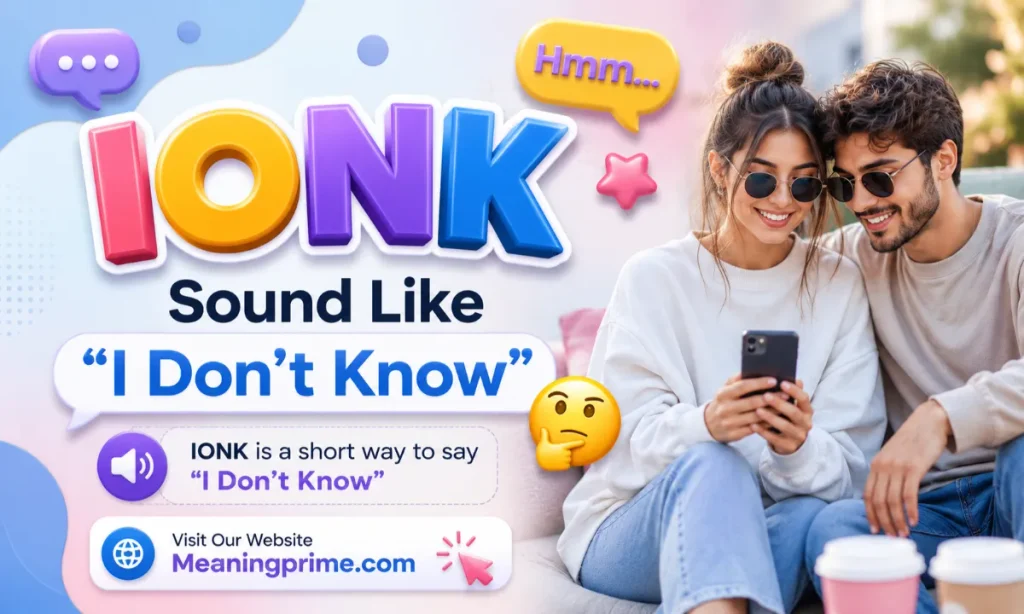
At its core, what does ionk mean in text comes down to one simple phrase: “I don’t know.” Unlike most texting abbreviations, which are built by stringing together the first letter of each word (think LOL, BRB, or IDK), this one works differently. It’s a phonetic respelling — the letters are chosen because they sound like the phrase when spoken quickly, not because they stand for it letter by letter.
Say “I don’t know” out loud at a normal conversational speed and it often collapses into something closer to “i-on-know” or “ion-know.” Drop that into text form, trim it down, and you land on the spelling people actually type. It’s the same instinct that gave us “ion” as a stand-in for “I don’t” in casual online slang — this term just tacks the “know” sound onto the end.
Functionally, it means exactly what IDK means. There’s no hidden depth or secondary meaning in the vast majority of contexts. If a friend texts “ionk what to wear tonight,” they mean precisely what it looks like: they haven’t decided yet.
Context is doing a lot of work here, too. Because this shorthand is so brief, its meaning leans heavily on the sentence around it. A one-word reply to a yes-or-no question communicates something different than the same word tucked into a longer sentence, even though the underlying phrase never changes. Once you can spot the pattern, the shorthand stops looking like a mystery and starts reading exactly like the plain-English phrase it’s standing in for.
Why Does IONK Sound Like “I Don’t Know”?
The Phonetic Logic Behind It
Texting slang tends to evolve in two directions: initialisms that shorten a phrase to its first letters, and phonetic spellings that shorten a phrase to how it sounds. This term belongs firmly in the second camp.
Break it down syllable by syllable:
- “I” stays as the letter I
- “don’t” compresses into the “on” sound, since the D and T often blur together when spoken fast
- “know” becomes simply “k,” mirroring how “okay” gets shortened to “k” in texts
Put those three sounds together — I, on, k — and the result is exactly what shows up on screen. This is the same logic behind other sound-based slang, like “ikr” (I know, right) evolving informally in speech patterns, or “prolly” standing in for “probably.” Texters aren’t spelling things out grammatically; they’re spelling things out the way they sound when mumbled through a phone screen. Once you notice this pattern in one piece of slang, you start seeing it everywhere online — shorthand built from sound rather than from strict grammar.
IONK vs. Similar Texting Slang
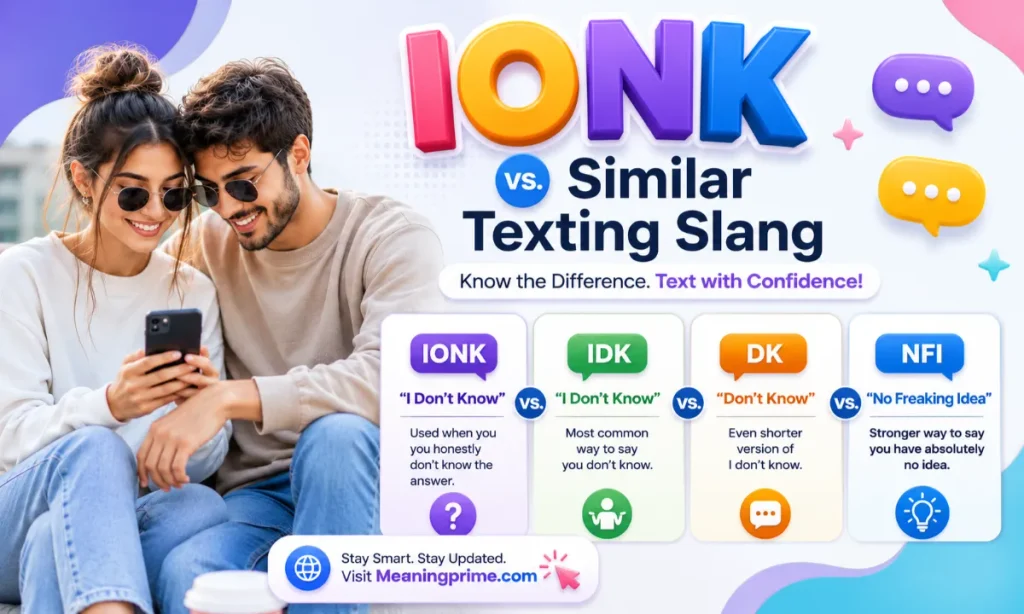
Because this term looks and sounds like several other pieces of internet shorthand, it’s easy to mix them up. Here’s how the most commonly confused terms actually differ.
IONK vs. IDK
IDK is the classic initialism for “I don’t know” — each letter stands for one word. The phonetic version of the same phrase is the one this article is about. They’re interchangeable in meaning; the only real difference is tone. IDK reads as slightly more neutral and widely understood across age groups, while the phonetic spelling feels more casual, more Gen Z-coded, and a bit more playful.
IONK vs. ION
“Ion” is a broader, more flexible piece of slang meaning “I don’t.” It’s a building block that gets attached to all sorts of things: “ion care,” “ion know,” “ion like that.” The four-letter version discussed here is essentially a contracted, fused form of “ion know” — the “know” sound gets folded directly into the word instead of typed out separately. So while “ion” is the open-ended base, this is one specific, ready-made phrase built from it.
IONK vs. IONO
IONO is another phonetic cousin, standing for “I don’t know” as well, but built slightly differently — closer to “I on-o” than “I on-k.” The two are near-synonyms and often used by overlapping groups of texters. Some people treat them as regional or personal-style variants; there’s no meaningful difference in what they communicate.
| Term | Meaning | Style | Common Context |
| IDK | I don’t know | Initialism, widely understood | Any chat, any age group |
| IONK | I don’t know | Phonetic, casual | Group chats, younger texters |
| ION | I don’t | Phonetic base phrase | Attaches to other words (“ion care”) |
| IONO | I don’t know | Phonetic variant | Similar meaning, slightly different spelling |
How People Use IONK in Real Conversations
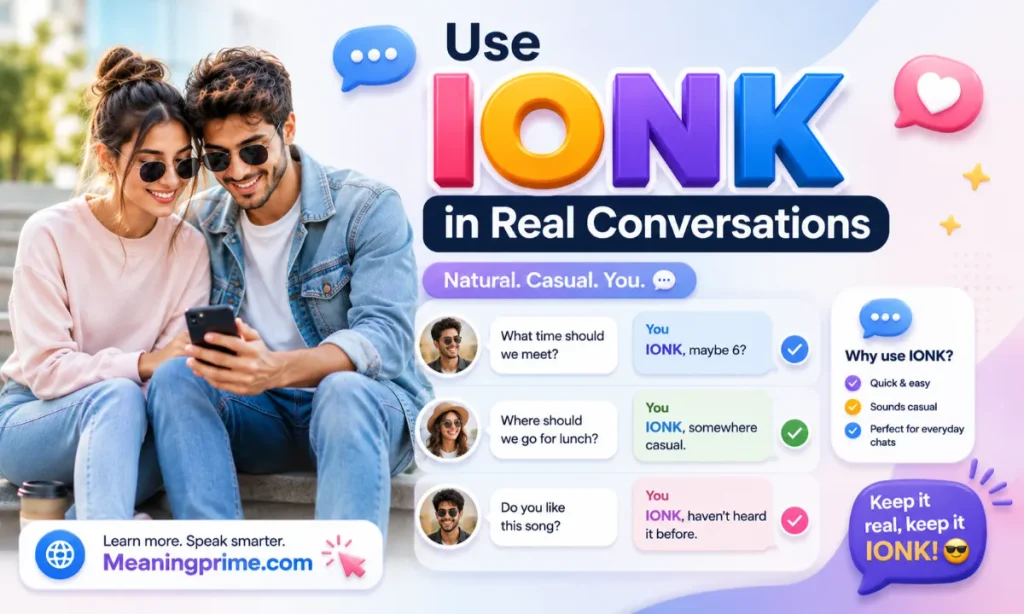
Seeing this shorthand defined on a page is one thing; seeing how it actually lands in a real conversation makes the meaning click faster.
In Group Chats
Group chats are its natural habitat. When a plan is up in the air — where to eat, what time to meet, whether someone’s coming — “ionk” is the fastest way to signal genuine uncertainty without derailing the conversation. It’s short enough to type with one thumb while doing something else entirely.
Between Friends
Between close friends, this reply often carries a slightly different weight than a formal “I don’t know.” It can soften a response, deflect a question the person doesn’t want to fully answer, or simply buy time. “You still mad at him?” “ionk, kinda” reads as more relaxed and noncommittal than a full sentence would.
In Flirty or Playful Texts
The same shorthand also shows up in lighter, flirtier exchanges, often paired with emoji or trailing punctuation to soften or tease. “ionk… you tell me 👀” uses the same base meaning but leans into ambiguity on purpose, turning genuine uncertainty into a bit of playful back-and-forth. In these settings, tone matters as much as the word itself — the letters stay the same, but the vibe around them shifts depending on who’s sending it and why.
| Message | Reply | What It Signals |
| “wanna get food later?” | “ionk yet, depends on work” | Genuine scheduling uncertainty |
| “do you like him??” | “ionk… maybe” | Playful deflection |
| “who’s driving tonight” | “ionk ask Sam” | Passing the question along |
Where You’ll See IONK Most (Platform Breakdown)
This slang isn’t tied to one single app — it travels across whichever platform its users are texting on at the moment — but it shows up more heavily on some than others.
What Does IONK Mean on Instagram?
On Instagram, this reply pops up most in DMs and comment replies, especially on Reels or Stories where a quick reaction is expected. The meaning doesn’t shift from its base definition; the platform just favors short, throwaway replies, which suits a word this compact perfectly.
What Does IONK Mean on Snapchat?
Snapchat’s fast, disappearing-message format is arguably where this shorthand feels most at home. Because Snaps are meant to be quick and low-stakes, a one-word “ionk” fits the platform’s whole rhythm — dash off a reply, move on, no need to overthink it.
| Platform | How Common | Typical Use |
| Snapchat | Very common | Quick chat replies, captions |
| TikTok | Common | Comment sections, duets |
| Discord | Common | Casual server chat |
| Moderate | Friend group chats | |
| iMessage | Moderate | Text threads between friends |
Does Emoji or Tone Change What IONK Means?
The core meaning stays fixed — it always means “I don’t know” — but the emotional flavor around it shifts depending on what surrounds it. Adding a crying-laughing emoji often reads as amused or exasperated uncertainty. A hard period at the end can come across flat or dismissive, especially if the sender is annoyed by the question. An exclamation point or a sweat-smile emoji tends to feel lighter and more good-natured. None of these variations change the literal meaning; they just color how the uncertainty is being expressed. Reading tone in text is always a bit of guesswork, but punctuation and emoji choice are usually the clearest clues you’ll get.
How to Respond When Someone Texts You “IONK”
There’s no wrong way to respond to an “ionk,” since it’s rarely meant to end a conversation — it’s usually an invitation to keep talking. A few natural options:
- Offer a suggestion of your own (“ionk either, wanna just pick something?”)
- Ask a follow-up question to narrow things down
- Match the energy with a similarly casual reply (“same tbh”)
- If it feels dismissive, a gentle “no worries, just curious” keeps things easy
Because this kind of reply is so low-effort by design, reading too much into a single instance of it usually isn’t necessary — it’s often just genuine uncertainty, not a signal of disinterest. If the conversation matters and a one-word answer isn’t enough, a quick follow-up almost always gets a fuller response.
Common Misconceptions About IONK
The most persistent myth about this term is that it stands for “I Only Now Know” — the exact opposite of its real meaning. This misreading tends to spread because the letters look like they could form a proper acronym, and “I Only Now Know” happens to fit them if you squint.
But that interpretation doesn’t match how the term is actually used online. Search any group chat, comment section, or slang dictionary and the pattern is consistent: it’s used to express not knowing something, not the moment of suddenly finding it out. The “I Only Now Know” reading is a backronym — a phrase reverse-engineered to match existing letters — rather than the term’s actual origin. If you see it used in context, “I don’t know” will fit every single time; “I Only Now Know” almost never will. When in doubt, swap in the plain-English phrase and check whether the sentence still makes sense — it almost always will, which is the simplest way to confirm the real definition.
Fun Variations of IONK (IONR, IONM & More)
Once a phonetic pattern like this catches on, it’s common for texters to riff on it playfully. IONR (“I don’t remember”), IONM (“I don’t mind” or “I don’t mean”), and similar one-off variants pop up occasionally in casual chats. These aren’t standardized slang the way the original term is — they’re closer to inside jokes or momentary wordplay that borrows its structure. If you see one you don’t immediately recognize, sounding it out phonetically, the same way you would with the base version, usually reveals the intended phrase. That’s really the master key to this whole family of slang: when the letters don’t obviously spell a word, read them out loud before assuming they’re gibberish.
“LONK” — Is It the Same as IONK?
If you’ve searched for this term and stumbled across “lonk” instead, you’re likely looking at a font or autocorrect quirk rather than a different word. In many fonts, comment sections, and lowercase typefaces, a capital “I” can visually resemble a lowercase “l,” which turns the original spelling into something that reads as “lonk” at a glance. There isn’t a separate slang term called “lonk” with its own established meaning — in nearly every case, it’s simply the same word, misread. If context makes it clear someone is answering a question with uncertainty, you can safely assume it’s the phonetic “I don’t know” under a confusing font, not a new word entirely. This kind of visual mix-up is common with short, all-caps slang in general, so it’s worth double-checking the surrounding sentence whenever a word looks slightly off.
Other Slang You Might Be Confusing With IONK
IHNC Meaning in Text
IHNC stands for “I have no clue,” a close cousin in both meaning and tone. It’s less phonetic and more of a straightforward initialism, but the two are often used interchangeably to express the same basic uncertainty.
IOK Meaning in Text
IOK is sometimes used as a shortened, slightly different spelling in the same phonetic family, again pointing back to “I don’t know.” Spelling here isn’t standardized — different texters land on slightly different letter combinations for the same sound.
What Does “Ion” Mean in Text?
As covered earlier, “ion” is the broader base phrase meaning “I don’t,” used as a flexible building block (“ion know,” “ion care,” “ion think so”). The word this article focuses on is one specific, fused offshoot of that base term.
Gonk and Jank — Different Slang Entirely
It’s worth clearing up two terms that sound similar but aren’t related to any of this at all. “Gonk” is slang for someone acting foolish or clueless — closer to calling someone a fool. “Jank,” meanwhile, describes something sketchy, poorly made, or low-quality, as in “that setup looks jank.” Neither has anything to do with expressing “I don’t know,” even though the short, punchy spelling might make them feel like part of the same slang family. They’re useful to know mainly so you don’t accidentally lump three unrelated words into one definition.
Why IONK Is So Popular in Texting Today
This term’s popularity fits into a broader pattern in how younger texters communicate: speed and effortlessness win out over grammatical correctness. Typing “I don’t know” in full takes noticeably longer than a four-letter phonetic stand-in, and in fast-moving group chats, that difference adds up. Phonetic slang like this also carries a built-in sense of in-group familiarity — using it signals fluency in the texting norms of a particular age group or online community, the same way any evolving slang does. As more people adopt shorthand like this across TikTok comments, Discord servers, and Snapchat threads, it becomes self-reinforcing: the more common it gets, the more natural it feels to use.
There’s also a generational layer worth noting. Older texting shorthand, like LOL or BRB, tends to be built from clear initials that almost anyone can decode at a glance. Newer phonetic slang asks the reader to sound things out instead, which naturally creates a bit of a barrier for people outside the group that popularized it. That barrier isn’t necessarily intentional, but it does help explain why a four-letter reply can feel instantly familiar to one reader and completely baffling to another — it’s less about the word itself and more about how recently someone has been steeped in this style of texting.
FAQs
What does “ion” mean in texting?
“Ion” means “I don’t.” It’s a flexible phonetic base that gets combined with other words, such as “ion know,” “ion care,” or “ion think so.”
What is “ion” in Gen Z slang?
Among Gen Z texters, “ion” functions the same way described above — a fast, spoken-sound stand-in for “I don’t,” used constantly as a prefix in casual messages.
What does “ions” mean in slang?
“Ions” typically isn’t a distinct slang term on its own; it’s usually either a typo or autocorrect variant of “ion” (I don’t), sometimes picked up when someone types quickly without checking.
Is IONK the same as IDK?
Yes, functionally. Both mean “I don’t know.” IDK is a standard initialism, while this version is a phonetic spelling of the same phrase, generally used in more casual settings.
Can IONK ever mean “I Only Now Know”?
No. This is a common misconception based on a backronym, not how the term is actually used in real conversations. Every established use online points back to “I don’t know.”
Is IONK rude to use?
Not inherently. Like any short reply, tone depends on context. Paired with a period or used in response to a serious question, it can come across as dismissive, but in casual chats it’s typically read as neutral or lighthearted.
How do you use IONK in a sentence?
Simply drop it in wherever “I don’t know” would naturally go: “ionk what time we’re leaving,” or just “ionk” as a standalone reply to a question.
Conclusion
At the end of the day, this is just a fast, phonetic way of texting “I don’t know” — nothing more mysterious than that. It sounds like the phrase when spoken quickly, it shows up most in group chats and casual DMs, and its tone shifts slightly depending on the emoji or punctuation around it, but its core meaning never changes.
Now that you know exactly what this shorthand means in text, you can use it confidently in your own conversations — and spot it instantly the next time it shows up in your notifications, instead of pausing to wonder what you missed. Whether it lands in a group chat, a comment section, or a late-night DM, the letters will always break down the same way: a quick, phonetic shrug that simply means the sender hasn’t made up their mind yet.