


You’re logging into your patient portal, scrolling through your latest visit summary, and there it is: WNL. No explanation, no context, just three letters sitting next to your heart exam or your lab panel. If you’ve never seen it before, it’s natural to wonder whether that’s good news, bad news, or something you’re supposed to already understand.
Here’s the good news: WNL is one of the easier pieces of medical shorthand to decode, and once you understand it, you’ll never squint at your chart notes the same way again. This guide breaks down the WNL medical abbreviation meaning in plain English, shows you exactly how it’s used across different specialties and tests, and explains the one important nuance most people miss about what it actually promises.
Quick Answer: What Does WNL Mean?
WNL stands for “Within Normal Limits.” Doctors, nurses, and other clinicians use it in charts, exam notes, and lab reports to show that a specific finding — a test result, a body system, an exam observation — falls inside the range considered typical and healthy. It’s a documentation shortcut, not a diagnosis, and it only applies to whatever was actually being checked.
What Does WNL Mean in Medical Terms?
The Simple Definition
The WNL medical abbreviation meaning comes down to this: something was checked, and it looked normal. That’s it. No red flags, no abnormal values, nothing that needed a second look during that particular assessment.
You’ll see it written next to individual body systems (“Cardiovascular: WNL”), specific test values (“Sodium: WNL”), or general observations during an exam. In every case, it’s shorthand for “this specific thing is fine,” not a sweeping statement about your overall health.
It’s worth noting that WNL isn’t a clinical score or a lab value itself — it’s a summary judgment a clinician makes after comparing your result to an established reference range. That distinction matters more than it sounds, and we’ll come back to it.
Why Doctors and Nurses Use It
Clinicians document dozens, sometimes hundreds, of findings a day. Writing out “the heart sounds were normal with no murmurs, gallops, or rubs detected” every single time would slow charting to a crawl and clutter records that other providers need to scan quickly.
So instead, a clinician writes:
Heart: WNL
Short, standardized, and instantly understood by anyone trained to read a chart. That efficiency is really the whole reason the WNL medical abbreviation exists — it keeps documentation fast without sacrificing clarity between providers who all speak the same clinical shorthand.
Where You’ll See WNL in Your Medical Records
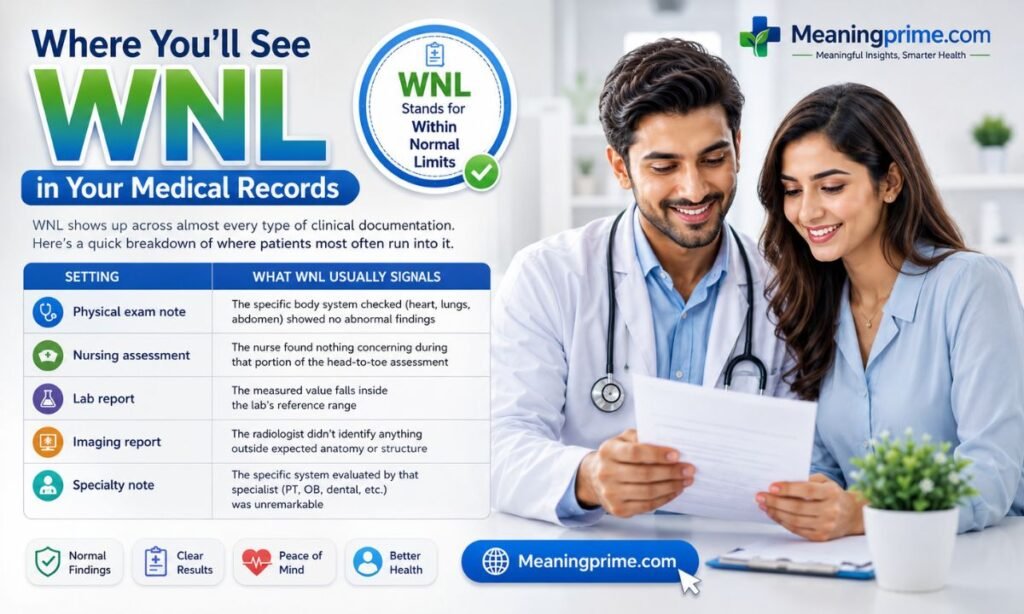
WNL shows up across almost every type of clinical documentation. Here’s a quick breakdown of where patients most often run into it.
| Setting | What WNL Usually Signals |
| Physical exam note | The specific body system checked (heart, lungs, abdomen) showed no abnormal findings |
| Nursing assessment | The nurse found nothing concerning during that portion of the head-to-toe assessment |
| Lab report | The measured value falls inside the lab’s reference range |
| Imaging report | The radiologist didn’t identify anything outside expected anatomy or structure |
| Specialty note | The specific system evaluated by that specialist (PT, OB, dental, etc.) was unremarkable |
Physical Exam Notes
During a physical exam, providers often move system by system and note findings in shorthand. You might see:
- HEENT: WNL — head, eyes, ears, nose, and throat all appeared normal
- Cardiovascular: WNL — regular rhythm, normal heart sounds, no murmurs
- Abdomen: WNL — no tenderness, swelling, or abnormal bowel sounds
- MSK: WNL — normal strength, movement, and no visible deformity
Nursing Assessments
Nurses lean on WNL heavily because bedside assessments happen constantly — sometimes every few hours. A typical nursing note might read:
Neuro: WNL, Resp: WNL, Cardiac: WNL, Skin: WNL
This lets the next nurse or physician scan the chart in seconds and immediately understand which systems were stable at that check-in.
Lab Results and Test Reports
This is probably where most patients actually encounter the WNL test full form — sitting right next to individual values on a lab printout. A complete blood count might list white blood cells, hemoglobin, and platelets all marked WNL, meaning each number landed inside the lab’s expected reference range for someone your age and sex.
One thing worth knowing: reference ranges aren’t universal constants. They can shift slightly between labs depending on the equipment used and the population the range was built from, which is why the same result might be flagged differently at two different facilities.
WNL Meaning by Body System and Specialty
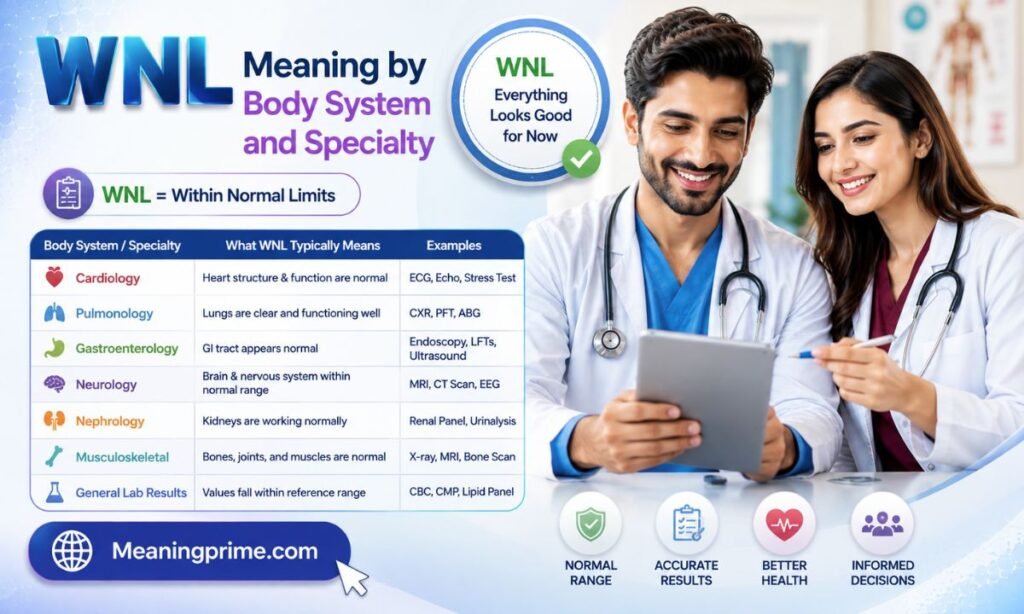
WNL isn’t a one-size-fits-all label. Its exact meaning shifts depending on which system or specialty is documenting it. Here’s how the WNL medical abbreviation meaning changes across common contexts patients search for.
VS WNL (Vital Signs Within Normal Limits)
“VS WNL” is one of the most common phrases you’ll see at the top of a chart note. It’s shorthand confirming that blood pressure, heart rate, temperature, respiratory rate, and oxygen saturation all landed within expected ranges at that visit. It’s usually one of the first things documented, since abnormal vitals often change the direction of the entire visit.
WNL Full Form in ECG
When an electrocardiogram (ECG or EKG) is reported as WNL, it means the electrical activity of your heart — rate, rhythm, and the shape of each wave on the tracing — fell within expected patterns, with no signs of arrhythmia, blockage, or other abnormality the test is designed to catch. You’ll sometimes see this paired with NSR (normal sinus rhythm), which is a more specific finding within a WNL ECG report.
WNL Medical Abbreviation Pregnancy
In prenatal charting, WNL shows up constantly because so many measurements are tracked at every visit — fundal height, fetal heart rate, blood pressure, weight gain, and lab panels. “Fetal heart tones: WNL” simply means the baby’s heart rate was within the expected range for that stage of pregnancy. As with any WNL notation, it reflects that specific check, not a guarantee that every aspect of the pregnancy is complication-free.
Cx WNL Medical Abbreviation
In obstetric notes, “Cx” refers to the cervix, and “Cx: WNL” typically appears during labor checks or prenatal exams to indicate the cervix appeared unremarkable for that stage of assessment — no unexpected dilation, lesions, or abnormal findings noted at that moment.
WNL Medical Abbreviation Eye
In an eye exam, WNL usually covers things like pupil response, visual fields, and general ocular structure. You might see it alongside a more specific abbreviation like PERRLA (pupils equal, round, reactive to light and accommodation), with WNL confirming the rest of the exam showed nothing abnormal.
WNL Full Form in X-Ray
On an imaging report, “WNL” (sometimes phrased as “no acute findings”) means the radiologist didn’t identify fractures, masses, fluid, or other abnormalities on that particular film. It doesn’t rule out every possible condition — only what that specific imaging study is capable of detecting.
WNL Meaning Dental
Dentists and hygienists use WNL during routine exams to note that gum tissue, bite alignment, or oral structures appeared healthy. It’s a fast way to document a clean checkup without writing out every individual observation.
How “Normal” Ranges Are Actually Determined
Here’s a detail almost nobody explains: reference ranges aren’t a single fixed number. Most labs build them from the results of a large, healthy population sample, then set the “normal” range to cover roughly 95% of those values. That means, statistically, about 1 in 20 perfectly healthy people will land just outside the “normal” line purely by chance — not because anything is actually wrong.
That’s part of why a clinician’s judgment still matters more than the WNL label itself. A number just outside range in an otherwise healthy person might mean nothing at all, while a number technically “within normal limits” could still be worth watching if it’s trending in the wrong direction over time.
Does WNL Mean You’re Completely Healthy? (The Honest Answer)

This is the question behind most searches for WNL medical abbreviation meaning, so let’s answer it directly: no, WNL does not mean you’re completely healthy. It means the specific thing that was checked looked normal.
Why WNL Only Covers What Was Actually Checked
A patient can have a chronic condition like diabetes or high cholesterol and still have a heart exam, lung exam, and neurological exam all documented as WNL. Those particular assessments simply didn’t reveal anything abnormal during that visit — they’re not a statement about conditions that weren’t being screened for in the first place.
Symptoms and normal results can also coexist. Fatigue, headaches, or dizziness might show up while blood counts, blood pressure, and a physical exam all come back WNL. That’s not a contradiction; it just means the specific tests run didn’t catch whatever’s causing the symptoms, and further evaluation might be needed.
“Normal” Isn’t Always “Optimal”
There’s also a subtler distinction worth knowing: normal and optimal aren’t the same thing. A cholesterol level can sit comfortably within the standard reference range and still be higher than ideal for someone with other risk factors for heart disease. WNL tells you where a number falls compared to a general population range — it doesn’t tell you what’s ideal for your specific health picture. That judgment call belongs to your provider, who factors in your history, symptoms, and risk profile alongside the raw number.
The “We Never Looked” Problem
Here’s something you won’t find in most patient guides, but it’s an open secret among clinicians: WNL has a well-known, half-joking alternate reading in medical circles — “We Never Looked.” It’s a wry acknowledgment that a rushed or incomplete exam can sometimes get documented the same way as a thorough one. If a provider is moving quickly through a long shift, “WNL” can occasionally get written out of habit rather than a truly detailed assessment.
This is exactly why many hospitals and training programs now push for more specific documentation in situations where precision actually matters — writing out findings like “alert and oriented x4, cranial nerves intact, normal gait” instead of a blanket WNL when a patient has active symptoms.This isn’t meant to make you distrust your chart. It’s meant to explain why, if something feels off despite a WNL note, it’s completely reasonable to ask your provider what exactly was assessed and how thoroughly.
WNL vs. Similar Medical Abbreviations
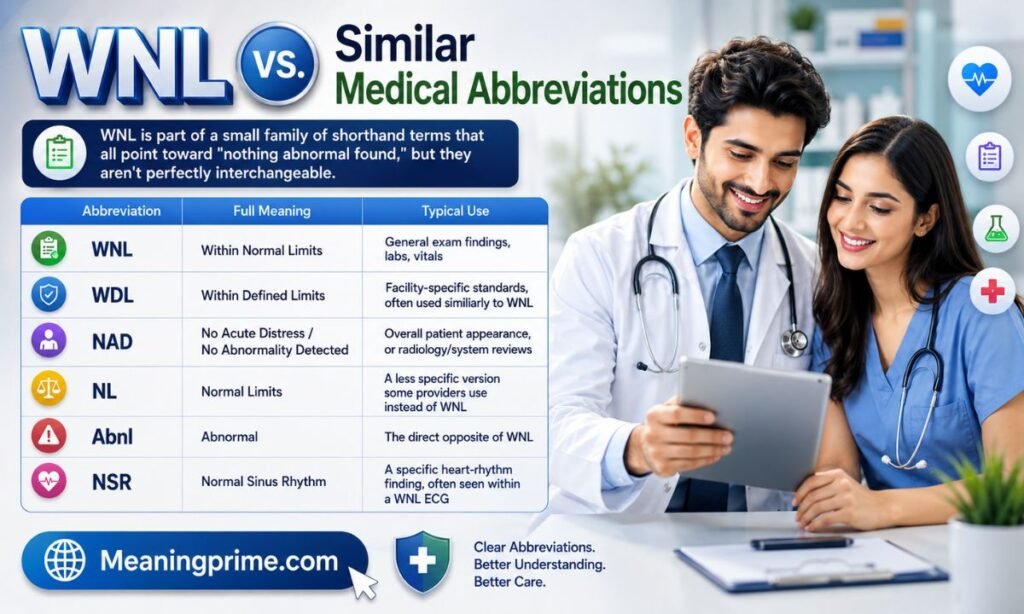
WNL is part of a small family of shorthand terms that all point toward “nothing abnormal found,” but they aren’t perfectly interchangeable.
| Abbreviation | Full Meaning | Typical Use |
| WNL | Within Normal Limits | General exam findings, labs, vitals |
| WDL | Within Defined Limits | Facility-specific standards, often used similarly to WNL |
| NAD | No Acute Distress / No Abnormality Detected | Overall patient appearance, or radiology/system reviews |
| NL | Normal Limits | A less specific version some providers use instead of WNL |
| Abnl | Abnormal | The direct opposite of WNL |
| NSR | Normal Sinus Rhythm | A specific heart-rhythm finding, often seen within a WNL ECG |
WNL vs. WDL: Is There a Real Difference?
“Vs WNL medical abbreviation” comparisons usually come up against WDL, and in practice, the two are used almost identically. The subtle difference is that WDL (“Within Defined Limits”) points to a facility’s own established standards, while WNL leans on broader clinical norms. In day-to-day charting, most providers and patients can treat them the same way.
Common Myths About WNL, Debunked
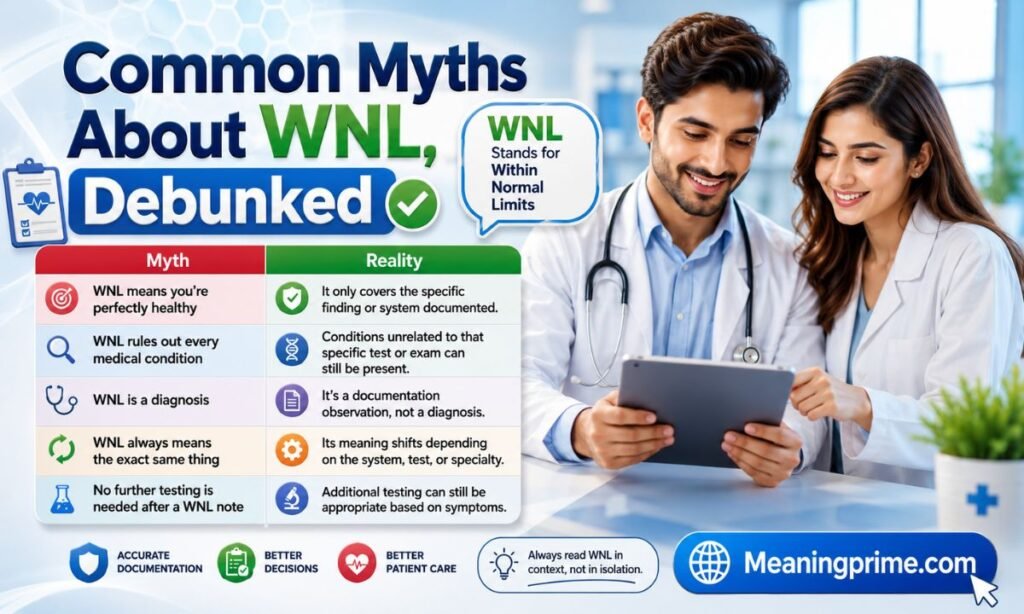
| Myth | Reality |
| WNL means you’re perfectly healthy | It only covers the specific finding or system documented |
| WNL rules out every medical condition | Conditions unrelated to that specific test or exam can still be present |
| WNL is a diagnosis | It’s a documentation observation, not a diagnosis |
| WNL always means the exact same thing | Its meaning shifts depending on the system, test, or specialty |
| No further testing is needed after a WNL note | Additional testing can still be appropriate based on symptoms |
How to Read and Respond to WNL in Your Own Chart
If you spot WNL in your own records, a few simple habits go a long way toward understanding what it actually tells you.
- Check the context. Note which system or test the WNL applies to — a WNL abdominal exam says nothing about your thyroid labs.
- Read the whole note, not just the shorthand. Diagnoses, recommendations, and follow-up plans usually carry more useful detail than a single abbreviation.
- Don’t self-diagnose from three letters. Chart shorthand is written for other clinicians, not for standalone interpretation.
- Bring your symptoms into the conversation, even if a related test came back WNL — the two can coexist.
Questions Worth Asking Your Provider
- “What exactly did you check when you documented this as WNL?”
- “Does this result rule out what I’m concerned about, or just this particular condition?”
- “Should we look into anything further given my symptoms?”
When to Push for More Detail
If symptoms persist despite a WNL note, if the terminology feels vague, or if a provider recommends additional testing anyway, it’s worth asking for more specifics than the abbreviation alone provides. You’re not being difficult — you’re asking for the same clarity a fellow clinician would expect from the chart.
Frequently Asked Questions
What does “WNL” mean in medical terms?
WNL stands for “Within Normal Limits.” It’s used by healthcare providers to show that a specific exam finding, test result, or body system fell within the expected normal range.
What is WNL in ECG?
On an electrocardiogram, WNL means the heart’s electrical activity — rate, rhythm, and wave patterns — looked normal, with no signs of arrhythmia or other abnormalities the test screens for.
What is WNL in a physical exam?
It means the specific body system being examined, such as the heart, lungs, or abdomen, showed no abnormal findings during that particular part of the exam.
Is WNL a good sign, or should I be concerned?
Generally, WNL is a reassuring finding. It shows nothing unusual was found in that specific assessment, though it’s still worth reading the full report for context.
Does WNL mean the same thing as “normal”?
Mostly, yes. WNL is often used interchangeably with “normal,” though it technically emphasizes that a result falls within an acceptable range rather than matching one exact expected value.
Can I have symptoms even if my results say WNL?
Yes. Symptoms can exist even when related tests or exams come back WNL, since WNL only reflects the specific area that was checked, not your entire health picture.
What’s the difference between WNL and WDL?
WNL means “Within Normal Limits” based on broad clinical standards, while WDL means “Within Defined Limits” based on a specific facility’s own established ranges. In practice, they’re used very similarly.
Conclusion
At its core, the WNL medical abbreviation meaning is simple: “Within Normal Limits,” used to show that a specific test, exam finding, or body system looked normal at the time it was checked. It’s one of the most common shortcuts in clinical documentation, and for good reason — it keeps charts fast and clear for the providers reading them.
The honest nuance worth carrying with you is that WNL is scoped, not sweeping. It tells you about the specific thing assessed, not your entire health story. If you ever see it in your own chart and something still doesn’t feel right, that’s not a reason to second-guess your instincts — it’s simply your cue to ask your provider a few clarifying questions and keep that conversation going.