

You just got a text back that says “fr” and now you’re sitting there wondering what it actually means. Did they agree with you? Are they questioning what you said? Or is this some new slang you missed while you weren’t paying attention? It’s a weirdly common moment — two letters show up, and suddenly you’re overthinking a reply.
Good news: it’s simpler than it looks once someone actually breaks it down for you. This guide covers the FR meaning in chat, every way people use it, how to reply without sounding awkward, and when you should just skip it altogether.
Quick Answer
FR stands for “for real.” People use it to show they’re being honest, to agree strongly with something, or to ask if a wild claim is actually true. It works as a statement ender (“I’m exhausted fr”), a solo reply (“fr”), or a question (“fr?”). Meaning stays the same across WhatsApp, Instagram, Snapchat, and texting — only the tone shifts depending on who you’re talking to.
You Saw It and Got Confused, Right?
Someone replied “fr” to your message and you genuinely couldn’t tell if they were agreeing with you or side-eyeing you. Or maybe your younger cousin texts it constantly and you’ve just been nodding along, pretending you understand. That confusion is fair. Two letters carrying that much weight seems unfair, honestly.
Here’s the thing though — once you know the context clues, you’ll never second-guess it again. It’s not some secret code. It’s just shorthand that leans hard on tone, and tone is exactly what gets lost in a text bubble.
Here’s What FR Actually Does in a Conversation
When someone types “fr,” they’re not just trimming a word to save time. They’re adding emotional weight to a message that would otherwise sound flat. Think of it as a verbal underline — it tells the other person, “I actually mean this.”
FR Full Form
The FR full form is simply “for real.” No hidden meaning, no complicated backstory. It’s the texting version of saying “I swear” or “no joke” mid-conversation. So when a friend texts “I’m so tired fr,” they’re emphasizing genuine exhaustion, not just making small talk to fill space.
Where You’ll Actually See People Using It
FR shows up in three main patterns, and once you spot them, you’ll notice them everywhere.
As a Statement Ender
Someone shares an opinion and tacks “fr” onto the end to back it up. “That movie was actually good fr” means they genuinely enjoyed it — they’re not just being polite.
As a Solo Reply
Sometimes you agree with someone so completely that typing out a full sentence feels unnecessary. Your friend vents about Monday mornings, you send back “fr,” and that’s the whole exchange. It works because you both get it.
As a Question — “Are You FR?”
This is where punctuation matters most. “You quit your job?” followed by “Fr?” means the sender can’t quite believe it and wants confirmation. Drop the question mark and the whole meaning shifts from disbelief to agreement, so don’t skip it.
FRFR — When One “FR” Isn’t Enough
Sometimes people double it up: frfr, or “for real, for real.” It’s the texting equivalent of saying “I’m serious, SERIOUS” — an extra layer of emphasis for when a single “fr” doesn’t feel strong enough. “I’m never eating there again frfr” tells the reader this isn’t a throwaway complaint.
You might also spot it misspelled as “frr” in fast typing or autocorrect fails — it means the exact same thing, just a typo rather than a separate term. One quick warning though: if you use frfr for something minor, like a slightly late bus, it loses its punch. Save the double for moments that genuinely need it.
Does FR Ever Mean Something Else?
Context matters, and “fr” isn’t exclusive to texting slang. Depending on where you see it, it could mean something completely different.
| Where You See It | What FR Means |
|---|---|
| Text, DMs, comments | For real |
| Religious writing (e.g., “Fr. Michael”) | Father |
| Clothing tags, safety gear | Flame-resistant |
| Social media notification | Friend request |
| Country codes, domains | France |
If a message doesn’t fit the “for real” pattern — say it’s on a priest’s name tag or a jacket label — that’s your clue the meaning has shifted entirely.
For Real Meaning in Urdu
If you’re translating for someone who doesn’t text in English slang, “fr” or “for real” in Urdu roughly translates to “سچ میں” (sach mein) or “واقعی” (waqai), both meaning “genuinely” or “truly.” It carries that same emphasis — you’re stressing that something is actually true, not exaggerating.
Why Tone Changes Everything
The exact same two letters can land completely differently depending on who’s reading them and what mood the conversation is in.
With Close Friends
“Fr” feels natural here and adds emphasis without any risk of misreading. You can toss it around freely because your friend already knows your texting style.
FR Meaning in a Relationship — Or From a Girl
In flirty or early-relationship texting, “fr” often signals genuine interest rather than polite small talk. “You’re actually funny fr” hits differently than “you’re funny” alone — it tells the other person you mean it, not that you’re just being nice. This applies regardless of who sends it; FR meaning in chat from a girl carries the same weight as from a guy — it’s about sincerity, not gender. That said, read the room: if someone’s opening up about something emotional, a bare “fr” can come across as cold rather than supportive.
The Sarcasm Trap
This is where people trip up most. “That’s a great idea fr” could be completely sincere, or it could be dripping in sarcasm. Without a tone of voice to guide you, the reader might take it the wrong way entirely. If you’re being sarcastic, an emoji or a little extra context saves you from being misunderstood.
How to Reply to FR
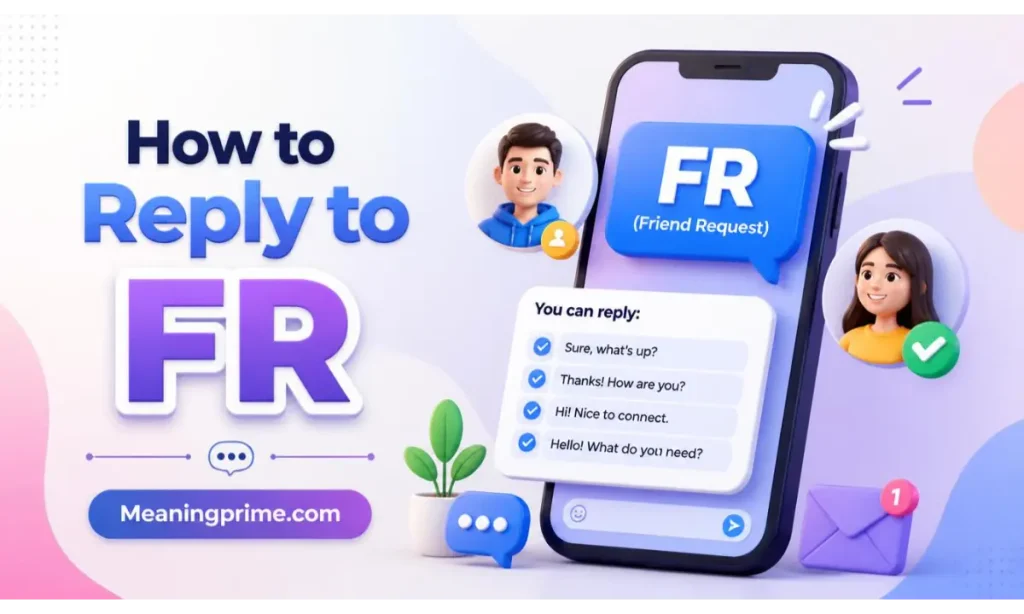
Not sure how to respond when someone sends you a solo “fr”? Here’s the honest breakdown:
- If it followed your statement — treat it as agreement. A simple “right?” or “exactly” keeps the exchange going.
- If it’s a question (“fr?”) — they want confirmation. Reply with a straight yes/no, or add detail if the news is big: “yeah fr, I’m serious.”
- If it feels sarcastic — match the energy, or clarify with a laughing emoji so nobody’s left guessing.
- If the topic is heavy — skip matching their “fr” with another “fr.” A real sentence shows you’re actually listening, not just reacting on autopilot.
Times When FR Makes You Look Bad
Skip it in work emails or messages to teachers, even if your workplace culture is fairly relaxed. “I finished the report fr” just reads oddly to anyone who isn’t used to internet shorthand.
Avoid it when someone’s dealing with something genuinely heavy. If a friend tells you their pet passed away and you respond “that’s awful fr,” it can come off like you’re brushing past their grief instead of sitting with it.
Steer clear with older relatives who aren’t active online. Explaining what “fr” means mid-conversation kills the moment and makes the whole exchange feel forced. Just type the real words instead.
And skip it in public comments on serious posts. Someone sharing tragic news doesn’t need “this is terrible fr” underneath it — it reads more like performance than genuine sympathy.
Other Ways to Say the Same Thing
If “fr” doesn’t quite fit the moment, here are alternatives at different intensity levels:
| Term | Meaning | Tone |
|---|---|---|
| no cap | I’m not lying | Casual, friend-group energy |
| facts | I agree completely | Casual, quick agreement |
| deadass | I’m dead serious | Stronger, more intense |
| frfr | For real, for real | Casual, extra emphasis |
| on god | I swear this is true | Casual, oath-like emphasis |
| seriously / honestly | I mean this | Neutral, works almost anywhere |
| actually / I mean it | Genuinely, truly | Neutral to slightly formal |
What It Looks Like in Real Messages (Platform by Platform)
FR meaning in WhatsApp: “Had a great time tonight fr” — used the same way as texting, showing genuine interest rather than a polite goodnight message.
FR meaning in Facebook: Usually shows up in comments under a photo or status. “You guys look so happy fr” reads as a sincere compliment, not a generic one.
Instagram comment: “That looks amazing fr” under a food photo — again, sincerity over politeness.
Group chat: “We seriously need a vacation.” “Fr.” — agreement, no elaboration required.
Snapchat: “I’m never doing that again fr fr” — the double version signals they really mean it this time.
TikTok comment: “me fr” under a relatable video means “this is literally my life,” which works a bit differently from confirming truth — it’s about identification.
Text/iMessage or Discord: “You’re moving to another country fr?” — disbelief, waiting on confirmation.
A Bit of History (And Why It Matters)
“Fr” didn’t start online. The phrase “for real” has roots in spoken English, especially African American Vernacular English (AAVE), long before texting existed. As Twitter and character limits pushed people toward shorter phrases, “fr” became the natural shorthand, and by the early 2020s it had fully crossed into mainstream texting and social media culture through music and viral platforms like TikTok.
Knowing that background matters because it’s a reminder this term has real linguistic roots, not just internet randomness. Younger users type it without a second thought; older millennials and Gen X might use it occasionally but feel a little self-conscious doing it. There’s no strict age cutoff — it’s more about whether it fits your natural texting voice.
Ways People Get FR Wrong
Assuming it’s always positive. “You’re annoying fr” isn’t a compliment just because slang is attached — the surrounding words still carry the meaning.
Overusing frfr. If you double it for something minor, people stop taking the emphasis seriously the next time you actually need it.
Forgetting the question mark. “Fr” and “Fr?” mean two different things entirely, and dropping punctuation can confuse whoever’s reading it.
Assuming everyone gets it. Your friend group might use it constantly, but coworkers, parents, or people outside your usual circles might not follow along at all.
Using it as filler. Sprinkling “fr” into every sentence the way people say “um” strips it of any actual emphasis.
Frequently Asked Questions
Is FR rude to use?
Not by itself. It can come across as dismissive, though, if it’s your only response to something that clearly needed more attention.
What’s the difference between FR and FRFR?
FR is standard emphasis, roughly “I’m serious.” FRFR ramps that up — think “I’m SERIOUS serious,” reserved for moments that really need the extra push.
What does FR mean in Gen Z?
Among Gen Z, FR functions as a constant, almost reflexive way to signal sincerity or agreement in casual conversation — it’s less a special phrase and more a built-in part of everyday texting.
What does “be fr” mean?
“Be fr” is a request for honesty, basically “be real with me” or “stop exaggerating.” Someone might say “be fr, did you actually like the movie?” when they want a genuine answer, not a polite one.
Should I use FR in professional messages?
Generally, no. Save it for workplaces that are extremely casual and only after you’ve seen coworkers use it first. When you’re unsure, leave it out.
Can older people use FR without seeming weird?
Sure, as long as it fits how you already text. Forcing it in just to sound current usually reads as exactly that — forced.
Conclusion
“Fr” looks simple on the surface, but it carries real conversational weight once you understand how it works. It’s not just a shortcut for “for real” — it’s a quick, casual way of telling someone you actually mean what you’re saying. The trick is reading the room: match it to your relationship with the person and the seriousness of the moment. Use it when it feels natural, skip it when the conversation calls for something more sincere, and you’ll never misread — or misuse — it again.