
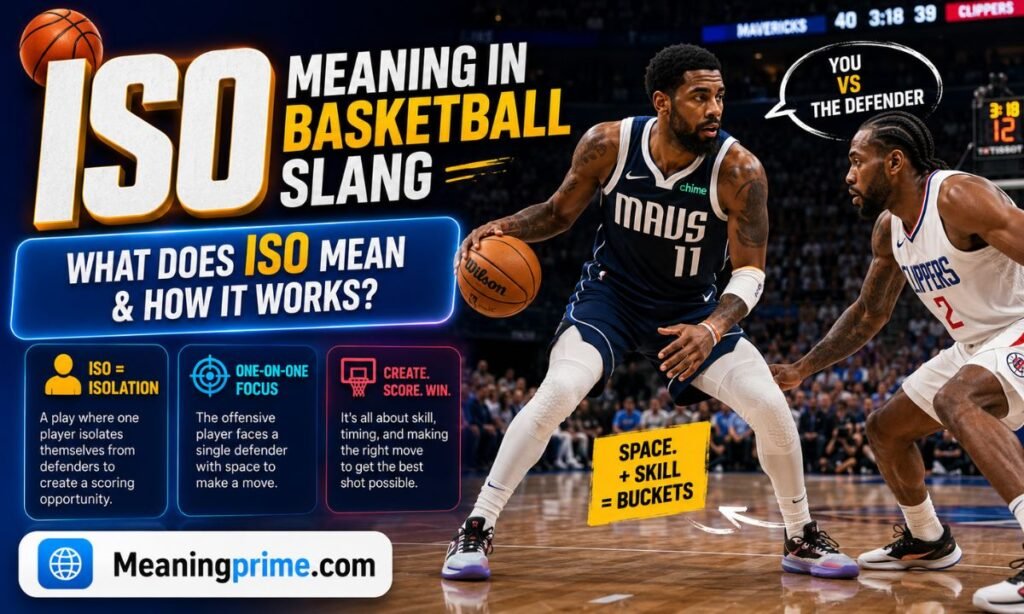

You’re watching a close game. The point guard waves everyone off to one side, and the announcer yells “he’s going ISO!” If you’ve ever paused and thought, wait, what does that actually mean — you’re not alone. It’s one of the most-used words in basketball commentary, yet almost nobody stops to explain it.
Here’s the good news: it’s simple once you break it down. ISO is short for isolation, and it’s both a real strategy coaches draw up and everyday slang fans throw around on the court, on Reddit, and in group chats after a big game.
Quick Answer: What Does ISO Mean?
ISO means isolation — a play where one offensive player gets the ball while their four teammates clear out to one side of the court, leaving that player to go one-on-one against a single defender.
- Used as a verb (“just let him ISO”) or a noun (“that was a nice ISO”)
- Built around giving one scorer space to attack one defender
- Common in the NBA, pickup games, and basketball slang online
Where the Term “ISO” Comes From

ISO comes straight from basketball playbooks, not internet slang. Coaches have used the word for decades to describe a set where the floor spaces out and one offensive player is left alone with their defender. Over time it got shortened on the sideline, picked up by broadcasters, then by fans — and now it’s just part of everyday hoop vocabulary.
What’s genuinely interesting is how far the word traveled: from strictly technical coach-speak in film sessions during the 90s and early 2000s, to a random guy at the park today saying “just give me the ISO” without ever having opened a playbook. That’s how deep it’s baked into basketball culture now.
How an ISO Play Actually Works
An ISO isn’t just “throw the ball to the best player and hope.” There’s real structure to it, even if it looks loose compared to a set play with cuts and screens. It usually starts from a dead possession, a timeout, or a natural break in the action, and it breaks down into two phases: the setup and the showdown.
The Clear-Out Setup
The clear-out is exactly what it sounds like — everybody except the ball handler moves out of the way. Usually the other four players spread beyond the three-point line, opening the lane or a full side of the court for one-on-one action. This spacing matters because it removes help defenders from easy reach, forcing the primary defender to guard the ball completely alone.
A good clear-out also sets up what happens if the defense sends help anyway. Because the other four players are spaced at the three-point line, any defender who leaves their man to help in the paint leaves someone wide open for a kick-out pass. That’s why even a “selfish-looking” ISO play can turn into a great team possession if the defense overreacts.
The One-on-One Showdown
Once the space is created, it’s just the ball handler versus their defender. This is where individual skill takes over — a crossover to get separation, a step-back three, a strong post-up dribble, whatever the player’s go-to move is. There’s no play design telling them what comes next; it’s pure read-and-react basketball.
This is also the moment fans live for. A great ISO showdown can end in a poster dunk, a smooth step-back jumper, or a defender getting faked out of their shoes. It’s basketball stripped to its rawest form — skill against skill, no help allowed, and everyone in the building knows exactly what’s about to happen.
ISO Meaning in NBA Usage
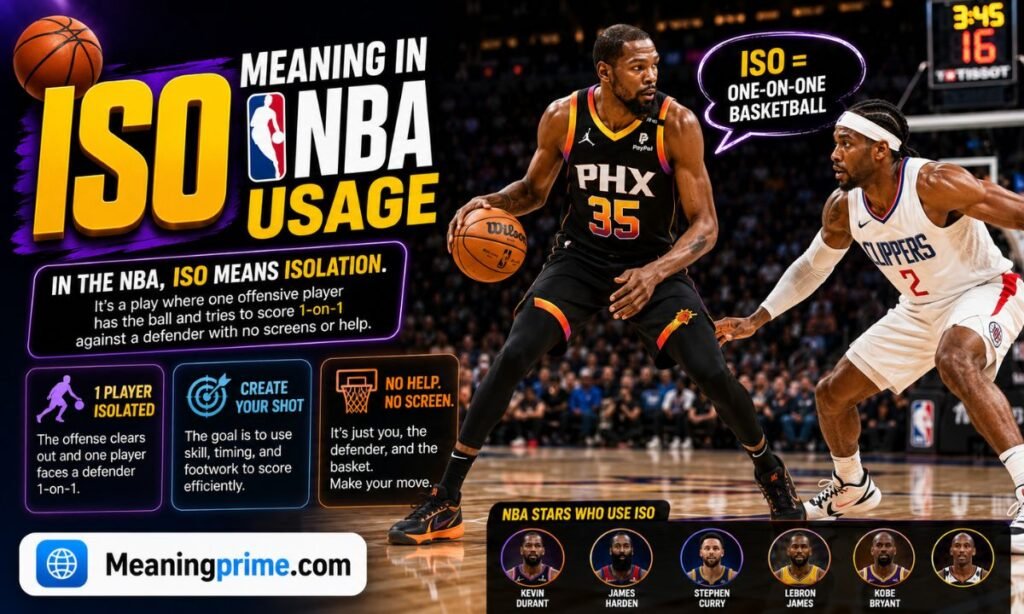
In the NBA, “ISO” gets used constantly — by broadcasters describing a play in real time and by fans breaking down highlights afterward. When a commentator says “they’re going to ISO him here,” it usually means a team is deliberately setting up a favorable matchup and letting their best player try to win the possession alone.
NBA usage carries a bit more edge than casual pickup usage. Because NBA defenses are so good, calling for an ISO late in a close game is a statement — the team is saying “we trust this one guy to win us the possession.” That’s why analysts praise a clutch ISO bucket as “taking over the game,” while an ISO that ends in a bad, contested shot gets criticized as “hero ball” or “stopping the offense.”
ISO Meaning on Reddit
On basketball subreddits like r/nba, ISO shows up constantly in game threads, highlight posts, and player debates. You’ll see comments like “he’s just cooking in ISO all night,” or arguments over which players are genuine “ISO killers” versus guys who just chuck up bad shots when isolated. Online, the term also becomes a stat-driven talking point, with fans citing isolation efficiency numbers to argue about who’s actually good in one-on-one situations.
Reddit also loves using ISO as shorthand for criticizing a team’s offense. Comments like “this offense is just ISO ball” or “way too much hero-ISO in the fourth quarter” show up whenever fans think a team leans too hard on one player instead of moving the ball. It’s become a word that swings between praise and insult depending entirely on context.
How to Call ISO on the Court
If you’re actually playing and want to run an ISO, communicating it is simple. Most players just point at themselves or a teammate and say “ISO” or “clear out,” and everyone else knows to spread to the perimeter immediately. In more organized settings, a coach or point guard might call a specific play name — but on the court, one word usually does the job.
Timing matters just as much as the call itself. Calling for an ISO too early in the shot clock wastes the possession’s flow, while calling it as the shot clock runs down — or in the final seconds of a close game — makes total sense because there’s no time left for anything more complex. Good players also read the matchup before calling it; you don’t ISO your weakest scorer against the other team’s best defender just because it’s “your turn.”
ISO on Urban Dictionary
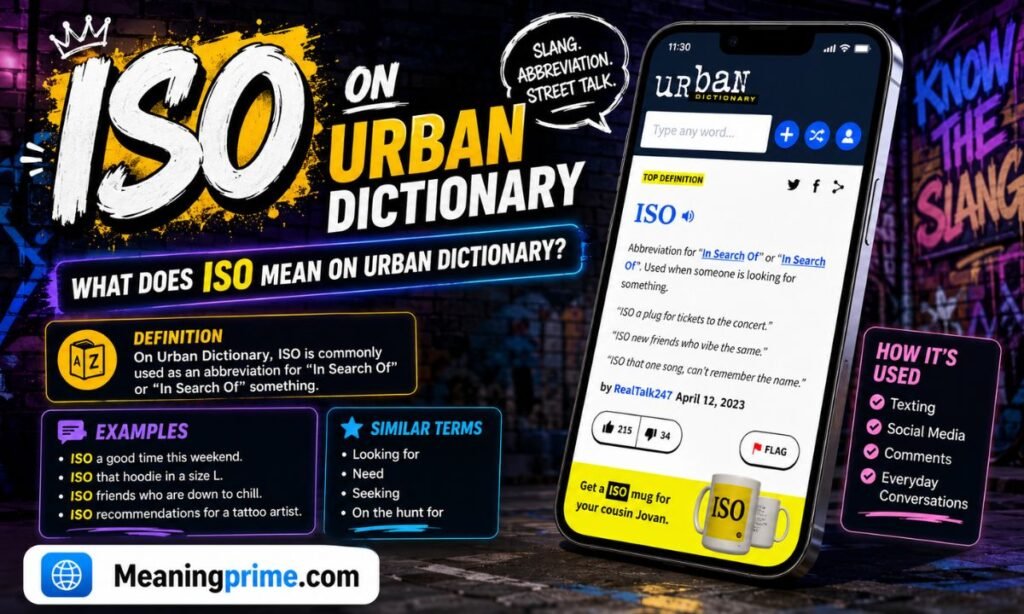
Urban Dictionary’s takes on “ISO” line up closely with the on-court meaning: a play where a player is given full space to go one-on-one, often with a nod to the confidence it takes to call for it. Slang dictionaries tend to lean into the personality side of the word — it’s not just a play, it’s a statement that a player believes they can win the matchup alone.
Informal definitions there also tie ISO to street basketball bragging rights. Calling for the ISO and then scoring easily is treated as a flex; calling for it and getting stuffed becomes a running joke among friends. That casual, half-serious tone is a big part of why the word spread so far beyond basketball strategy talk.
ISO in Basketball Memes
ISO shows up constantly in basketball meme culture, usually in two flavors: hype and roast. Hype memes celebrate a player going full ISO mode and cooking a defender, often captioned “him vs. the world” or “let him work” — these get shared heavily during playoff runs when a star takes over a game single-handedly.
Roast memes go the other direction, mocking players or teams who lean on ISO too much without results — think a clip of a guy dribbling the shot clock down and forcing a bad shot while four teammates just stand and watch. “ISO ball” has basically become its own meme category for criticizing stagnant, one-man offense, especially when it fails in a big moment.
ISO Defense — How Teams Guard Against It
Defending an ISO is its own skill, and good isolation defenders are genuinely valuable. The main goal is containment: keeping the ball handler in front of you, forcing a tough, contested shot instead of a clean look, and avoiding fouls that hand over free points. Elite ISO defenders rely on quick feet, active hands, and body positioning to cut off a player’s strongest move without needing help.
Teams also defend ISO situations with more than the on-ball defender alone. Coaches sometimes send a soft double-team at the right moment, funnel the ball handler toward a help defender camped in the paint, or scheme specific coverages for a known ISO threat. The risk is always the same one mentioned earlier — send help, and you risk leaving a shooter open on the perimeter, so smart defenses time their help carefully.
ISO vs Other Basketball Plays
ISO isn’t the only way to generate offense. Here’s how it compares to other common plays:
| Play Type | How It Works | Best Used When |
| ISO | One player clears out and attacks their defender alone | Late-game, mismatch, or need a quick bucket |
| Pick-and-Roll | Ball handler uses a screen to create space or force a switch | Generating good shots through defensive confusion |
| Post-Up | A player backs down a defender near the basket | Size or strength mismatch inside |
| Motion Offense | Constant player and ball movement with off-ball screens | Team-oriented scoring, wearing down defenses |
The biggest difference is trust and tempo. ISO puts the entire possession on one player’s shoulders and slows the game to a one-on-one pace, while pick-and-roll and motion offense rely on multiple players moving together to create advantages as a group.
Pick-and-roll and post-ups can actually lead into an ISO — a screen might get switched onto a smaller defender, and instead of running more action, the team simply lets their player isolate that mismatch. So ISO isn’t always a separate play call; sometimes it’s the natural result of another play working exactly as designed.
Pros and Cons of Running ISO
Like any strategy, ISO has real strengths and real weaknesses depending on the situation.
| Pros | Cons |
| Great for exploiting a clear mismatch | Can make an offense predictable and stagnant |
| Ideal for late-clock or last-second shots | Relies heavily on one player’s health and form |
| Simple to call and execute under pressure | Often less efficient than ball movement |
| Lets a team’s best scorer control the outcome | Can lead to “hero ball” and rushed, bad shots |
The takeaway: ISO works best in small doses and specific moments, not as a full-time offensive identity. Teams that use it situationally — mismatches, end of quarters, late-game possessions — tend to get far more value from it than teams that lean on it every trip down the floor.
Best ISO Players in Basketball History

Some players are simply built for isolation basketball. Kobe Bryant was famous for his ISO game, especially in the post and mid-range, where his footwork and fadeaway made him nearly unguardable one-on-one — which is exactly why “Kobe ISO” became shorthand for a cold-blooded, unstoppable scoring mentality. Michael Jordan and Allen Iverson built similar reputations in earlier eras, turning isolation scoring into must-watch basketball.
More recent players carry that torch differently. Kyrie Irving and James Harden use elite handles and step-backs to break defenders down. Kevin Durant’s size and shooting touch make him nearly impossible to guard one-on-one. Luka Dončić has become one of the league’s most dangerous ISO threats through footwork and shot-making rather than pure speed. Big men like Shaquille O’Neal and Dirk Nowitzki also deserve mention for turning post isolations into a nightly problem for opposing defenses.
Related Slang You’ll Hear Courtside
ISO rarely shows up alone — it’s usually paired with other slang that adds context or attitude to the moment.
- Clear out — the instruction version of ISO, telling teammates to get out of the way
- Let him cook — give the ball handler room because they’re playing well
- Hero ball — the critical version of ISO, used when a player forces one-on-one over trusting the offense
- Empty ISO — an isolation possession that results in stats but doesn’t help the team win, like a tough contested shot instead of a smarter pass
Knowing these related terms helps you catch not just what ISO means, but the tone behind how people use it — since the same play can be described as “taking over” or “stopping the offense,” depending on how it turns out.
Frequently Asked Questions
What does “ISO” mean in basketball?
ISO means isolation — a play where one offensive player goes one-on-one against their defender while teammates clear space around them.
What does “ISO” mean in slang?
Outside strict basketball terms, ISO slang describes a player being given full space and trust to take on a challenge alone, often with a tone of confidence or swagger.
What does “isos” mean in slang?
“Isos” is just the plural — multiple isolation plays or possessions, as in “he ran a bunch of isos in the fourth quarter.”
What does “Kobe ISO” mean?
It refers to Kobe Bryant’s signature isolation scoring style, known for footwork, fadeaways, and a fearless mentality against any defender.
Is ISO the same thing as one-on-one?
They’re closely related, but ISO is the structured team play that sets up the one-on-one — the spacing and clear-out are specific to ISO.
Why do players call for an ISO?
To exploit a favorable matchup, control the pace late in games, or let their most skilled scorer create a shot without relying on a longer play.
Is ISO used in NBA 2K and video games?
Yes, basketball video games include ISO plays and dedicated ISO controls, mirroring how the strategy works in real basketball.
Is running ISO a good strategy?
It can be, in the right moments — mismatches and late-game situations — but relying on it too often usually makes an offense less efficient overall.
Final Thoughts
At the end of the day, ISO is one word doing a lot of work. It’s a real coaching strategy, a piece of everyday basketball slang, and sometimes even a compliment or a criticism depending on how the play turns out. Once you know what it means, you’ll start noticing it everywhere — commentary, highlight clips, pickup games, even memes.
Next time someone calls for the ISO or you see a player clear out the floor, you’ll know exactly what’s about to happen. It’s basketball in its purest form: one player, one defender, and everyone else watching to see who wins.