

You send a message, wait for a reply, and it lands: “K.” No emoji. No exclamation point. Nothing to soften it. Suddenly you’re scrolling back through your last five texts, wondering what you did wrong.
Take a breath — you’re probably not in trouble. “K” is one of the most over-analyzed replies in texting, and what it actually means depends almost entirely on who sent it, when, and how. Here’s a clear breakdown of what’s really going on.
Quick Answer
“K” is short for “okay.” In most cases, it simply means the person read your message and agrees — nothing more needs saying. It only starts to feel cold or passive-aggressive when the tone of the conversation calls for a longer reply and doesn’t get one.
What Does “K” Actually Mean in Texting?
The Simple, Literal Meaning
At its core, “K” is a shortcut for “okay.” People use it to confirm plans, acknowledge information, or wrap up a conversation quickly — the texting version of a nod instead of a full sentence.
If a friend texts “See you at 6” and you reply “K,” you’ve confirmed the plan in two keystrokes. There’s usually no hidden message in that.
It shows up everywhere — group chats, work threads, quick check-ins — anywhere a full sentence would just slow things down. The confusion only starts once emotion or a sensitive topic enters the picture.
Why the Same Letter Can Feel So Different
“K” on its own carries almost no emotional information, so your brain fills in the blanks using context. A “K” after a joke usually reads as relaxed. The same “K” after an apology or a serious question can feel loaded, even if the sender didn’t think twice about it.
Relationship history changes the reading too. A close friend’s “K” rarely raises an eyebrow. The exact same reply from someone you just started dating can trigger a full mental investigation. The letter never changes — everything around it does.
K, K., kk, Kkk — Does Punctuation Change the Meaning?
Small changes in how “K” is typed can shift its tone quite a bit, even though the underlying meaning stays the same. A lowercase “k” tends to feel casual and low-stakes. Add a period or a capital letter, and it often reads as more final or serious.
| Variant | Common Tone | Typical Use |
| k | Casual, neutral | Quick, relaxed acknowledgment |
| K | Slightly more serious | Confirming something plainly |
| K. | Cold, final, sometimes annoyed | Ending a tense exchange |
| kk | Friendly, warm | Casual confirmation among friends |
| kkk | Playful or amused | Reacting lightly, almost like a laugh |
| okkk | Sarcastic or unimpressed | Dismissive agreement |
Punctuation acts as a stand-in for tone of voice, which text naturally strips away. A period slows the reply down visually and makes it feel more deliberate — which is exactly why “K.” tends to sting more than a plain “k.” None of this is a fixed rule, but recognizing the pattern helps you read intent instead of assuming the worst.
Where Did “K” Come From?
“K” didn’t start with smartphones. It traces back to “OK,” a joke abbreviation that became popular in the 1830s for “oll korrect” — a deliberately misspelled version of “all correct.”
When SMS arrived with character limits and per-message costs, “OK” got shortened even further to “K” to save time and space. The habit carried over into instant messaging, gaming, and social media, and it never really left — even after character limits stopped mattering.
K Meaning in Text From a Girl
When a girl texts “K,” it usually means exactly what it looks like: acknowledgment or agreement. Context still shapes the tone — a “K” in a lighthearted exchange reads very differently than one sent right after a disagreement or an ignored question.
The common overthinking trap is assuming a short reply automatically means disinterest or anger. More often, it just means she’s busy, multitasking, or doesn’t feel the topic needs a longer answer. If the conversation otherwise feels normal, the “K” probably is too.
K Meaning in Text From a Guy
A guy’s “K” tends to follow the same basic pattern — quick confirmation, minimal effort, not necessarily minimal interest. Plenty of guys default to short replies as a general texting habit, not as a reaction to anything specific.
Where it gets murkier is in emotionally charged conversations, where a one-word reply can feel like avoidance even if that’s not the intent. If a “K” shows up right when a deeper conversation was expected, it’s more useful to just ask than to guess.
K Meaning in Love (Dating & Relationships)
In dating and relationships, “K” carries more weight than almost anywhere else, simply because these conversations are already emotionally loaded. A partner replying “K” to “I’ll be late tonight” can feel dismissive, even if they genuinely had nothing else to add.
The period version — “K.” — has a particular reputation in relationship texting. It’s often read as frustration or someone shutting the conversation down, and honestly, that reputation isn’t entirely undeserved — people do use it that way during arguments. But it’s not universal. If a short reply feels out of character for that person, checking in is a better move than assuming the worst.
K Meaning in Social Media
Across platforms, “K” mostly keeps its core meaning, but the vibe shifts with the app. On Instagram and Snapchat DMs, it’s usually a quick, low-effort acknowledgment — though Snapchat’s more personal feel can make a bare “K” land colder than intended.
On TikTok, “K” often shows up humorously or sarcastically, poking fun at dry texting culture itself. In gaming chats and Discord, it’s almost always neutral — just confirming a callout with zero emotional weight attached.
What Does K Mean in Hood Slang?
In hood or street slang, “K” is generally used the same way as in everyday texting — a fast way to say “okay” or “cool,” common in quick, casual back-and-forth where speed matters more than full sentences.
In certain regional or subcultural contexts, “K” is also sometimes used as slang for a controlled substance. That meaning depends heavily on context and isn’t the common, everyday usage — so it should be read carefully rather than assumed.
K Meaning in Numbers, Money & Views
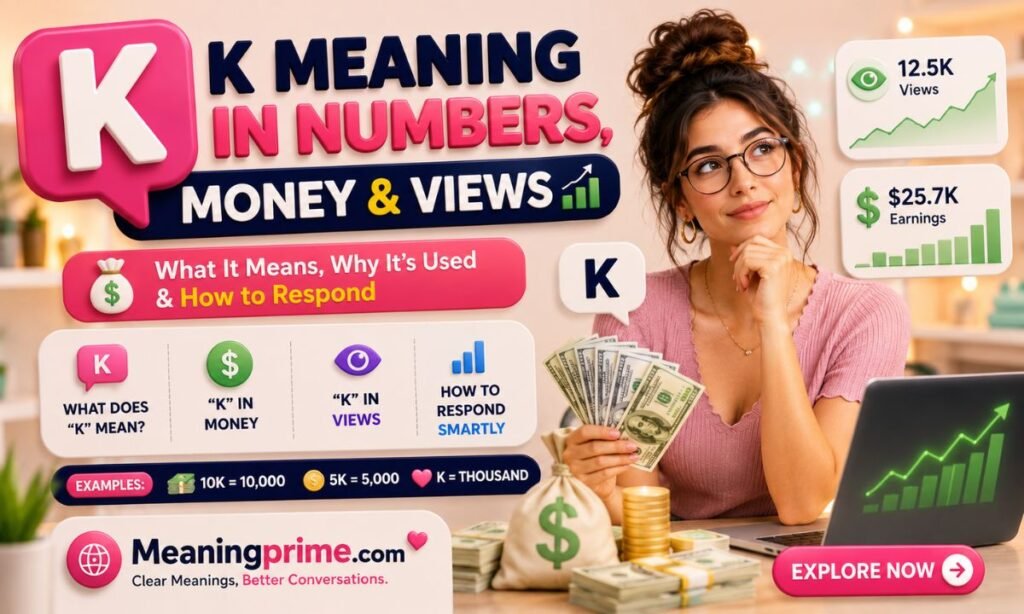
K Meaning in Numbers
Outside of texting, “K” is standard shorthand for “thousand,” borrowed from the metric prefix “kilo.” It shows up everywhere from race distances to step-count goals because it’s faster to read than the full number.
For example, “10K” means 10,000 — whether that’s a race distance or a follower count. This usage has nothing to do with the “okay” meaning and is almost always obvious from context.
K Meaning in Money
In money terms, “K” is shorthand for a thousand currency units, used constantly in salaries, prices, and budgets. A job posting listing “70K” is describing a $70,000 salary.
- “I make 60K a year” → $60,000 annual salary
- “The car costs 15K” → $15,000
- “She saved 10K this year” → $10,000
This shorthand is common across finance, real estate, and everyday conversation simply because writing out full numbers repeatedly slows people down.
K Meaning in Views
On social media, “K” describes view counts, likes, and follower numbers using the same thousand-based shorthand. A video with “250K views” has been watched 250,000 times.
Platforms format numbers this way to keep stats readable at a glance — scrolling past a wall of digits is harder to process. It’s purely a display convention, with no connection to the emotional “K” used in personal texting.
Why a One-Letter Reply Feels So Cold (The Psychology Behind It)
Humans are wired to read emotional meaning into ambiguous signals, especially when normal social cues like tone of voice or facial expression are missing. Texting strips both away, so the brain compensates by scanning for clues in reply length, punctuation, and response time.
This connects to what psychologists call negativity bias — the tendency to weigh negative interpretations more heavily than neutral or positive ones. A short reply like “K” gives the brain very little to work with, so it often defaults to assuming something’s wrong rather than assuming everything’s fine.
How to Reply When You Get a “K”
How you respond depends entirely on what the situation actually calls for. If the conversation has been normal and the topic is low-stakes, there’s usually no need to read into it at all.
- From a friend after casual plans: “Cool, see you then!” — or just leave it, no response needed.
- From a crush or partner after a normal message: “Everything good?” keeps things light without accusing them of anything.
- After an argument or serious topic: “I feel like that came off short, can we talk?” opens the door without assuming the worst.
- From a coworker or boss: No action needed — short replies are usually efficiency, not personal.
If a “K” genuinely feels out of place given the conversation, asking a simple, non-confrontational question almost always works better than guessing.
How to Avoid Accidentally Sending a Cold “K”
Sometimes the coldest “K” isn’t intentional at all — it’s just a texting habit that autocorrect or muscle memory reinforces without you noticing. If you type fast and default to short replies, a few small habits can soften the message without much extra effort.
Adding a single emoji, an exclamation point, or one extra word changes how a reply lands completely — turning “K” into “K!” or “K, sounds good.” It’s a small adjustment, but it removes almost all the ambiguity that sends the other person into overthinking mode.
Is “K” Rude or Offensive?
“K” isn’t inherently rude. It’s a neutral abbreviation that’s been used harmlessly for decades across texting, gaming, and messaging without any negative intent behind it.
It only starts to feel rude when it clashes with the expected tone of a conversation — especially during emotional discussions or arguments where a fuller response feels appropriate. In those cases, the rudeness comes from the mismatch between context and effort, not from the letter itself.
“K” vs Similar Replies (OK, Okay, kk, Sure, Got It)
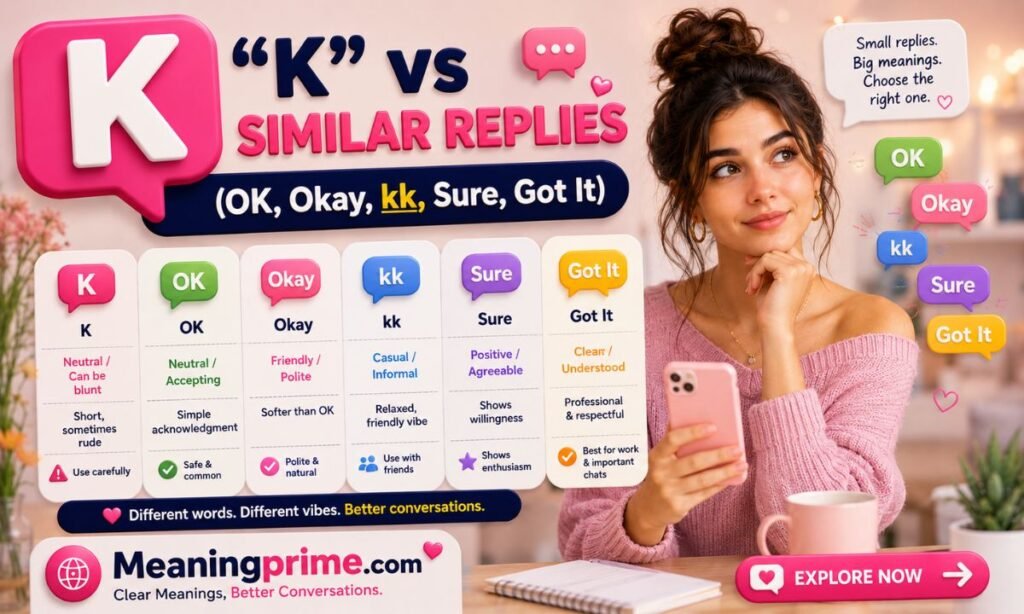
These replies technically mean the same thing, but they land differently based on how much effort they visually convey. “OK” feels slightly more complete than “K,” while “Okay” reads as the most polished and least likely to be misread.
“kk” feels warmer and more casual — almost like a nod between friends — while “Sure” and “Got it” sound more intentional, especially at work. None of these are objectively better; picking the right one just saves unnecessary back-and-forth.
Frequently Asked Questions
What does K mean in chat?
It means “okay” — a quick way to confirm or acknowledge a message without typing a full reply.
Is K dry texting?
It can be, especially if it replaces what would normally be a longer or more engaged response in that conversation.
What does K mean in Gen Z slang?
It’s used the same way as standard texting slang — mainly a fast, low-effort way to say “okay” or confirm something.
What does it mean if a girl texts K?
Usually just acknowledgment or agreement. Tone and context decide whether it reads as neutral, busy, or intentionally short.
Does K mean something different from a crush versus a friend?
Yes. Emotional stakes are higher with a crush, so the same reply is far more likely to get overanalyzed than it would from a friend.
Why does K feel so cold or passive-aggressive?
Because text lacks tone of voice, short replies during serious moments often get read as dismissive even when that’s not the intent.
What’s the difference between K and K. with a period?
The period tends to make the reply feel more final, serious, or annoyed compared to a plain, casual “k.”
What does K mean in numbers, like 5K?
In that context, K stands for “thousand,” so 5K simply means 5,000 — unrelated to the “okay” meaning in texting.
Conclusion
Most of the time, “K” isn’t as dramatic as it feels in the moment. It’s ambiguity, not evidence — and the person sending it usually isn’t thinking about tone at all, they’re just replying fast. Context, relationship history, and timing almost always matter more than the letter itself.
If a “K” genuinely doesn’t sit right with you, the simplest fix is asking instead of assuming. And if you’re the one sending it, tossing in one extra word or emoji costs you almost nothing — but it can save the other person a whole afternoon of overthinking.