


You’re scrolling through a Spanish group chat when someone types ¿Vosotros venís esta noche? and you freeze. Nobody taught you that word in class. Is it a typo, slang, or something you should have known? So you search for the vosotros meaning and hope for a straight answer.
Here it is. This guide explains the vosotros meaning in plain English. Then it shows where people use the word, how it sounds in real chats, and how to reply without stress. You’ll also get a clean list of 10 common forms and a quick way to decide if you even need it.
Quick Answer: The vosotros meaning is “you all” or “you guys” in the informal sense. People in Spain use it to talk to a group of friends, family, or peers. Most of Latin America skips it and says ustedes instead. That’s the vosotros meaning in a nutshell: “you” for more than one person, in a casual setting.
Vosotros Meaning – Quick Definition
The vosotros meaning is simple. It’s a Spanish pronoun for a group you’re talking to directly. Think of it as the plural of tú, the casual “you.”
English uses one word for “you” no matter how many people listen. Spanish splits it by number and by closeness. That’s why the vosotros meaning feels strange if you grew up with a single “you.”
Vosotros Meaning in English (Does It Mean “You Guys”?)
Yes, it does. The vosotros meaning in English is “you all,” “you guys,” or “y’all.” It only works when you speak to two or more people. For one person you’d pick tú or usted.
Which English word fits best? It depends on your accent. “You guys” works in most of the US. “Y’all” suits the South.
Vosotros Meaning in Spanish (En Español)
Spanish speakers describe it in one line. Vosotros es el plural informal de tú. In English: “Vosotros is the informal plural of tú.” People use it in Spain with friends, family, classmates, and teammates.
So the vosotros meaning in Spanish comes down to a tidy idea. One casual “you” becomes a casual “you all.”
Simple Examples
Here are three quick sentences that show the vosotros meaning in action:
- Vosotros sois mis mejores amigos. (You all are my best friends.)
- ¿Vosotros queréis un café? (Do you guys want a coffee?)
- Vosotros no entendéis nada. (You all don’t understand a thing.)
Origin & Background of “Vosotros”
Where did such an odd-looking word come from? The vosotros meaning hides inside the word itself. Vosotros glues together vos (an old form of “you”) and otros (“others”). Literally, it means “you others.”
Old Spanish already had vos as a plural “you.” Speakers often added otros to make the group feel clear. Over time that extra word stuck for good. That’s how the modern form was born.
How It Evolved
At first, vos did double duty. It could address several people. It could also show respect to one. Spanish gradually sorted these jobs into separate words. In Spain, vosotros took over as the casual plural. Ustedes became the polite one.
Latin America took a different road. Most regions dropped vosotros and let ustedes cover everyone. Academic studies describe the same pattern in Andalusia and the Canary Islands. Those places also use ustedes as their normal plural.
Cultural Influence
Schools, TV, and everyday speech kept vosotros alive in much of Spain. Across the Atlantic the same forces kept ustedes in charge.
Today the split works like an accent. You can understand both sides perfectly. Yet one pronoun quietly tells listeners where you learned your Spanish. Even so, the vosotros meaning never changes.
Vosotros vs. Ustedes: What’s the Difference?
Here’s where the vosotros meaning gets tangled with ustedes. In Spain, vosotros is the friendly plural and ustedes is the polite one. Picture a table of classmates versus a panel of professors.
- ¿Vosotros venís al cine? (Are you guys coming to the movies?)
- ¿Ustedes desean algo más? (Would you like anything else?) A waiter might say this.
In Latin America the choice disappears. Ustedes handles formal and casual groups alike. The same goes for the Canary Islands and Andalusia. Linguists note that some eastern Andalusian dialects may be an exception.
One rule saves you trouble. Don’t mix the two. Vosotros hablan and ustedes habláis both sound off. Match each pronoun to its own verb ending and you’re safe.
Comparison Table: Vosotros, Nosotros, Usted & Ellos
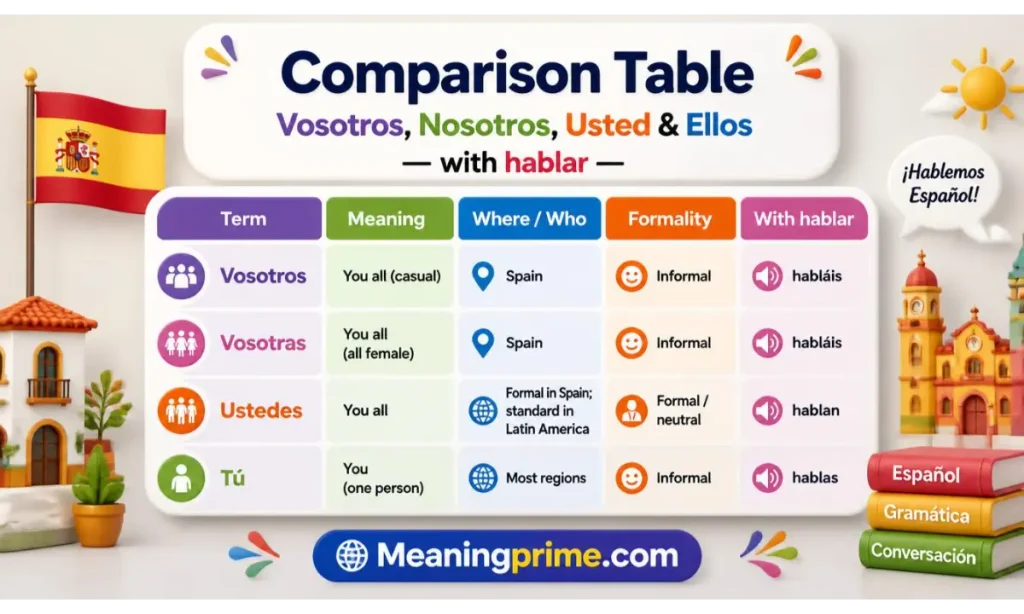
A side-by-side view clears up the vosotros meaning fast. The verb hablar (“to speak”) shows how each pronoun behaves.
| Term | Meaning | Where / Who | Formality | With hablar |
|---|---|---|---|---|
| Vosotros | You all (casual) | Spain | Informal | habláis |
| Vosotras | You all (all female) | Spain | Informal | habláis |
| Ustedes | You all | Formal in Spain; standard in Latin America | Formal / neutral | hablan |
| Tú | You (one person) | Most regions | Informal | hablas |
| Usted | You (one person) | Everywhere | Formal | habla |
| Vos | You (one person) | Argentina, Uruguay, Paraguay and others | Informal | hablás |
| Nosotros | We | Everywhere | Neutral | hablamos |
| Ellos | They | Everywhere | Neutral | hablan |
Key insight: To sound natural with a group of friends in Spain, vosotros matters. Elsewhere, ustedes is the safer pick.
What’s the Difference Between Vosotros and Nosotros?
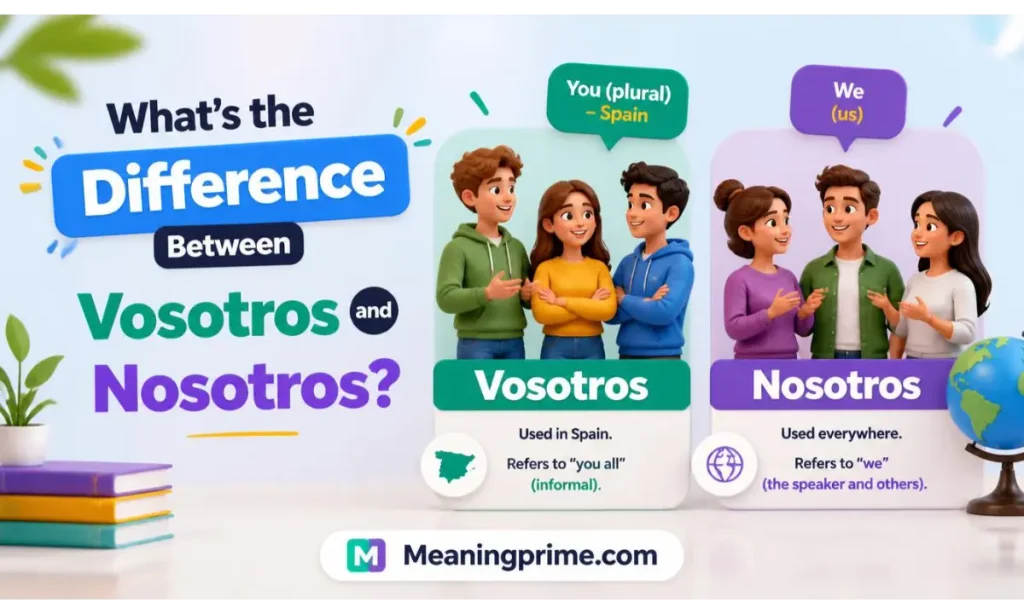
The two words look like twins. Nosotros means “we” and includes the speaker. Vosotros means “you all” and points at the listeners.
Here’s a trick. Nosotros shares its first letter with nuestro (“ours”). Vosotros shares its first letter with vuestro (“yours”). For example: Nosotros vamos; vosotros venís. (We’re going; you all are coming.)
Does Vosotros Mean “They”?
No. “They” is ellos, or ellas for an all-female group. That word talks about people who aren’t in the conversation. The vosotros meaning always targets people who are.
Usted and Ellos Meaning
Usted is the polite “you” for one person. Use it with a stranger, an older neighbor, or your boss. Ellos simply means “they.” Beginners sometimes swap the two by accident.
Regional & Cultural Usage
Geography shapes how the vosotros meaning plays out. Where you stand changes which word feels right.
Spain (Western Culture)
Spain is the home turf of vosotros. People use it daily with friends, siblings, coworkers they like, and classmates. A Spaniard who skipped it with friends would sound stiff.
Still, Spain isn’t one block. In the Canary Islands and Andalusia, ustedes serves both formal and casual groups. So the vosotros meaning stays the same while the habit changes by region.
Why Don’t Mexicans Say “Vosotros”?
Mexicans use ustedes for every group. Friends, relatives, and bosses all get the same word. The same holds across Latin America.
Why did that happen? Many linguists link it to southern Spain and the Canaries, which also use ustedes. The full story is still debated. Here’s what matters. The vosotros meaning is understood there but rarely used. In Mexico, vosotros would sound foreign or old-fashioned. You may still spot it in prayers, older books, and Bible translations.
Learners Around the World
Most classes outside Spain teach Latin American Spanish. So vosotros shows up late in many courses or never at all. Learners in Asia, the Middle East, and elsewhere often meet it first in Spanish shows, songs, or travel plans.
Grasp the vosotros meaning first. Using it can wait until you need it.
Global Internet Usage
The web spreads vosotros beyond Spain’s borders. It pops up in memes, YouTube comments, and creator videos from Spain. Everyone understands the vosotros meaning. Few people outside Spain use it.
Real-Life Conversations

Textbook sentences feel flat. Real chats show how the vosotros meaning lives in daily speech. Here are three short scenes.
WhatsApp Group Chat
Person A: ¿Vosotros os apuntáis a la cena de hoy?
(Are you all in for dinner tonight?)
Person B: Sí, llegamos sobre las nueve. ¿Reserváis vosotros?
(Yes, we’ll get there around nine. Are you booking?)
Person A: Ya está reservado, tranquilos.
(It’s already booked, relax.)
Instagram DMs
Person A: Vosotros no os separáis nunca, ¿eh? 😂
(You two are never apart, huh?)
Person B: Somos un pack, ya sabes.
(We’re a package deal, you know.)
Text Message Between Friends
Person A: Dijisteis que llamaríais. Os esperé toda la tarde.
(You said you’d call. I waited for you all afternoon.)
Person B: Perdón, se nos fue el santo al cielo.
(Sorry, it totally slipped our minds.)
Notice how relaxed each scene feels. That easy tone is the heart of the vosotros meaning in everyday Spain.
Vosotros Examples: Vosotros in a Sentence
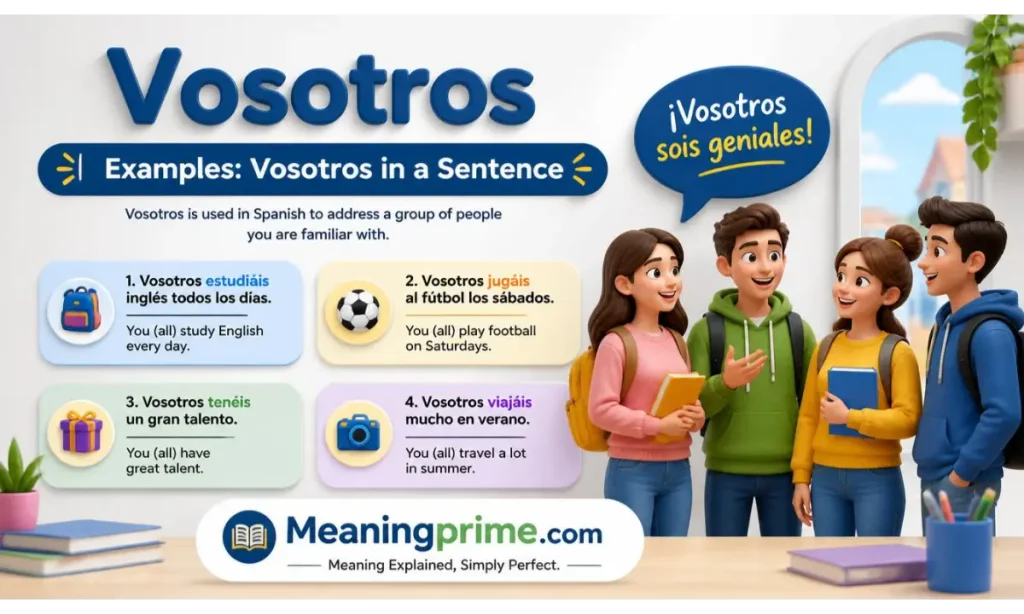
Want more sentences to lock in the vosotros meaning? Here’s a handy set. Copy any of them into your notes.
| Situation | Spanish | English |
|---|---|---|
| Invitation | ¿Vosotros venís a mi fiesta? | Are you guys coming to my party? |
| Statement | Vosotros sois muy graciosos. | You all are really funny. |
| Question | ¿Qué hacéis vosotros este finde? | What are you all doing this weekend? |
| Negative | Vosotros no tenéis la culpa. | It’s not your fault, guys. |
| Plan | Vosotros decidís el restaurante. | You all pick the restaurant. |
Spaniards often drop the pronoun. ¿Venís mañana? works just as well as ¿Vosotros venís mañana?
“Up to Vosotros” Meaning
Have you seen the phrase “up to vosotros” online? The vosotros meaning there is “it’s up to you all.” Spanish has natural ways to say it:
- Depende de vosotros. (It depends on you all.)
- Vosotros decidís. (You all decide.)
- Es cosa vuestra. (That’s your call.)
Use the first one for plans. Use the last one for friendly shrugs.
Usage in Different Contexts
Place changes how a word lands. The vosotros meaning stays fixed while the setting changes how it sounds.
Social Media
Creators from Spain often use vosotros to chat with followers. A caption like Vosotros sabéis de qué hablo feels like talking to a room of friends.
Comments work the same way. A fan from Madrid might write Vosotros sois los mejores. A fan from Mexico would likely write Ustedes son los mejores. Same message. Different home.
Friends & Relationships
Friends use it all day. So do siblings and cousins. Couples also use it when they talk to another couple.
Vosotros siempre me apoyáis. (You all always support me.) That single line carries warmth. It says “you’re part of my circle.”
Work or Professional Settings
Relaxed teams in Spain may use vosotros during casual chats. A manager might tell close colleagues Vosotros podéis revisarlo mañana.
Formal emails and presentations call for ustedes. When in doubt, choose the polite option.
Casual vs. Serious Tone
| Context | Appropriate? |
|---|---|
| Friends | ✅ Yes |
| Family | ✅ Yes |
| Social media (Spain) | ✅ Yes |
| Classroom | ⚠️ Depends on the teacher |
| Formal email | ❌ No |
| Business meeting | ❌ No |
When to Say Vosotros (Quick Checklist)
Say vosotros when all three of these are true:
- You’re speaking to two or more people.
- You’d call each of them tú one by one.
- You’re in Spain or talking with someone from Spain.
Miss one of those and ustedes is probably the better choice.
Emotional & Psychological Meaning
Words carry feelings. The vosotros meaning carries closeness. Vosotros says “we’re on the same level.” It tells your listeners they belong to your circle.
That warmth explains why Spanish friends use it without thinking. A stiff ustedes can feel cold at a casual dinner. Using the pronoun well shows you read the room.
Vosotros Meaning Slang & Bad: Is It Rude?
Short answer: no. The vosotros meaning isn’t slang. It’s standard grammar taught in Spain and recorded in dictionaries. It’s also not a bad word.
So why do people search “vosotros meaning bad”? Usually because of tone. Vosotros siempre llegáis tarde can sound like a scolding. That’s the sentence talking. The pronoun is innocent.
Context can also create awkward moments. Say you greet a group of elderly strangers in Spain with vosotros. It may sound too familiar. Ustedes is the respectful pick there. And in Latin America, vosotros may sound old-fashioned rather than rude.
10 Common Forms of Vosotros
Each verb takes its own vosotros ending. Most end in -áis, -éis, or -ís. The stress lands on that last syllable. Here are ten forms that bring the vosotros meaning to life.
| # | Form | Verb | Meaning | Chat example |
|---|---|---|---|---|
| 1 | Vosotros sois | ser | You all are | Sois increíbles. |
| 2 | Vosotros estáis | estar | You all are (state) | ¿Dónde estáis? |
| 3 | Vosotros tenéis | tener | You all have | Tenéis razón. |
| 4 | Vosotros vais | ir | You all go | ¿Adónde vais? |
| 5 | Vosotros habláis | hablar | You all speak | Habláis muy rápido. |
| 6 | Vosotros podéis | poder | You all can | Podéis venir cuando queráis. |
| 7 | Vosotros queréis | querer | You all want | ¿Qué queréis cenar? |
| 8 | Vosotros sabéis | saber | You all know | Ya sabéis cómo soy. |
| 9 | Vosotros hacéis | hacer | You all do / make | ¿Qué hacéis hoy? |
| 10 | Vosotros venís | venir | You all come | ¿Venís o no venís? |
Notice the pattern. The verb ending does the heavy lifting.
Vosotras, Os, Vuestro & Commands
A few small extras make your Spanish sound far more natural. None of them is hard.
Vosotros vs. Vosotras
Use vosotras when every person in the group is female. Use vosotros for mixed groups or all-male groups. One man in a crowd of ten women still makes it vosotros. The verb endings stay identical.
Handy Extras: Os & Vuestro/a
Os is the object pronoun for “you all.” Example: Os llamo mañana. (I’ll call you all tomorrow.) Vuestro and vuestra mean “your” for a group. Example: Vuestra casa es preciosa. (Your house is beautiful.)
Ustedes uses su and sus instead.
Commands (Hablad, No Habléis)
To tell a group what to do, drop the final -r of the infinitive and add -d. Hablar becomes hablad. Comer becomes comed. Vivir becomes vivid.
Negative commands use different endings: no habléis, no comáis, no viváis. Reflexive verbs have a quirk. Sentaos means “sit down, all of you.” And idos means “go away, all of you.”
Why You Often Don’t Hear the Word at All
Spanish verbs already show who’s acting. Habláis can only mean “you all speak.” So speakers usually skip the pronoun. They add vosotros for emphasis or contrast.
¿Venís mañana? is the everyday version. ¿Vosotros venís mañana? adds a nudge, like “and what about you guys?”
Common Misunderstandings
A few myths blur the vosotros meaning again and again. Let’s clear them out.
- “Vosotros is used everywhere.” Not true. It lives mainly in Spain.
- “It’s the same as ustedes.” Not quite. In Spain, vosotros is casual and ustedes is polite.
- “You must learn it to speak Spanish.” Not true either. Latin American learners can wait.
When NOT to Use Vosotros
Skip it in these cases:
- Talking to a group of older people you don’t know
- Writing formal emails or reports
- Speaking with a Latin American audience
- Giving formal speeches or announcements
Do You Really Need to Learn It?
It depends on your goals. This quick table settles it.
| Your goal | Learn to speak it? | Learn to recognize it? |
|---|---|---|
| Moving to Spain | ✅ Yes | ✅ Yes |
| Visiting Spain often | ✅ Yes | ✅ Yes |
| Watching Spanish shows | Optional | ✅ Yes |
| Talking with Latin Americans | ❌ No | ✅ Helpful |
| Passing a Spain-focused exam | ✅ Likely | ✅ Yes |
How to Respond When Someone Uses “Vosotros”
Did someone just message your group with vosotros? Once you know the vosotros meaning, replying gets easy. You just need a reply that fits the mood.
Casual Replies
- Sí, claro. (Yes, of course.)
- Tenéis razón. (You’re right, guys.)
- Vamos juntos. (Let’s go together.)
Funny Replies
- Vosotros siempre igual. (You guys never change.) 😄
- ¿Otra vez vosotros? (You lot again?)
- Qué pesados sois. (You’re so annoying, guys.)
Mature / Confident Replies
- Entiendo lo que decís. (I get what you’re saying.)
- Lo hablamos luego. (We’ll talk later.)
- Contad conmigo. (Count me in.)
Private or Respectful Replies
- Gracias por avisarnos. (Thanks for letting us know.)
- Lo tendremos en cuenta. (We’ll keep that in mind.)
- Os lo agradezco. (I appreciate it.)
Frequently Asked Questions
Does “vosotros” mean “you guys”?
Yes. The vosotros meaning is “you guys,” “you all,” or “y’all” for an informal group. It never refers to a single person.
Why do Mexicans not say “vosotros”?
Mexican Spanish, like most Latin American Spanish, uses ustedes for every group. Linguists connect this to the Spanish of southern Spain and the Canary Islands, which also favor ustedes.
What’s the difference between vosotros and nosotros?
Nosotros means “we.” Vosotros means “you all.” Think of nuestro (ours) for the first and vuestro (yours) for the second.
When should you say “vosotros”?
Say it when you talk to two or more people you’d call tú individually. It fits best in Spain. Choose ustedes in formal settings or in Latin America.
Is “vosotros” formal or informal?
It’s informal. That casual feel is a core part of the vosotros meaning. The formal version for a group is ustedes.
Conclusion
The vosotros meaning boils down to one friendly idea. It’s the casual “you all” of Spain. Context, place, and closeness decide when it fits.
If you’re heading to Spain or chatting with Spanish friends, learn it. If your Spanish lives in Latin America, simply recognize it. Either way, try one vosotros sentence with a friend today. A small step like that makes the whole language feel closer.