

Your friend texts “como??” and you have no idea if they’re confused, shocked, or just vibing. Fair — this word does about four different jobs depending on where you see it.
Good news: once you know the pattern, “como” stops being confusing. It’s turned up in comment sections, captions, and group chats so often that it’s basically become its own reaction, separate from the actual Spanish word it started as. Here’s every meaning, where each one shows up, and how to reply without guessing.
Quick Answer
“Como” is Spanish for “how” or “like/as.” Online, it’s slang for a shocked or confused reaction — a dressed-up way of saying “wait, what?” A less common third use calls someone clueless or naive. Context and punctuation decide which one you’re looking at.
Como vs. Cómo: Why the Accent Actually Matters
Spanish keeps these two jobs separate:
- Como (no accent) = “like” or “as,” used for comparisons or explaining a method. “Estaban llorando como niños” — they were crying like children.
- Cómo (with accent) = “how,” used in questions. “¿Cómo estás?” — how are you?
Online, almost nobody types the accent. Phone keyboards don’t push you toward it, and slang doesn’t follow textbook rules anyway. So when “como?” lands in your DMs, it’s standing in for “cómo?” — the question version — accent or not.
If you drop “como” into Google Translate on its own, you’ll get “how,” “like,” or “as” depending on the sentence you paste it into — the tool is guessing at context, same as you would. That’s because “como” isn’t a single-meaning word to begin with; it’s a connector, doing the same flexible job “like” does in casual English. It can compare two things, open a question, or explain the way something’s done, all with the same five letters.
Where “Como” Slang Came From
This didn’t come out of nowhere. Spanish speakers make up one of the largest groups online, and code-switching — mixing languages mid-conversation — happens constantly in comment sections, group chats, and gaming voice chats.
“Como” specifically caught on because it’s short, quick to type, and hits harder than a plain “what.” A few creators used it for comedic timing, other people copied it, and it turned into a recognizable reaction rather than just a Spanish word borrowed by accident.
TikTok pushed it further than most platforms. In comment sections and duets, “como” shows up typed in all caps or stretched out — “COMOOOO” — to signal shock, and it fits the platform’s fast, meme-heavy comment culture where a three-letter reaction spreads quicker than a full sentence ever could. Creators who aren’t even fluent Spanish speakers use it in captions too, purely because it gives a sentence a certain rhythm — the same reason English speakers sprinkle in French or Italian words for effect.
The 3 Ways People Actually Use “Como”
1. Como = “How?” / “Wait, What?”
This is the version you’ll see most. Someone drops surprising news, and the reply is just “como?” — meaning “how is that even possible” or “okay, explain.”
Punctuation changes the temperature. A single “como?” reads curious. “COMOOO” or “como??!” reads like full shock. Either way, they want details.
2. Como = A Clueless or Naive Person
Less common, but it’s out there. Calling someone “a como” pokes fun at their cluelessness — closer to “goofball” than an actual insult. It shows up mostly inside close friend groups, not wider meme culture, because without established rapport it can land wrong.
Urban Dictionary has a few entries built around this exact use — someone who missed something obvious, said with a laugh rather than real annoyance. It’s the kind of label that only works because everyone in the conversation already knows it’s a joke.
3. Como = Filler, No Real Meaning
Sometimes “como” isn’t asking or comparing anything — it’s just rhythm, the same way “like” gets dropped into English sentences as filler. You’ll see it in aesthetic captions (“living my best life como siempre”) where it’s there for vibe, not translation.
This use leans more aesthetic than functional. It shows up in mood-board captions, edit soundtracks, and comments meant to sound dramatic rather than literal. If a sentence doesn’t quite make grammatical sense with “como” plugged into it, this filler use is probably what’s happening — nobody’s asking a question, and nothing’s being compared.
Quick Reference Table
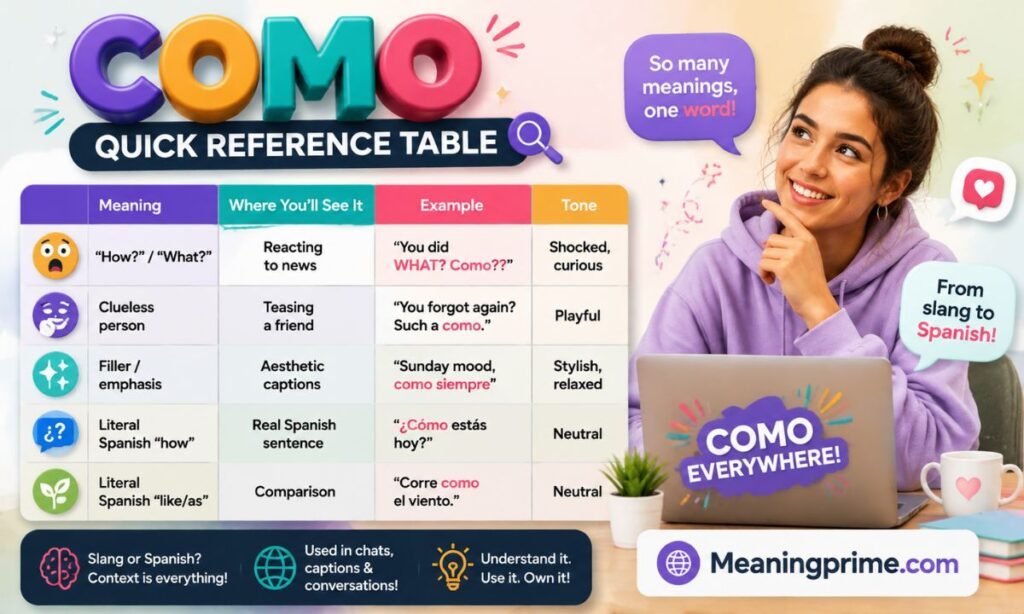
If you only remember one thing from this guide, let it be this table — it maps every version of “como” you’ll run into against the tone it usually carries.
| Meaning | Where You’ll See It | Example | Tone |
| “How?” / “What?” | Reacting to news | “You did WHAT? Como??” | Shocked, curious |
| Clueless person | Teasing a friend | “You forgot again? Such a como.” | Playful |
| Filler / emphasis | Aesthetic captions | “Sunday mood, como siempre” | Stylish, relaxed |
| Literal Spanish “how” | Real Spanish sentence | “¿Cómo estás hoy?” | Neutral |
| Literal Spanish “like/as” | Comparison | “Corre como el viento.” | Neutral |
Real Examples From Actual Chats
- Text: “I got the job!!” → Reply: “COMO?? tell me everything rn”
- Instagram comment on a plot-twist video: “como is this real”
- Group chat: “He proposed at the airport” → “como 😭 that’s so cute”
- Caption on a slow video: “living life como siempre” (like always)
- Comment under a plot-twist recap: “wait como, I need a part 2”
- Reply to a friend’s confusing update: “como so u broke up but still living together??”
Notice how punctuation carries the tone. A calm “como.” with a period feels chill. “COMOOO” with stretched letters and no punctuation feels like pure disbelief.
How to Say “Como” Out Loud
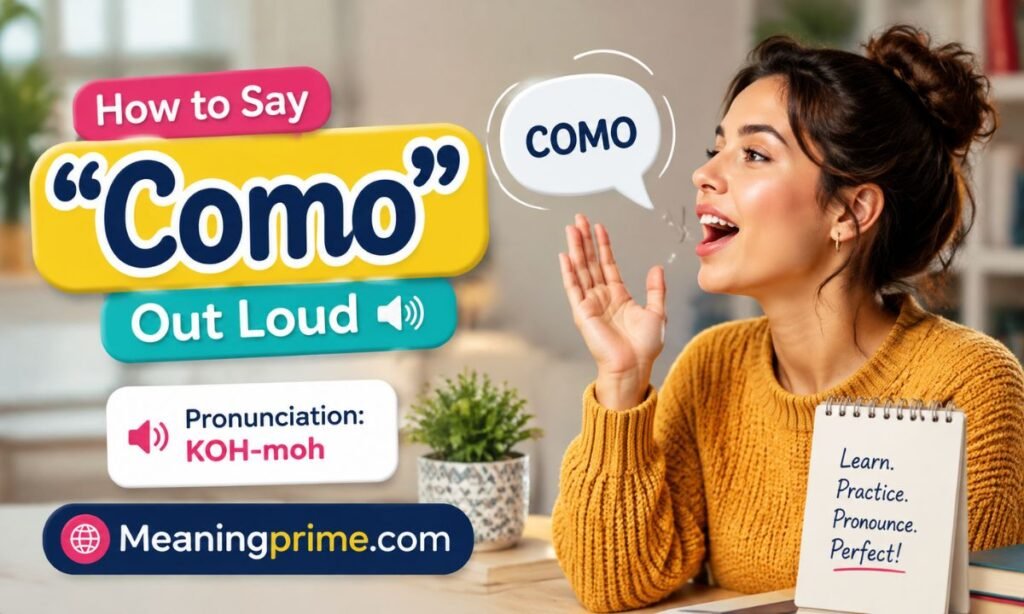
“Como” is pronounced “KOH-moh,” stress on the first syllable, with short, clean vowel sounds — closer to the “o” in “so” than a drawn-out English vowel. It’s a quick two-beat word, not something you linger on.
Pronunciation matters more if you’re actually speaking it inside a Spanish sentence than if you’re just typing it as a reaction online. In texting, spelling and punctuation do all the emotional heavy lifting instead — stretch the letters, add extra question marks, and the tone comes through without you saying a word.
How to Reply to “Como?”
If someone hits you with “como?” after big news, they’re not doubting you — they want more. Answer like they’d typed “how?” or “what happened?”
If it comes right after something you said sounded vague, take it as your cue to clarify. It’s almost never negative — it just means “give me the details, now.”
Not “Como” — Two Unrelated Look-Alikes
Worth knowing so you don’t mix these up:
- CoMo — a nickname for Columbia, Missouri.
- CoMO — an acronym for “Certainty Of Missing Out.”
Neither connects to the slang usage above, but both are common enough that a quick search for “como” can surface them by accident — worth knowing so you’re not thrown off if one shows up in unrelated results.
When to Skip “Como”
Leave it out of professional emails, school papers, and job interviews — it reads as slang, not vocabulary, in formal writing. Same goes for talking with people outside Spanish or internet slang culture; the reaction can confuse instead of land, since not everyone reading it will recognize the shorthand.
And go easy on the “clueless person” meaning with people you don’t know well. Without an established joking dynamic, it can read as an insult even when that’s not the intent — tone doesn’t always survive translation to text, and neither does context for someone outside the conversation.
“Como” and Its Viral Cousins

“Como” isn’t traveling alone. Words like vamos (let’s go), bueno (good/okay), and loco (crazy) show up constantly in English captions, comments, and even sports commentary, regardless of whether the person typing them speaks Spanish. Wey — Mexican Spanish for “dude” — has followed the same route through gaming and meme communities: short, expressive, easy to drop in without breaking the sentence.
What ties all of these together is efficiency. None of them need translation to land — they carry a feeling on their own, which is exactly why they survive outside their original language instead of fading out like most borrowed slang does.
Does “Como” Mean the Same Thing Everywhere?
Mostly, yes — but tone can shift slightly depending on where you’re seeing it. In Mexican and Central American online spaces, “como” as shock tends to pair with humor, often followed by a laughing emoji rather than genuine distress. In Spain-influenced spaces, the same word can carry a bit more sarcasm, especially when someone’s clearly not buying the story they just heard.
None of this changes the core meaning — it’s still “how” or “wait, what” at heart — but if a “como?” reply feels a little sharper or a little softer than you expected, regional flavor is often why.
Frequently Asked Questions
What does “como” mean in a text?
It usually means “how?” or “what?” — a reaction to surprising news, asking for more detail.
Is “como” the same as “cómo”?
Related but not identical. “Cómo” (with the accent) asks “how.” “Como” (no accent) means “like” or “as.”
What does “como” mean in slang?
A dramatic reaction to surprising news — the internet’s version of “wait, what?”
Where did “como” as slang come from?
It spread through Spanish-English code-switching online, especially in TikTok and Instagram comment sections.
Does “como” always mean “how”?
No. It can mean “how,” “like/as,” or just add emphasis — the meaning depends entirely on context.
What does the acronym “CoMo” mean?
As an acronym, “CoMO” can stand for “Certainty Of Missing Out,” and “CoMo” is also a nickname for Columbia, Missouri — both unrelated to the slang usage.
Is it rude to call someone “a como”?
Not usually, if it’s said to someone you’re already joking around with — it lands closer to “goofball” than an insult. With strangers or new acquaintances, skip it.
Final Thoughts
“Como” carries more range than a four-letter word has any right to — real Spanish grammar, a comparison word, and a full internet reaction, all in one spelling. Once you can tell “cómo” the question apart from “como” the slang reaction, and both apart from the filler version that isn’t really asking anything, you won’t have to guess again.
Next time “como?” shows up in your notifications, you’ll know exactly what’s being asked of you — a request for details, a laugh at a friend’s expense, or just a word doing its job to add rhythm to a caption. Read the punctuation, read the context, and reply accordingly.