

You saw “KMS” pop up in a group chat or under a TikTok comment, and your first thought was probably somewhere between “haha relatable” and “wait, should I be worried?” That split-second hesitation is normal — the abbreviation looks a lot more serious than it usually is, and that gap between how it reads and how it’s meant is exactly why people keep Googling it.
This guide breaks down what KMS actually means, how people use it in real conversations, and — more importantly — how to tell the difference between someone joking around and someone who might actually need you to check in. No lecture, just the stuff you actually need to know.
Quick answer: KMS stands for “kill myself,” and in almost every text or comment you’ll see it in, it’s used as exaggeration — not a literal statement. People type it after something embarrassing, frustrating, or mind-numbingly boring happens. It’s the digital equivalent of a dramatic sigh. That said, because the phrase does reference self-harm, it’s worth knowing the handful of situations where it’s not just a joke, and what to do if you’re not sure.
So What Does KMS Actually Mean?
KMS is short for “kill myself” (sometimes stretched to “killing myself”). It’s internet slang, and like most internet slang, it’s almost never meant word-for-word. People use it the same way they’d use “I’m dead” or “I want to disappear” — as a way to say this is a lot without writing a whole paragraph about it.
You’ll usually see it after something like a bad grade, an awkward interaction, or a string of bad luck. It’s fast, it’s dramatic on purpose, and it gets the point across in three letters instead of a full sentence. Less commonly, people use it to mean “killing me slowly,” which is more about something being tediously boring or drawn-out than about frustration.
Where This Slang Comes From
KMS grew out of the same texting culture that gave us LOL, BRB, and a hundred other shortcuts — people compressing emotional reactions into something quick to type. As group chats, gaming lobbies, and comment sections became the main place people vent about small daily disasters, KMS became a go-to for exaggerated despair.
It picked up steam through meme culture, where dramatic overstatement is basically the whole joke. A missed bus or a bad haircut isn’t a big deal, but typing “KMS” makes the reaction feel bigger and funnier, almost like a punchline. From there it spread through TikTok captions, gaming chat, and texting until it became one of those terms most people under 30 recognize instantly.
KMS in Real Texts — What It Looks Like
Context does most of the work here, so seeing it in action helps more than any definition. Here’s what typical KMS usage actually looks like:
- “Just called my teacher ‘mom’ in front of the whole class KMS 💀”
- “Tripped in the hallway and my backpack exploded everywhere kms”
- “Lost my ranked match because my teammate left. KMS.”
- “My mom found my search history from 2019 I’m never recovering from this KMS”
- “Stuck in this line for 40 minutes and it hasn’t moved. KMS.”
- “He liked my photo from three years ago and I know he knows I saw it KMS”
Notice the pattern — it’s always reacting to something specific that just happened. It’s rarely a standalone message with no context, and it’s almost always paired with something small enough that you’d never actually worry about the person’s safety.
KMS, KYS, and KMSL — Don’t Mix These Up
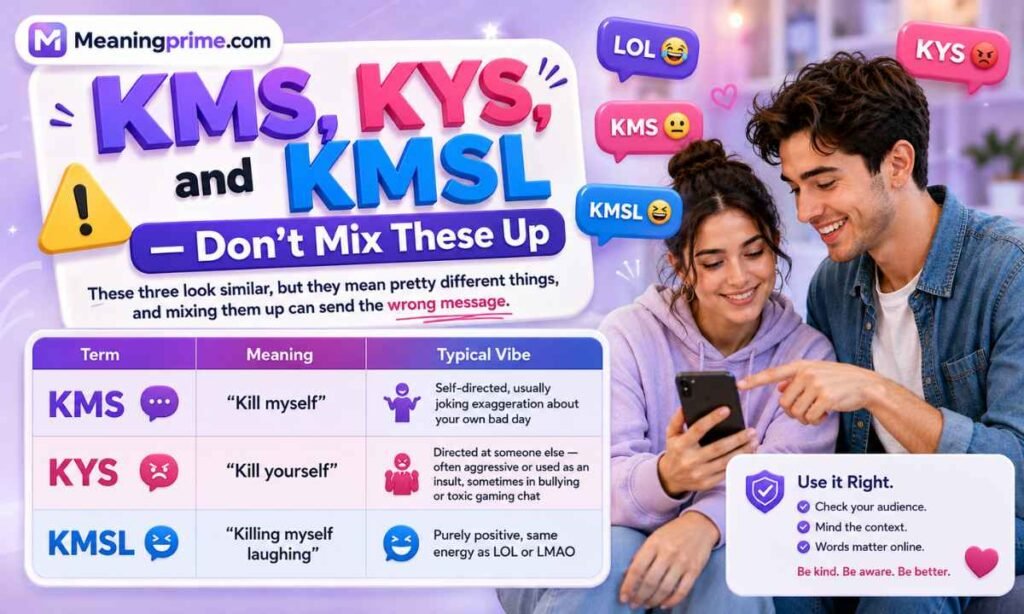
These three look similar, but they mean pretty different things, and mixing them up can send the wrong message.
| Term | Meaning | Typical Vibe |
| KMS | “Kill myself” | Self-directed, usually joking exaggeration about your own bad day |
| KYS | “Kill yourself” | Directed at someone else — often aggressive or used as an insult, sometimes in bullying or toxic gaming chat |
| KMSL | “Killing myself laughing” | Purely positive, same energy as LOL or LMAO |
The big one to know is KYS. Unlike KMS, it’s aimed at another person, and it shows up a lot more in hostile contexts — trash talk in competitive games, comment-section pile-ons, or outright harassment. It’s not the same as someone venting about their own day, and it should be taken more seriously, especially if it’s repeated or targeted at someone who seems genuinely upset.
Where KMS Shows Up (TikTok, Snapchat, Discord, and More)
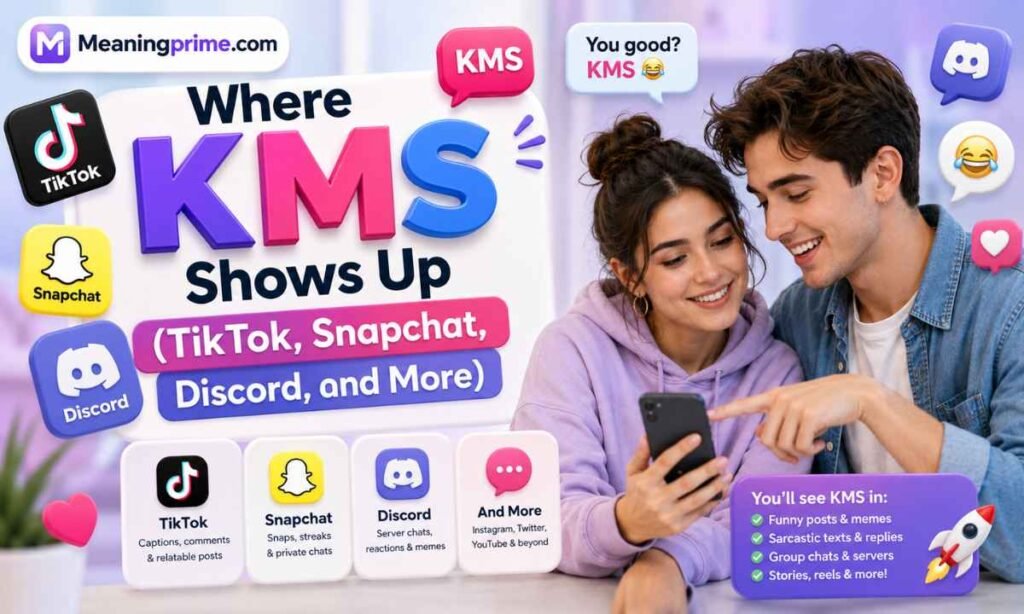
You’ll see KMS most on the platforms younger people use to react to things in real time. TikTok comments are full of it, usually under videos about embarrassing moments, fails, or relatable daily chaos. Snapchat and Instagram DMs use it constantly between friends reacting to something that just happened. Discord and gaming chats lean on it after rough matches or bad rounds.
It shows up less on Facebook and almost never on LinkedIn, for obvious reasons. On X (Twitter), it’s common but often mixed in with other dramatic phrases. One thing worth knowing: TikTok’s algorithm actively flags the term because it’s associated with self-harm content, and comments using it sometimes get hidden or removed. That’s part of why you’ll also see people write “unalive” or “kermit” instead — it’s not a different meaning, just a workaround for content moderation filters.
Is It Always a Joke?
Mostly, yes — but not always, and this is the part worth actually reading carefully.
Most of the time, KMS is context-dependent hyperbole. It shows up after something small and specific, it’s paired with an emoji like 💀 or 😭, and the person is still chatting normally before and after. That combination is a pretty reliable sign someone’s venting, not struggling.It reads differently when there’s no context attached — a lone “KMS” with nothing else, especially from someone who’s gone quiet lately, or someone who’s mentioned feeling like a burden or like nothing’s getting better.
The situation matters too. A joke about a pop quiz is not the same as someone typing it after describing weeks of feeling isolated or overwhelmed. Text strips out tone, so the same three letters can land completely differently depending on everything around them.The honest takeaway: don’t panic every time you see it, but don’t automatically wave it off either. Pay attention to the pattern, not just the acronym.
What If You’re Not Sure Someone’s Joking?
If you’re genuinely unsure, the easiest move is to just ask — plainly, without making it weird. A few ways to open that door:
- “Hey, that sounded kind of serious — you doing okay?”
- “Wait, are you actually stressed or just being dramatic lol”
- “I know that’s probably a joke but wanted to check in anyway”
- “You’ve seemed kind of off lately, what’s going on?”
You don’t need the perfect script. What matters is that you asked instead of assuming. If they say they’re fine and go back to joking around, that’s usually the end of it. If the answer is vague, if they don’t really respond, or if something in your gut says this isn’t just texting slang, it’s worth staying in the conversation a bit longer or gently suggesting they talk to someone — a parent, school counselor, or another trusted adult. You don’t have to fix it. You just have to not brush it off.
Places You Shouldn’t Use “KMS”
Even as a joke, there are places where typing this is a bad idea:
- At school or work. Teachers, HR, and administrators don’t have the context your friends do, and they’re required to take it seriously no matter how obviously you meant it as a joke.
- With people who don’t know your sense of humor. A new match on a dating app, a distant relative, or someone you just met online isn’t going to read the sarcasm the way a close friend would.
- In public comments. What lands as funny in your friend group can look alarming to a stranger scrolling by — and as mentioned, some platforms will flag or hide it anyway.
- Right after someone opens up to you about something real. If a friend just told you they’re actually struggling and you respond with “same, KMS,” it can come across like you’re making light of what they said, even if that’s not your intent.
Better Things to Say Instead
If you want the same energy without the baggage, there’s no shortage of alternatives:
Joking around:
- “I’m never living this down”
- “End me”
- “I can’t with this today”
Genuinely frustrated:
- “I’m so done”
- “This day needs to be over”
- “I can’t catch a break”
Bored out of your mind:
- “This is dragging forever”
- “Someone come save me from this meeting”
Around teachers, coworkers, or people you don’t know well:
- “That was rough”
- “Not my finest moment”
- “Today’s been a lot”
These get the same point across without anyone wondering if they should be worried.
Other Meanings of KMS (Not Slang)
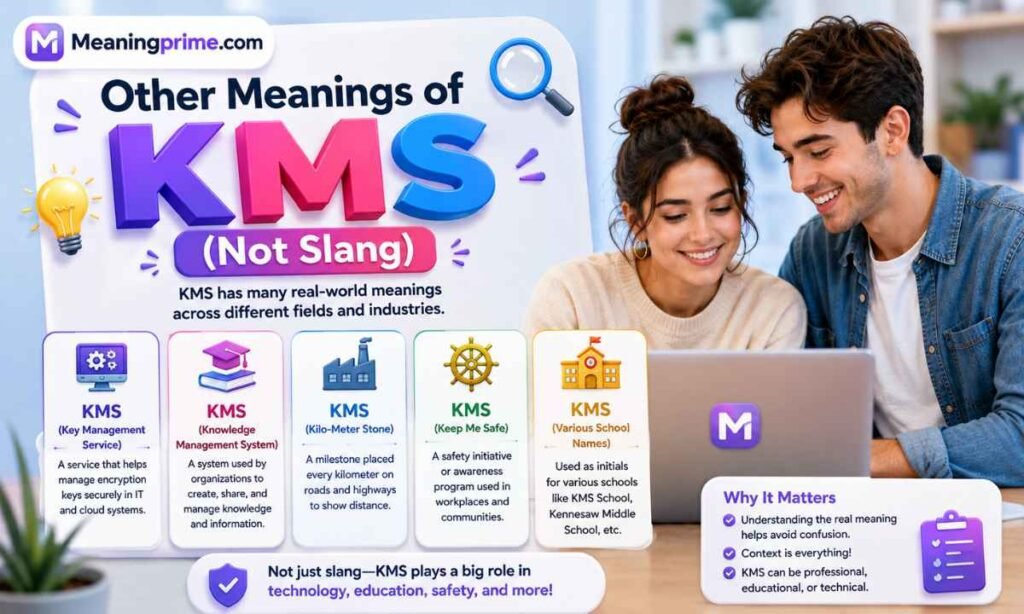
Outside of texting, KMS shows up in a couple of unrelated contexts. In IT and cloud computing, KMS stands for Key Management Service, used for things like Windows activation and encryption key management. In measurement contexts — car listings, race results, fitness apps — “kms” is just shorthand for kilometers. Neither has anything to do with the slang meaning, but it’s worth knowing so you’re not thrown off if you see it in a completely different setting.
Frequently Asked Questions
What does “KMS” mean in Gen Z slang?
It stands for “kill myself,” used almost entirely as dramatic exaggeration to react to something embarrassing, frustrating, or annoying — not as a literal statement.
What kms does?
In texting, KMS expresses an over-the-top reaction to something bad happening, similar to saying “I want to disappear” or “I’m dead.” It’s meant to amplify the emotion, not describe an actual intention.
What is kms tiktok?
On TikTok, KMS shows up in captions and comments reacting to embarrassing or relatable moments. Because the platform links the term to self-harm content, some comments using it get hidden or flagged, which is why you’ll also see workaround spellings like “unalive.”
What does km mean in texting?
Without the “s,” “km” is almost always just kilometers — a distance measurement, not related to the KMS slang term. Context makes it obvious: “ran 5 km today” versus “KMS, I bombed that test.”
Is KMS always about self-harm?
No. The vast majority of the time it’s hyperbole with zero literal meaning behind it. It’s worth taking seriously only when there’s no clear context, the person’s been withdrawn or upset lately, or the surrounding conversation suggests real distress rather than a reaction to something minor.
What’s the difference between KMS and KYS?
KMS is self-directed and usually joking. KYS (“kill yourself”) is aimed at someone else and shows up more often in hostile or bullying contexts, so it deserves a different level of concern.
What does KMSL mean?
KMSL means “killing myself laughing.” It’s unrelated to the self-harm meaning of KMS and works the same way as LOL or LMAO — pure amusement, nothing more.
Is it okay to text KMS to a friend as a joke?
Between close friends who clearly get your sense of humor, it’s usually fine. It’s a different story with people who don’t know you well, in professional settings, or right after someone’s shared something genuinely hard — those are the moments it can land wrong.
What should I do if I’m genuinely struggling, not joking?
Talk to someone you trust — a friend, parent, teacher, or counselor — about what you’re actually feeling. If it feels like more than you can carry alone, the 988 Suicide & Crisis Lifeline is free, confidential, and available 24/7 by call or text at 988, or through chat at 988lifeline.org.
Conclusion
KMS is one of those terms that sounds a lot heavier than it usually is. Ninety-nine times out of a hundred, it’s just internet shorthand for “I’m embarrassed” or “this is annoying,” and the emoji, the context, and the conversation around it usually make that obvious. The letters themselves aren’t the thing to watch — the pattern around them is.
If something ever feels off — no context, no emoji, a friend who’s gone quiet — trust that instinct enough to check in. And if you’re ever the one who means it, even a little, you don’t have to sit with it alone: the 988 Suicide & Crisis Lifeline is there to talk, text, or chat any time, no judgment, no pressure.