

You saw it in a comment, a caption, or a text from a friend, and now you’re stuck staring at it. Is it just a typo for “boy”? Is it an inside joke you’re not part of?
Good news: you didn’t miss much. This guide breaks down exactly what boi means, where it came from, and how to use it depending on where you see it.
Quick Answer
Boi is an informal, playful spelling of “boy” used across texting, memes, and social media to add humor, affection, or attitude. It also carries a specific, well-documented meaning in LGBTQ+ communities, where it can describe a masculine-presenting lesbian, a young trans man, or a gender-nonconforming person. Context decides which meaning applies.
What Does “Boi” Mean? — Quick Definition
At its core, boi is a stylized respelling of “boy.” Say it out loud and it sounds exactly like “boy” — the spelling just looks different. It’s not a new word so much as a new outfit for an old one.
What boi mean really comes down to tone. In casual chat, it usually signals humor, teasing, or affection rather than a literal age or gender label. In LGBTQ+ spaces, though, it functions as an actual identity term with real history behind it — more on that below.
Quick breakdown:
- Pronounced the same as “boy,” not “boh-eye”
- Can refer to a person, but often carries more attitude or emotion than “boy” does
- Meaning shifts depending on who’s using it and where
Does “Boi” Mean “Boy”?
Sort of, but not always. “Boy” is neutral and literal. “Boi” is loaded with context. When a friend texts “that boi really ate the whole pizza,” they mean boy, just with extra flavor. But when someone in a queer community uses “boi” to describe themselves, they’re often naming an identity, not just spelling a word differently. Treating the two as interchangeable is where a lot of confusion starts.
Where Did “Boi” Come From? A Quick Timeline
AAVE Roots & Big Boi (Outkast)
The spelling has roots in African American Vernacular English (AAVE), where deliberate alternate spellings — like “phat” or “thicc” — have long been part of the culture. Rapper Big Boi, one half of Outkast, helped push the spelling into wider pop culture in the early 1990s.
Skate, Rave & Emo Culture (Sk8er Boi Era)
By the mid-to-late 1990s, skateboarding, rave, and emo scenes had picked up “boi” as shorthand for a softer, countercultural version of masculinity. Avril Lavigne’s 2002 hit “Sk8er Boi” borrowed directly from this usage.
LGBTQ+ Adoption
Around the same era, gay and queer communities started using “boi” for a young, attractive gay man, and separately, for boyish or masculine-presenting young women in skate culture. By the early 2000s, “young butch lesbian” was one of the most common definitions in queer spaces, and it stuck around for years.
The “Dat Boi” Meme That Broke the Internet (2016)
In April 2016, an old animation of a frog riding a unicycle got paired with the caption “here come dat boi” — and it exploded. That meme is arguably the biggest reason “boi” jumped from niche subcultures into everyday internet vocabulary.
The LGBTQ+ Meaning of “Boi”
This is the part a lot of slang guides skip, and it shouldn’t be skipped, because it’s arguably the most historically significant meaning of the word.
Within LGBTQ+ and butch/femme communities, “boi” is an identity term, not just a spelling choice. Depending on the community and the person, it can describe:
- A masculine-presenting or “boyish” lesbian
- A young trans man, especially one early in transitioning
- A gender-nonconforming person who identifies with a blend of masculine traits
- A younger gay or bisexual man with more traditionally feminine characteristics
The meaning isn’t rigid, and people who use “boi” as part of their identity often define it slightly differently for themselves. If someone tells you they identify as a boi, the respectful move is simple: listen to how they define it rather than assuming.
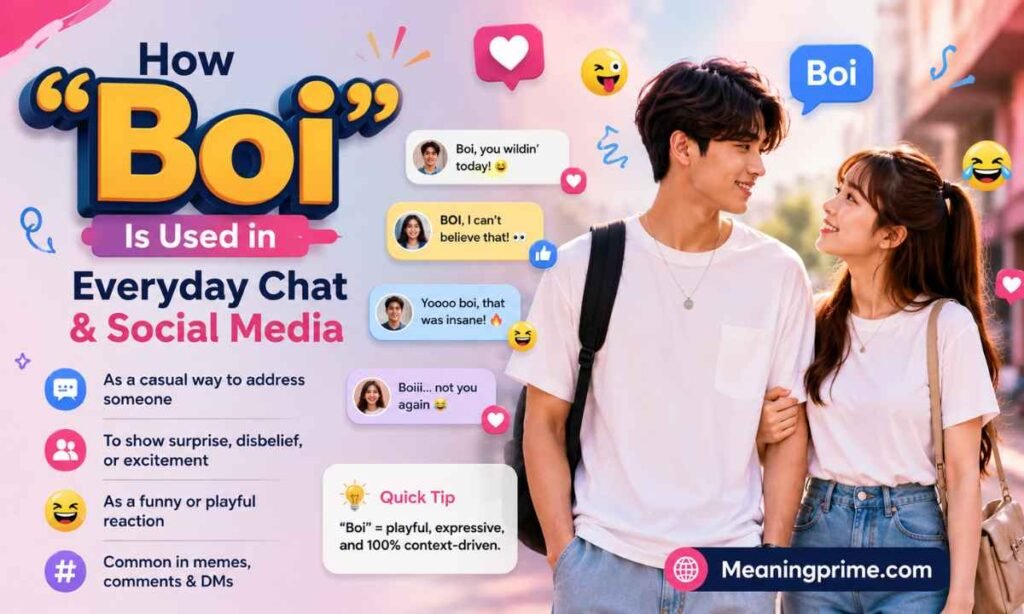
How “Boi” Is Used in Everyday Chat & Social Media
What Does “Boi” Mean in Texting?
In texts, boi meaning is almost always about tone, not literal definition. It softens a message, adds humor, or signals “I’m not being serious right now.” A text like “boi stop” reads very differently than a flat “stop.”
Boi Meaning in Chat From a Girl
When a girl texts “boi” to a friend or in a group chat, it’s typically playful teasing or mock disbelief — think “boi, no you didn’t” energy. It’s rarely about the recipient’s gender at all; it’s about reaction and tone.
What Does “Boi” Mean on TikTok?
On TikTok, “boi” shows up constantly in captions and comments, usually for comedic emphasis or light roasting. A comment like “this boi thought one gym session would fix everything” is poking fun, not describing someone literally.
Boi Meaning on Instagram
Instagram comments and DMs use “boi” similarly — often as a reaction to someone doing something impressive, chaotic, or funny. “Okay boi, I see you” is a compliment dressed up as sass.
Boi Meaning in Love (Romantic & Affectionate Use)
Used affectionately, “boi” can be a soft, playful nickname between partners or close friends — something like “my boi” to mean “my person,” with warmth instead of formality. It’s casual by design, so it tends to show up more in flirty texting or inside jokes than in serious, formal declarations. In LGBTQ+ relationships specifically, “boi” can also carry the identity meaning covered above, layered right into the affection.
What Does “Boi” Mean in Business?
Here’s an important distinction: capitalized BOI in a professional or legal context has nothing to do with slang. BOI stands for Beneficial Ownership Information — a term tied to U.S. regulations under the Corporate Transparency Act, where many businesses must file BOI reports identifying who owns or controls the company. If a coworker mentions “BOI reporting” in a meeting, they’re talking about compliance paperwork, not internet slang.
What Does “Boi” Mean in Spanish?
“Boi” isn’t a standard Spanish word, so you won’t find it in a Spanish dictionary. Where it does appear in Spanish-speaking online spaces, it’s typically borrowed directly from English internet slang and used the same playful way — often in memes or bilingual social media captions rather than everyday spoken Spanish.
Regional & Cultural Differences
- United States (Gen Z/internet culture): Broad, casual usage across memes and texting, mostly detached from its deeper origins.
- AAVE context: The word’s roots run deep in Black American culture and language; using it with that awareness matters.
- Wales, UK: In parts of northern Wales, “boi” is simply a familiar, gender-neutral greeting — closer to “mate” than to anything gender- or internet-related.
- LGBTQ+ communities globally: Carries specific identity weight, as outlined above.
“Boi” vs. Similar Words
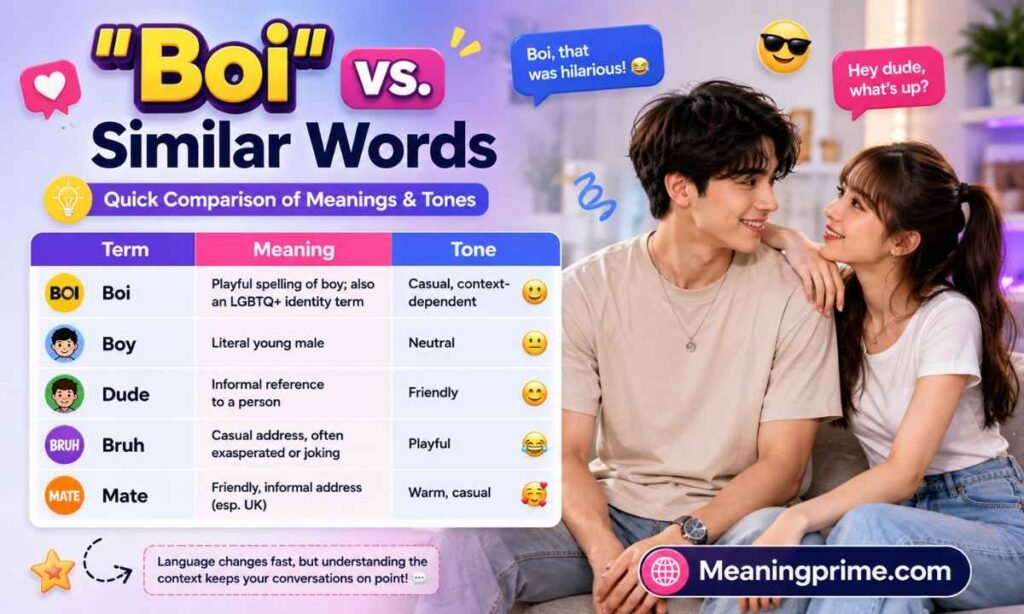
| Term | Meaning | Tone |
| Boi | Playful spelling of boy; also an LGBTQ+ identity term | Casual, context-dependent |
| Boy | Literal young male | Neutral |
| Dude | Informal reference to a person | Friendly |
| Bruh | Casual address, often exasperated or joking | Playful |
| Mate | Friendly, informal address (esp. UK) | Warm, casual |
Common Ways People Use “Boi”
- Good boi – affection or praise
- Sad boi – emotional vulnerability, often self-aware humor
- Soft boi – sensitive, artistic personality type
- Chaotic boi – unpredictable, high-energy behavior
- Sleepy boi – tired or lazy, said fondly
Each version tweaks the emotion attached to the word without changing its core playful spirit.
Is It Okay to Use “Boi”? Context Matters
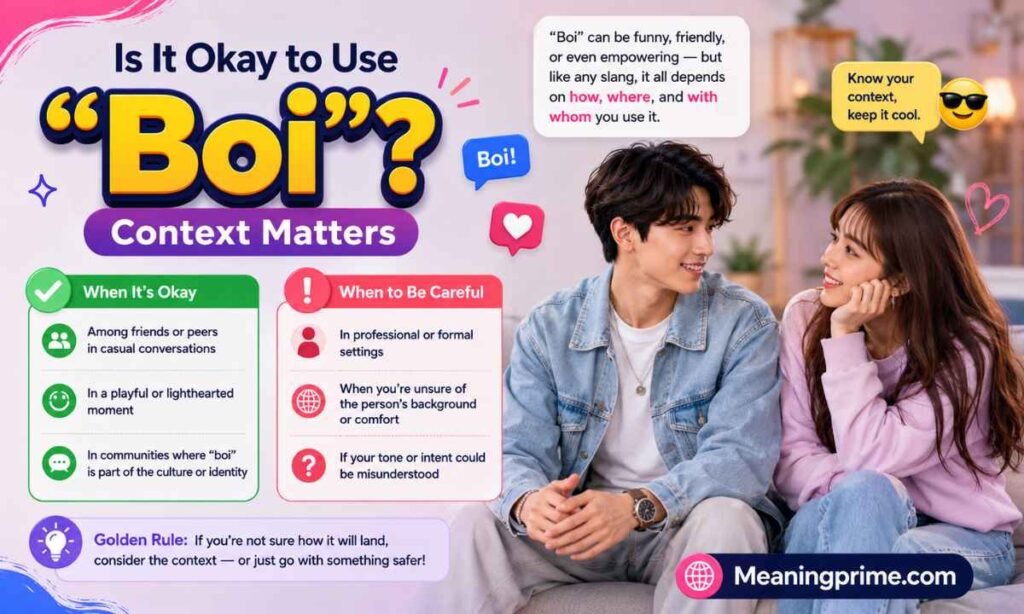
In casual conversations with friends, “boi” is generally safe and lighthearted. In professional settings, skip it — even in relaxed workplaces, it can read as unprofessional. And because the word carries real cultural and LGBTQ+ history, using it to mock someone’s identity, rather than in the spirit it was built on, crosses from playful into disrespectful fast.
How to Respond When Someone Calls You “Boi”
- Casual: “Yeah, that’s me.”
- Funny: “Certified boi behavior.”
- Confident: “I’ll take that as a compliment.”
- Unsure how it’s meant: “Ha, what do you mean by that?”
Frequently Asked Questions
What does boi stand for?
It doesn’t stand for anything as an acronym — it’s a stylized spelling of “boy.” (Capitalized BOI is different; that’s shorthand for Beneficial Ownership Information in business contexts.)
What does boii mean in text?
“Boii” is just an exaggerated version of “boi,” usually adding extra emphasis, excitement, or drama to a message — same meaning, louder delivery.
When was saying boi popular?
The spelling has roots in the early 1990s, gained momentum through skate and LGBTQ+ culture in the late ’90s and 2000s, and went fully mainstream after the “Dat Boi” meme in 2016.
What does it mean when someone calls you boi?
It usually means they’re being playful, teasing, or affectionate rather than literal. If you’re unsure, the tone of the rest of the message is your best clue.
Is “boi” the same as “BOI” in business or legal contexts?
No. Lowercase “boi” is slang; capitalized “BOI” refers to Beneficial Ownership Information, a legal filing requirement for many U.S. businesses.
Is calling someone “boi” offensive?
Not usually — most everyday use is playful. But because it carries real history in AAVE and LGBTQ+ communities, using it to mock someone’s identity or background isn’t okay.
Can “boi” be used for women or nonbinary people?
Yes. In LGBTQ+ contexts especially, “boi” has long been used for masculine-presenting women, trans men, and gender-nonconforming people — it isn’t limited to describing men.
Conclusion
“Boi” was never just a cute misspelling of “boy.” It’s a word with real layers — AAVE roots, skate and emo culture, LGBTQ+ identity, and a viral meme that pushed it into everyone’s vocabulary. What it means in any given moment depends entirely on who’s typing it and why.
Next time you see it, you’ll know it’s rarely random. Read the tone, consider the context, and you’ll never be left wondering what someone actually meant.