

You saw it in a text, a Snapchat caption, or a comment section, and now you’re stuck. “Opps” doesn’t show up in any dictionary you grew up with, and typing it into a normal search bar feels a little silly. Maybe your kid said it, or a friend dropped it in a group chat, and you just nodded along like you understood.
Good news: it’s simpler than it looks. This guide breaks down exactly what does opps mean in slang, where it came from, and how it shows up across texting, Snapchat, TikTok, Instagram, and everyday online chat.
Quick Answer
“Opps” is slang for enemies, rivals, or people who are against you. It’s the plural of “opp,” which comes from the word “opposition.” Most of the time it’s used casually or jokingly, not to describe actual danger.
Meaning & Explanation of Opps in Slang
Opps Meaning in Text
In a text message, opps almost always means the same thing: people someone considers rivals, haters, or competition. It’s shorthand — instead of typing out “people who don’t like me,” someone just types “opps.”
- “We saw our opps at the mall.”
- “Watch your back, too many opps around tonight.”
Opps Slang Meaning
The word traces back to “opposition.” Over time it got shortened to “opp,” and the plural “opps” became the version people actually use in conversation. It can point to:
- Rival friend groups
- Competitors in sports or games
- People who spread gossip or drama
- Anyone acting against you in a given moment
What Does Opps Mean in Chat?
In a chat thread, opps usually signals tension, rivalry, or mild distrust — not always serious hostility. It’s a fast way to express a feeling without writing a paragraph.
A: Why didn’t you invite them? B: They’ve been acting like opps lately.
Opps Meaning in Social Media
On social platforms, “opps” often shows up in captions, comments, or memes rather than direct accusations. Someone might caption a photo “no new friends, too many opps” as a joke about drama, not an actual warning.
Is Opps an Acronym or Typo?
Neither. Opps is a plural slang word, not an acronym and not a spelling mistake. It comes directly from “opposition,” shortened into “opp,” then pluralized into “opps.” That’s the whole story — no hidden letters to decode.
OPP vs. Opps vs. Opportunity — Don’t Get Confused
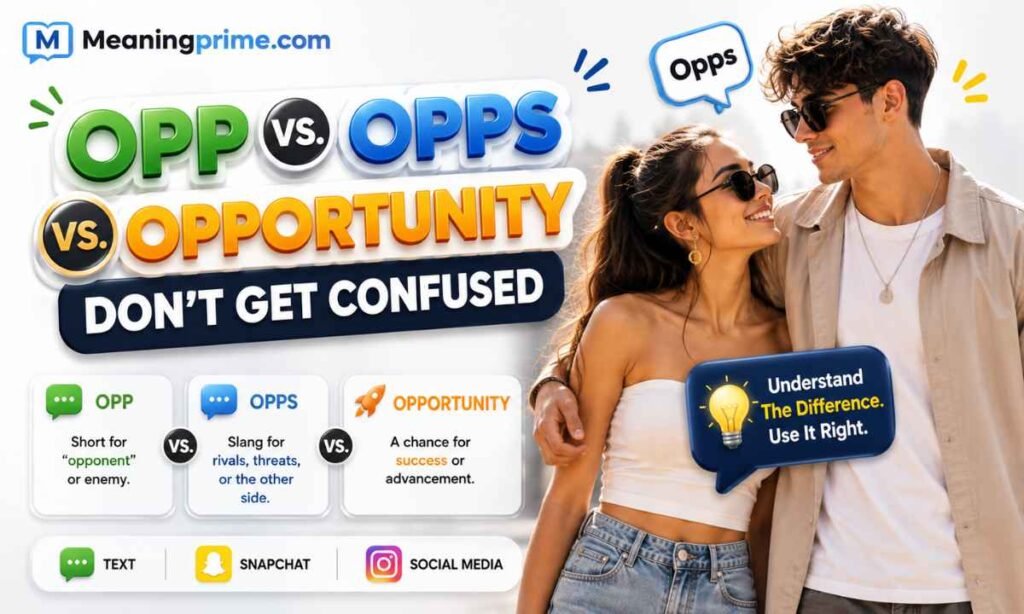
“OPP” gets used differently depending on where you see it, so a little disambiguation helps.
OPP Meaning in Rap
In rap and hip-hop, especially drill music, “opps” refers to rival groups or personal enemies. Phrases like “sliding on the opps” or “checking for opps” describe watching out for rivals. This is the meaning that shaped how the word spread into everyday slang.
OPP Meaning in a Relationship
Older listeners might know “O.P.P.” from Naughty by Nature’s 1991 song, where it stood for “Other People’s Property” — referring to someone else’s romantic partner. That’s a different meaning from today’s “opps”; the two just happen to share letters.
Does Opps Mean Cops?
No. Some people confuse it with slang for police, but that’s not accurate. “Opps” means rivals or enemies, nothing to do with law enforcement.
What Does Opps Mean in Healthcare?
Outside of slang, “OPPS” is also a real healthcare acronym — the Outpatient Prospective Payment System, a Medicare billing method for hospital outpatient services. It’s spelled the same but has zero connection to the slang term. If you saw “OPPS” in a medical or insurance document, that’s the one being referenced, not the internet slang version.
Opps Meaning on Snapchat, Instagram, TikTok & WhatsApp
The core meaning doesn’t change across apps, but the tone shifts depending on where you see it.
Opps Meaning Slang Instagram
On Instagram, opps usually appears in meme captions or indirect posts hinting at drama without naming anyone. It’s often more performative than literal — a way to add flair to an ordinary post.
Opp Meaning TikTok
TikTok is where a lot of people first learn the word, through slang-explainer videos, storytime content, or jokes exaggerating small annoyances into “opp behavior.”
Opps Meaning on Snapchat
Snapchat captions lean dramatic by nature, and opps fits right in:
- “Moving smart because of the opps.”
- “No new friends — too many opps.”
Opps on WhatsApp & Group Chats
In WhatsApp groups, the word tends to show up when friends are ribbing each other about petty conflicts — someone eating the last slice, missing a call, or picking sides in a joke argument.
Opps Meaning UK Slang vs. US Slang
The word started in American hip-hop and drill culture, but UK drill scenes (especially in London) adopted it heavily too, and the meaning carried over almost unchanged: rivals or enemies. British teens use “opps” the same casual way American ones do — it’s less about geography now and more about which corner of internet culture you’re in.
Tone & Context Variations
Tone changes everything with this word.
Funny & Playful Tone
A: You finished the ice cream again. B: I was hungry. A: Wow. Living with my opps.
Sarcastic Tone
A: You didn’t like my playlist? B: It was fine. A: Didn’t know I had opps at home.
Romantic Tone
A: You picked gaming over dinner. B: I’ll make it up tomorrow. A: Sounds like something my opps would say.
Angry or Serious Tone
A: They spread rumors about us. B: Yeah, they’re definitely our opps.
Real Chat Examples
- “Did you see them talking about us? Looks like we got new opps.”
- “Our team lost again — those opps trained hard.”
- “She unfollowed me. Turning into the opps now.”
- “Someone leaked the surprise party. We definitely got opps around.”
- “Why didn’t they invite us? Maybe they’re the opps.”
- “You beat me again. You’re joining the opps list.”
Grammar & Language Role
Part of Speech & Sentence Position
Opps functions as a plural noun and can sit anywhere in a sentence: “Opps everywhere today,” “We ran into our opps at school,” or just “They’re acting like opps.” It can even stand alone as a full reply — someone asks if they got betrayed, and “opps” answers it completely.
Formal vs. Informal Use
This is strictly casual language. Skip it in emails, school assignments, or workplace messages — save it for texting, captions, and group chats with friends.
How to Reply When Someone Says “Opps”
- Funny: “Guess I need better security.”
- Serious: “What happened between you two?”
- Neutral: “Oh, that sounds complicated.”
- Flirty: “If I’m one of your opps, why are you smiling?”
Opps vs. Other Slang Terms
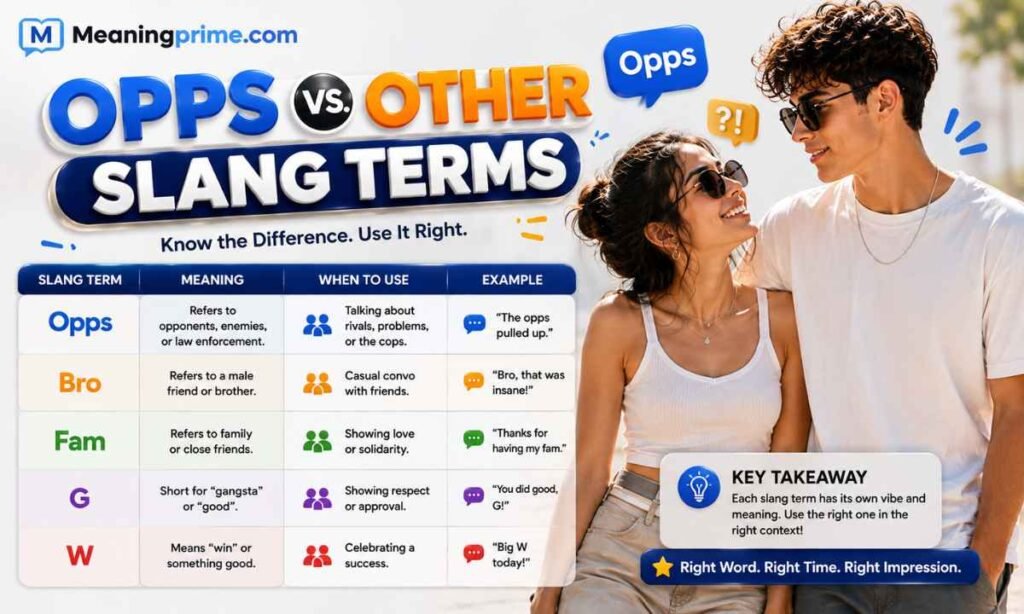
| Term | Meaning | Tone | Popularity |
| Opps | Enemies or rivals | Playful/serious | Growing |
| IDK | I don’t know | Neutral | Very high |
| ION | I don’t | Casual | Moderate |
| IDC | I don’t care | Dismissive | High |
Where Does “Opps” Come From?
“Opps” grew out of African American Vernacular English and hip-hop culture, where “opposition” described rival groups. The word gained real traction through drill rap, a subgenre that started in Chicago in the early 2010s before spreading to cities like London. Social media then did what it always does — took a term with sometimes serious roots and turned it into something teenagers use about losing a video game.
Who Uses “Opps”?
Gen Z vs. Millennials
Gen Z uses it constantly and casually, especially on TikTok and Snapchat. Millennials generally understand it but reach for it more sparingly, usually as a joke.
Platforms Where It’s Popular
TikTok, Snapchat, Instagram, WhatsApp, and Discord all see heavy use — anywhere fast, informal messaging happens.
Is Opps Rude or Offensive? Should You Worry About It?
Not inherently, no. If a teenager in your life calls their teacher, coach, or you an “opp,” that doesn’t mean anything alarming is happening. It usually just means someone is enforcing a rule the teen finds mildly annoying — homework, chores, a curfew. The word carries real weight in drill lyrics, but in daily texting, it’s mostly exaggerated for humor. Context and tone tell you which version you’re dealing with.
Usage Tips & Common Mistakes
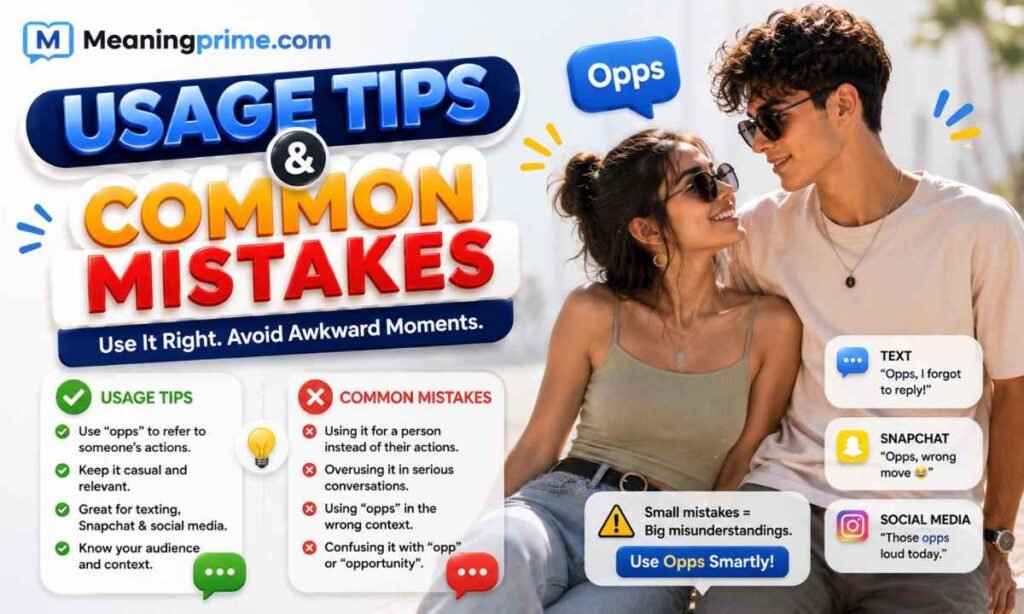
- Keep it in casual settings — friends, captions, group chats.
- Pay attention to tone before assuming real conflict.
- Don’t use it in professional or academic writing.
- Don’t panic if a young person calls you an opp — it’s usually a joke.
Frequently Asked Questions
What does opps mean in text?
It means enemies, rivals, or people acting against you. It’s the plural of “opp,” short for “opposition.”
Is opps the same as OPP from the Naughty by Nature song?
No. That 1991 song used “O.P.P.” for “Other People’s Property,” referring to someone’s partner. Today’s “opps” comes from drill rap and means rivals or enemies — a completely different meaning.
Is it rude or offensive to call someone an opp?
Not usually. It’s informal slang, often used jokingly among friends or teens describing minor annoyances rather than real enemies.
What does opps mean on Snapchat specifically?
The same core meaning applies — rivals or people someone doesn’t trust — but Snapchat captions tend to lean dramatic or humorous rather than literal.
What does “opps” mean in Gen Z slang?
Gen Z uses “opps” to mean rivals, haters, or anyone perceived as against them, frequently in a playful or exaggerated way rather than a literal one.
Why does Gen Z say “OOP”?
“OOP” (often written “oop” or “welp, oop”) is a separate slang term used to react to an awkward or unexpected moment — it’s not related to “opps” despite the similar spelling.
What is ops in Gen Z slang?
“Ops” is just an alternate spelling of “opps,” meaning the same thing: rivals or enemies, used the same casual way across texting and social media.
What is opps slang for on TikTok?
On TikTok, “opps” is used the same way as elsewhere — rivals or enemies — but often shows up in comedic storytimes, slang explainer videos, or exaggerated jokes about everyday annoyances.
Conclusion
At its core, “opps” means enemies, rivals, or opposition — a word that started in hip-hop and drill culture and became one of the most common terms in casual online slang. Most of the time, it’s playful rather than literal, showing up in captions, jokes, and group chats far more than actual conflict.
The best way to read it is simple: check the tone before the definition. Save it for casual conversations with friends, and you’ll never misuse it.