

You open your phone and see your friend’s reply. There it is: “TMI.” No emoji. No laugh. Just three cold letters. Suddenly you’re asking yourself, what does TMI mean here? Are they teasing you, or did you say something strange?
That tiny moment is why people type “what does TMI mean in text” into Google. This guide gives you the plain definition, nine real uses, tone clues, sample chats, and easy ways to reply. By the end, you’ll know what the sender meant and what to say next.
Quick Answer: What does TMI mean? It stands for “too much information.” People type it when someone shares more personal detail than they wanted to hear, like bathroom stories, body talk, or private dating drama. Tone changes everything, though. Between close friends it’s usually a joke. With someone new, it can be a real boundary.
People Keep Seeing This and Getting Confused
You’re scrolling through comments and spot “TMI!” under someone’s post. Or a friend texts it back, and you can’t tell whether they’re amused or annoyed. That’s a fair thing to wonder. Three letters carry plenty of weight when you can’t hear a voice.
The confusion makes sense. The same acronym can work as a joke, a warning, a polite brake pedal, or even a request for more. Context decides which one you’re getting. Add social platforms and K-pop fan culture, and the plot thickens. That’s why the question “what does TMI mean?” deserves more than a one-line answer.
The Real Feeling Behind “TMI”: What Does TMI Mean Beyond the Letters?
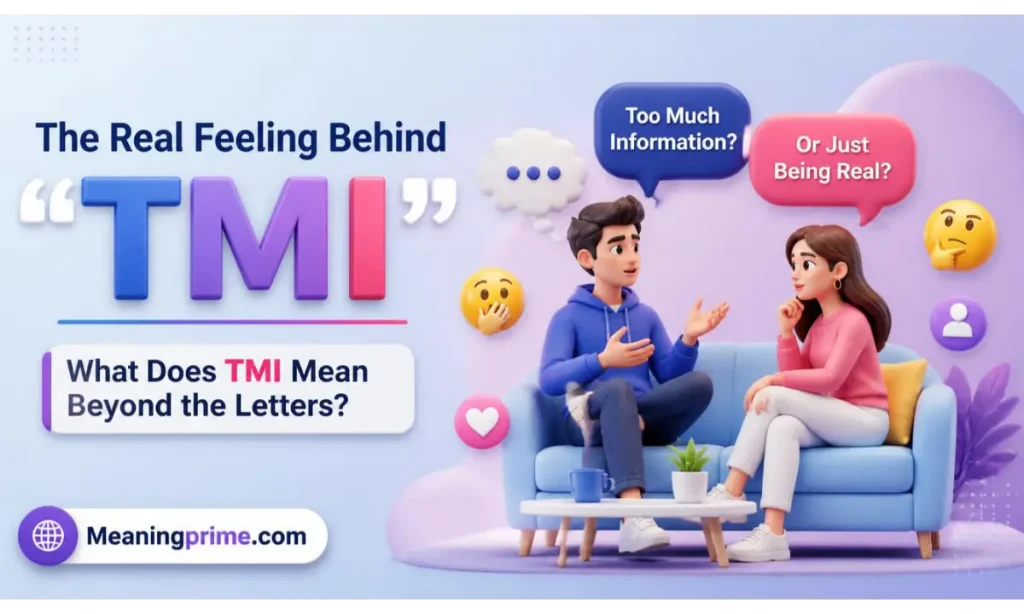
Strip away the spelling, and TMI works like a brake pedal for conversation. The speaker feels you’ve wandered into territory that’s too personal, too gross, or simply more detailed than they asked for. It’s rarely an attack. Most of the time it arrives with a laugh and a little squirm.
So what does TMI mean emotionally? It says, “Please slow down, I’m not comfortable.” People choose it over “I really don’t want to hear that” because it’s faster and softer. It keeps the mood light while still drawing a line. It’s almost always a reaction. Rarely does anyone open a conversation with it.
What Does TMI Mean in Texting and Chat?
In texting and chat, what does TMI mean? It’s shorthand for “too much information,” used as a quick response to an overshare. You’ll spot it in DMs, group chats, and comment threads. Typing three letters beats typing a whole sentence. That’s exactly why the shorthand caught on.
It also escapes the screen. People say “TMI!” out loud, often with a laugh, when a dinner-table story takes a sharp turn. Whether typed or spoken, the job stays the same. The listener signals that the details have gone far enough.
What Does TMI Mean in Gen Z Slang?
In Gen Z slang, TMI is less a scolding and more a reflex. It works as a reaction, a joke, and a caption all at once. You might see “ok TMI but…” before a story or a lowercase “tmi” under a friend’s post. Does TMI mean something different in Gen Z circles? Not really. The definition matches the older one. Only the casual speed has changed.
Plenty of people, younger users included, also flag their own overshare before anyone else can. That self-aware habit turns an awkward moment into a shared laugh.
Where TMI Came From (and What Did TMI Mean Back Then?)
Internet slang usually starts as a typing shortcut, and TMI fits the pattern. Early chat rooms and instant messaging rewarded short replies, so “too much information” shrank to three letters. The phrase itself may be older. Wiktionary credits a 1988 use to a Wall Street Journal writer, but that claim comes without a citation. Treat it as a lead rather than a fact.
The firmer record begins in 2002. An Urban Dictionary user posted the earliest known definition that October: way more than you need or want to know about someone. NetLingo then listed the abbreviation as text shorthand in 2007. So what did TMI mean in 2002? The same thing as today: too much information, usually about bodies and bathrooms. What changed is the reach. The acronym hopped from chat rooms to texts, social media, and everyday speech.
Where You’ll Actually Spot This Term: 9 Meanings of TMI
Here are nine answers to “what does TMI mean?” in real chats, so you can match the one in front of you.
1. The Classic Reaction to Oversharing
This is the main event. Someone shares a graphic detail, and you answer with “TMI.” A quick “TMI 🤢” tells them they’ve crossed the line without a lecture. What does TMI mean here? “Stop, that’s plenty.” Most people use this version every time they type the acronym.
2. Playful Teasing Between Friends
Among close friends, TMI often works as a joke. You say it. They laugh. The story keeps rolling. A laughing emoji usually means teasing, not shutting you down. At heart, the message is “I love you, but I didn’t need that image.”
3. The Self-Aware Warning (“Sorry, TMI, but…”)
Plenty of people say it about themselves. “Okay, TMI, but I haven’t showered in three days” works as a heads-up before the overshare. “Sorry, TMI” works as an apology right after it. In both cases, what does TMI mean? “I know I’m sharing too much.” The speaker beats you to the punch and keeps the mood light.
4. A Boundary-Setter With Someone New
Here the vibe shifts. If you barely know someone and they reply “TMI,” you probably moved faster than they’re comfortable with. They’re not necessarily angry. They simply want the pace to slow down. Treat it as a gentle stop sign. Change the subject and let the friendship build at its own speed.
5. The Sarcastic “Keep Going” Bait
Some people type “ugh, TMI” while grinning. You start a juicy story, stop halfway, and they push back with a fake complaint. In truth, they’re begging for the rest. Clues include an emoji, a follow-up question, or a rapid-fire reply. So does TMI mean “stop” here? Nope. It means “don’t you dare stop.”
6. Information Overload (“Slow Down, I’m Lost”)
Not every TMI involves bodies. Sometimes a listener is simply buried in details. Imagine asking how to fix a leaky faucet and getting a list of tools you’ve never heard of. Does TMI mean disgust in that moment? No. “TMI, slow down” signals overload. This meaning is rarer, but it’s genuine.
7. The Third-Person Noun (“She Gave Me TMI”)
You can also use it as a noun when you’re retelling a story. “My coworker gave me so much TMI at lunch” describes the overshare without repeating it. The acronym becomes a label for the whole conversation. People also say “TMI alert” before launching into something personal.
8. A Caption or Hashtag Warning
On social platforms, #TMI or “TMI incoming” works as a content label. The creator tells you that something personal is on the way, so you can scroll past or lean in. It’s less of a boundary and more of a fun-size disclaimer attached to a candid post.
9. Fan Trivia in K-Pop Culture
Fans in K-pop spaces use TMI for harmless little facts. Think of an idol’s favorite snack or the hour they woke up. Nothing gross. Nothing embarrassing. We’ll dig into that corner of the internet further down.
Why “TMI” Hits Different Depending on Who Says It
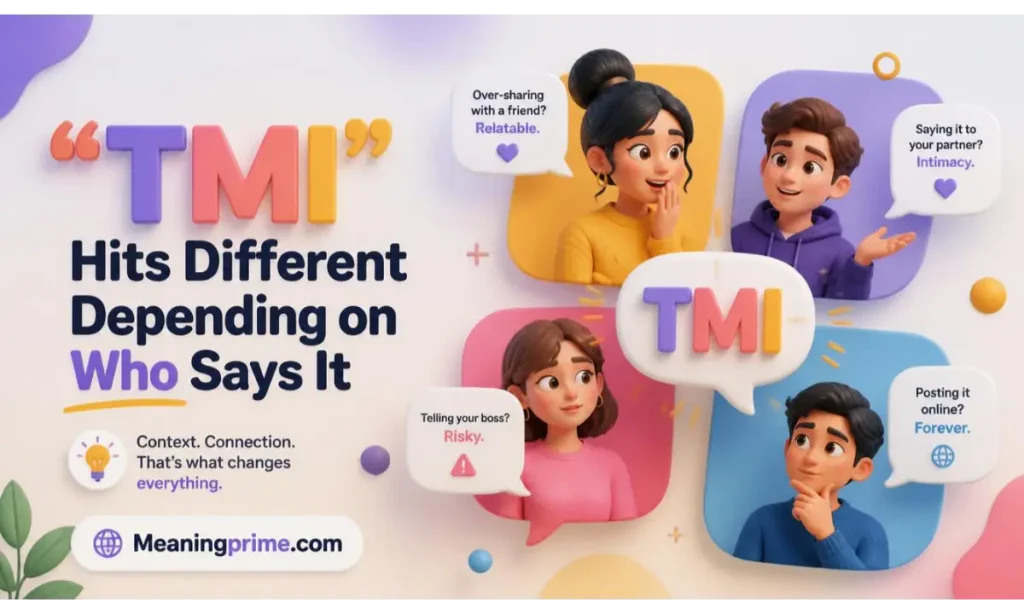
Same three letters, wildly different vibes. Who types them, and how, changes the entire message.
What Does TMI Mean in Friendship?
Inside a friendship, what does TMI mean? Mostly playful teasing. Close friends overshare constantly, so the acronym becomes a running gag. You can say it, keep listening, and nobody walks away hurt. One friend spills. Another types “TMI.” The first adds even more detail on purpose.
With Someone You Barely Know
A “TMI” from a new contact tells you to dial it back. Maybe you shared a health detail, a past relationship story, or a family issue too soon. Nobody’s judging you. They’re just signaling comfort limits. Pause, switch topics, and try again once you’ve built more trust.
What Does TMI Mean From a Girl (and for Girls Generally)?
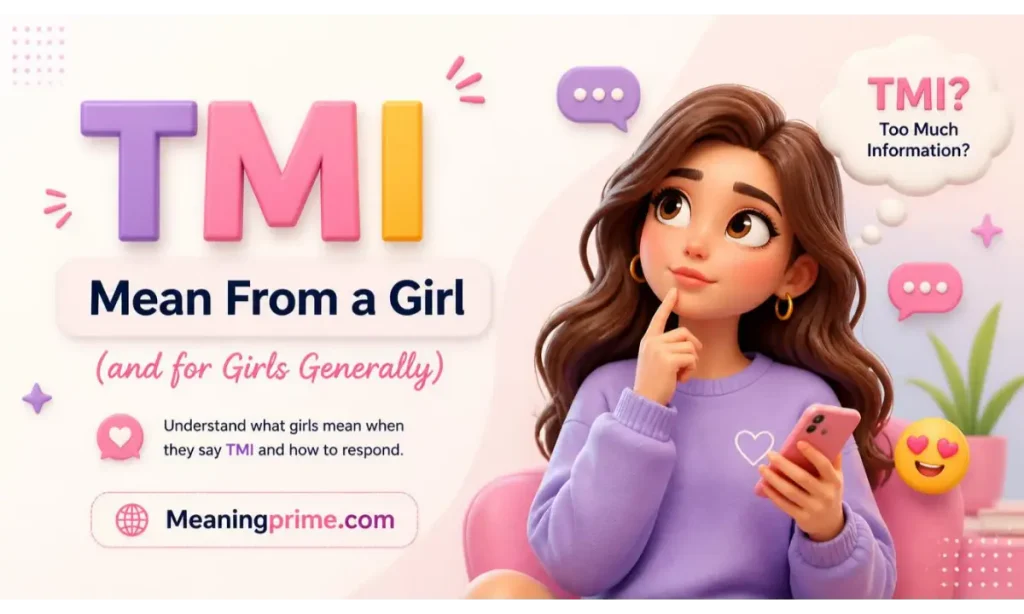
What does TMI mean from a girl? The same thing it means from anyone: she heard more than she wanted to hear. Gender doesn’t rewrite the definition. The relationship does. From a close friend, it’s teasing. From a crush or a new match, it’s a hint to slow down the personal details.
Look at the clues around the message. A laughing emoji and a follow-up question suggest she’s amused. A flat “TMI.” followed by a subject change suggests a real boundary. So what does TMI mean for girls specifically? Read the tone, not the gender.
Tone Decoder: Joking, Serious, or Sarcastic?
Use this quick table to read the room.
| Clue | Likely tone | Example |
|---|---|---|
| Laughing emoji or “lol” | Joking | “TMI 😂 keep going” |
| Period, then a topic change | Serious | “TMI. Anyway, how’s work?” |
| “Ugh, TMI” plus a question | Sarcastic bait | “TMI… wait, then what happened?” |
| Sender says it about themselves | Self-aware warning | “I cried at a commercial, sorry TMI” |
| Repeated or all caps | Playful panic | “TMI TMI TMI” |
When you’re unsure, treat it as real. You can always return to the story later.
Places Where “TMI” Just Doesn’t Work
Slang has a time and a place.
At Work and in Professional Emails
Skip it at work. Calling something TMI in an email or meeting can feel dismissive. What does TMI mean at work? Usually casual banter, which rarely belongs near a deadline. If a coworker overshares, try “Let’s keep this high-level” or “Thanks, let’s focus on the project.” Both redirect without embarrassing anyone.
During Serious or Vulnerable Moments
Don’t say TMI when someone is opening up about something heavy, like a diagnosis, a breakup, or a family crisis. In those moments, the details are the point. A quick TMI can cut off someone who finally found the courage to talk. Try “I’m here, keep going” instead.
With Parents, Teachers, and Bosses
Be careful with anyone who holds authority over you or deserves extra respect. A casual TMI can sound like you’re shushing them. Unless you’re truly close, pick a gentler line like “Let’s move on from that.”
Other Ways to Say “That’s Too Much” Without Using “TMI”
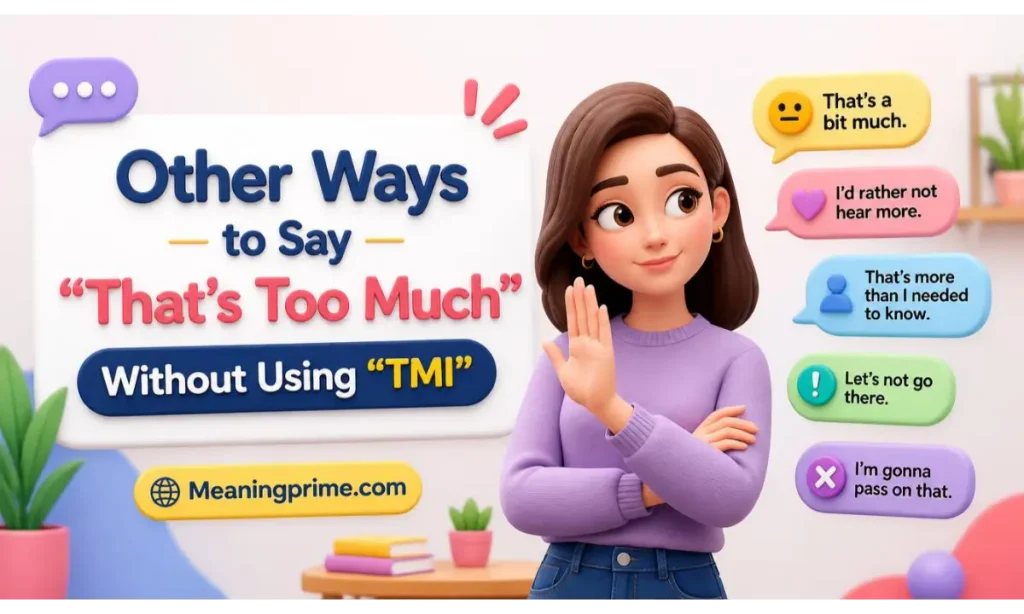
Variety keeps your reactions fresh. If you’d rather skip the acronym, swap in one of these.
| Tone | Try saying |
|---|---|
| Casual | “Okay, I’ve got the picture 😂” / “Maybe skip the details” / “That’s plenty, thanks” |
| Polite or professional | “That’s more detail than I need, thanks” / “Let’s shift gears” / “Understood, thank you” |
| Playful | “I’m never unseeing that” / “Thanks for the mental image” / “Bold of you to share that” |
Mix them up so no single phrase gets stale.
Actual Texts People Send (TMI Edition)
Here are six realistic exchanges, each showing a different flavor of TMI.
Friend with a stomach bug
Maya: Been in the bathroom since 7 a.m. Everything’s coming out both ends.
You: TMI 🤢 hope you feel better
Group chat date story
Jordan: So my date last night suddenly started…
Sam: TMI TMI TMI. Summary only, please.
Self-aware overshare
Priya: Wore the same hoodie four days straight lol. Sorry, TMI.
You: Honestly, respect.
Sarcastic bait
Chris: Wild story from last weekend, but I can’t repeat it.
You: Ugh, TMI. Wait, no. Tell me everything.
Early dating chat
Alex: My stomach hates cold weather. Long story.
You: TMI for day one 😂 but noted.
Parent moment
Mom: Your uncle’s whole surgery story is…
You: Mom, TMI! Love you, though.
TMI Means Something Totally Different on TikTok and in K-Pop Spaces
Platform culture changes how the acronym feels.
What Does TMI Mean in Social Media?
Across social media, TMI works in two directions. Commenters use it as a reaction to an overshare. Posters use it as a pre-emptive label. You’ll see “Ok TMI but…” at the start of a story or “TMI alert” in a caption. Neither version carries much heat. What does TMI mean in both cases? The details are personal.
What Does TMI Mean on Instagram?
On Instagram, TMI usually lives in captions and comments. A caption might read “TMI, but I finally booked therapy,” flagging a personal post before anyone scrolls in. In comments, it’s a light reaction to a story that shared a little too much. It reads as friendly commentary rather than a rule.
What Does TMI Mean on TikTok?
On TikTok, creators sometimes tag a video with #TMI before sharing something candid, like a bodily mishap or a dating confession. Viewers know what’s coming. Many watch anyway, and that’s half the appeal. Comments often answer with a quick “TMI” and a laughing emoji. Treat it as entertainment, not an alarm.
What Does TMI Mean in K-Pop?
In K-pop fan culture, what does TMI mean? Something delightfully different. Fans ask idols for their “TMI of the day,” a tiny, random detail like a favorite snack, a morning routine, or the song stuck in their head. Nobody feels grossed out. The term entered Korean from English, and Wiktionary notes that it isn’t treated as taboo there the way it is in English. BTS even included TMI in a Korean slang lesson for Entertainment Weekly in 2019. So when a fan account asks for your TMI, they probably want snack trivia, not medical history.
How to Respond When Someone Says TMI (or When You Say It)
Both sides deserve a graceful exit.
If Someone Says TMI to You
Don’t panic. Start by reading the tone. Before you answer, ask what does TMI mean in this chat: a joke, a boundary, or bait? If it came with a laugh, laugh back and either keep going or wrap up the story. If it came flat, apologize briefly and change the subject. A simple “ha, my bad” works. Skip the long explanation, since that adds more detail, which is exactly what they didn’t want.
If You Need to Say TMI Kindly
Soften it with warmth. “Haha, TMI, but I’m glad you told me” keeps the friendship intact. For heavier topics, try “I want to hear about this, but maybe with fewer details.” That sets a limit without shaming anyone. The goal is to protect your comfort, not to embarrass them.
Misreading TMI Meaning: Why This Gets Awkward Fast
Most misreadings happen because TMI meaning depends so heavily on tone. Here are the usual traps.
It’s not always negative. Between close friends, it often sounds affectionate. You overshare, they react, and everyone laughs.
Overuse drains it. If every story earns a TMI, people stop noticing the line you actually meant to draw. Save it for moments that truly feel like too much.
Sarcastic ones fool people. A grinning “ugh, TMI” can mean “keep going.” Pushing past a flat, serious one is the opposite mistake. If the reply carries no warmth, drop the topic.
It’s not NSFW. The two overlap rarely. More on that next.
TMI vs. NSFW, TIHI, and Other Look-Alikes
TMI gets confused with a few neighbors. This table sorts them out.
| Term | Stands for | Core idea | Example |
|---|---|---|---|
| TMI | Too much information | Personal oversharing | “I threw up twice before lunch.” |
| NSFW | Not safe for work | Content unsuitable for work or public spaces | An explicit meme |
| TIHI | Thanks, I hate it | Reaction to something unpleasant or cursed | “TIHI” under a strange photo |
| Overshare | A word, not an acronym | Telling people more than they want to know | A long story about your rash |
TMI is about personal detail. NSFW is about inappropriate content. You can have a work-safe TMI, like a story about a weird rash, and an NSFW post that isn’t TMI at all. TIHI sits close by, but it reacts to something unpleasant rather than to unwanted detail.
What Does TMI Mean in Medical Contexts? Is It a Stroke Term?
People often search for a medical or stroke meaning, but TMI isn’t a standard stroke or clinical abbreviation. The likely mix-up is TIA, short for transient ischemic attack, which doctors also call a mini-stroke. It’s a brief episode of reduced blood flow to the brain that can warn of a bigger stroke later. The two share nothing but a similar look on screen.
If you ever see signs of a stroke, such as a drooping face, a weak arm, or slurred speech, call emergency services right away. Don’t waste time decoding abbreviations. In everyday conversation, TMI means oversharing. That worry shouldn’t stop you at the doctor’s office, though. Clinicians generally prefer more detail, not less, so share your symptoms.
Other Things “TMI” Can Stand For
Outside slang, TMI is a popular set of initials. Wiktionary lists trimethylindium in organic chemistry, transmarginal inhibition in psychology, trans-Mars injection in astrodynamics, and a color-correction term in video work. Organizations share the initials too, including Tolani Maritime Institute, TMI Contracting & Equipment Rental Ltd, and Traffic Management, Inc. Context nearly always settles which one you’re looking at.
Frequently Asked Questions
Is saying TMI rude?
It depends on your relationship and tone. With close friends, it’s usually a joke. With someone you barely know, it can feel like a shutdown, so soften it with a smile or a friendly follow-up.
Can TMI be sarcastic?
Yes. Some people say it while smiling because they actually want the full story. Emojis and follow-up questions usually give the game away.
Does TMI mean the same thing everywhere?
Not exactly. In English texting, TMI means too much personal detail. In K-pop circles, it points to harmless trivia.
When did people start using TMI?
It spread with chat rooms and instant messaging around the late 1990s and early 2000s. The earliest known Urban Dictionary definition dates to 2002, and NetLingo listed it in 2007.
Can you use TMI in professional emails?
No. It’s too casual and can sound dismissive. Try “Let’s keep this high-level” or “That’s more detail than we need” instead.
Conclusion
TMI is short for “too much information,” but those three letters shift meaning depending on who says them, where, and how. They can tease, warn, set a boundary, or even ask for more. On K-pop timelines, they can point to cute trivia instead.
So before you hit send or feel stung by a reply, check the relationship and the vibe. If you’re unsure, treat the message as a real boundary, stay kind, and change the subject. So, what does TMI mean? Too much information, with the real message hiding in the tone.